Executive Snapshot
- Client type: HarborFresh Food Distribution, a fictional Singapore-based wholesaler serving approximately 300 B2B customers.
- Industry: Fresh-food wholesale: seafood, meat, dairy, fruits, and vegetables.
- Core problem: ERP stock quantities do not reliably reflect QA holds, shelf-life requirements, reservations, or delivery capacity when sales makes commitments.
- Why agentic AI: Five specialized agents can coordinate changing order, inventory, quality, purchasing, and logistics constraints across existing systems.
- Deployment stage: Proposed pilot, initially chilled seafood and dairy at the central warehouse; no deployment is claimed.
- Primary result: An approval-gated future workflow is specified; no operational uplift has been measured.
1. Business Context
HarborFresh purchases perishables from approximately 45 suppliers and delivers to restaurants, hotels, supermarkets, and institutional kitchens. Its illustrative footprint is 95 employees, two temperature-controlled warehouses, 18 refrigerated vehicles, and 1,100 SKUs. About 250–350 daily orders arrive through ERP, email, approved messages, and phone calls. Buyers forecast demand in spreadsheets; ERP tracks purchasing, sales, and invoicing; a separate WMS handles receiving, batches, picking, and dispatch. Temperature reports are not consistently linked to saleable inventory. An order promised against unsuitable stock can therefore trigger shortages, emergency procurement, expensive transport, customer returns, or spoilage.
2. Why Simpler Automation Was Not Enough
A parser can enter an order, a dashboard can display stock, and a fixed first-expiring-first-out (FEFO) rule can rank batches. None alone establishes whether the right lot is approved, meets this customer’s remaining-shelf-life requirement, and can arrive within the delivery window. The answer may change after a quality alert, inbound delay, warehouse transfer, or vehicle conflict. The central analytical point is constraint-aware coordination before commitment: specialized agents assemble one actionable picture, while authorized staff make consequential decisions. Research on supply-chain multi-agent coordination motivates this approach, but its experimental settings do not prove benefits at HarborFresh.12 Perishable-inventory research also favors preserving explicit inventory logic inside data-driven decisions.3
3. Pre-Agent Workflow: People Reconcile the Gaps
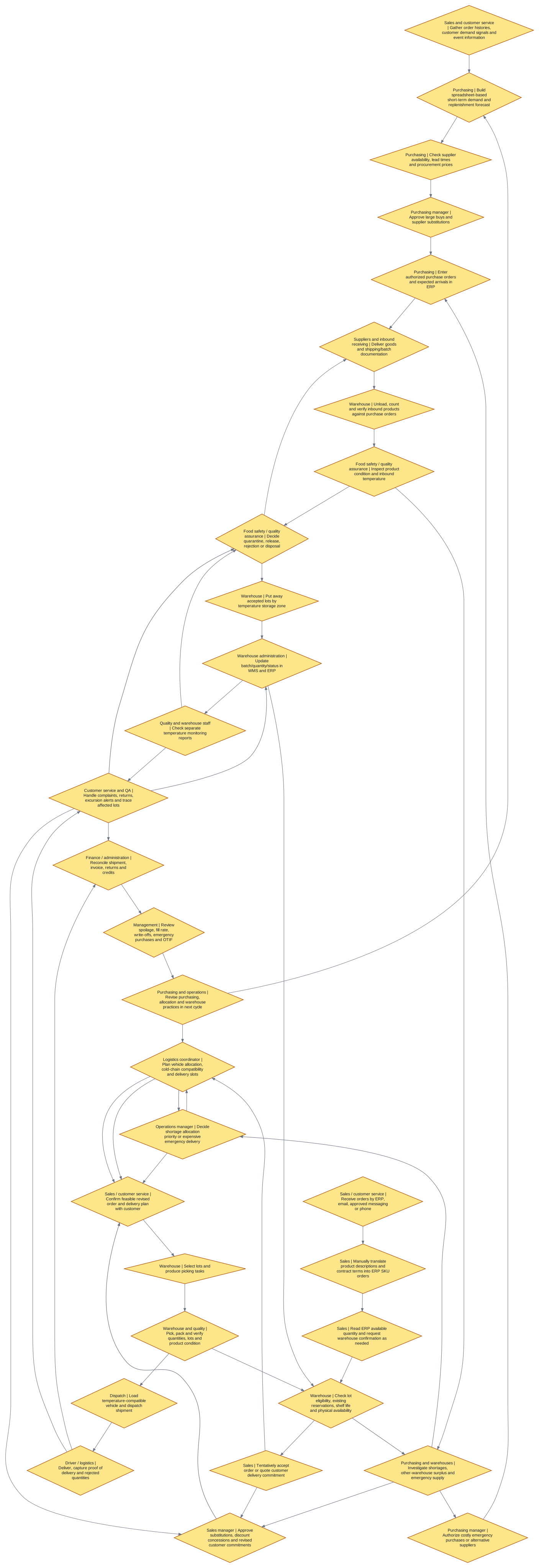
Figure 1. Inferred pre-agent workflow; procurement and customer-order activities also occur in parallel.
- Plan and procure. Sales shares order histories and known events; buyers build spreadsheet forecasts, check suppliers, and seek purchasing-manager approval for large orders or supplier changes before entering purchase orders in ERP.
- Receive and inspect. Warehouse staff unload, count, and record incoming lots. QA accepts, quarantines, or rejects goods; released batches enter temperature-controlled storage. WMS/ERP stock updates and separate temperature reports may be reconciled later.
- Take and promise orders. Sales converts emails, calls, and messages into ERP SKUs, interprets customer contracts, checks recorded inventory, and calls the warehouse about reservations, physical stock, expiry, and quality status. A provisional promise can precede complete confirmation.
- Resolve conflicts by hand. Buyers investigate shortages, suppliers, and the second warehouse. Sales managers approve substitutions, discounts, or changed promises. Logistics checks picking readiness, refrigerated vehicle compatibility, and delivery slots; operations managers decide costly emergency trips or competing allocations. Short picks restart the availability check.
- Fulfill, close, review. Staff pick and verify lots, dispatch loads refrigerated vehicles, and drivers record delivered or rejected quantities. Customer service and QA investigate complaints and temperature excursions. Finance reconciles invoicing and credits; management reviews fill rate, spoilage, emergency buys, and on-time-in-full (OTIF) delivery before adjusting the next cycle.
Bottlenecks: Book stock is mistaken for customer-eligible stock; sales, QA, purchasing, and logistics act on different snapshots; exceptions consume calls, spreadsheets, and rework. These are inferred risks, not measured incident counts.
4. Agent Design and Guardrails: Reconcile, Recommend, Approve
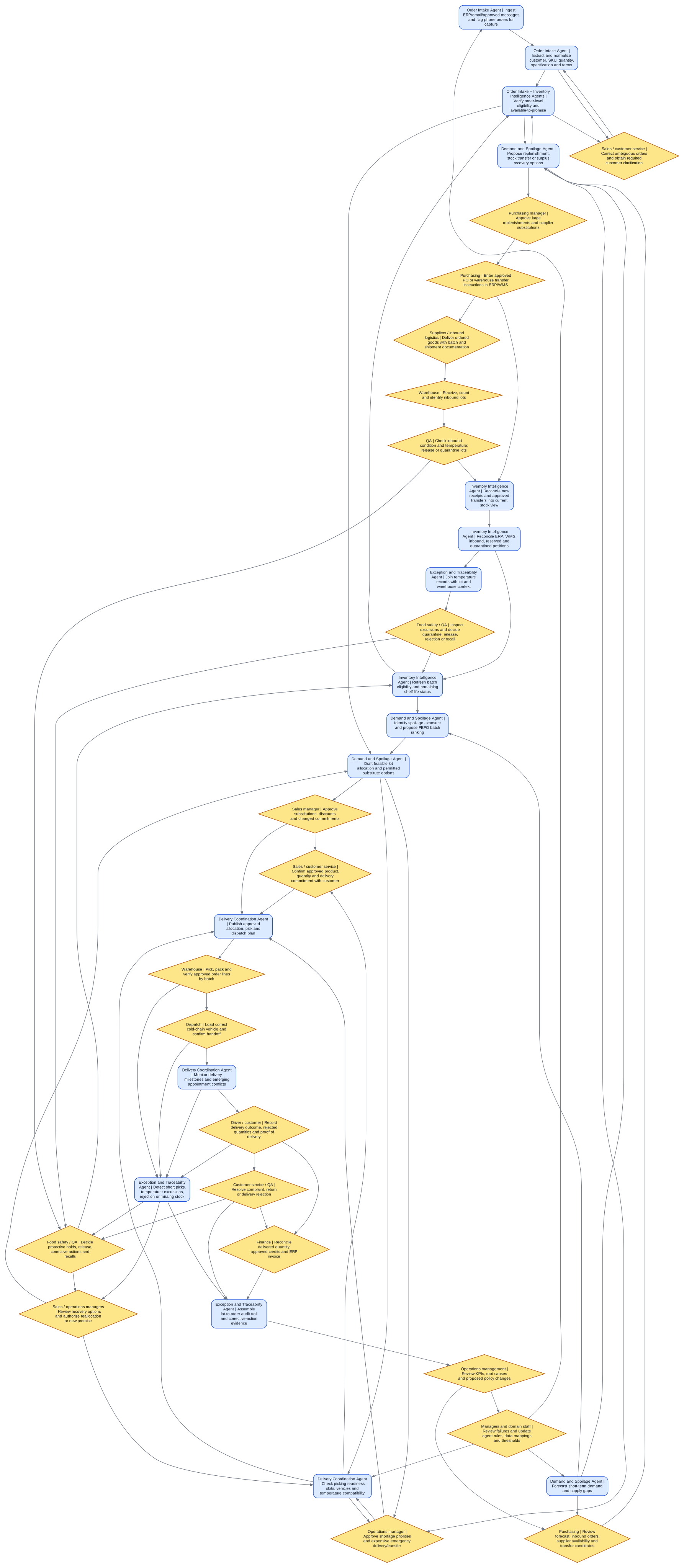
Figure 2. Proposed post-agent workflow layered over existing ERP, WMS, QA, warehouse, and transport operations.
- Order Intake Agent: Reads ERP, email, and approved messages; extracts SKUs, quantities, specifications, contracts, and delivery windows. Phone orders need an authorized entry record; ambiguities return to sales.
- Inventory Intelligence Agent: Joins confirmed receipts, reservations, warehouse positions, inbound shipments, expiry dates, and QA holds. It computes eligible available-to-promise, excluding blocked or unsuitable lots and flagging stale records.
- Demand and Spoilage Agent: Forecasts gaps, ranks eligible batches by FEFO, and recommends replenishment, inter-warehouse transfers, or permitted substitutions. Shelf-life predictions cannot override labeled expiry or QA status.3
- Delivery Coordination Agent: Checks pick readiness, vehicle temperature class, delivery capacity, and appointment windows before publishing an approved pick/dispatch plan. Warehouse workers and drivers still confirm physical execution.
- Exception and Traceability Agent: Connects short picks, temperature alerts, missing stock, and rejections to affected lots, orders, vehicles, and records. It builds evidence for review and corrective-action history, not safety verdicts. Cold-chain monitoring research supports early warnings but identifies sensor failure as a practical risk.4
Approval boundaries: QA alone controls quarantine, release, rejection, and recall. Purchasing management authorizes major buys and supplier substitutions; sales management controls commercial substitutions, discounts, and revised promises; operations management resolves contested stock priorities and expensive emergency deliveries. Customer acceptance is obtained when required. ERP/WMS execution is permitted only against the approved plan, with rechecking if the plan changes—an application of action-bound approval research, not a capability yet demonstrated here.5
State and exclusions: Agents retain source timestamps, lot and order identities, exception status, plan versions, and review outcomes. They cannot independently release held goods, place unapproved purchase orders, change prices, or invent missing vehicle telemetry. Finance continues to reconcile verified deliveries and authorized credits.
5. One Workflow Walkthrough: The 450 kg Salmon Illusion
ERP shows 450 kg of chilled salmon, and three customers request 320 kg for next-day delivery. The Order Intake Agent normalizes their terms. Inventory reconciliation finds 80 kg under QA hold after a temperature alert and 120 kg that fails these customers’ remaining-shelf-life requirements. Assuming the two groups do not overlap, only 250 kg is eligible—a 70 kg shortfall despite the apparent surplus.
The Exception and Traceability Agent attaches sensor and lot evidence for QA, which alone controls the hold. The Demand and Spoilage Agent proposes transferring 70 kg from 100 kg of qualifying stock at the satellite warehouse. Purchasing checks transfer versus emergency-buy options; the Delivery Coordination Agent checks a compatible vehicle, transfer timing, warehouse readiness, and delivery windows. The operations manager authorizes a material-cost transfer if required. Sales confirms the resulting feasible promise. Warehouse staff verify the approved lots; dispatch and drivers record the shipment and accepted quantities. A short pick or new excursion reopens the exception and approval loop; finance closes against actual delivery, and management reviews the outcome. This is an illustrative scenario, not an observed shipment.
6. Results: What Can Be Evaluated
- Baseline/evaluation periods: None observed; a controlled pilot and dated baseline remain to be established.
- Pilot scope: Chilled seafood and dairy, central warehouse, selected hotel and restaurant orders.
- Process measures: Clarification handoffs, order-to-promise time, stock reconciliation time, exception-resolution effort.
- Decision measures: Incorrectly eligible lots, allocation feasibility, FEFO adherence, override frequency, and false or missed sensor-to-lot alerts.
- Business measures: Fill rate, OTIF, spoilage/write-offs, emergency purchases, and returns.
- Evidence status: Planned evaluation, not measured pilot or production results.
For illustration, HarborFresh begins with 92% fill rate, 88% OTIF, 4.2% spoilage/expiry write-offs as a share of perishable purchase cost, 93% stock-record accuracy, 15 emergency purchases per week, and 25 minutes per manual exception. These are hypothetical baselines, not verified measurements. Any later comparison should use defined pre/post windows and comparable SKU/customer groups, accounting for seasonality, supplier disruption, and order mix. No percentage improvement is asserted.
7. First-Iteration Weakness and Correction
A critical design-stage failure mode is assuming a cold-room sensor alert identifies precisely which lots were affected. Incorrect association could release unsafe stock or block unrelated goods. The proposed correction preserves sensor provenance, marks uncertain lot mappings, excludes unresolved stock from promises, and escalates disposition to QA. The same principle applies to stale reservations or unconfirmed transfers. This is a predicted weakness with a specified safeguard, not a claim that a deployed version failed. Sensor coverage and product-specific temperature-to-shelf-life models still require validation.4
8. Transferable Lesson
- Check a complete promise, not a stock number: eligibility, contractual shelf life, picking, and transport capacity must agree.
- Keep authority at the right boundary: agents assemble options; QA and managers approve actions within their respective mandates.5
- Learn from execution, not forecasts alone: receipts, picks, holds, rejections, credits, and approved corrections must update the next cycle.
This case shows how an AI orchestration layer can replace repeated departmental reconciliation with timely, accountable, evidence-linked decisions—without replacing physical verification or food-safety authority.
-
Valeria Jannelli, Stefan Schoepf, Matthias Bickel, Torbjørn Netland, and Alexandra Brintrup, Agentic LLMs in the Supply Chain: Towards Autonomous Multi-Agent Consensus-Seeking (2024), arXiv:2411.10184. Supply-chain consensus mechanisms studied in inventory settings, not this distributor. ↩︎
-
Yinzhu Quan and Zefang Liu, InvAgent: A Large Language Model based Multi-Agent System for Inventory Management in Supply Chains (2024), arXiv:2407.11384. Evaluates multi-agent inventory management in modeled scenarios. ↩︎
-
Xuan Liao, Zhenkang Peng, and Ying Rong, Deep Learning for Perishable Inventory Systems with Human Knowledge (2026), arXiv:2601.15589. Supports structure-guided perishable replenishment; not proof of this proposed FEFO system. ↩︎ ↩︎
-
Jeremiah Taguta, Jean Frederic Isingizwe Nturambirwe, and Clement Nthambazale Nyirenda, Real-World Deployment and Performance Characterisation of Fog-Based Deep Learning for Cold-Chain Temperature Prediction over LoRaWAN (2026), arXiv:2609.14036. Cold-room temperature modeling, including a sensor-related single point of failure; not food-release validation. ↩︎ ↩︎
-
Laurent Bindschaedler, Ferdi Kossmann, Chunwei Liu, and Jason Mohoney, Guarded Commits: Transactional Human Approvals for LLM Workflows (2026), arXiv:2610.00037. Proposes action-bound approval records, with evidence limited to trace reconstruction outside food distribution. ↩︎ ↩︎