Executive Snapshot
- Client type: Research university technology-transfer office
- Industry: Higher education, intellectual-property management, and research commercialization
- Core problem: A small team had to turn incomplete invention disclosures and fragmented technical, funding, contributor, patent, and market evidence into time-sensitive commercialization decisions.
- Why agentic AI: The work required several evidence-gathering roles to operate against a shared case state, return weak findings for revision, and stop at legal, confidential, or commercially binding decisions.
- Deployment stage: Pilot design
- Primary result: A governed workflow in which evidence preparation can run in parallel after manager validation, while patentability, filing, inventorship, licensing, startup, and disclosure decisions remain human-controlled.
1. Business Context
The technology-transfer office received disclosures throughout the year from researchers working across software, biotechnology, engineering, materials, and research instrumentation. A case could arrive as a form, draft paper, email thread, contributor list, grant references, and notice of an approaching conference presentation. The office had to choose among patent protection, licensing, a spinout, industry collaboration, further validation, open release, or closure. Relevant facts were distributed across case records, research-administration systems, sponsor agreements, academic and patent databases, company information, and correspondence. Delays mattered because publication could narrow protection options, while errors in funding obligations, contributor history, ownership, or confidential disclosure could create legal and institutional risk.
2. Why Simpler Automation Was Not Enough
A checklist could identify empty fields, a dashboard could display deadlines, and a chatbot could summarize a paper. None could reliably coordinate the whole case. Search terms changed as the technical contribution became clearer; a funding clause could restrict an otherwise attractive commercial pathway; an apparent contributor inconsistency could require inventor clarification and legal review; and partner research had to use non-confidential descriptors until disclosure was authorized. The workflow therefore needed state, branching, retries, source provenance, and different approval levels.
The analytical point drawn from the five papers is that the unit of transformation is the evidence handoff, not the final model answer. ReAct interleaves reasoning with external action and plan revision.1 Self-RAG distinguishes retrieval from checking whether evidence supports an output.2 MetaGPT organizes specialized roles around structured intermediate artifacts.3 AutoGen combines agents, tools, and configurable human input.4 Reflexion converts reviewed failures into reusable process memory.5 Together, they imply a controlled case pipeline, not an autonomous “commercialization oracle.”
3. Pre-Agent Workflow
- Intake and triage. An administrator or technology-transfer manager registered the disclosure, checked confidentiality, completeness, and publication deadlines, and assigned a domain owner. Missing technical descriptions, funding references, contributor histories, or disclosure dates triggered email follow-ups with the inventors.
- Manual case construction. The assigned manager read the disclosure, draft manuscript, attachments, and correspondence and converted them into an internal case summary. Ambiguities returned to the researchers, after which the manager repeated the completeness check.
- Sequential evidence gathering. The manager conducted academic and patent searches, then requested grant, sponsor, and collaboration records from research administration. Results were reconciled against contributors, ownership questions, obligations, and deadlines. Commercial applications were mapped only after the invention appeared sufficiently stable.
- Market and partner research. Licensing staff or the manager reviewed company portfolios, comparable technologies, investors, and previous university relationships. They had to avoid exposing unpublished claims while still producing useful market evidence.
- Briefing and approval. The manager assembled the commercialization review brief, a senior reviewer returned incomplete work, and scoped legal or contractual issues went to research administration or outside counsel. A committee or senior manager selected the pathway. Separate approval was required before confidential outreach, after which staff executed the filing, licensing, partnership, startup-support, validation, or closure decision and tracked the resulting deadlines.
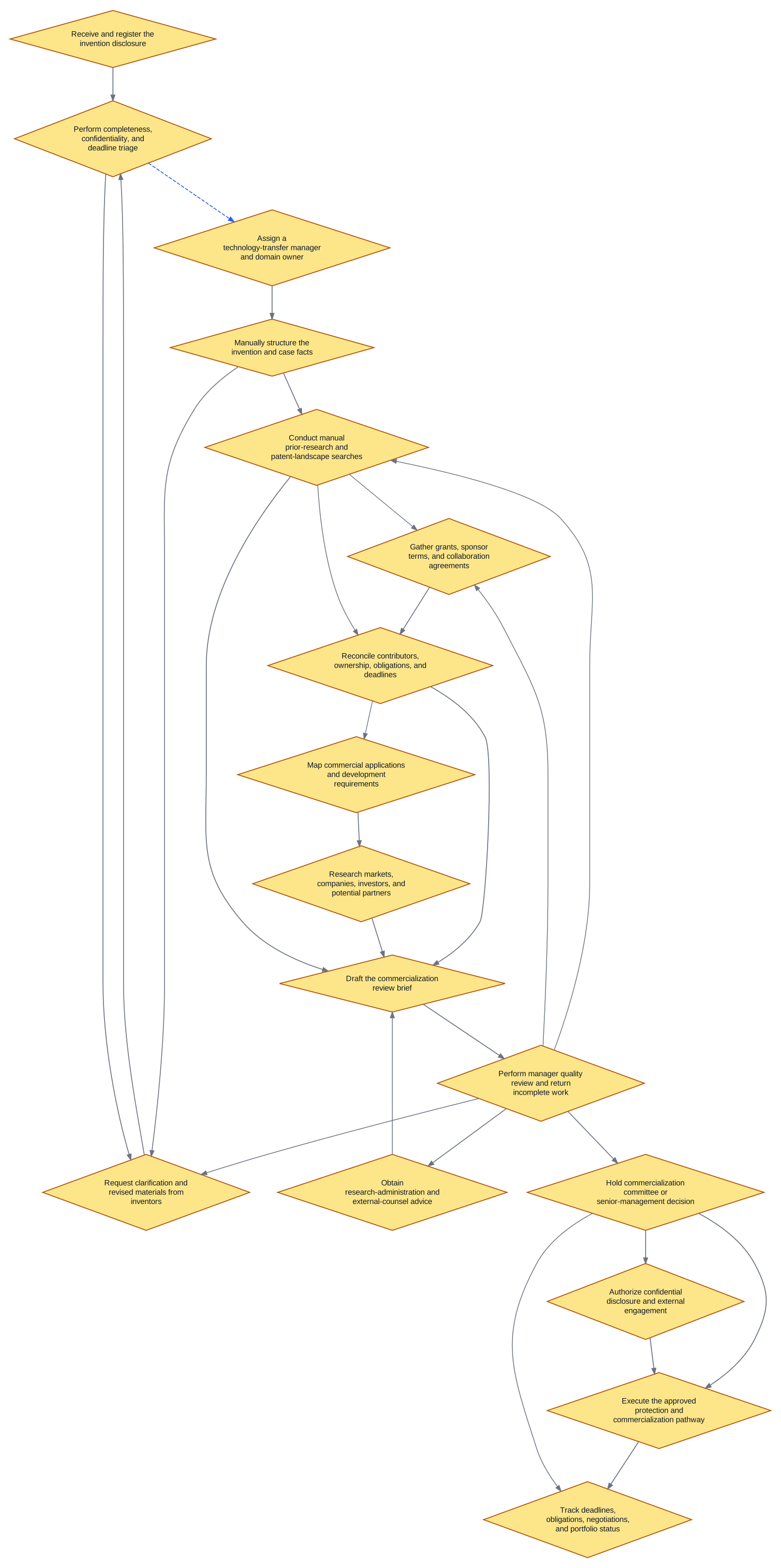
The pre-agent workflow concentrated structuring, searching, reconciliation, drafting, and follow-up in the technology-transfer manager.
Key pain points:
- Evidence workstreams were commonly sequential, so a late funding, contributor, or publication issue compressed the remaining decision window.
- Search notes, contract findings, commercial hypotheses, and inventor responses were assembled manually, creating repeated checking and inconsistent traceability.
- Managers spent substantial time coordinating routine evidence collection while also remaining accountable for exceptions, committee quality, and external deadlines.
4. Agent Design and Guardrails
- Inputs: Invention disclosure forms, draft papers, supporting files, contributor records, publication plans, grant references, sponsor and collaboration agreements, internal correspondence, approved academic and patent sources, and public company information.
- Understanding: Structured extraction of the technical concept, asserted novelty, development evidence, contributors, funding, prior disclosures, deadlines, missing fields, and source locations.
- Reasoning: Manager-approved review planning; parallel retrieval, obligation checking, and application mapping; evidence relevance and support checks; conflict detection; confidence tagging; and issue-type escalation.
- Actions: Update the restricted case model, draft inventor questions, retrieve and cluster research evidence, identify candidate obligations, map commercial pathways, research organizations using approved descriptors, produce a source-linked review brief, and issue deadline or exception alerts.
- Memory/state: A case-scoped workspace stores document versions, source pointers, agent outputs, unresolved issues, approvals, corrections, deadlines, and portfolio status. Only reviewed corrections and process lessons enter reusable memory.
- Human review points: Initial case framing and source permissions; inventor clarification; disputed contributor, ownership, contractual, or confidentiality issues; verification of the generated brief; counsel and research-administration advice; pathway selection; and approval of confidential, expensive, rights-affecting, or irreversible actions.
- Out-of-scope actions: Legal patentability judgments, patent filing or abandonment, formal inventor attribution, ownership determination, confidential disclosure, licensing negotiation, startup approval, and patent-budget allocation.
After registration, the Invention Disclosure Structuring Agent builds the case model. The manager validates the framing, urgency, permitted sources, and confidentiality boundary before releasing three parallel workstreams: the Prior Research and Patent Landscape Retriever, Funding Obligation Checker, and Commercial Application Mapper. Evidence-support and conflict checks rerun weak searches, downgrade unsupported applications, return missing facts to inventors, and escalate high-risk conflicts. Only validated non-confidential descriptions reach the Industry Partner Research Agent. The Commercialization Review Brief Generator assembles the evidence, alternatives, deadlines, assumptions, and open issues. The manager remains accountable and can reopen any workstream.
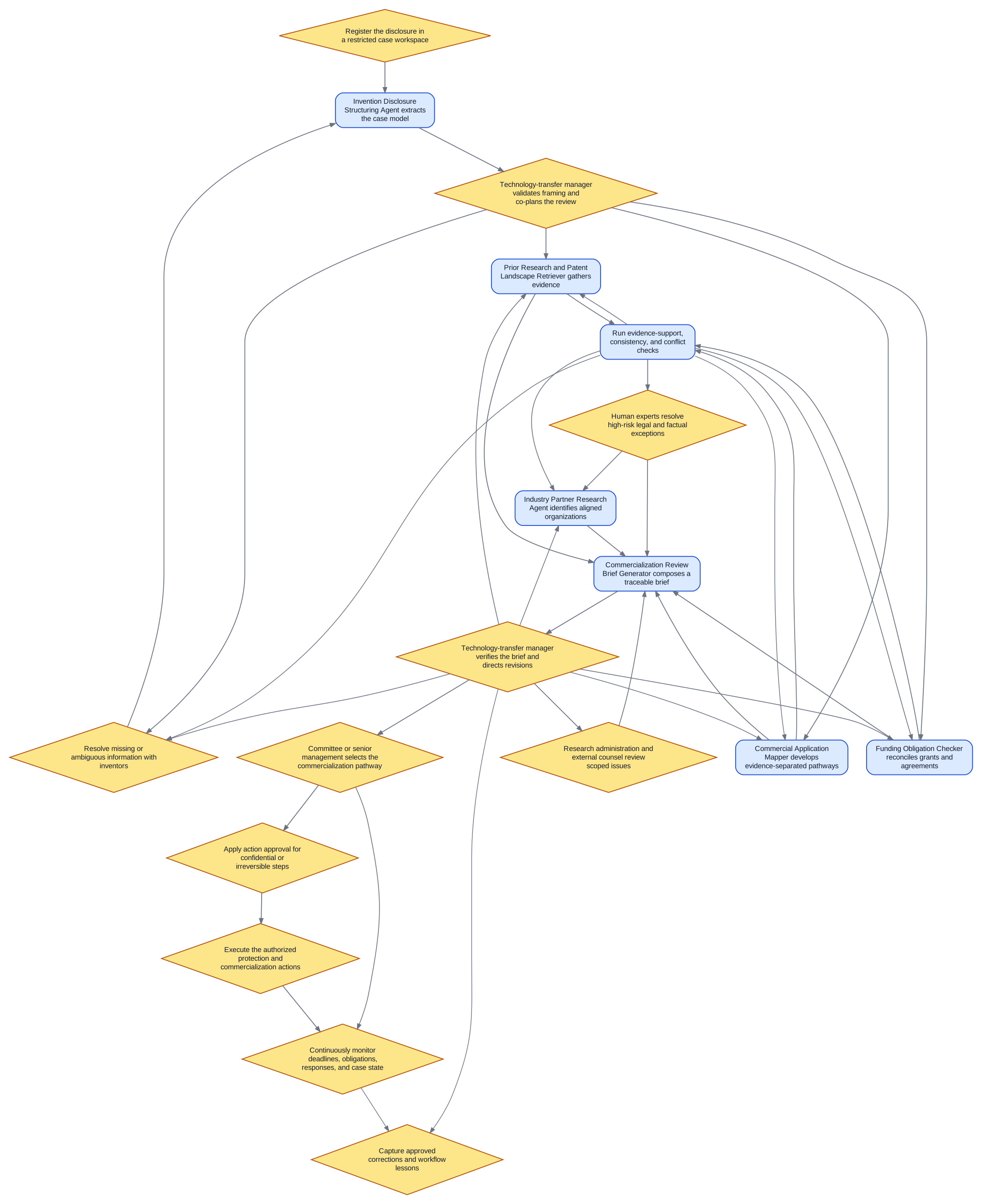
The post-agent workflow parallelizes bounded evidence tasks but adds validation loops and explicit action guards before authority leaves the university.
5. One Workflow Walkthrough
A laboratory submitted an AI-enabled research platform six weeks before a planned conference presentation. The restricted workspace recorded the draft paper, a provisional contributor list, several grant references, and a mention of a corporate research collaboration. The Structuring Agent extracted the claimed technical contribution and publication date but flagged an absent collaboration agreement and a mismatch between the paper authors and disclosure contributors. The technology-transfer manager validated a narrow, non-confidential invention description and sent targeted questions to the researchers.
Once the answers arrived, three workstreams ran in parallel. The landscape retriever found related patents but marked several as only partially relevant. The obligation checker located a sponsor review right and a government reporting duty. The application mapper separated pharmaceutical research, industrial inspection, and academic laboratory use into hypotheses with different validation needs. The conflict check escalated contributor history and sponsor interpretation to humans rather than merging them automatically. After research administration and counsel resolved those issues, the partner agent identified aligned companies using the approved description. The generated brief recommended a provisional filing and targeted market validation, while deferring spinout support. The committee approved that pathway; external outreach remained blocked until a separate disclosure approval was recorded. All filing, reporting, outreach, and review dates then moved into monitored case state.
6. Results
- Baseline period: The previous twelve months of disclosures should be reconstructed before pilot launch; no baseline values were supplied for this case.
- Evaluation period: Proposed twelve-week pilot followed by a portfolio review.
- Workflow scope/sample: New disclosures with standard confidentiality controls; active litigation, unresolved institutional ownership disputes, and highly restricted sponsor matters should remain outside the first pilot.
- Process change: Replace one predominantly sequential manager workflow with manager-approved parallel evidence workstreams and targeted return loops.
- Decision/model change: Judge the system on evidence completeness, source support, early exception detection, and correct escalation—not on autonomous patent or licensing recommendations.
- Business effect: Expected movement of manager time from document assembly and repeated searching toward inventor interviews, expert interpretation, committee preparation, negotiation, and portfolio judgment.
- Evidence status: Planned; no production or pilot performance claim is made.
Pilot acceptance criteria should require every material brief claim to retain a source pointer or assumption label, every confidential external action to have recorded approval, and zero autonomous legal, inventorship, licensing, startup, or patent-spending decisions. Measures should include time to verified brief, manager hours, clarification cycles, late-discovered obligations, brief revisions, and publication risks found before committee review. Speed targets should follow the first pilot cases, once task difficulty and evidence quality are known.
7. What Failed First and What Changed
The first prototype failed at the structuring-to-retrieval handoff. Broad technical summaries generated noisy patent results, while plausible applications appeared beside validated evidence without a clear distinction. The redesign inserted a manager-approved invention definition and confidentiality boundary before searching. Each workstream now labels relevance, support, confidence, and conflicts; weak findings return for narrower retrieval or revised hypotheses, while sensitive conflicts go to humans. The remaining limitation is substantive: no retrieval or critique loop can replace counsel’s analysis, an inventor interview, or authorized market feedback.
8. Transferable Lesson
- Automate bounded evidence products, not institutional authority. Each agent should own a defined intermediate artifact, while named humans retain decisions that affect rights, money, confidentiality, or external commitments.
- Parallelism requires an early control point. The office gains speed only after a manager validates the shared case model, approved descriptors, deadlines, and information boundary.
- Make revision paths part of the architecture. Retrieval, obligation checks, application mapping, and partner research need explicit return loops, escalation rules, and reviewed memory; otherwise automation merely produces errors faster.
This case shows that agentic AI works best in professional services when it makes complex coordination inspectable, evidence-linked, and interruptible before it makes it faster.
-
Shunyu Yao et al., “ReAct: Synergizing Reasoning and Acting in Language Models,” arXiv:2210.03629, 2022, https://arxiv.org/abs/2210.03629. ↩︎
-
Akari Asai et al., “Self-RAG: Learning to Retrieve, Generate, and Critique through Self-Reflection,” arXiv:2310.11511, 2023, https://arxiv.org/abs/2310.11511. ↩︎
-
Sirui Hong et al., “MetaGPT: Meta Programming for a Multi-Agent Collaborative Framework,” arXiv:2308.00352, 2023, https://arxiv.org/abs/2308.00352. ↩︎
-
Qingyun Wu et al., “AutoGen: Enabling Next-Gen LLM Applications via Multi-Agent Conversation,” arXiv:2308.08155, 2023, https://arxiv.org/abs/2308.08155. ↩︎
-
Noah Shinn et al., “Reflexion: Language Agents with Verbal Reinforcement Learning,” arXiv:2303.11366, 2023, https://arxiv.org/abs/2303.11366. ↩︎