Executive Snapshot
- Client type: Boutique film, advertising, and video-production company
- Industry: Creative production and commercial video services
- Core problem: Production managers were manually reconciling scripts, shooting schedules, location permits, actor availability, equipment needs, budget changes, call sheets, and post-production tasks across scattered files and messages.
- Why agentic AI: The workflow was not one linear checklist; it required stateful coordination, exception monitoring, role-specific reasoning, and human approvals across creative, operational, budget, and delivery decisions.
- Deployment stage: Designed pilot
- Primary result: The proposed workflow shifts production coordination from reactive human chasing to structured agent-assisted planning, risk flagging, call-sheet drafting, and post-production tracking, while leaving final approvals with producers, directors, and clients.
1. Business Context
The organization produces commercials, branded videos, short-form campaigns, corporate videos, and occasional documentary-style shoots. Each project begins with a client brief and creative concept, then moves through script breakdown, actor and crew availability checks, location booking, permit handling, budget monitoring, daily call-sheet preparation, shoot-day exception handling, and post-production delivery. The work happens repeatedly across several active productions each month. The operating stack is typical for a small creative business: scripts and storyboards in shared folders, schedules in spreadsheets, call sheets in PDFs, location notes in email threads, urgent updates in chat groups, and post-production tasks in informal boards. Errors matter because a missing permit, late actor, outdated call sheet, or incomplete footage handoff can turn into overtime, reshoots, client frustration, and margin loss.
2. Why Simpler Automation Was Not Enough
A dashboard could show task status, and a chatbot could answer questions about a document, but neither would solve the central problem: production coordination changes whenever one constraint changes. If an actor becomes unavailable, the schedule, location booking, crew call time, transport plan, catering, budget forecast, client notice, and post-production handoff may all need adjustment. The analytical point used in this case is that agentic AI creates value by maintaining a shared operational state and routing exceptions through specialized agents, while humans approve decisions that affect creative intent, legal compliance, spending, safety, and client commitments. This design follows five research-informed ideas: interleaving reasoning and action for dynamic tasks,1 using conversable multi-agent structures with tools and human input,2 assigning specialized roles to reduce fragmentation,3 treating workflows as ordered agent decisions over tools and environments,4 and using process intelligence to support decisions, resource allocation, and process improvement.5
3. Pre-Agent Workflow
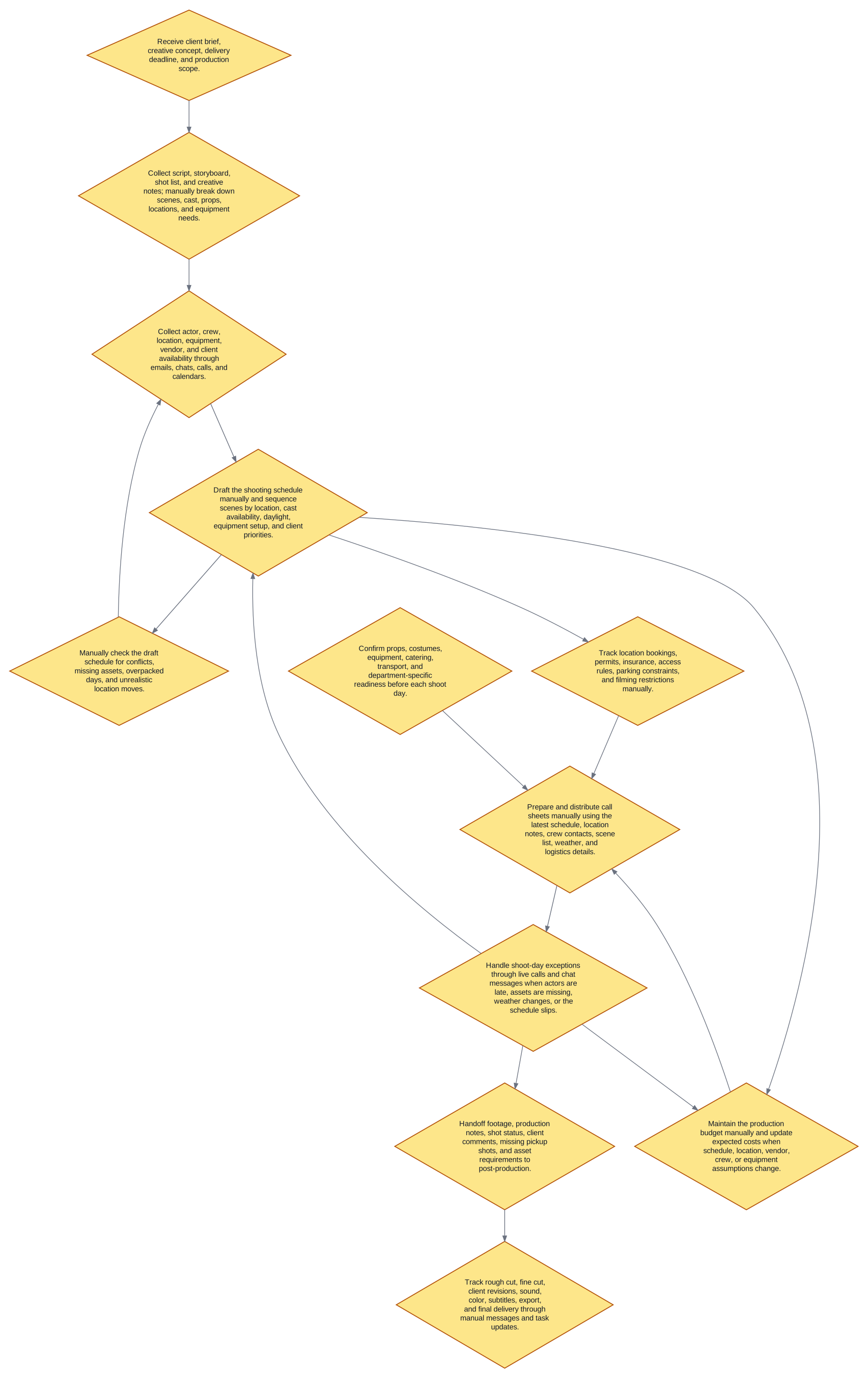
Before the AI agents, the production manager acted as the main integration layer for the whole project.
- Project intake and manual breakdown. The producer or production manager received the client brief, creative concept, delivery deadline, script, storyboard, and shot list. The team manually broke the script into scenes, cast, props, locations, equipment needs, and shooting blocks.
- Availability and constraint gathering. The production manager collected actor, crew, location, equipment, vendor, and client availability through emails, chats, calls, and calendars. Each update created a new version-control risk because the latest information did not live in one reliable operating state.
- Manual schedule drafting and conflict checking. The schedule was drafted by sequencing scenes around location moves, daylight, cast availability, client priorities, and equipment setup. The same person then checked for conflicts, missing assets, overpacked days, and unrealistic moves. When conflicts appeared, the workflow looped back to renewed availability checks.
- Parallel permit, budget, and asset tracking. Location bookings, permits, insurance, access rules, parking limits, filming restrictions, props, costumes, catering, transport, and equipment readiness were tracked manually. Budget updates were reviewed separately when schedule, vendor, crew, equipment, or location assumptions changed.
- Call-sheet distribution and reactive exception handling. Call sheets were prepared from the latest available schedule, location notes, contacts, weather, and logistics details. During the shoot, late actors, missing assets, weather changes, or schedule slips were handled through live calls and chat messages. After shooting, footage, production notes, shot status, client comments, pickup-shot needs, and asset requirements were handed off to post-production, where rough cuts, fine cuts, client revisions, subtitles, sound, color, export, and delivery were again tracked manually.
Key pain points:
- The production manager became the bottleneck for reconciling creative, operational, financial, and post-production information.
- The schedule changed faster than call sheets, permit notes, and budget forecasts could be updated.
- Post-production delays often started earlier, when missing shots, unclear client comments, or incomplete production notes were not captured cleanly at handoff.
4. Agent Design and Guardrails
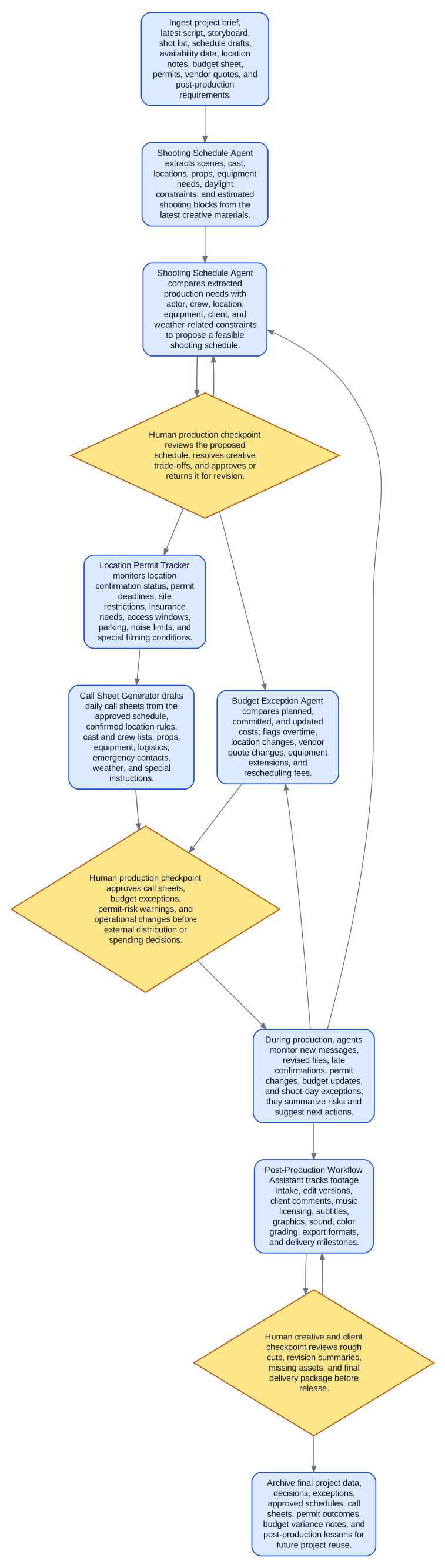
The AI Film Production Coordination Agent was designed as a human-governed multi-agent workflow, not as an autonomous producer. The system ingests the project brief, current script, storyboard, shot list, draft schedules, availability data, location notes, budget sheet, permits, vendor quotes, and post-production requirements. It then separates the workflow into five specialized operating roles.
- Inputs: Client brief, scripts, storyboards, shot lists, schedules, actor and crew availability, location agreements, permits, vendor quotes, budget sheets, call-sheet templates, chat updates, client comments, and post-production task lists.
- Understanding: The system extracts scenes, cast, locations, props, equipment, daylight needs, access windows, permit status, budget categories, revision requests, and delivery milestones. Low-confidence or conflicting extractions are flagged instead of silently resolved.
- Reasoning: The Shooting Schedule Agent compares production needs with actor, crew, location, equipment, client, and weather-related constraints. The Location Permit Tracker monitors confirmation status, permit deadlines, insurance needs, access windows, parking, noise limits, and special filming conditions. The Budget Exception Agent compares planned, committed, and updated costs. The Call Sheet Generator prepares daily drafts from approved structured data. The Post-Production Workflow Assistant tracks footage intake, edit versions, client comments, licensing, subtitles, sound, color, export formats, and delivery milestones.
- Actions: The system can draft schedules, generate risk summaries, prepare call sheets, flag budget exceptions, create post-production status reports, and route review items to the right human owner.
- Memory/state: The workflow keeps project state across approved schedules, unresolved warnings, permit outcomes, budget variance notes, call-sheet versions, client comments, and final delivery decisions.
- Human review points: Producers approve budget exceptions and operational changes. Production managers approve schedules and call sheets before distribution. Location or legal owners confirm permit-sensitive items. Directors and clients approve creative outputs, rough cuts, final revisions, and release packages.
- Out-of-scope actions: The agents do not independently approve spending, sign location commitments, override safety or permit restrictions, send final client-facing instructions, change creative direction, or release final deliverables.
The guardrail is simple: agents may draft, compare, flag, summarize, and recommend; humans approve decisions that create legal, financial, creative, safety, or client-facing consequences.
5. One Workflow Walkthrough
A location owner sent a late message saying that the main lobby could only be used until 2:00 p.m., and that parking was limited to two production vehicles. The Location Permit Tracker first tagged the message as a confirmed restriction and linked it to the affected shoot day. The Shooting Schedule Agent checked the approved scene order and found that two lobby scenes were scheduled after lunch, while the lighting setup required a longer reset than the remaining access window allowed. It proposed moving one office-interior scene into the morning and compressing the lobby scenes before 2:00 p.m. The Budget Exception Agent estimated possible overtime and transport impact if the team rejected the change. Because the revised schedule changed actor call times and external logistics, the system escalated the proposal to the production manager. After review, the production manager approved the revised order, rejected the overtime option, and asked the Call Sheet Generator to draft an updated call sheet. The final output was a revised call sheet with location restrictions, parking notes, scene order, actor call times, and unresolved warnings logged for audit and future project learning.
6. Results
- Baseline period: Current pre-AI operating model reconstructed from workflow discovery
- Evaluation period: Proposed four-week pilot across active commercial and branded-video projects
- Workflow scope/sample: Intake-to-delivery coordination covering script breakdown, scheduling, permit tracking, budget variance, call-sheet generation, shoot-day exceptions, and post-production handoff
- Process change: The workflow moves from manual reconciliation across messages and spreadsheets to a shared project state where specialized agents monitor schedule, permit, budget, call-sheet, and post-production risks.
- Decision/model change: The system does not make final production decisions. It creates ranked exceptions, proposed schedule changes, and review-ready drafts so humans can approve or reject decisions with more context.
- Business effect: Expected benefits include faster call-sheet preparation, earlier detection of permit and budget risks, fewer outdated production documents, cleaner post-production handoff, and reduced coordination load on production managers.
- Evidence status: Estimated and planned. The pilot should measure call-sheet preparation time, number of late schedule conflicts detected before shoot day, budget exceptions flagged before approval, permit-risk escalations, post-production missing-asset incidents, and human override rates.
The most important metric is not full automation rate. It is the percentage of production risks surfaced early enough for a human to make a controlled decision before the issue becomes a shoot-day emergency or client-delivery delay.
7. What Failed First and What Changed
The first version failed by treating every uploaded document as equally current. When an old schedule remained in the shared folder, the system used outdated scene timing to draft part of a call sheet. The fix was to introduce source priority, version labels, approval status, and unresolved-conflict warnings. A call sheet could no longer be marked ready if the schedule version, location restrictions, actor call times, or permit status conflicted. The limitation still remains: the system is only as reliable as the project state it can see. If critical decisions happen only in private phone calls and are never logged, the agents must flag uncertainty rather than pretend the workflow is complete.
8. Transferable Lesson
- Agentic AI is most useful when the business problem is not document generation alone, but the coordination of changing constraints across multiple roles, documents, and deadlines.
- Specialized agents should map to real operational responsibilities: scheduling, permits, budgets, call sheets, exceptions, and delivery. This makes review ownership clear.
- Human checkpoints should be designed around consequence, not convenience: creative direction, legal permissions, spending, safety, and client-facing communication require explicit approval.
This case shows that agentic AI works best when it turns fragmented operational work into a monitored, reviewable workflow without removing human authority over high-stakes decisions.
-
Shunyu Yao et al., “ReAct: Synergizing Reasoning and Acting in Language Models,” arXiv:2210.03629, https://arxiv.org/abs/2210.03629. ↩︎
-
Qingyun Wu et al., “AutoGen: Enabling Next-Gen LLM Applications via Multi-Agent Conversation,” arXiv:2308.08155, https://arxiv.org/abs/2308.08155. ↩︎
-
Chen Qian et al., “ChatDev: Communicative Agents for Software Development,” arXiv:2307.07924, https://arxiv.org/abs/2307.07924. ↩︎
-
Chunyang Yu et al., “A Survey on Agent Workflow — Status and Future,” arXiv:2508.01186, https://arxiv.org/pdf/2508.01186. ↩︎
-
Sven Weinzierl et al., “Machine Learning in Business Process Management: A Systematic Literature Review,” arXiv:2405.16396, https://arxiv.org/abs/2405.16396. ↩︎