Executive Snapshot
- Client type: Mid-sized B2B AI advisory and automation firm
- Industry: AI consulting, implementation, and corporate education
- Core problem: The firm wanted to publish frequent LinkedIn posts on generative AI trends, but manual production was slow and uneven, while naive AI drafting risked shallow claims, weak sourcing, and generic tone.
- Why agentic AI: The workflow required ongoing topic discovery, source triage, claim extraction, post drafting, quality checks, and feedback-based improvement rather than a one-shot chatbot prompt.
- Deployment stage: Pilot-ready design with human approval retained at publication
- Primary result: The redesigned workflow shifted the bottleneck from first-draft creation to editorial review, making it feasible to increase publishing cadence without handing brand or credibility control to the model.
1. Business Context
The firm used LinkedIn as a credibility and demand-generation channel rather than a pure awareness channel. Its audience included founders, functional leaders, operations managers, and innovation leads who wanted short but commercially meaningful interpretations of generative AI developments. Before the agent, the workflow happened several times each week: someone manually scanned company blogs, arXiv papers, product announcements, and commentary threads; selected a topic; distilled the main claims; drafted a post; and sent it to a senior reviewer for tone and credibility checks. The work spanned browser tabs, saved links, internal notes, and draft posts. Delays mattered because AI news moved quickly, while mistakes mattered because one overstated or weakly sourced post could damage the firm’s positioning as a serious interpreter of the market.
2. Why Simpler Automation Was Not Enough
A scheduler, dashboard, or generic chatbot could accelerate fragments of the job, but not the workflow as a whole. The process branched at multiple points: whether a trend was merely viral or strategically relevant; whether a claim came from a primary source or recycled commentary; whether caveats were strong enough to change the framing; and whether the right tone for LinkedIn was analytical, provocative, or cautionary. The output also needed memory of past posts so the firm would not repeat the same framing every week. Research on social-media post generation, newsroom AI tools, source-attribution interfaces, claim-level factual verification, and disclosure effects all point to the same design implication: generation is easy to scale, but trust, fit, and editorial responsibility are not.12345
Analytical point from the literature: In this kind of thought-leadership workflow, the scarce resource is not text generation. It is controlled editorial compression: turning a noisy, fast-moving technical topic into a short post that stays audience-relevant, source-traceable, and safe enough for a human approver to sign off quickly.12345
3. Pre-Agent Workflow
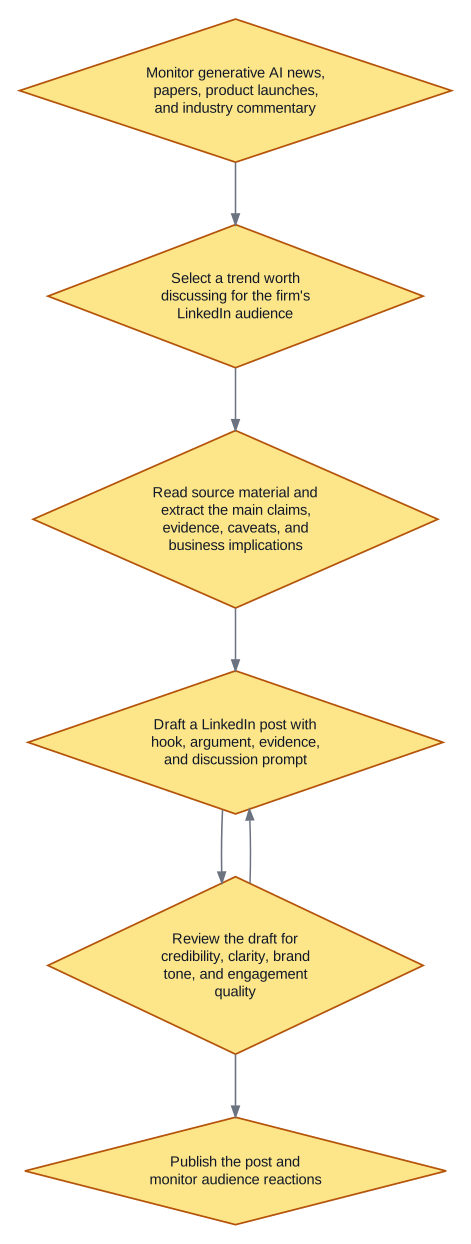
- A founder, marketer, or analyst manually monitored generative AI news, papers, model launches, and industry commentary.
- The same person chose a topic largely by intuition, recency, or perceived buzz, then read several sources to separate substance from hype.
- A draft LinkedIn post was written manually, usually with a hook, a short argument, one or two supporting points, and a closing prompt.
- A senior reviewer checked the post for credibility, tone, and business relevance, often requesting rewrites when the draft sounded too generic, too technical, or too confident.
- The post was published only when reviewer time was available, and lessons from audience response were captured informally rather than fed back into the next cycle.
Key pain points:
- Topic selection depended too heavily on individual intuition.
- Source checking was real but inconsistent, especially when the team was busy.
- The reviewer became the bottleneck because quality control happened late, after the draft was already written.
4. Agent Design and Guardrails
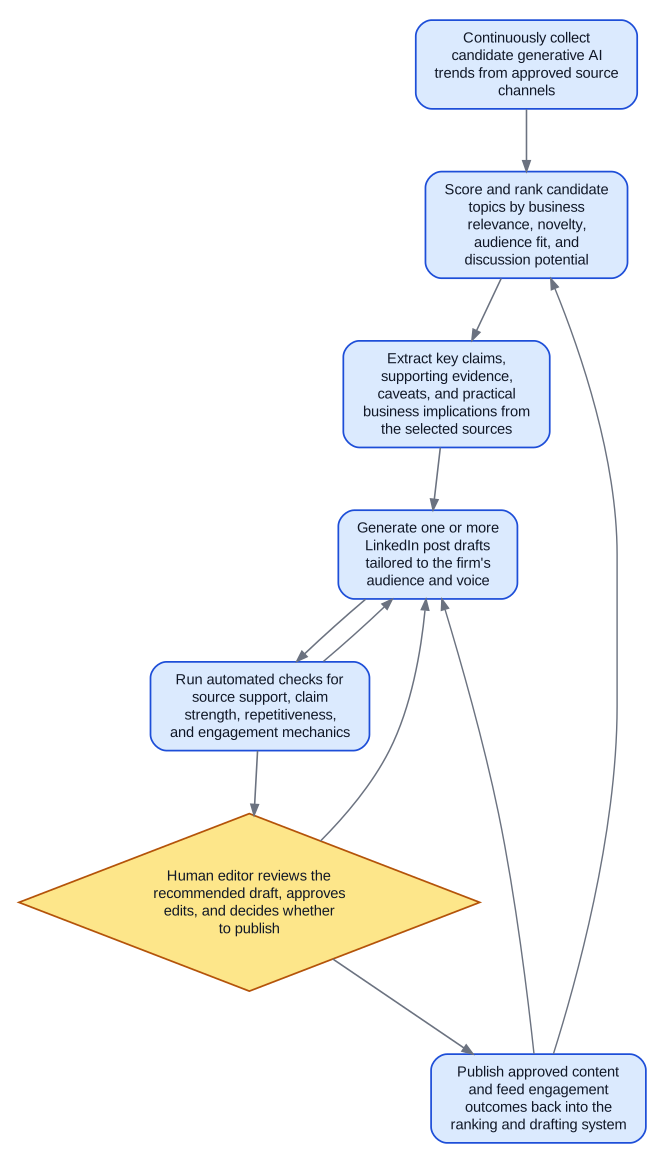
- Inputs: Approved feeds of company announcements, arXiv papers, reputable reporting, analyst commentary, prior LinkedIn posts, and audience-performance history.
- Understanding: The agent ingests candidate topics, extracts claims and caveats, tags source type and source quality, and builds an evidence sheet before drafting.
- Reasoning: It ranks topics by business relevance, novelty, audience fit, and discussion potential, then chooses a post angle only after checking whether enough support exists to defend that angle.
- Actions: It produces one or more post drafts, flags unsupported or weakly supported claims, suggests a discussion prompt, and packages the draft with its source notes for review.
- Memory/state: The system retains prior topics, repeated phrases, reviewer edits, weak-source incidents, and engagement outcomes so it can avoid redundancy and improve future ranking.
- Human review points: A human editor still approves publication, rewrites sensitive claims, rejects topics that are strategically off-brand, and can veto drafts built on thin evidence or fragile benchmarks.
- Out-of-scope actions: The agent does not publish autonomously, invent proprietary market data, make legal or regulatory claims without explicit source backing, or respond publicly to contentious comments without human approval.
Operationally, the major change was sequencing. In the old workflow, the human wrote first and verified later. In the new workflow, the agent had to produce a compact evidence structure first, then draft. That made the human reviewer’s job narrower and more decision-oriented: approve, tighten, soften, or reject. Management responsibility also became clearer. The marketing lead owned cadence, the subject-matter reviewer owned accuracy and brand risk, and the agent owned preliminary triage, synthesis, and draft assembly.
5. One Workflow Walkthrough
When a frontier-model vendor released a new enterprise feature set with bold claims about agentic productivity, the system first collected the vendor announcement, the technical paper, and two reputable analyses from the approved source pool. It then extracted the main claims, identified which ones were directly evidenced and which were promotional extrapolations, and scored the topic highly because it matched the firm’s audience of managers evaluating real deployment implications. The agent drafted three LinkedIn variants: one strategic, one skeptical, and one operations-focused. Because the most engaging draft leaned too hard on the vendor’s benchmark language, the verification layer flagged two phrases as weakly supported and marked the draft for higher-risk review. A human editor kept the operational framing, removed the benchmark-heavy hook, added one sentence on implementation limits, and approved publication. The final result was a post that still rode the news cycle, but did so with a calmer claim profile and a clearer call for discussion around enterprise adoption trade-offs. The topic, sources, edits, and review notes were then logged for future ranking and audit.
6. Results
- Baseline period: Prior 12 weeks of manual posting
- Evaluation period: Proposed 6-week pilot using the new workflow on a limited set of recurring GenAI topics
- Workflow scope/sample: 18 candidate topics, 12 drafted posts, 8 approved posts
- Process change: Draft-preparation time per publishable post was expected to fall from roughly 90-120 minutes of fragmented manual work to about 30-45 minutes of review-centered work.
- Decision/model change: The biggest expected gain was earlier filtering of low-quality or weakly sourced topics before anyone spent time polishing them.
- Business effect: The firm expected a steadier posting cadence, more consistent quality, and more qualified engagement because posts would be built around audience fit and evidence rather than recency alone.
- Evidence status: Estimated in pilot design, not yet measured in production
The case does not claim that the agent would automatically improve strategic judgment. The more defensible expectation is narrower: it should reduce coordination drag, make evidence checking more systematic, and let senior reviewers spend their time on framing and risk rather than on first-pass drafting. In this workflow, speed matters, but the more important business effect is higher consistency under limited expert attention.
7. What Failed First and What Changed
The first design failed by optimizing for apparent engagement too early. It over-weighted viral commentary and draft hooks, which produced posts that sounded confident but were too close to recycled LinkedIn discourse. The fix was to force provenance before prose: the agent had to build an evidence sheet, classify source type, and flag unsupported claims before generating final draft variants. That improved review quality, but one limitation still remained: even with better evidence handling, the system could not fully judge whether a topic was strategically worth the firm’s public attention. That decision still belonged to a human.
8. Transferable Lesson
- Put the agent before the draft, not only inside the draft. Topic triage and evidence structuring are where much of the value is created.
- Treat engagement as a constraint, not the objective. In B2B thought leadership, the real win is qualified discussion and trust, not empty reach.
- Keep final publication authority with a human, especially when the content compresses uncertain technical developments into strong public claims.
This case shows that agentic AI works best when the organization uses it to restructure a judgment-heavy workflow, not merely to accelerate copywriting.
Footnotes
-
Assessing Capabilities of Large Language Models in Social Media Analytics: A Multi-task Quest (arXiv:2604.18955), which evaluates LLMs on authorship verification, social-media post generation, and user-attribute inference, highlighting the difficulty of realistic post generation in platform-style contexts. https://arxiv.org/html/2604.18955v1 ↩︎ ↩︎
-
The Role of Human Creativity in the Presence of AI Creativity Tools at Work: A Case Study on AI-Driven Content Transformation in Journalism (arXiv:2502.05347), which found that creators used AI as a creative springboard but still had to edit many outputs, with editorial critique remaining essential. https://arxiv.org/html/2502.05347v1 ↩︎ ↩︎
-
Facilitating Human-LLM Collaboration through Factuality Scores and Source Attributions (arXiv:2405.20434), which reports that users trust LLM outputs more when relevant source passages are highlighted or references are attached. https://arxiv.org/html/2405.20434v1 ↩︎ ↩︎
-
Facts&Evidence: An Interactive Tool for Transparent Fine-Grained Factual Verification of Machine-Generated Text (arXiv:2503.14797), which uses claim-by-claim evidence retrieval and factuality checks to verify model-generated text. https://arxiv.org/html/2503.14797v1 ↩︎ ↩︎
-
Disclosure of AI-Generated News Increases Engagement but Does Not Reduce Aversion, Despite Positive Quality Ratings (arXiv:2409.03500), which suggests that disclosure can increase immediate willingness to keep reading without automatically changing longer-run attitudes toward AI-generated content. https://arxiv.org/html/2409.03500v2 ↩︎ ↩︎