Executive Snapshot
- Client type: Upper-midscale to upscale city hotel
- Industry: Hospitality / facility operations
- Core problem: Air-conditioning consumed too much electricity because cooling decisions were tied to fixed schedules and manual heuristics rather than likely room use.
- Why agentic AI: The workflow branched across reservations, housekeeping, front desk, engineering, weather, and live complaints, so the hotel needed a stateful control layer that could predict, decide, escalate, and learn rather than just automate one rule.
- Deployment stage: Pilot design / supervisory-control rollout
- Primary result: The redesigned workflow shifts routine cooling decisions from staff coordination to prediction-guided control, with human review reserved for exceptions and conservative target savings of 12–18% in HVAC electricity intensity.
1. Business Context
HarborView Grand Hotel is a 240-room business hotel in a hot, humid city where air-conditioning is one of the largest controllable operating costs. Every day, the hotel has to reconcile reservation files, expected arrivals and departures, housekeeping room-status changes, ballroom and meeting-room schedules, outdoor weather, and guest comfort standards. Before the redesign, most cooling decisions were made through fixed schedules and shift-level judgment: engineering set default zone temperatures, front desk flagged incoming guests, housekeeping marked rooms clean, and staff manually precooled rooms before likely arrival. Errors mattered immediately. A room that was still warm at check-in created a service failure; a room cooled for hours with no guest inside created pure electricity waste.
2. Why Simpler Automation Was Not Enough
A dashboard alone would not solve the problem because the hotel did not suffer from a lack of visibility so much as a lack of operational coordination. The workflow changed constantly: a room could be booked but not yet checked in, cleaned but not assigned, occupied but temporarily empty, or delayed because of flight changes or conference timing. Simple scripts could schedule cooling windows, but they could not decide when uncertainty was high enough to keep a room in standby, when a VIP booking required a more conservative choice, or when an anomaly should be escalated to engineering. A chatbot would be even further from the real control problem. The hotel needed a supervisory agent that could maintain state across rooms and zones, combine multiple signals, apply policy constraints, and send only the right edge cases to humans.12345
3. Analytical Point from the Literature
The most useful lesson from the HVAC literature is not that one control method wins universally. It is that successful systems combine three layers: forecasting, comfort-constrained optimization, and supervisory adaptation. Occupancy prediction papers show why static schedules leave savings on the table.2 MPC and RL papers show how control can trade off comfort and energy in a structured way.345 More recent human-in-the-loop work shows that real deployment improves when human feedback and override paths remain part of the control loop rather than being treated as noise.1 For a hotel, that means the decisive design move is not “install AI” but “shift from schedule-based cooling to a stateful supervisory workflow that can predict demand, act conservatively under uncertainty, and escalate exceptions.”
4. Pre-Agent Workflow
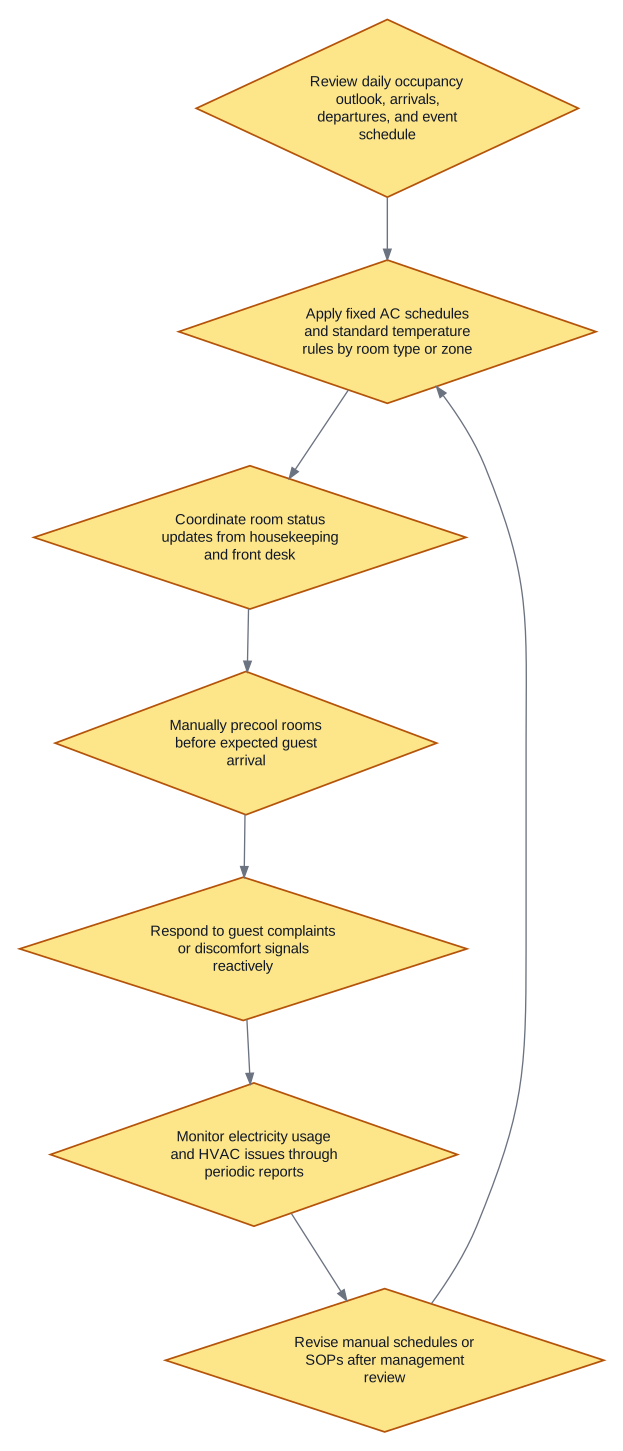
- Front office and operations reviewed daily arrivals, departures, and event bookings at the start of the shift.
- Engineering applied fixed room and zone schedules through the BMS and standard thermostat rules by room type, floor, or public area.
- Housekeeping and front desk exchanged room-status updates, then staff manually precooled selected rooms based on broad assumptions such as expected check-in time or occupancy level.
- Problems appeared when guests arrived earlier or later than expected, when cleaned rooms sat empty while fully cooled, or when conference spaces remained overcooled during low traffic periods.
- Front desk and engineering then handled complaints reactively, and management revised schedules only after periodic energy and service reviews.
Key pain points:
- Cooling decisions were made too early in the process, before uncertainty about actual arrival had narrowed.
- Staff judgment was spread across departments, so no one owned a full room-level cooling decision trail.
- The feedback loop was slow: waste and comfort failures were visible only after complaints or periodic reporting.
5. Agent Design and Guardrails
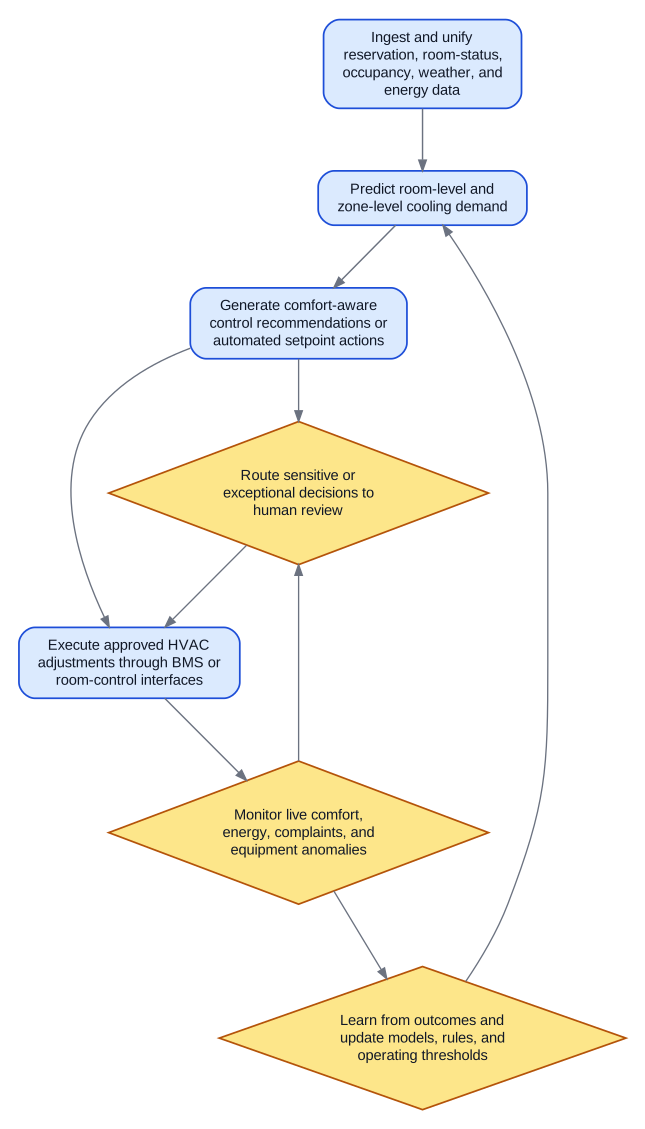
The redesigned system was built as a supervisory control layer rather than a fully autonomous building brain. Inputs included reservation and PMS data, actual check-in/check-out timestamps, housekeeping room status, event schedules, weather feeds, zone-level energy data, thermostat setpoints, and complaint tickets. Understanding came from room-state tagging: booked-not-arrived, cleaned-ready, occupied, likely temporarily vacant, public-zone active, and anomaly candidate. Reasoning combined short-horizon demand prediction with policy checks. The system estimated likely arrival timing, predicted vacancy duration, and selected among actions such as precool now, hold in standby, relax setpoint, or escalate for review. Actions included writing recommendations to the engineering dashboard, sending exception alerts, and in mature zones pushing approved setpoints directly to room-control interfaces.
The system also maintained memory/state: recent overrides, guest comfort incidents, zone-level anomaly history, and model confidence by room or floor. Human review points were mandatory for VIP arrivals, group blocks, recommendation confidence below threshold, repeated comfort complaints, equipment anomalies, and actions outside approved comfort bands. Out-of-scope actions included overriding emergency engineering lockouts, changing asset-protection rules, or applying aggressive setback policies to premium rooms without supervisor approval. This kept the agent useful but governable.
6. One Workflow Walkthrough
When a 6:40 p.m. conference arrival was expected on a hot, high-humidity evening, the system first observed that Room 1412 was cleaned and ready, booked for that guest, currently unoccupied, and located on a west-facing side of the building that typically required a longer cooling lead time. It then checked weather conditions, historical arrival behavior for conference guests, and the room’s recent thermal response. Instead of following the old rule of precooling all similar rooms well before the dinner rush, it held the room in standby until its estimated arrival window narrowed, then recommended a precool action at 5:55 p.m. A complication appeared when the group shuttle was delayed and the front desk logged later arrivals than expected. Because the confidence score dropped and the booking belonged to a corporate group, the system routed the room to the duty engineer for review rather than automatically keeping full cooling in place. The engineer approved a milder setpoint rather than the original aggressive precool. The guest still entered a comfortable room, while the case was logged as a timing-uncertainty example for later model tuning.
7. Results
- Baseline period: Prior peak-season operating pattern under fixed schedules and manual precooling
- Evaluation period: Planned 12-week summer pilot
- Workflow scope/sample: 240 guest rooms plus lobby, corridor, and meeting-space zones
- Process change: Routine room-level cooling decisions move from broad manual scheduling to exception-based review; staff intervene mainly on flagged rooms and anomalies
- Decision/model change: The control logic uses room-state prediction, booking context, weather, and comfort constraints instead of default precooling windows
- Business effect: Target reduction of 12–18% in HVAC electricity intensity, a 60–80% drop in manual precooling decisions, and fewer temperature-related check-in escalations
- Evidence status: Estimated design case grounded in workflow reconstruction and external literature, not yet observed in production
What changes most is not only energy use but labor allocation. In the old process, staff attention was spent on routine cooling choices and avoidable rework. In the redesigned process, routine choices are automated or recommended by the agent, while human effort is concentrated on genuinely uncertain cases: VIP bookings, delayed arrivals, comfort complaints, and equipment anomalies. That is the operational leverage.
8. What Failed First and What Changed
The first design failed by relying too heavily on reservation time and recent occupancy patterns while treating all booked rooms as roughly similar. That looked efficient on paper but created risk for late-arriving conference guests, group blocks, and west-facing rooms with slower temperature recovery. The fix was not simply “more data.” The team added explicit buffers for room orientation, housekeeping completion time, event-linked arrival patterns, and confidence-based escalation rules. They also made supervisor review mandatory for premium rooms and group bookings. The system became less aggressive, but more deployable. The remaining limitation is that occupancy sensing is still imperfect when guests leave belongings behind, return unpredictably, or share rooms with mixed movement patterns.
9. Transferable Lessons
- Put AI at the decision bottleneck, not merely on top of reporting. The value came from replacing broad precooling heuristics with room-level supervisory decisions.
- Keep human review as a formal control path for uncertain, high-value, or reputationally sensitive cases. In hotels, comfort failures are service failures.
- Treat forecasting, optimization, and feedback as one workflow. Occupancy prediction without control logic is incomplete; control logic without override and learning is brittle.
This case shows that agentic AI works best where operational state changes faster than human teams can coordinate, but where full autonomy would still be too risky without explicit guardrails.
References
-
Xinyu Liang, Frits de Nijs, Buser Say, and Hao Wang, “Human-in-the-Loop AI for HVAC Management Enhancing Comfort and Energy Efficiency,” arXiv:2505.05796, 2025, https://arxiv.org/abs/2505.05796. ↩︎ ↩︎
-
Juye Kim, “LSTM-based Space Occupancy Prediction towards Efficient Building Energy Management,” arXiv:2012.08114, 2020, https://arxiv.org/abs/2012.08114. ↩︎ ↩︎
-
Roja Eini and Sherif Abdelwahed, “Learning-based Model Predictive Control for Smart Building Thermal Management,” arXiv:1909.05331, 2019, https://arxiv.org/abs/1909.05331. ↩︎ ↩︎
-
Guanyu Gao, Jie Li, and Yonggang Wen, “Energy-Efficient Thermal Comfort Control in Smart Buildings via Deep Reinforcement Learning,” arXiv:1901.04693, 2019, https://arxiv.org/abs/1901.04693. ↩︎ ↩︎
-
A. Ryzhov, H. Ouerdane, E. Gryazina, A. Bischi, and K. Turitsyn, “Model predictive control of indoor microclimate: existing building stock comfort improvement,” arXiv:1806.08999, 2018, https://arxiv.org/abs/1806.08999. ↩︎ ↩︎