Executive Snapshot
- Client type: Cross-border online retailer / manufacturer-led seller
- Industry: Apparel e-commerce
- Core problem: The business was not only slowed by manual tasks; it was slowed by the communication burden around those tasks—invoice interpretation, stock reconciliation, support handoffs, ad decisions, exception escalation, and managerial approvals all required repeated human coordination.
- Why agentic AI: The workflow crossed documents, transactions, support conversations, platform dashboards, and approval gates. The real bottleneck was not a single repetitive task but a chain of interdependent human handoffs, which is exactly where specialized, stateful agents can outperform isolated scripts or a chatbot alone.12
- Deployment stage: Operational AI layer added on top of existing systems rather than a full system replacement.
- Primary result: The case reports improvement in inventory efficiency and support workload, along with estimated gains in sales growth, margin, and operating efficiency. More importantly, management shifted effort away from chasing updates, reconciling fragmented inputs, and approving routine matters, and toward higher-value commercial decisions.
Workflow Before and After
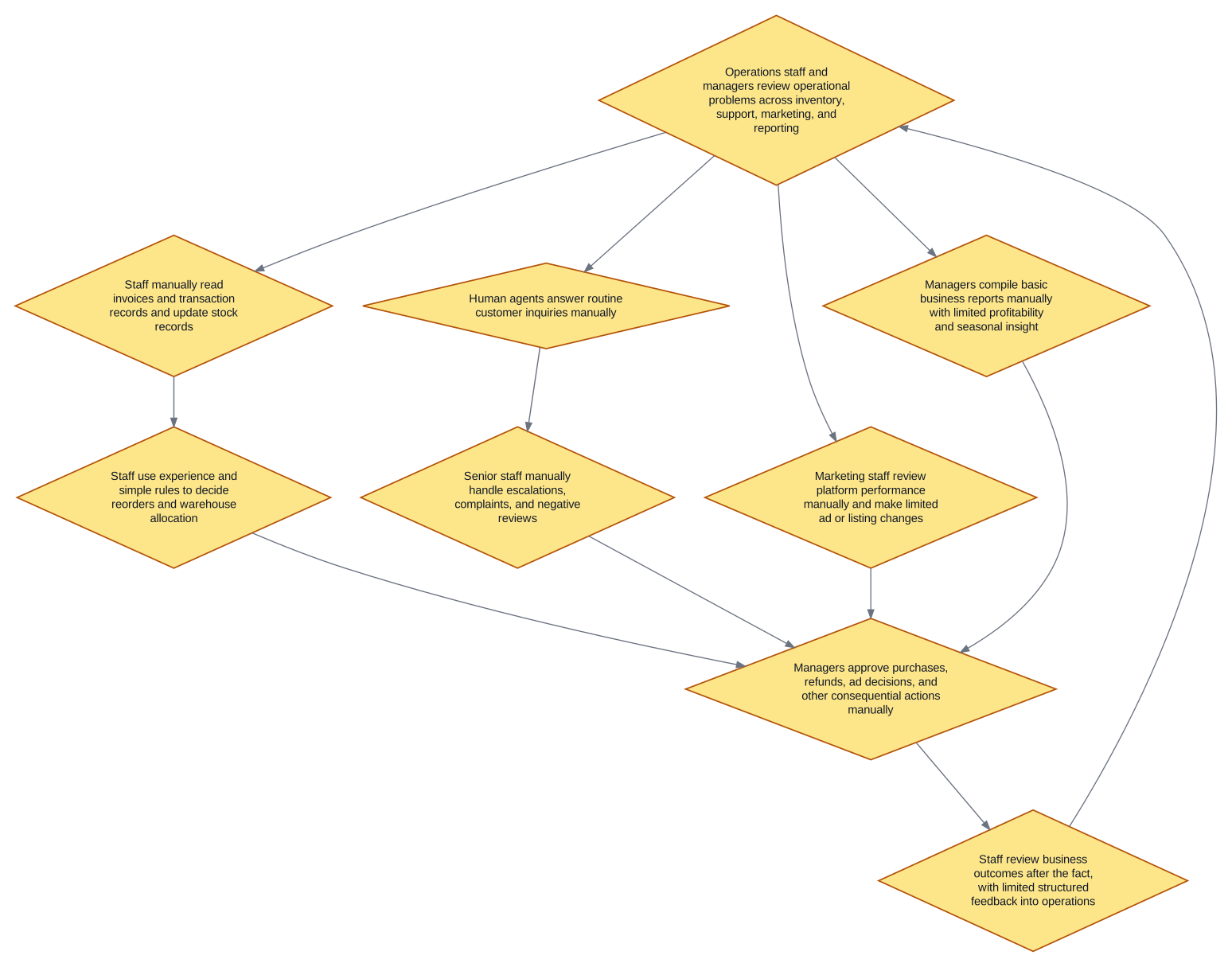
Before AI agents
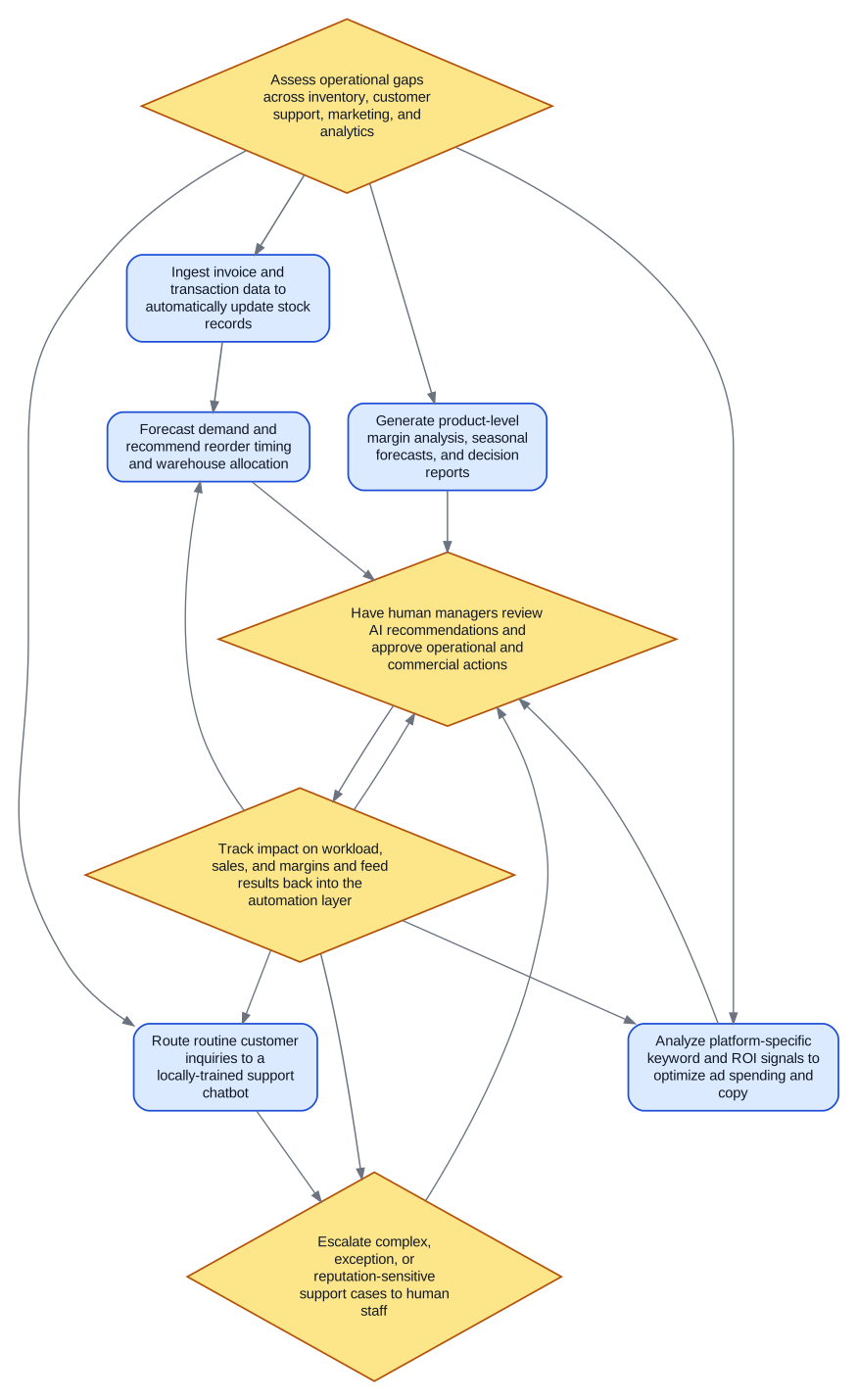
After AI agents
1. Business Context
The client was a China-based underwear seller operating across Shopee, Lazada, and TikTok in the Philippines, with existing tools already in place for commerce operations and ERP management. The problem was not the absence of software. The problem was that core work still moved through humans as the integration layer. Operations staff manually read invoices and updated stock. Reorder and warehouse allocation decisions depended on experience and rough rules. Support staff answered nearly all routine inquiries by hand, while senior staff absorbed escalations, complaints, and negative reviews. Marketing decisions were made by manually checking platform dashboards, and managers compiled basic spreadsheet reports with limited profitability or seasonal insight. In practice, the workflow consumed substantial energy in clarification, follow-up, checking, and approval rather than in actual decision making.
2. Why Simpler Automation Was Not Enough
A script could automate one invoice format. A dashboard could summarize last week’s sales. A chatbot could answer one slice of customer service. None of those tools would solve the actual operating problem because the business was constrained by cross-functional coordination rather than by one isolated task. Inventory updates affected reorder timing. Reorder timing affected customer-facing availability. Availability affected support load and marketing choices. Marketing affected demand, which fed back into stock risk and management approvals. In environments like this, traditional manual planning tends to rely on repeated negotiation, manual adjustment, and iterative communication across roles, which creates delay and inflexibility.1 The stronger design pattern is an agentic one: decompose the work into specialized agents, preserve workflow state, and surface only the consequential decisions to humans.32
3. Pre-Agent Workflow
Before the agentic layer, the business already had the same major operating lanes as the later AI workflow, but each lane depended primarily on humans.
- Problem detection: Operations staff and managers identified issues through experience, backlog pressure, spreadsheet checks, and periodic reviews.
- Inventory update: Staff manually read invoices and transaction records, then reconciled stock records by hand.
- Replenishment judgment: Staff used experience, recent sales impressions, and simple rules to decide reorders and warehouse allocation.
- Customer support: Human agents answered routine inquiries manually, while more experienced staff handled escalations and negative reviews.
- Marketing adjustment: Marketing staff checked platform performance dashboards and made limited, mostly reactive listing or ad changes.
- Business reporting: Managers compiled basic spreadsheet reports, usually backward-looking and weak on product-level profitability or seasonal demand.
- Approval and governance: Managers manually approved purchases, refunds, discounts, and other consequential actions, but usually without a unified recommendation layer.
- Retrospective review: Staff reviewed outcomes after the fact, with little structured monitoring or systematic feedback into the operating workflow.
Key pain points:
- Manual stock updates created delay, inconsistency, and mismatch risk.
- Routine support scaled almost linearly with headcount.
- Marketing optimization was too shallow and too slow for multi-platform retail.
- Managers spent too much time on communication and governance overhead—requesting status, reconciling conflicting inputs, and validating routine decisions—rather than on higher-value commercial judgment.12
4. Agent Design and Guardrails
The new workflow did not replace the whole stack. It inserted an agentic orchestration layer on top of the existing business systems.
- Inputs: invoices, platform orders, ERP stock records, warehouse receipts, returns, support messages, campaign data, listing performance, margin data, and sales history.
- Understanding: the system extracted invoice and transaction data, normalized identifiers, classified support intents, interpreted keyword and ROI signals, and assembled manager-ready operating context.
- Reasoning: specialized agents handled stock reconciliation, demand forecasting, reorder timing, warehouse allocation, support triage, marketing optimization, reporting, and anomaly monitoring.
- Actions: the system updated stock records, generated replenishment recommendations, auto-handled routine support, drafted or proposed marketing changes, compiled decision packs, and escalated exceptions.
- Memory/state: the workflow preserved operational state across inventory, support, campaign, and KPI objects, so later steps used the same refreshed context rather than isolated prompts.
- Human review points: consequential actions still required human approval—large purchase orders, major warehouse transfers, refund or compensation exceptions, material ad-budget changes, and policy-sensitive support cases.
- Out-of-scope actions: the system was not positioned as a fully autonomous business manager. It narrowed human involvement to oversight, exception handling, and high-stakes decision review.
This matters because the redesign changed the economics of coordination. In the old workflow, humans were the routing layer between tasks. In the new workflow, agents became the routing layer and humans became the control layer. Research on agentic retail and supply-chain systems increasingly describes the same pattern: shifting human effort from manual execution and stage-to-stage coordination toward supervision, exception handling, and strategic decision making.2 In the strongest versions of this architecture, one human can supervise multiple specialized workflows through a unified interface rather than repeatedly coordinating multiple people through chat, email, and spreadsheet handoffs.2 That is not just automation. It is governance compression.
5. One Workflow Walkthrough
When a new invoice arrived under the old workflow, an operations staff member had to read the document, translate it into stock changes, compare it with platform orders, decide whether the new stock solved or worsened a looming shortage, notify the right people if there was a mismatch, and then wait for managers to weigh in if the implications touched reorder timing, customer promises, or promotional activity. The work itself was not only data entry. It was interpretation, communication, and approval.
Under the new workflow, the same trigger initiates a coordinated agent path. The inventory agent ingests the invoice and reconciles stock records. The forecasting agent evaluates days of cover and recommends reorder timing or warehouse allocation. The support agent can immediately use the updated inventory state to answer availability-related inquiries. The marketing agent can suppress or promote campaigns depending on stock position and margin. Only if a discrepancy is unresolved, forecast confidence is low, or the commercial impact crosses a threshold does the case move to a human manager. The manager is no longer asked to reconstruct the situation from fragmented messages. Instead, the manager receives a structured, decision-ready packet with rationale, confidence, and the specific action requiring approval.
6. Results
The reported impact can be read in three layers.
- Process layer: inventory efficiency improved from 1.00 to 1.15, while customer-service workload dropped from 1.00 to 0.50.
- Decision layer: reorder timing, warehouse allocation, support triage, marketing adjustments, and business reporting moved from fragmented manual judgment toward structured, cross-functional recommendations.
- Business layer: the case reports about 30% lower operational workload, 20–30% sales growth, and 10–20% profit-margin improvement.
The deeper benefit, however, is organizational. The old workflow required managers to spend time on non-productive coordination: gathering inputs, confirming what had already happened, resolving handoff ambiguity, and rechecking routine proposals before anything moved. The new workflow did not eliminate managerial control; it made control more selective. Managers stayed in the loop for consequential choices, but they no longer had to serve as the main communication bus between inventory, support, marketing, and reporting. That shift is consistent with recent agentic workflow research, which frames the payoff not only as task automation, but as the transfer of human effort from coordination-heavy execution to strategic oversight and exception handling.12
Evidence status: Mixed. Some improvements are presented as indexed operational changes, while the headline business impacts are best read as estimated case outcomes rather than externally audited measurements.
7. What Failed First and What Changed
The first thing that failed in the old model was not forecasting math or customer-service quality in isolation. It was the workflow itself. Too much of the operating system lived in human communication. Each lane depended on someone noticing an issue, informing the next person, explaining context again, and waiting for approval or correction. That made even routine execution expensive.
The redesign fixed this by making the workflow explicit. The new system separated routine handling from exception handling, encoded operational state in shared data objects, and routed only uncertain or high-impact cases to humans. That reduced avoidable communication without removing accountability. The limitation that remains is deliberate: truly consequential commercial actions still need human approval, because an AI agent should operate as a delegated decision system under supervision, not as an unchecked autonomous authority.24
8. Transferable Lesson
- The most valuable AI-agent deployments are often not the ones that replace a single clerk. They are the ones that collapse chains of human handoffs across adjacent functions.
- In e-commerce, the gain is often twofold: automate routine execution and compress governance overhead, so managers review fewer but better-prepared decisions.25
- The best design is usually not “remove humans.” It is “move humans upward” from repetitive coordination into exception handling, policy control, and commercial judgment.32
Optional Closing Line: This case shows that agentic AI works best when the real bottleneck is not a missing dashboard or one slow task, but an operating model where too much business logic is trapped inside human-to-human communication.
Footnotes
-
Jiaheng Yin et al., Rethinking Supply Chain Planning: A Generative Paradigm, arXiv:2509.03811v2. The paper describes how traditional planning relies on repeated negotiations, manual adjustments, and iterative communication across organizational levels, creating inefficiency and delay. https://arxiv.org/html/2509.03811v2 ↩︎ ↩︎ ↩︎ ↩︎
-
Flowr — Scaling Up Retail Supply Chain Operations Through Agentic AI in Large Scale Supermarket Chains, arXiv:2604.05987. The paper explicitly frames the shift as moving human effort away from manual execution and coordination toward oversight, exception handling, and strategic decision-making, and describes how a single manager can supervise multiple specialized agent workflows through a unified interface. https://arxiv.org/html/2604.05987 ↩︎ ↩︎ ↩︎ ↩︎ ↩︎ ↩︎ ↩︎ ↩︎ ↩︎
-
Agentic AI Framework for Smart Inventory Replenishment, arXiv:2511.23366. The paper outlines a multi-agent replenishment architecture with specialized agents and a coordination layer designed to preserve coherence, transparency, and traceability across procurement and inventory decisions. https://arxiv.org/html/2511.23366 ↩︎ ↩︎
-
What Is Your AI Agent Buying? Evaluation, Biases, Model Dependence, & Emerging Implications for Agentic E-Commerce, arXiv:2508.02630. The paper frames the AI agent as a delegated economic actor rather than a passive proxy, which supports keeping consequential commercial actions under human supervision. https://arxiv.org/html/2508.02630 ↩︎
-
Yineng Yan et al., FaMA: LLM-Empowered Agentic Assistant for Consumer-to-Consumer Marketplace, arXiv:2509.03890. The paper argues that many marketplace tasks remain manual and time-consuming, and reports up to a 2x speedup on selected marketplace interactions through an agentic assistant. https://arxiv.org/html/2509.03890 ↩︎