Cover image

OmniAvatar’s Metrics & Training: Under the Hood of Next-Gen Avatars

The magic behind OmniAvatar isn’t just in its motion—it’s in the meticulous training pipeline and rigorous evaluation metrics that power its realism. Here’s a closer look at how the model was built and validated. Training Data: Curated, Filtered, and Massive OmniAvatar trains on a carefully filtered subset of the AVSpeech dataset (Ephrat et al., 2018), a publicly available corpus with over 4,700 hours of speech-aligned video. To ensure lip-sync precision and high visual quality: ...

June 24, 2025 · 2 min · Zelina
Cover image

Proofs and Consequences: How Math Reveals What AI Still Doesn’t Know

What happens when we ask the smartest AI models to do something truly difficult—like solve a real math problem and prove their answer is correct? That’s the question tackled by a group of researchers in their paper “Mathematical Proof as a Litmus Test.” Instead of testing AI with casual tasks like summarizing news or answering trivia, they asked it to write formal mathematical proofs—the kind that leave no room for error. And the results? Surprisingly poor. ...

June 23, 2025 · 4 min · Zelina
Cover image

Thinking Inside the Gameboard: Evaluating LLM Reasoning Step-by-Step

LLMs are great at spitting out answers—but are they any good at thinking through problems? A new benchmark, AdvGameBench, introduces a process-based evaluation approach that places LLMs into three rule-based strategic games to measure not outcomes, but the quality of reasoning. Developed by Yuan et al., this framework focuses on how LLMs plan, revise, and make resource-limited decisions in dynamic settings. Three Games, Three Cognitive Demands 1. Tower Defense tests spatial planning and rule-following. Models place defenders on a battlefield to block enemies—positioning, cooldowns, and cost management are key. ...

June 20, 2025 · 3 min · Zelina
Cover image

Mind Over Modules: How Smart Agents Learn What to See—and What to Be

In the race to build more autonomous, more intelligent AI agents, we’re entering an era where “strategy” isn’t just about picking the next move—it’s about choosing the right mind for the job and deciding which version of the world to trust. Two recent arXiv papers—one on state representation in dynamic routing games, the other on self-generating agentic systems with swarm intelligence—show just how deeply this matters in practice. We’re no longer only asking: What should the agent do? We now must ask: ...

June 19, 2025 · 5 min · Zelina
Cover image

The Conscience Plug-in: Teaching AI Right from Wrong on Demand

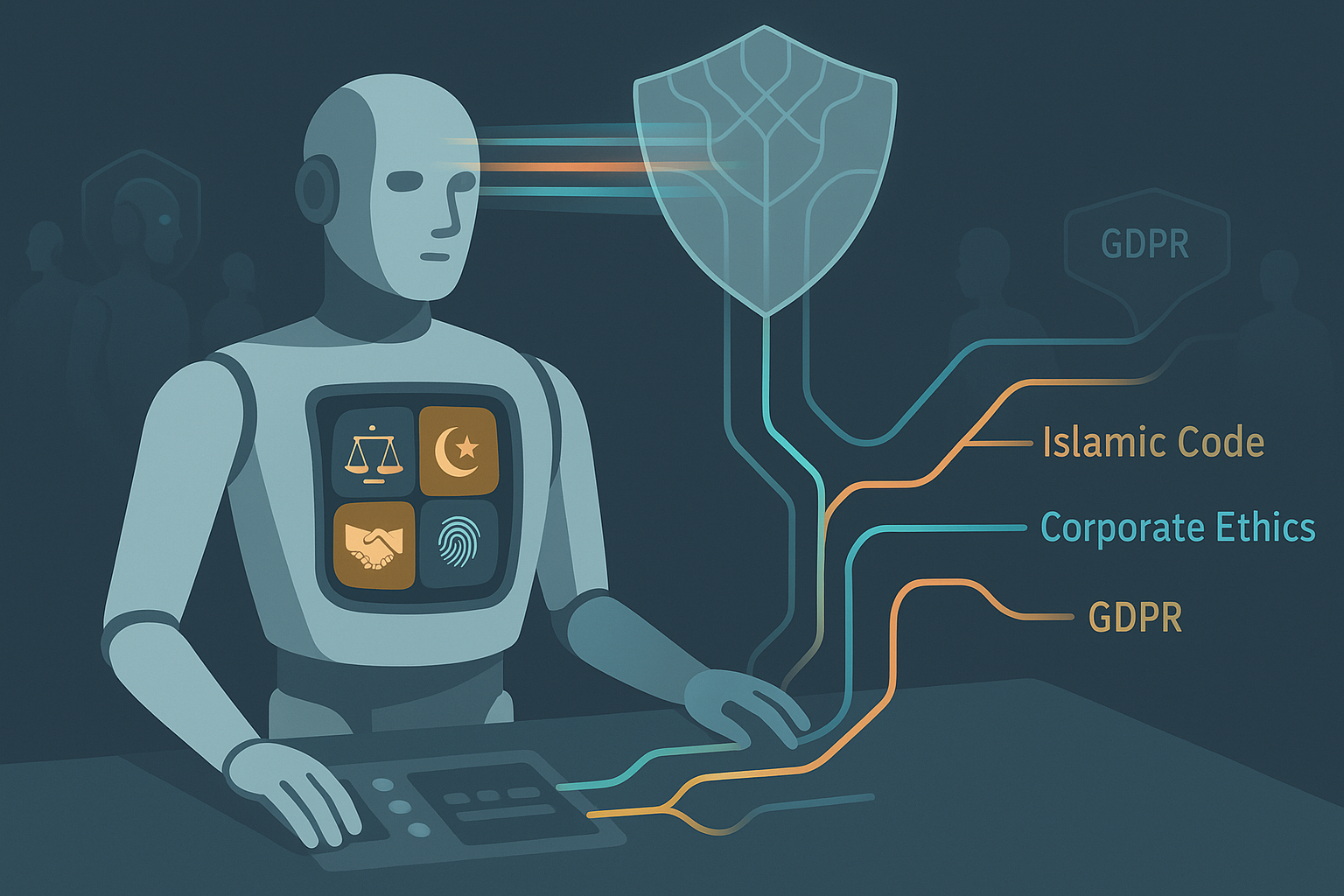
🧠 From Freud to Fine-Tuning: What is a Superego for AI? As AI agents gain the ability to plan, act, and adapt in open-ended environments, ensuring they behave in accordance with human expectations becomes an urgent challenge. Traditional approaches like Reinforcement Learning from Human Feedback (RLHF) or static safety filters offer partial solutions, but they falter in complex, multi-jurisdictional, or evolving ethical contexts. Enter the idea of a Superego layer—not a psychoanalytical metaphor, but a modular, programmable conscience that governs AI behavior. Proposed by Nell Watson et al., this approach frames moral reasoning and legal compliance not as traits baked into the LLM itself, but as a runtime overlay—a supervisory mechanism that monitors, evaluates, and modulates outputs according to a predefined value system. ...

June 18, 2025 · 4 min · Zelina
Cover image

Good Bot, Bad Reward: Fixing Feedback Loops in Vision-Language Reasoning

1. A Student Who Cracked the Code — But Not the Meaning Imagine a student who aces every test by memorizing the positions of correct answers on multiple-choice sheets. He scores high, earns accolades, and passes every exam — but understands none of the material. His reward system is misaligned: success depends not on learning, but on exploiting test mechanics. Now, replace the student with an AI agent navigating a simulated room guided by language and images. This is the scenario that today’s leading research in Vision-and-Language Reinforcement Learning (RLVR) is grappling with. ...

June 13, 2025 · 5 min · Zelina
Cover image

From Ballots to Bots: Reprogramming Democracy for the AI Era

From Ballots to Bots: Reprogramming Democracy for the AI Era Cognaptus Insights Democracy, at its core, is a decision-making system designed to fairly resolve conflicts and distribute resources in society. Historically, it has depended on human political agents—elected representatives who negotiate on behalf of their constituents. But as artificial intelligence matures, this centuries-old mechanism may be heading for a systemic rewrite. A Brief History of Democratic Pitfalls From Athenian direct democracy to parliamentary representation and constitutional republics, political systems have evolved to solve the problem of collective decision-making. Yet across cultures and eras, common systemic pitfalls emerge: ...

June 10, 2025 · 4 min
Cover image

The Memory Advantage: When AI Agents Learn from the Past

What if your AI agent could remember the last time it made a mistake—and plan better this time? From Reaction to Reflection: Why Memory Matters Most language model agents today operate like goldfish—brilliant at reasoning in the moment, but forgetful. Whether navigating virtual environments, answering complex questions, or composing multi-step strategies, they often repeat past mistakes simply because they lack a memory of past episodes. That’s where the paper “Agentic Episodic Control” by Zhihan Xiong et al. introduces a critical upgrade to today’s LLM agents: a modular episodic memory system inspired by human cognition. Instead of treating each prompt as a blank slate, this framework allows agents to recall, adapt, and refine prior reasoning paths—without retraining the underlying model. ...

June 3, 2025 · 3 min
Cover image

From Sparse to Smart: How PROGRM Elevates GUI Agent Training

The GUI Agent Bottleneck: Stuck in Sparse Feedback Training LLM-based GUI agents to complete digital tasks—such as navigating mobile apps or automating workflows—faces a fundamental limitation: reward sparsity. Traditional reward formulations (Outcome Reward Models, or ORMs) provide feedback only at the end of a trajectory. If the task fails, the agent receives zero signal, regardless of how many useful intermediate steps it took. This severely limits credit assignment and slows learning, especially in environments with long action horizons. ...

May 26, 2025 · 3 min
Cover image

The Art of Control: Balancing Autonomy, Authority, and Initiative in Human-AI Co-Creation

In the expanding domain of artificial intelligence, creativity is no longer a human-only endeavor. From music composition to visual art and storytelling, AI agents are taking on increasingly creative roles. But as these systems become more proactive, one question looms large: who’s really in control? Enter MOSAAIC — a framework developed to guide the design of co-creative systems by managing autonomy, initiative, and authority in shared human-AI decision-making. The Three Pillars: Autonomy, Initiative, and Authority The authors define three interrelated yet distinct aspects of control: ...

May 25, 2025 · 3 min