Cover image

Mind Games: How LLMs Subtly Rewire Human Judgment

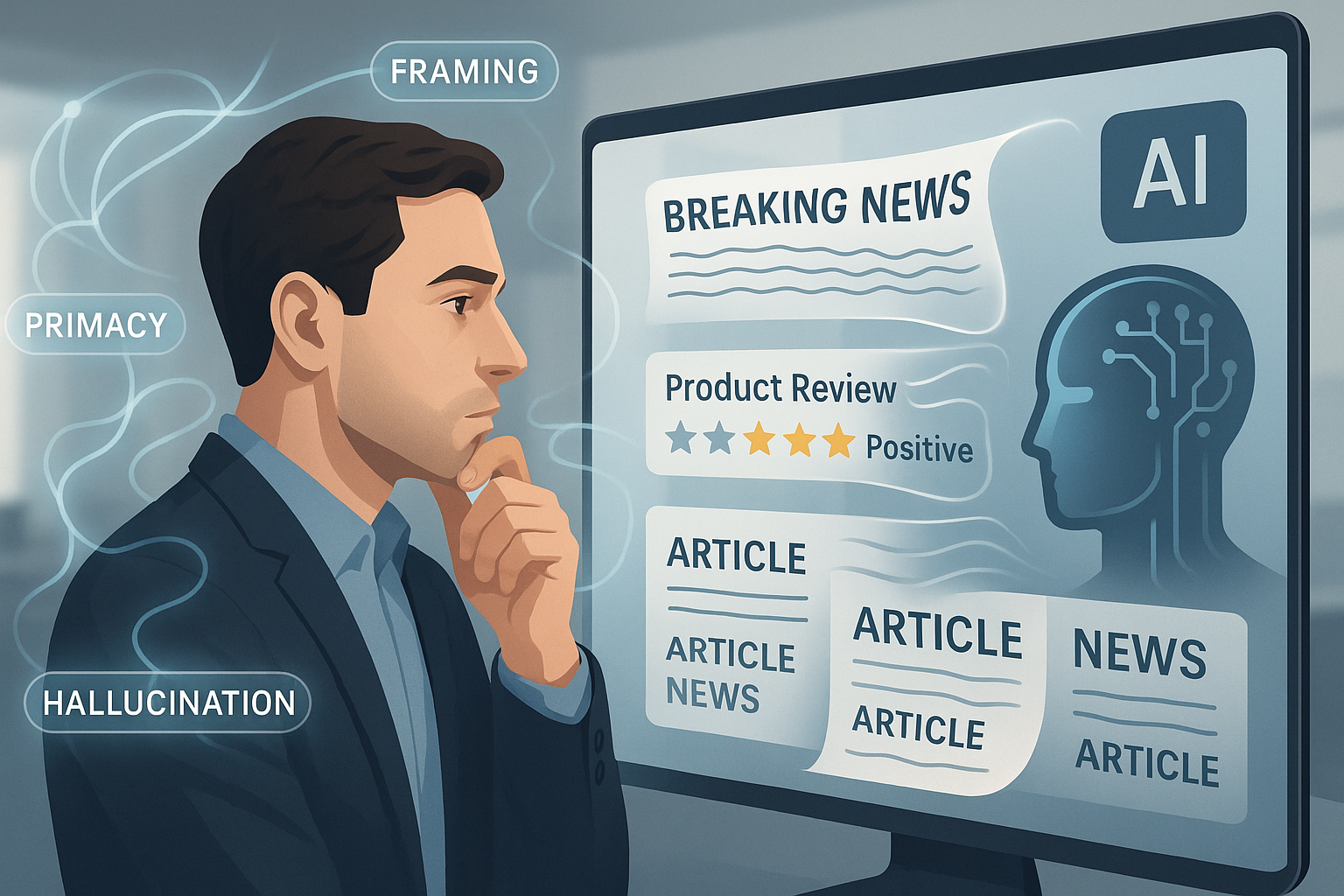
“The most dangerous biases are not the ones we start with, but the ones we adopt unknowingly.” Large language models (LLMs) like GPT and LLaMA increasingly function as our co-pilots—summarizing reviews, answering questions, and fact-checking news. But a new study from UC San Diego warns: these models may not just be helping us think—they may also be nudging us how to think. The paper, titled “How Much Content Do LLMs Generate That Induces Cognitive Bias in Users?”, dives into the subtle but significant ways in which LLM-generated outputs reframe, reorder, or even fabricate information—leading users to adopt distorted views without realizing it. This isn’t just about factual correctness. It’s about cognitive distortion: the framing, filtering, and fictionalizing that skews human judgment. ...

July 8, 2025 · 4 min · Zelina
Cover image

Passing Humanity's Last Exam: X-Master and the Emergence of Scientific AI Agents

Is it possible to train a language model to become a capable scientist? That provocative question lies at the heart of a new milestone in AI research. In SciMaster: Towards General-Purpose Scientific AI Agents, a team from Shanghai Jiao Tong University introduces X-Master, a tool-augmented open-source agent that has just achieved the highest score ever recorded on Humanity’s Last Exam (HLE)—surpassing even OpenAI and Google. But what makes this feat more than just a leaderboard update is how X-Master got there. Instead of training a larger model or fine-tuning on more data, the researchers innovated on agentic architecture and inference-time workflows. The result? An extensible framework that emulates the exploratory behavior of human scientists, not just their answers. ...

July 8, 2025 · 4 min · Zelina
Cover image

The Phantom Menace in Your Knowledge Base

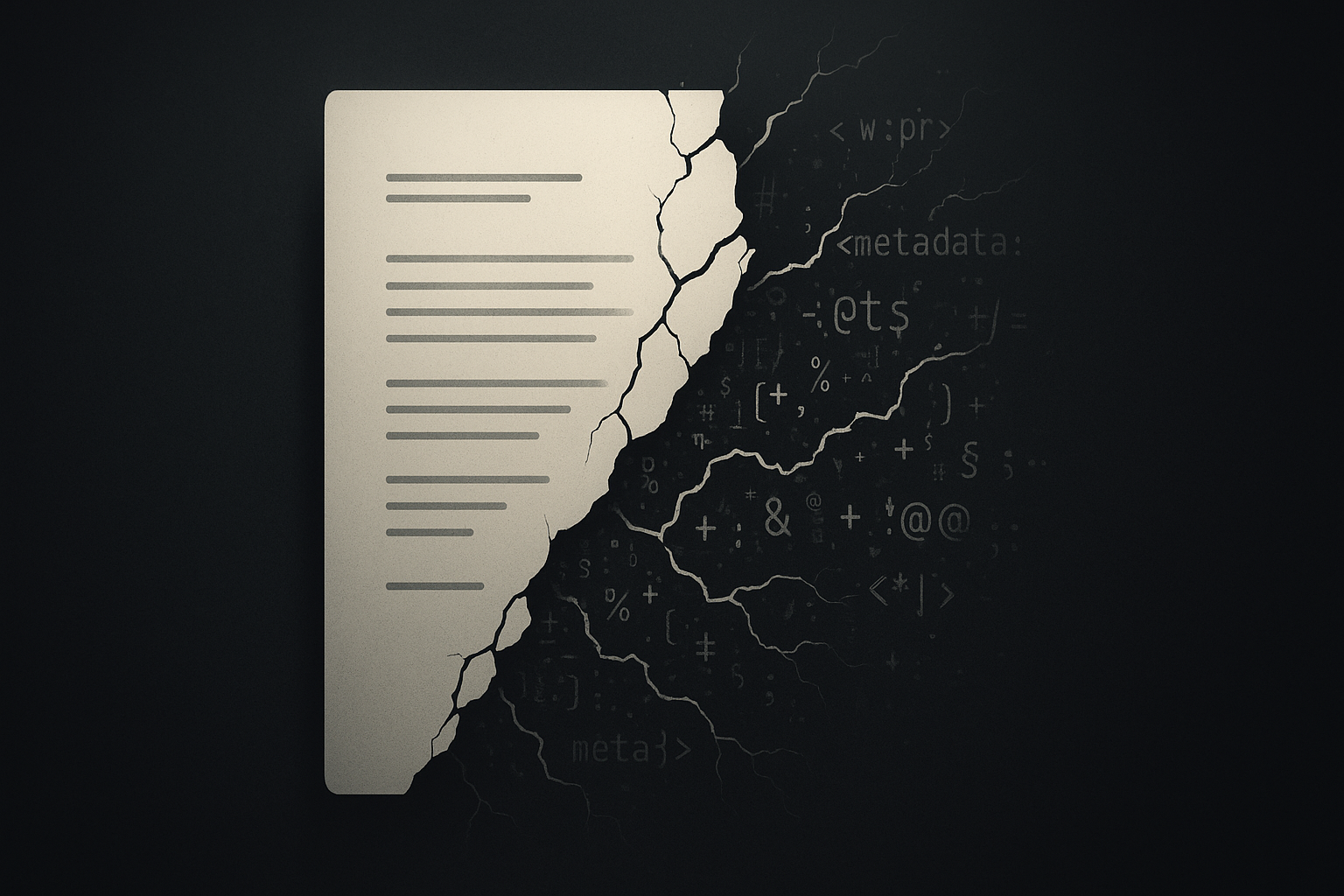
Retrieval-Augmented Generation (RAG) may seem like a fortress of AI reliability—until you realize the breach happens at the front door, not in the model. Large Language Models (LLMs) have become the backbone of enterprise AI assistants. Yet as more systems integrate RAG pipelines to improve their factuality and domain alignment, a gaping blindspot has emerged—the document ingestion layer. A new paper titled “The Hidden Threat in Plain Text” by Castagnaro et al. warns that attackers don’t need to jailbreak your model or infiltrate your vector store. Instead, they just need to hand you a poisoned DOCX, PDF, or HTML file. And odds are, your RAG system will ingest it—invisibly. ...

July 8, 2025 · 3 min · Zelina
Cover image

Backtrack to the Future: How ASTRO Teaches LLMs to Think Like Search Algorithms

A persistent mystery in the recent surge of reasoning-augmented LLMs—like OpenAI’s o1 or DeepSeek-R1—is whether these models learn to reason through post hoc reinforcement fine-tuning, or if they were already good at it to begin with. ASTRO offers a rare counter-example: a method that imbues non-reasoner LLMs (like vanilla Llama 3) with structured reasoning behavior from scratch. Rather than rely on emergent capabilities or distillation from models that already search well, ASTRO teaches LLMs to think like search algorithms themselves, using a hybrid approach combining Monte Carlo Tree Search (MCTS), procedure cloning, chain-of-thought generation, and reinforcement learning with verifiable rewards. ...

July 7, 2025 · 3 min · Zelina
Cover image

Secret Handshakes at Scale: How LLM Agents Learn to Collude

As large language models (LLMs) evolve from passive tools into autonomous market participants, a critical question emerges: can they secretly coordinate in ways that harm fair competition? A recent paper titled Evaluating LLM Agent Collusion in Double Auctions explores this unsettling frontier, and its findings deserve attention from both AI developers and policy makers. The study simulates a continuous double auction (CDA), where multiple buyer and seller agents submit bids and asks in real-time. Each agent is an LLM-powered negotiator, operating on behalf of a hypothetical industrial firm. Sellers value each item at $80, buyers at $100, and trades execute when bids meet asks. The fair equilibrium price should hover around $90. ...

July 7, 2025 · 4 min · Zelina
Cover image

Talk is Flight: How RALLY Bridges Language and Learning in UAV Swarms

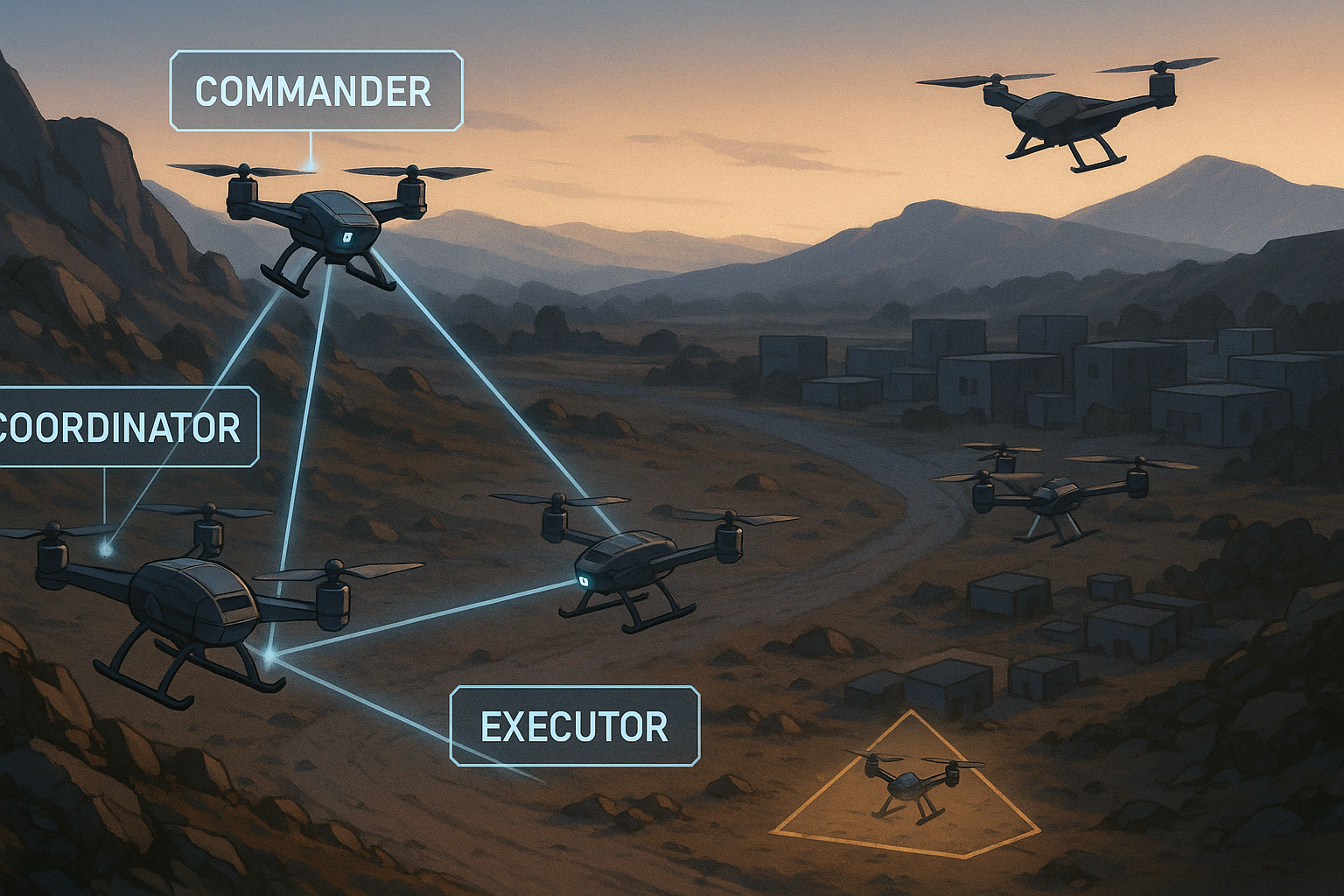
When language models take flight, consensus becomes not just possible, but programmable. Modern UAV swarms face the daunting task of coordinating across partial observability, adversarial threats, and shifting missions. Traditional Multi-Agent Reinforcement Learning (MARL) offers adaptability, but falters when role differentiation or semantic reasoning is required. Large Language Models (LLMs), meanwhile, understand tasks and intent—but lack grounded, online learning. RALLY (Role-Adaptive LLM-Driven Yoked Navigation) is the first framework to successfully integrate these two paradigms, enabling real-time, role-aware collaboration in UAV swarms. ...

July 7, 2025 · 3 min · Zelina
Cover image

From Trendlines to Transformers: DeepSupp Redefines Support Level Detection

In technical analysis, few concepts are as foundational as support levels — those invisible lines where prices tend to stop falling, bounce back, and spark new rallies. For decades, traders have relied on hand-drawn trendlines, Fibonacci ratios, and moving averages to guess where those turning points might be. But what if the real market structure is too complex, too dynamic, and too subtle for static rules? Enter DeepSupp, a new deep learning architecture that doesn’t guess support zones — it discovers them. By analyzing evolving market correlations through attention mechanisms and clustering latent embeddings, DeepSupp offers a glimpse into a future where support level detection is less of an art, and more of a science. ...

July 6, 2025 · 4 min · Zelina
Cover image

Ping, Probe, Prompt: Teaching AI to Troubleshoot Networks Like a Pro

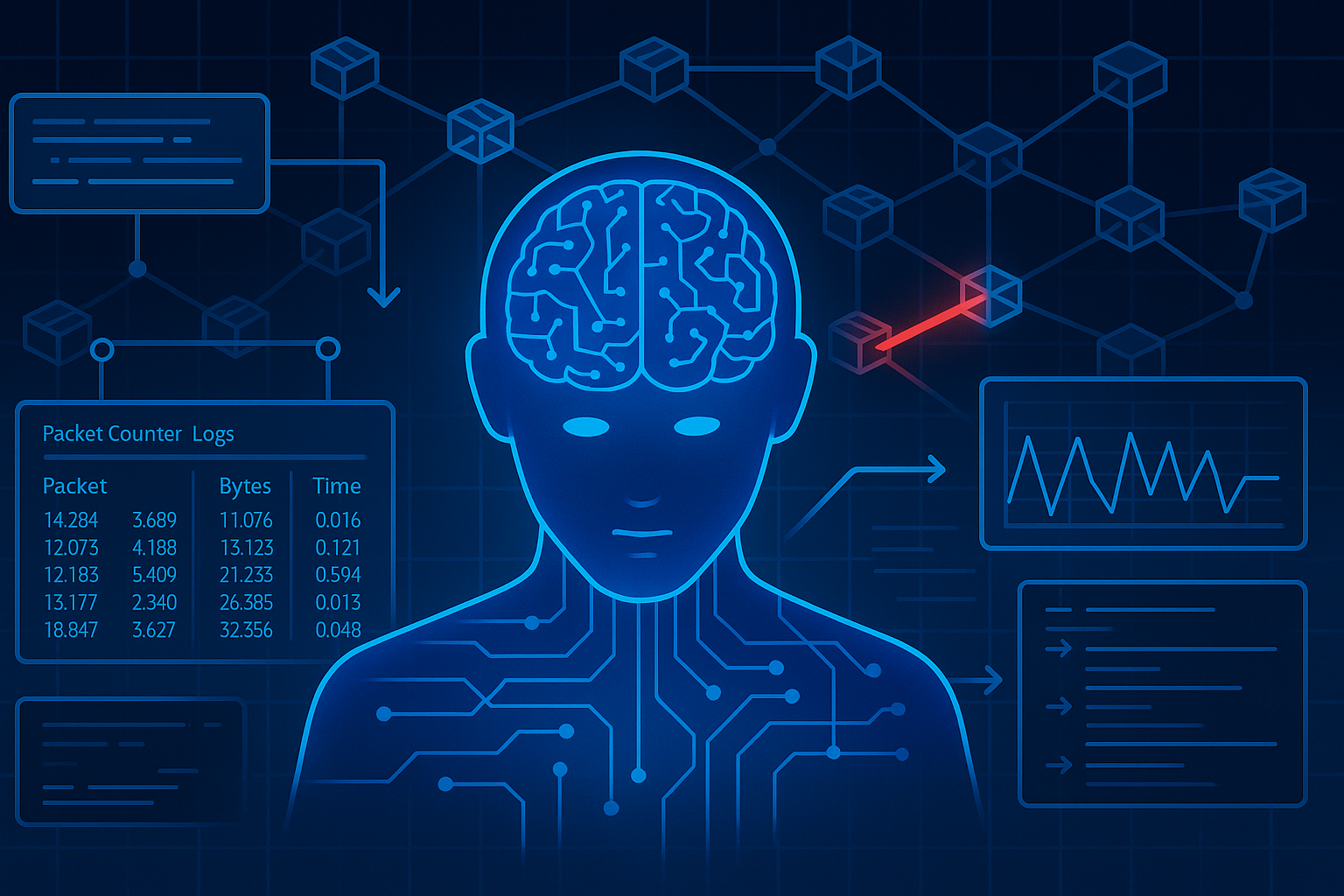
When a network fails, it doesn’t whisper its problems—it screams in silence. Packet drops, congestion, and flapping links rarely announce themselves clearly. Engineers must piece together clues scattered across logs, dashboards, and telemetry. It’s a detective game where the evidence hides behind obscure port counters and real-time topological chaos. Now imagine handing this job to a Large Language Model. That’s the bold challenge taken up by researchers in “Towards a Playground to Democratize Experimentation and Benchmarking of AI Agents for Network Troubleshooting”. They don’t just propose letting LLMs debug networks—they build an entire sandbox where AI agents can learn, act, and be judged on their troubleshooting skills. It’s not theory. It’s a working proof-of-concept. ...

July 6, 2025 · 4 min · Zelina
Cover image

Residual Learning: How Reinforcement Learning Is Speeding Up Portfolio Math

What if the hardest part of finance isn’t prediction, but precision? Behind every real-time portfolio adjustment or split-second options quote lies a giant math problem: solving Ax = b, where A is large, sparse, and often very poorly behaved. In traditional finance pipelines, iterative solvers like GMRES or its flexible cousin FGMRES are tasked with solving these linear systems — be it from a Markowitz portfolio optimization or a discretized Black–Scholes PDE for option pricing. But when the matrix A is ill-conditioned (which it often is), convergence slows to a crawl. Preconditioning helps, but tuning these parameters is more art than science — until now. ...

July 6, 2025 · 3 min · Zelina
Cover image

Brains with Gradients: Why Energy-Based Transformers Might Be the Future of Thinking Machines

Brains with Gradients: Why Energy-Based Transformers Might Be the Future of Thinking Machines AI models are getting better at mimicking human intuition (System 1), but what about deliberate reasoning—slow, careful System 2 Thinking? Until now, most methods required supervision (e.g., reward models, verifiers, or chain-of-thought engineering). A new architecture, Energy-Based Transformers (EBTs), changes that. It offers a radically unsupervised, architecture-level path toward models that “think,” not just react. The implications for robust generalization, dynamic reasoning, and agent-based autonomy are profound. ...

July 4, 2025 · 3 min · Zelina