TL;DR for operators
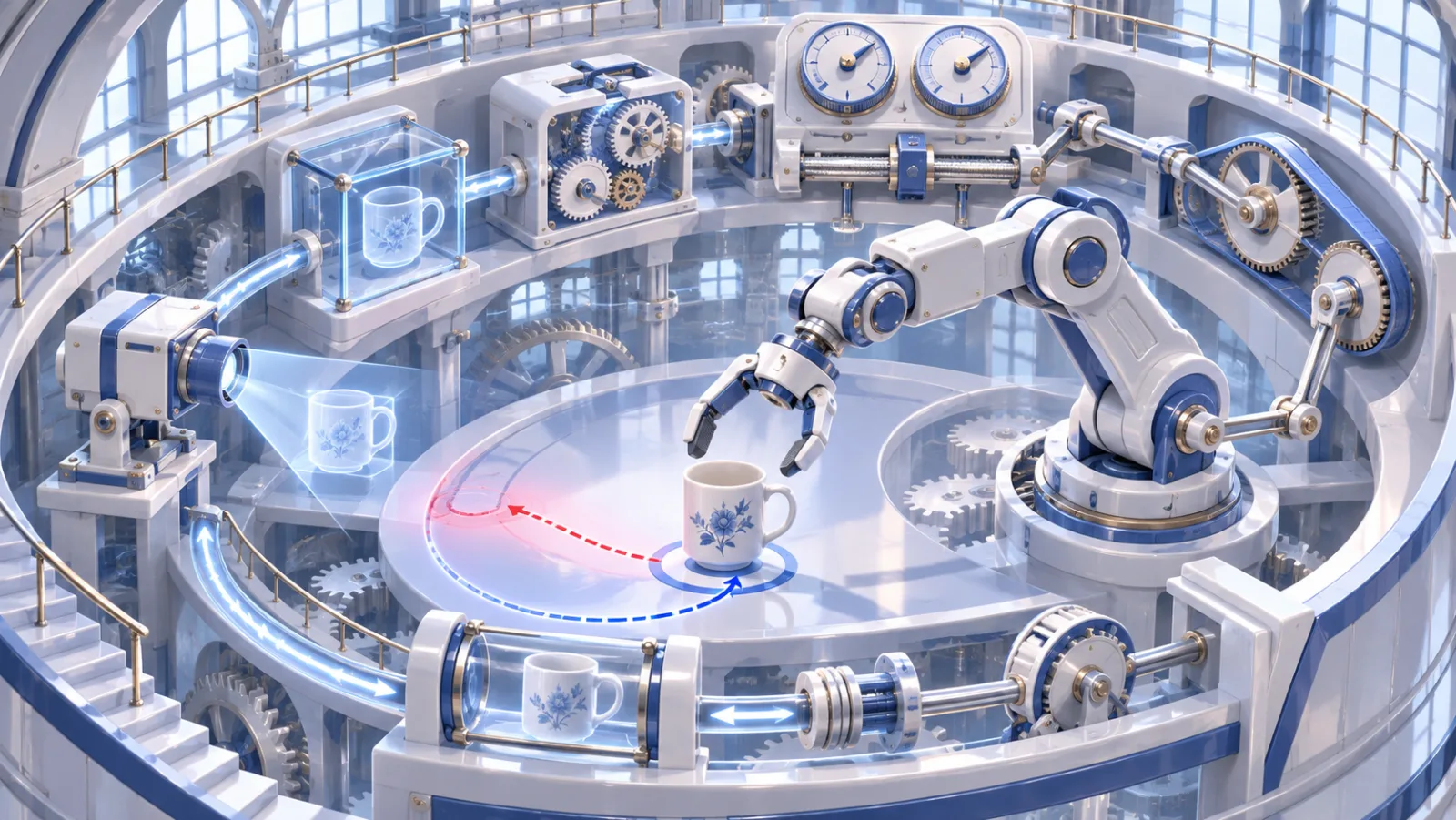
Knowing a mug’s current height does not tell a robot where the mug will end up after its next movement, or which internal model adjustment will raise it.
Minseok Jeong and colleagues1 develop a control-theoretic extension of the linear representation hypothesis that accounts for candidate robot actions. They prove that shared representations can approximate future physical quantities under specified conditions, and establish a separate monotonic steering guarantee for an idealized stochastic policy.
In pretrained OpenVLA-OFT experiments, their action-conditioned probes predict mug-position changes with held-out R² values of approximately 0.90–0.98. More consequentially, steering through the model’s action-head Jacobian produces physical changes close to simulator-gradient interventions, while ordinary probe directions can move the robot in the wrong direction.
For robotic automation developers, the relevant investment is not simply a better representation decoder. It is a combined capability to predict action consequences, calculate how representation changes affect generated actions, and verify the resulting physical behavior. The evidence comes from mathematical constructions and one simulated manipulation setting, not demonstrated deployment reliability.
A correct estimate does not identify the right movement
Consider a robot instructed to place a mug on a plate. Its vision-language-action model may encode the mug’s current height accurately. An operator nevertheless needs to know something more demanding: what will happen to that height after the model executes its next sequence of movements?
The distinction becomes especially consequential when attempting to modify the robot’s behavior without retraining it. Finding an internal direction that represents mug height does not establish that moving the representation along that direction will raise the mug.
The paper supplies a particularly clear example. In a simulated manipulation task, steering along a static height-probe direction produced a median −2.2 mm change in white-mug height between the tested intervention endpoints. A direction accounting for the downstream action generator produced +12.9 mm, matching the simulator-gradient reference.
Both interventions targeted the same physical property. Their different outcomes indicate that representation decoding and physical control must be evaluated separately.
Future physical quantities require the candidate action
The authors extend the linear representation hypothesis from static semantic properties to quantities that evolve under physical dynamics.
Let $x$ be the current physical state, $u$ a candidate action trajectory, and $\psi$ a physical quantity of interest, such as mug height or distance to a target. The relevant prediction is $\psi(F_u(x))$: the quantity after executing that trajectory.
Their proposed action-conditioned linear probe takes the form:
Here, $\lambda(x)$ represents the current state, $S(u)$ describes the action trajectory, and $L_\psi$ is a measurement map specific to the physical quantity.
The action description matters because physical outcomes depend on the sequence and interaction of control inputs. The authors use path signatures, built from iterated integrals, to encode these interactions. The Chen–Fliess expansion then expresses propagated physical quantities through combinations of state-dependent coefficients and action-dependent signature terms.
Theorem 4.2 establishes the representation-side result. For finitely many physical quantities, a compact initial-state set, bounded admissible controls, and uniform convergence and regularity conditions, a shared finite-dimensional representation can approximate all their propagated values to arbitrary positive accuracy.
This is an existence theorem. It explains how action-dependent physical prediction can have a linear representation, but does not establish that a pretrained robot model has learned that representation.
That distinction matters when selecting architectures: a mathematical construction demonstrates feasibility, while the quality of a particular learned representation still requires measurement.
The theoretical steering guarantee has a specific policy mechanism
Predicting a movement’s consequences is only one part of the problem. The authors also ask when changing an internal representation can systematically change the physical outcome.
They construct a stochastic policy in which the representation serves as the natural parameter of a signature exponential family. Action trajectories receive probabilities according to how their signatures align with that parameter.
Using information geometry, the authors derive a straight steering path through the natural-parameter space. Under exact linear probing, a bounded measurement operator, and admissible policy parameters, Theorem 5.3 gives:
The derivative of the expected future physical quantity equals its variance under the steered policy. Consequently, increasing steering strength cannot decrease that expectation within the theorem’s conditions.
This is a guarantee about an expectation under a particular stochastic policy family, not about every individual robot movement.
The authors verify the mechanism numerically in a constructed planar-navigation system with 671 candidate action chunks. Exact probing reaches errors around $3\times10^{-16}$, and the numerical steering slope agrees with the predicted variance to approximately $10^{-11}$.
As steering strength increases from 0 to 4 to 8, the expected lateral-position quantity rises from 0.000 to 0.134 to 0.255. The corresponding KL divergences rise from 0 to 0.27 to 0.98 nats, illustrating that stronger steering changes the policy distribution and that its effects eventually saturate over the finite candidate set.
This oracle experiment verifies the proposed mathematical mechanism in a deliberately constructed setting. The pretrained robot experiments test a related but different mechanism.
Action-conditioned probes predict changes that static probes miss
The learned-model evaluation uses pretrained OpenVLA-OFT on a LIBERO-10 simulated task involving two mugs and two target plates.
The authors collect 788 state snapshots from 50 initial layouts, including 46 successful nominal rollouts. At 404 snapshots, they evaluate 32 candidate action chunks, allowing them to examine how alternative movements change the physical state.
They fit probes combining PCA-reduced model representations with action signatures truncated at second order. The central comparison concerns the change induced by an action chunk, rather than the current physical quantity alone.
Across six mug-position coordinates, bilinear action-conditioned probes achieve held-out increment-prediction R² values from 0.901 to 0.979, outperforming additive alternatives.
The benefit is especially visible in predicting mug height after an action:
| Propagated height prediction | Static-only R² | Static plus bilinear R² |
|---|---|---|
| White mug | 0.636 | 0.946 |
| Yellow-and-white mug | 0.620 | 0.959 |
Source: Section 6.2, Table 1. The static-only baseline assumes no action-induced change in the quantity.
These improvements demonstrate why state and action interactions deserve explicit modeling. A strong estimate of the current position does not necessarily predict where an object will be after the next control chunk.
The appendix comparisons further show that nonlinear alternatives improve increment prediction by at most approximately 0.03 R² over the bilinear specifications. This supports the adequacy of a relatively structured readout in the evaluated setting, rather than establishing that nonlinear representations are generally unnecessary.
The action head determines whether the intervention works
The pretrained OpenVLA-OFT model has a deterministic action head, not the stochastic exponential-family policy assumed by Theorem 5.3.
To connect a physical-quantity probe to an effective intervention, the authors therefore account for how the action head converts a representation into generated robot actions.
They calculate a local Jacobian describing how changes in the representation affect the signature of the resulting action chunk. Transporting the physical-quantity probe backward through this Jacobian produces a representation-space direction intended to increase the predicted physical quantity.
This is the essential additional step: a physical property can be readable in latent space without the corresponding readout direction being aligned with the model’s available control behavior.
The controlled steering comparisons make the difference measurable:
| Target quantity | Simulator-gradient effect | Transported-probe effect | Static-probe effect |
|---|---|---|---|
| White-mug height | +12.9 mm | +12.9 mm | −2.2 mm |
| Negative white-mug-to-plate distance | +12.3 mm | +11.9 mm | −11.3 mm |
| End-effector height | +9.5 mm | +9.8 mm | −4.2 mm |
Source: Section 6.2, Table 2; Appendix D.3, Table 5. Values are median differences between steering coefficients +8 and −8 across 20 held-out states per quantity, with equal representation displacement. Positive changes in negative-distance quantities indicate movement toward the target.
Across seven tested quantities, the transported directions achieve median cosine similarities of 0.98–1.00 with simulator gradients. They also meet the reported monotonic-response criterion in 138 of 140 held-out state–quantity evaluations.
That criterion is a Spearman correlation of at least 0.8 across evaluated steering coefficients. It should not be confused with the exact mathematical monotonicity established for the theoretical stochastic policy.
A separate closed-loop illustration applies steering over six replanned action chunks spanning 2.4 seconds. For steering strengths −16, 0, and +16, the final end-effector distances to the white mug are 20, 11.8, and 9 cm, respectively. This demonstrates that intervention effects can persist through replanning in one held-out simulated episode, without establishing consistent task-level improvement.
What robotic automation developers should test
Cognaptus infers three connected engineering priorities from these findings.
First, developers evaluating an existing VLA for task-specific adaptation should test whether its representations predict action-induced physical changes, not only current object positions. Where candidate movements and measured outcomes are available, action-conditioned probes provide a more relevant diagnostic for future-state prediction.
Second, developers considering inference-time steering should examine action-head sensitivity before selecting intervention directions. The reported results show that a predictive readout alone is an unreliable guide to physical intervention, whereas transporting it through the action head can closely approximate simulator-gradient directions in the tested task.
Third, operators should validate interventions against physical measurements and task constraints. A predicted increase in mug height may be measurable without being desirable at every point in a placement procedure. Local improvement in a selected quantity is not equivalent to successful manipulation.
The possibility of adapting a policy without retraining is economically interesting where new demonstrations or fine-tuning are expensive. However, the paper does not measure adaptation costs or establish that probe construction and validation are cheaper than alternative methods in production.
The boundary is physical reliability, not representational accuracy
The study provides strong conditional mathematical results and encouraging controlled evidence, but several boundaries determine how the method should be used.
The existence theorem does not guarantee that arbitrary pretrained VLAs contain the required representation. The monotonicity theorem assumes exact probes and a specific stochastic policy; quantitative guarantees under imperfect probing remain open. The learned-model results instead rely on local action-head Jacobians, whose accuracy under larger interventions must be checked empirically.
The evaluation is also concentrated on one pretrained model and one simulated manipulation task. High probe R² and close gradient alignment do not establish robust task success, safe interaction, or reliable performance across robot platforms and physical environments.
The resulting engineering lesson is narrower and more actionable than a general claim that robot representations are controllable. A useful physical representation must be tested against candidate actions, and a useful steering direction must be tested through the action generator and the environment.
That distinction makes representation probing a potential component of robot adaptation and diagnostics, while leaving deployment reliability as a separate validation problem.
Cognaptus: Automate the Present, Incubate the Future.
-
Minseok Jeong and Hyewon Choi and Hiroyasu Tsukamoto and SooJean Han (2026). The Linear Representation Hypothesis for Vision-Language-Action Models. arXiv:2609.30996. https://arxiv.org/abs/2609.30996 ↩︎