TL;DR for operators
Changing an autonomous team’s assignments should not necessarily require retraining every agent. SpecMAGIC1 explores an alternative: train reusable local behaviors, then use a centralized planner to combine them according to new task-ordering, dependency, and participation requirements.
In simulated three-agent navigation, SpecMAGIC achieved a 96% success rate on out-of-distribution individual tasks, compared with 4% for ACC-MARL. Its sampling-based planner also avoided explicitly constructing a rapidly expanding global task automaton. These results support specification-driven recomposition, although differences between the learning methods prevent attributing the entire success-rate gap to planning.
The crucial distinction is between a logically valid plan and successful execution. SpecMAGIC proves properties of its symbolic planner, not that learned controllers will consistently avoid collisions or complete their assigned subtasks.
For robotics architects, the relevant design choice is whether to separate reusable execution capabilities from changing coordination rules. That architecture could improve task flexibility, but planning latency, agent-count changes, and physical execution reliability still require independent validation.
The Assignment Changes, but the Skills Have Not
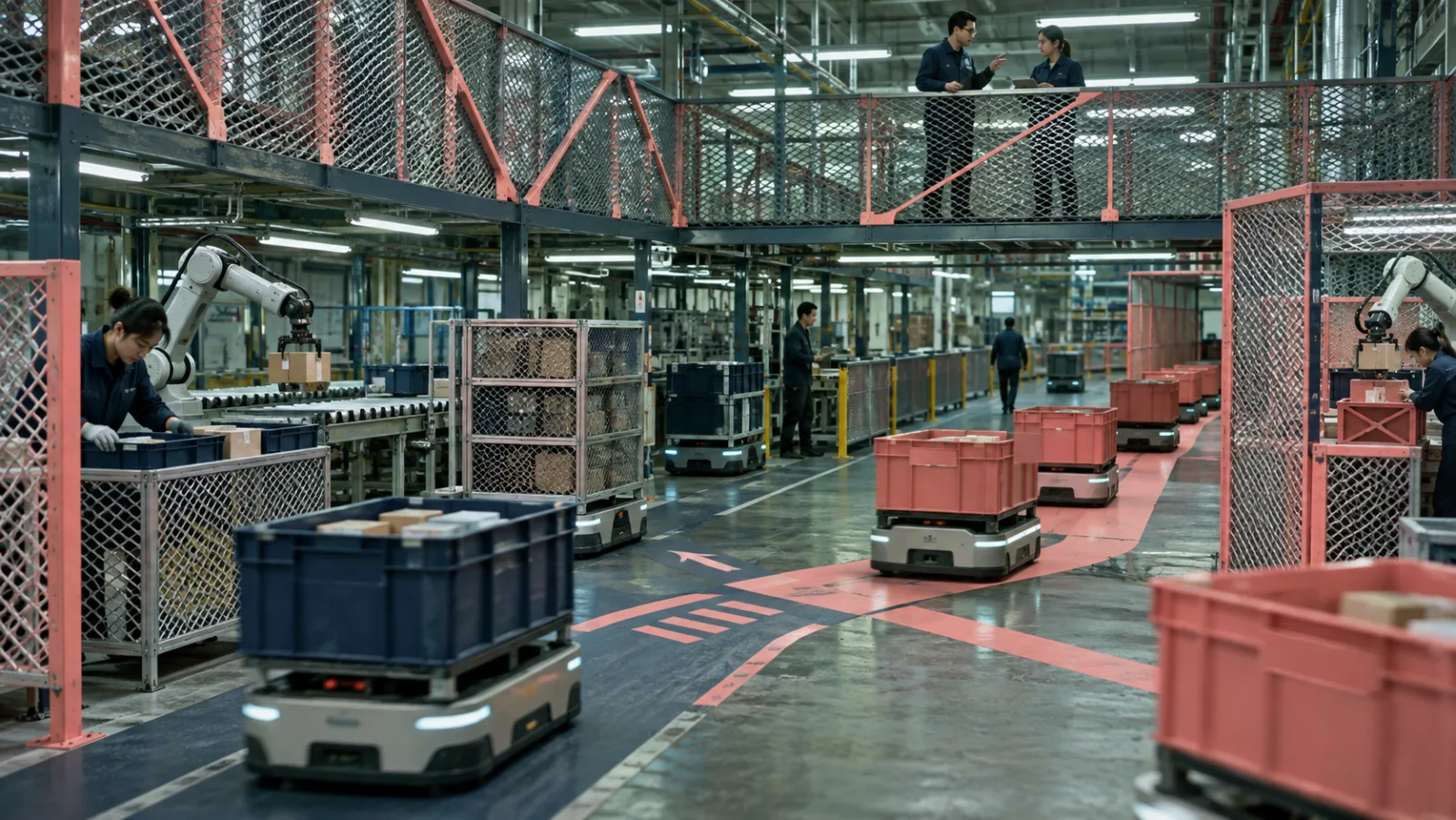
Consider a warehouse fleet whose robots already know how to navigate between storage zones. One day, a robot must complete an inspection before another begins transport. Another assignment requires three robots to reach a location simultaneously. A third requires three distinct robots to visit a location, without requiring them to arrive together.
The basic navigation capabilities have not changed. What changes is how those capabilities must be coordinated.
A system trained around complete, fixed task combinations may need new training or increasingly elaborate joint planning as these instructions change. For an automation architect, that creates a recurring question: can new assignments be expressed as rules governing existing capabilities rather than as entirely new behaviors?
SpecMAGIC addresses this question using a hierarchy that separates the interpretation of global requirements from their physical execution. The warehouse example illustrates the possible business application; the research itself evaluates simulated navigation agents.
Plan Over Reusable Subtasks, Not Every Joint State
SpecMAGIC expresses agent objectives using linear temporal logic (LTL), a formal language for specifying which conditions must eventually occur, which must be avoided, and how events must be ordered.
Instead of training a policy for each complete task specification, the framework learns local reach-avoid behaviors: reach a specified condition while avoiding forbidden conditions along the way.
The coordination layer then works through three stages.
First, each individual or coordination specification is converted into an automaton and decomposed into candidate sequences of reach-avoid subtasks. These sequences represent possible ways to make progress toward satisfying the requirement.
Second, a centralized sampling-based planner selects combinations of subtasks that can proceed together. It rejects combinations where satisfying a required reach condition would necessarily violate an active avoidance condition. It also preserves ordering constraints.
Third, decentralized policies execute the selected subtasks. These policies are trained using subtask-conditioned reinforcement learning without requiring the high-level planner during training. During evaluation, the system can replan as component automaton states change.
This architecture avoids explicitly constructing a global product automaton—a single representation tracking every component specification’s progress together. Such a representation can grow combinatorially with additional agents and requirements.
SpecMAGIC instead searches over compatible component-level progressions. Its central contribution is this change in planning representation, combined with reusable learned behaviors.
Coordination becomes part of the specification
The framework introduces four compact operators:
- Req: Expresses prerequisite ordering between conditions.
- EachReq: Expresses recurring prerequisite relationships.
- Sync: Requires at least a specified number of distinct agents to satisfy a condition simultaneously.
- Async: Requires the specified number of distinct agents to satisfy a condition eventually, without simultaneous completion.
For example, a requirement that three robots reach a loading zone together is different from one requiring three robots to visit the zone at any time. Sync and Async encode that difference explicitly.
These operators do not expand the expressive power of LTL. They provide more convenient notation that can be translated into standard temporal logic.
For an autonomous-system designer, this matters because coordination requirements can become explicit, inspectable inputs to planning rather than assumptions embedded entirely within trained behavior.
The Benchmark Supports Recomposition, With an Attribution Limit
The strongest direct performance comparison is against ACC-MARL on three-agent, finite-horizon individual-task specifications.
| Task distribution | SpecMAGIC success | ACC-MARL success |
|---|---|---|
| In-distribution (IND) | 0.95 ± 0.02 | 0.21 ± 0.09 |
| Out-of-distribution (OOD) | 0.96 ± 0.02 | 0.04 ± 0.02 |
Source: Section 5.1, Table 1. Mean ± standard deviation across five seeds, with 100 evaluated trajectories per seed.
The differences are substantial: 74 percentage points for IND tasks and 92 percentage points for OOD tasks.
The latter is particularly relevant to the architecture’s purpose. It indicates that the evaluated system can successfully execute many previously unseen task specifications without learning a separate policy for each complete specification.
However, this is a comparison between learning systems, not an isolated experiment on planner quality. ACC-MARL and SpecMAGIC differ in observation access and policy-conditioning assumptions. The full performance gap therefore cannot be assigned solely to the sampling planner.
SpecMAGIC’s broader three-agent evaluation also includes dependency and count requirements. Across four finite-horizon task classes, its average success rates are 0.94 ± 0.03 for IND and 0.89 ± 0.07 for OOD specifications, with violation rates of 0.05 ± 0.03 and 0.07 ± 0.04, respectively.
Those broader results demonstrate execution across more complex specification families, but ACC-MARL does not directly support the corresponding dependency and count comparisons.
As these coordination requirements become more demanding, success generally decreases and execution takes more steps.
Smaller Planning Trees Do Not Eliminate Scaling Costs
The computational result offers a separate reason to examine SpecMAGIC.
In the high-level planner scalability experiment, the reported averages were:
| Agents | Explored tree nodes | Planning time |
|---|---|---|
| 3 | 7.9 | 0.02 s |
| 5 | 10.4 | 0.17 s |
| 10 | 12.6 | 8.64 s |
Source: Section 5.2, Table 2; averages over ten seeds.
For ten agents, complete construction of the global product automaton exceeded the reported one-hour computational limit, with more than 118,814 states already identified. The sampling planner’s 8.64 ± 0.77-second measurement excludes automaton construction but includes component-path discovery and allocation, so these timings are not identical end-to-end measurements.
A more controlled planner comparison holds the learned low-level policies fixed. Under that condition, the sampling planner produces similar task-satisfaction and violation outcomes to product-automaton search while requiring less planning time. In the evaluated specifications involving four or more agents, the product-automaton search failed to find feasible paths within its ten-minute comparison limit.
This planner ablation provides more direct evidence that the planning representation itself improves computational efficiency.
It does not establish polynomial worst-case complexity. The high-level planner remains centralized, and its planning time rises substantially between the five- and ten-agent experiments.
A Correct Symbolic Plan Is Not a Reliable Execution Guarantee
SpecMAGIC establishes two theoretical properties.
Soundness means that a symbolic path returned by the planner satisfies the combined specification under the framework’s planning semantics.
Probabilistic completeness means that, if a feasible candidate subtask sequence exists under the stated assumptions, the probability of discovering it approaches one as sampling iterations increase.
Neither property ensures that a feasible path will be found within a fixed time budget.
More importantly, neither guarantees that learned agents will physically execute it successfully.
The planner reasons about logical compatibility. The low-level policies act under partial observations, stochastic execution, and collision constraints. A permitted subtask can still fail because a controller misses its target or violates a requirement.
The empirical results preserve this distinction. Success deteriorates when evaluation uses more agents than were present during policy training, where congestion and changed observation distributions create additional execution difficulties.
The supplementary infinite-horizon evaluation reports an average violation rate of 0.10 ± 0.06 and 8.18 ± 2.80 accepting-state visits on non-violating trajectories. These measurements indicate progress during finite simulation rollouts; they do not prove satisfaction over an actual infinite execution or establish superiority over an infinite-horizon baseline.
For system assurance, logical plan validity, feasible-plan discovery, and trajectory reliability must therefore be measured separately.
What an Autonomous-Systems Architect Should Validate
Cognaptus inference: SpecMAGIC suggests an architecture in which stable capabilities are maintained independently of changing workflow requirements.
A robotics architect considering this approach would need to evaluate four questions.
First, are local behaviors sufficiently reusable across the expected task variations? The research supports recomposition in simulated navigation, but not arbitrary execution domains.
Second, can operational requirements be translated accurately into temporal propositions and coordination constraints? An internally sound planner can still produce an undesirable result when the formal specification misrepresents the intended task.
Third, does centralized planning meet the application’s latency requirements at its intended fleet size? Avoiding global automaton construction is beneficial, but the planner does not explicitly optimize task-completion time or the probability that learned controllers will succeed.
Fourth, how does execution reliability change with population size and capability differences? The experiments involve homogeneous agents and at most ten participants. They do not establish performance for heterogeneous fleets or larger production deployments.
The same architectural separation could interest developers of software-agent workflows with changing approvals, dependencies, or participation requirements. That extension remains a hypothesis: the paper does not evaluate business-process agents.
Flexibility Has to Survive Execution
SpecMAGIC’s contribution is a way to change what agents are asked to accomplish together without necessarily changing the skills they have already learned.
Its formal planner can compose logically compatible subtasks, and its simulation results show substantial specification-generalization and planning-efficiency advantages under the evaluated conditions.
The remaining engineering problem is whether those plans can be executed reliably when agents, environments, and constraints change.
For organizations designing autonomous teams, the research supports investigating specification-driven coordination as a distinct system layer. Its value will ultimately be determined not only by how many new task combinations can be planned, but by how consistently the available agents can carry them out.
Cognaptus: Automate the Present, Incubate the Future.
-
Zijian Guo and İlker Işık and H. M. Sabbir Ahmad and Wenchao Li (2026). SpecMAGIC: Specification-Guided Multi-Task Generalization in Multi-Agent Reinforcement Learning. arXiv:2610.30443. https://arxiv.org/abs/2610.30443 ↩︎