TL;DR for operators
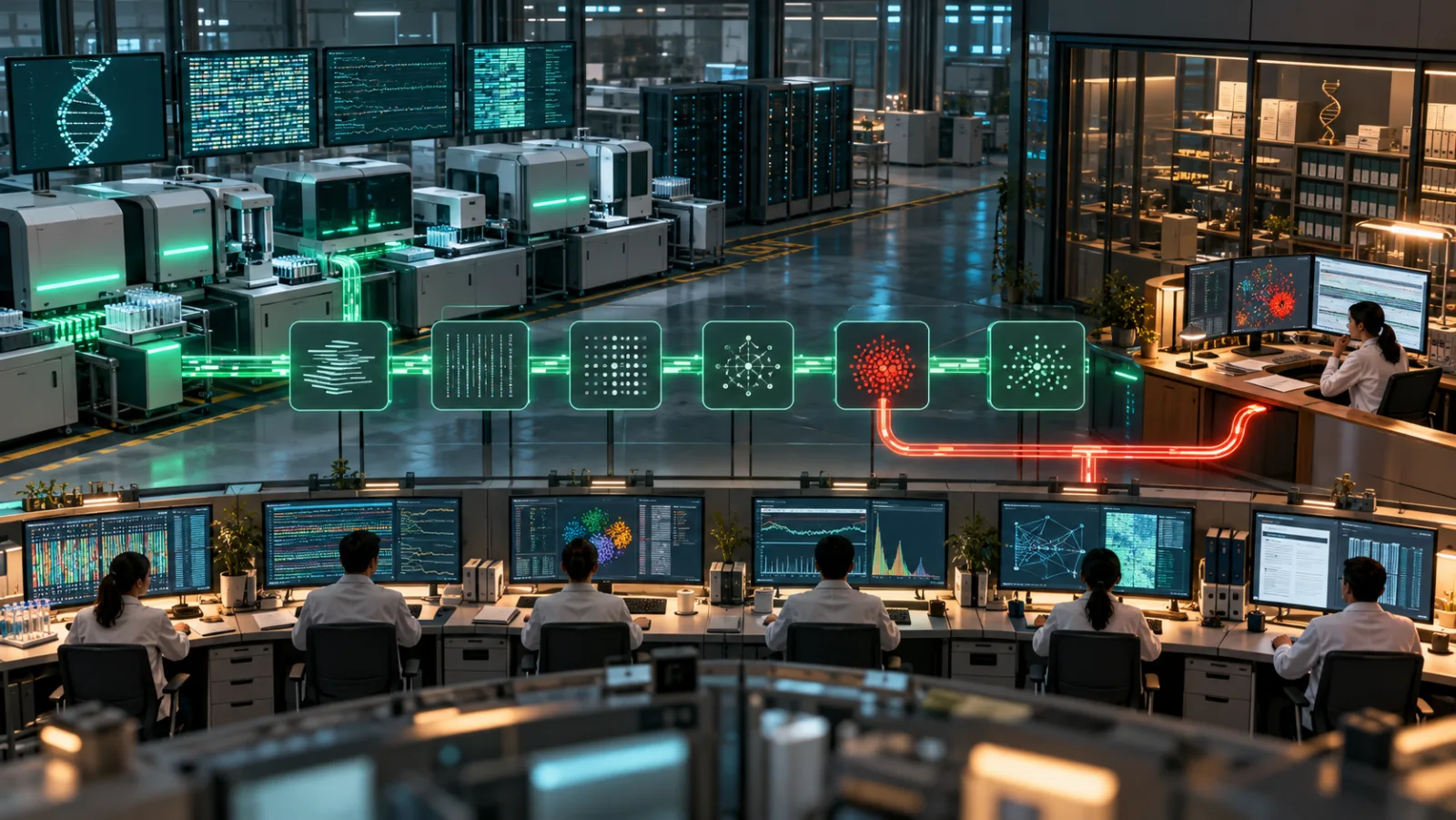
A DNA sequencing pipeline can finish every computational stage successfully and still produce results that warrant investigation. BaseCamp1 illustrates this problem with a scenario in which individual processing metrics appear acceptable, yet their combined results show an unusually high rate of reported genetic differences. Completing the workflow does not establish that its scientific conclusions are credible.
BaseCamp proposes six specialized AI agents to handle contextual decisions around established sequencing software, rather than replace its scientific computations. The agents assess quality, recommend analytical configurations and filtering choices, monitor inconsistencies across stages, and coordinate reporting. Recorded configurations and filtering histories support reproducibility, while human approval checkpoints and escalation of unresolved disagreements preserve expert authority. Local processing is intended to protect sensitive sequencing data.
This is a prototype architecture, not evidence of improved laboratory performance. The paper’s principal evaluation results and training-data counts are explicitly placeholders. Laboratories should treat BaseCamp as a design reference for supervised, auditable automation—not a validated replacement for expert judgment. Whether its decision architecture improves accuracy, efficiency, or anomaly detection remains unproven.
Every Stage Can Pass While the Result Remains Suspicious
A sequencing laboratory completes a processing run. Its quality checks appear acceptable, the reads align to a reference genome, and the analytical software produces the expected output files. Yet the number of reported genetic differences is unexpectedly high relative to comparable samples.
Nothing necessarily crashed. The problem appears only when results from several stages are considered together.
BaseCamp illustrates this situation through a representative anomaly scenario in Sections 5.5 and 6.4. The values are illustrative, but the operational problem is concrete: a workflow can execute correctly without establishing that its outputs are analytically credible.
Modern workflow engines such as Nextflow and Snakemake automate computational dependencies, job execution, and reproducibility. They do not independently resolve every contextual judgment surrounding a sequencing experiment. Someone still needs to decide whether sample quality supports downstream analysis, which analytical settings are appropriate, why particular results should be excluded, and whether an unusual pattern requires investigation.
Those decisions involve scientific context, laboratory conventions, and judgment across processing stages. Introducing an AI model creates another operational question: which decisions may it execute, which may it recommend, and which must remain under expert control?
Six Agents Manage Decisions Around Established Scientific Tools
BaseCamp separates scientific computation from contextual decision-making.
In conventional DNA sequencing analysis, software compares observed DNA data with a reference to identify candidate genetic differences. This identification process, known as variant calling, depends on established algorithms. Analysts subsequently apply filters to distinguish candidate differences worth retaining from results that fail specified quality criteria.
BaseCamp keeps these computations inside established bioinformatics software. Its language-model agents select configurations, interpret measurements, coordinate execution, and evaluate outputs.
The architecture distributes those responsibilities across six agents:
| Agent | Contextual responsibility |
|---|---|
| Sample intake and QC | Interpret sample-quality metrics and recommend dispositions |
| Alignment | Select suitable references and alignment configurations |
| Variant calling | Configure callers, recommend filters, and document exclusions |
| Annotation and interpretation | Support annotation and variant prioritization |
| Pipeline monitoring and exception handling | Detect anomalous patterns across stages and recommend investigation |
| Reporting | Assemble results and their supporting decision records |
The distinction is operationally significant. A language model recommending a filtering threshold is not itself calculating which DNA variants exist. The scientific tool performs that calculation using the selected configuration.
For these agents to work together, they need controlled access to existing tools and structured information from earlier stages. BaseCamp uses the Model Context Protocol (MCP) to connect agent workflows with bioinformatics services. The implementation also describes the OpenAI Agents SDK, Ollama for locally served models, and LM Studio for human orchestration.
The architecture permits targeted intervention and potentially selective re-execution of affected stages. It does not establish that such interventions consistently reduce end-to-end processing time.
Decision Records Make Agentic Automation Inspectable
Automating a configuration choice creates a reproducibility problem if the system records only the final result.
Consider variant filtering. A candidate genetic difference excluded by a threshold may disappear from downstream analysis. If the laboratory retains only the resulting variant list, a reviewer cannot necessarily reconstruct what was removed or why.
BaseCamp proposes an explicit filtering ledger that records applied thresholds, their justifications, and the numbers of affected variants. Alongside tool parameters, software versions, model versions, and adapter revisions, these records are intended to make the decision history inspectable.
This goes beyond asking a model to explain its recommendation. An explanation can describe an intended decision; an execution record establishes what configuration was actually used.
The reasoning architecture also combines multiple domain-specialized language models, adapted through parameter-efficient fine-tuning, with a central GPT-OSS reasoning model. The central model compares and synthesizes their recommendations. Consequential disagreements that remain unresolved are recorded and escalated to human operators.
Human approval checkpoints retain expert authority over critical transitions, disputed settings, and report release.
These controls define how responsibility is allocated. Agents may prepare and recommend routine actions, but permission to execute consequential changes remains a separate decision.
Local model hosting is intended to keep sequencing data inside institutional infrastructure. That deployment choice addresses data-movement concerns, although it does not independently establish the security of every tool integration.
Cross-Stage Monitoring Checks Analytical Plausibility
The monitoring agent extends supervision beyond conventional execution failures.
Its proposed inputs include sequencing coverage, alignment statistics, variant-call rates, and historical distributions from comparable runs. A single measurement might fall within an acceptable range while its relationship with other measurements is unusual.
For example, acceptable alignment quality combined with an unexpectedly elevated variant-call rate could justify investigating sample contamination, reference suitability, or inappropriate analysis settings. The pattern is evidence of a possible inconsistency, not proof of a particular cause.
BaseCamp’s monitoring design also covers coverage shortfalls, contamination or index hopping, batch effects, and other anomalies. The intended response is to surface a metric-grounded alert, suggest possible explanations, and direct consequential decisions to an operator.
For a laboratory quality-assurance team, the potential benefit is earlier investigation of suspicious analytical outcomes that ordinary job-status monitoring may miss. Whether the system actually improves detection speed or accuracy remains an empirical question.
The Prototype Demonstrates Behaviors, Not Validated Performance
The paper describes prototype workflows and evaluation designs for two agents: Variant Calling and Pipeline Monitoring and Exception Handling.
Their reported numerical results require unusually careful interpretation.
| Evidence | Reported example | What it establishes |
|---|---|---|
| Variant-calling evaluation, Table 4 | 96.2% caller agreement and 99.1% call-set concordance with expert configuration | Intended expert-concordance measures; all values are placeholders |
| Monitoring evaluation, Table 5 | Overall recall of 0.88 and precision of 0.85 | Intended anomaly-detection measures; all values are placeholders |
| Fine-tuning corpus, Table 2 | 4,450 total records, including 420 held-out runs | Illustrative corpus composition; all counts are placeholders |
| Fine-tuning configuration, Table 3 | Model, adapter, training, and resource settings | Implementation description; several hyperparameters and resource measurements are placeholders |
Figure 8 likewise presents placeholder results. Table 1 is an author-defined comparison with related systems, not an independent empirical benchmark.
These components serve different purposes. Tables 4 and 5 outline the principal evaluations; Tables 2 and 3 describe implementation inputs and settings. None constitutes a controlled architectural ablation or validated robustness test.
Even with verified numbers, agreement with expert configurations would not establish superior scientific accuracy. A model could faithfully reproduce a laboratory’s established conventions, including imperfect ones.
The paper has not isolated performance on cases requiring departures from laboratory defaults. Nor does it demonstrate that combining several specialized models outperforms one suitably adapted model.
Independent genomic truth-set benchmarking, controlled component comparisons, prospective evaluation, and cross-laboratory validation remain outstanding. The paper also provides insufficient detail to establish the reliability of its reported human assessments.
Consequently, the prototype supports discussion of how an accountable decision layer could operate, while the magnitude of any accuracy, labor, or detection-latency improvement is unknown.
Deployment Should Begin With Bounded Decision Authority
For genomics laboratories considering an AI-assisted workflow, Cognaptus draws a practical inference from the architecture: modernization need not begin by replacing existing analytical software.
A controlled pilot could retain the laboratory’s established workflow engine and scientific tools while running specialized agents in recommendation-only mode. Operators could then compare agent proposals against expert decisions, independent genomic truth sets, and documented laboratory policies.
Three questions deserve priority.
First, does the agent recognize when standard settings are inappropriate? Testing only agreement with historical configurations risks rewarding replication of defaults rather than contextual judgment.
Second, does monitoring identify consequential problems without overwhelming operators? Evaluation should measure false-alert burden, diagnostic quality, investigation time, and whether earlier intervention changes outcomes.
Third, can every consequential decision be reconstructed and authorized? Testing should cover filtering-ledger completeness, actual executed parameters, model revisions, approval records, and failures at tool boundaries.
Only after these conditions are measured should a laboratory consider granting agents greater execution authority. Costs, model latency, security controls, and performance across different sample types or laboratories would also need assessment.
BaseCamp’s more transferable contribution is its allocation of responsibilities: established software performs scientific computation, specialized agents interpret operational context, and human experts retain authority where consequences or uncertainty warrant intervention.
The unresolved question is whether that allocation produces measurable improvements under real laboratory conditions. BaseCamp offers a concrete architecture for testing the proposition, but the validation still needs to be done.
Reference
Cognaptus: Automate the Present, Incubate the Future.
-
Eranga Bandara and Xueping Liang and Asanga Gunaratna and Tharaka Hewa and Abdul Rahman and Peter Foytik and Safdar H. Bouk and Sachini Rajapakse and Isurunima Kularathna and Pramoda Karunarathna and Chalani Rajapakse and Ng Wee Keong and Kasun De Zoysa and Amin Hass and Wathsala Herath and Ross Gore and Ravi Mukkamala and Nihal Siriwardanagea and Gihan Siriwardanagea and Aruna Withanage and Nilaan Loganathan and Sachin Shetty (2026). BaseCamp — An Agentic AI Framework for Automating DNA Sequencing Data Pipelines. arXiv:2609.28557. https://arxiv.org/abs/2609.28557 ↩︎