TL;DR for operators
A robotics team may have a small, expensive set of demonstrations from its target robot and a much larger pool of cheaper human demonstrations of apparently similar tasks. The tempting move is to combine them. The paper’s randomized simulation results show why that decision needs more control: robot-only training averages 0.34 task success, while randomly mixed human data falls to 0.32. Selecting human demonstrations by relevance raises the average to 0.40, and adding sample-specific weighting raises it further to 0.42.
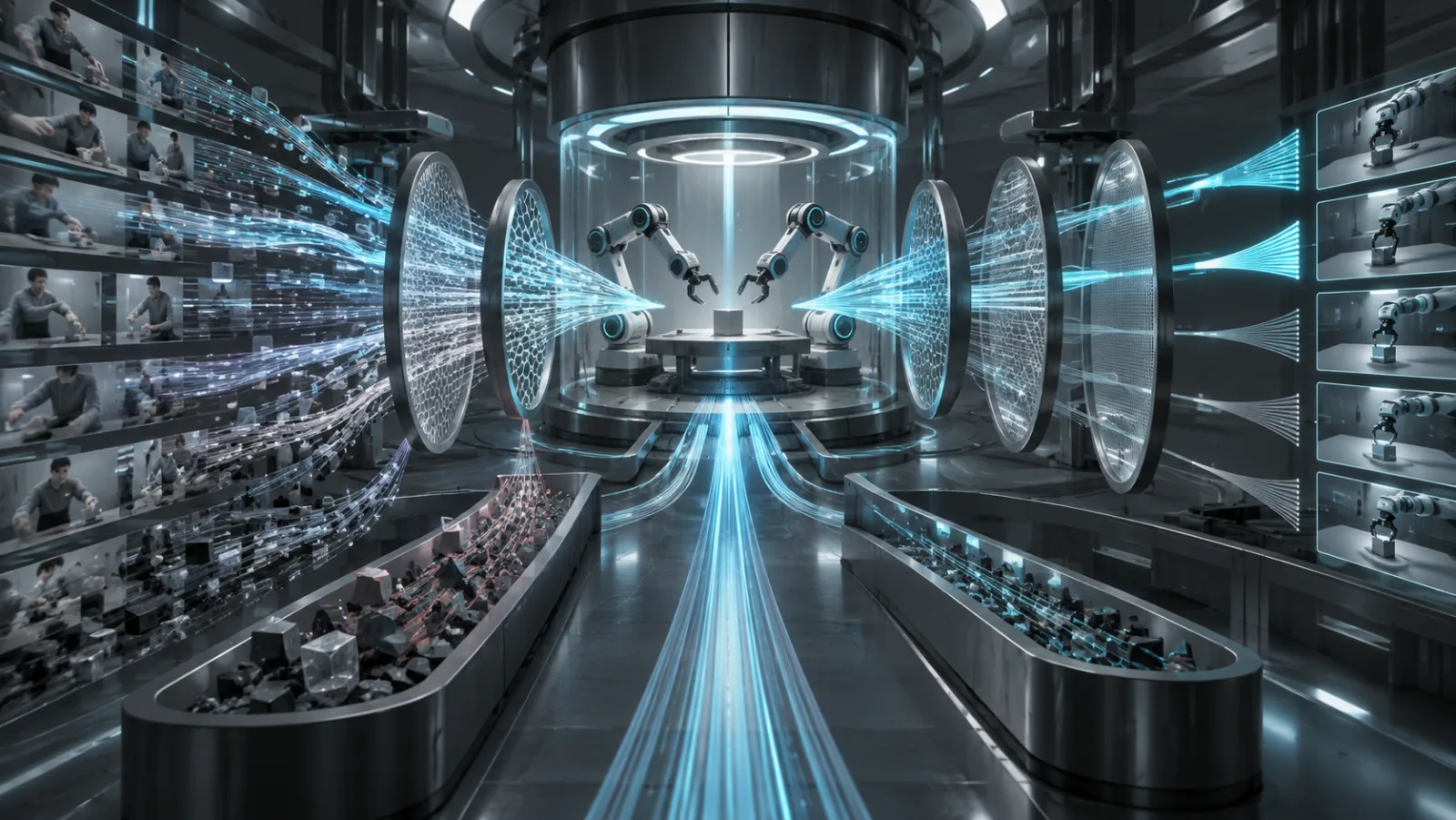
ReWeight1 treats human-data post-training as two allocation decisions. First, decide which human trajectories are behaviorally compatible with the target robot. Second, decide how strongly each retained human sample should influence optimization. In the evaluated settings, both steps contribute. For teams trying to stretch scarce robot demonstrations with cheaper human data, the implication is narrower than “use more human video”: estimate transferability before deciding what enters post-training and how much influence it receives.
More human demonstrations do not guarantee better robustness
The underlying business situation is straightforward. Robot demonstrations are costly because they require the target hardware, operators, setup time, and often repeated collection. Human egocentric video is much easier to obtain at scale. If both show the same task, adding the human data appears economically attractive.
The complication is embodiment. A person and a dual-arm robot can complete the same task using different motion patterns, timing, reachable configurations, and visual-action relationships. A task label such as “stack bowls” says what both agents are doing, but not whether a particular human trajectory provides useful supervision for the robot.
The simulation comparison makes that mismatch visible.
| Training strategy | Clean average success | Randomized average success |
|---|---|---|
| Robot only | 0.39 | 0.34 |
| Random human mixing | 0.44 | 0.32 |
| Retrieved human data, uniform weight | 0.52 | 0.40 |
| ReWeight | 0.57 | 0.42 |
Random mixing improves the clean average from 0.39 to 0.44, yet falls below robot-only training after randomization. Using all available human data is weaker still in the randomized comparison at 0.29.
This is the paper’s most consequential correction to the simple scaling intuition. Human demonstrations can contain transferable experience, but their value is conditional on compatibility with the target robot. Data volume and usable supervision are not the same quantity.
ReWeight separates selection from influence
The method first converts estimated human hand trajectories toward robot-compatible action space using LeVR plus a residual policy trained with PPO. It then learns a cross-embodiment representation that combines visual observations with future actions.
That representation supports a sequence-level comparison between human and robot demonstrations. Because corresponding moments need not occur at identical timestamps, the paper uses entropically regularized optimal transport to find soft alignments between the two sequences. The resulting discrepancy is intended to measure behavioral compatibility rather than simple frame-level visual resemblance.
Each candidate human demonstration is compared with same-task robot demonstrations. ReWeight averages its five smallest discrepancies and retrieves the lowest-scoring human trajectories until the selected human set matches the number of robot demonstrations.
Retrieval is only the first decision.
Inside the retained trajectories, individual timesteps can still vary in compatibility. ReWeight therefore computes sample-level discrepancies and converts them into continuous training weights. Robot samples keep their ordinary loss contribution; human samples contribute according to their estimated relevance, with a minimum weight controlled by $\alpha$.
Operationally, this changes the data-curation problem from one binary decision into two:
- Should this human trajectory enter post-training at all?
- If retained, how much should each part of it influence the model?
The experimental results suggest that the second decision is not redundant. In clean simulation, retrieved human demonstrations with uniform weight 1.0 average 0.52 success; sample-specific ReWeight reaches 0.57. Under randomized conditions the difference is smaller but remains positive: 0.40 versus 0.42.
Behavioral matching requires more than visual similarity
The representation ablations are mechanism tests, not separate evidence that the downstream VLA universally generalizes better.
Removing future-action information reduces average cross-embodiment stage accuracy from 0.93 to 0.83 and increases average keyframe distance from 4.1 to 10.0 frames. Removing the temporal mismatch penalty also degrades correspondence, lowering stage accuracy to 0.86 and increasing keyframe distance to 8.0 frames.
These results support the paper’s design choice: demonstrations should be compared using what the agent is progressing toward, not merely what the camera sees at a particular instant.
The $\alpha$ experiment serves a different purpose: sensitivity analysis. Across three selected tasks, $\alpha=0.5$ produces the highest tested average success at 0.68, compared with 0.62 when $\alpha=1.0$, which corresponds to leaving retrieved human samples effectively unweighted. This supports the usefulness of suppressing weaker matches, but it does not establish that 0.5 is generally optimal outside those tasks.
Physical experiments extend the result beyond simulation
On four dual-arm DoBot tasks, ReWeight averages 68.8% success under clean conditions. Robot-only training reaches 40.0%, while naive human-robot mixing reaches 55.0%.
The perturbation evaluation is more informative for the paper’s central claim because it tests whether the additional human supervision remains useful after visual conditions change. Across lighting changes and unseen distractors, ReWeight succeeds in 48 of 80 trials, or 60.0%. Robot-only training succeeds in 23 of 80 trials, or 28.8%, while naive mixing reaches 33 of 80, or 41.3%.
The paper also reports successful manipulation of bananas and grapes that appear in the human demonstrations but not in the robot teleoperation data. That is evidence that the human pool can contribute experience unavailable in the robot dataset within this setup. It should be treated as object-level generalization evidence from the evaluated tasks, not proof of open-ended transfer from arbitrary human video.
For robotics teams, human data becomes a curation problem
What the paper directly shows: within the tested pi_0.5 configurations, relevance-based retrieval outperforms indiscriminate human-data mixing, and sample-specific weighting adds further gains over retrieval with uniform human weights.
Cognaptus inference: teams adapting a VLA with scarce robot demonstrations should evaluate human-video pools as heterogeneous supervision rather than count them as uniformly valuable examples. A retrieval layer can concentrate post-training compute on trajectories that resemble robot behavior, while continuous weights can reduce the influence of partially compatible samples without discarding them entirely.
That changes where engineering effort may earn a return. Instead of treating robot-data collection and human-data acquisition as substitutes measured mainly by volume, teams can invest in estimating the transferability of cheaper human data relative to a small robot reference set.
It also suggests a useful evaluation discipline: test heterogeneous-data strategies under distribution shift, not only on nominal task conditions. In this paper, naive mixing looks more favorable in clean simulation than it does after randomization.
The evidence is promising but tightly scoped
ReWeight still depends on target-robot demonstrations. It does not eliminate robot data or infer relevance without a robot-domain reference set.
The reported results use one VLA backbone, pi_0.5; eight RoboTwin 2.0 simulation tasks; four physical tasks; EgoDex-derived human pools; and one dual-arm DoBot platform. The human demonstrations are task-relevant rather than drawn from an unrestricted, noisy video repository. The pipeline also adds substantial preprocessing: human-action estimation, retargeting, residual-policy refinement, representation training, optimal-transport matching, retrieval, and weighting.
Most importantly for interpreting the reported margins, the paper does not provide confidence intervals, standard deviations, or statistical significance tests for the main success-rate comparisons. The repeated trials make the comparisons informative within the benchmark, but the available evidence does not quantify uncertainty around those differences.
The practical conclusion is therefore specific. The paper provides strong comparative evidence that, in its tested settings, the value of human demonstrations depends on estimated compatibility with the target robot and that transferability varies even inside demonstrations already judged relevant. For teams attempting to stretch a limited robot dataset with human experience, that is a more defensible design principle than assuming every additional task-matched video deserves equal influence during post-training.
Cognaptus: Automate the Present, Incubate the Future.
-
Chenwei Wang and Dianye Huang and Match W. L. Ko and Chenjia Bai and Zhongliang Jiang (2026). ReWeight: Leveraging Human Data for VLA Post-Training via Demonstration Retrieval and Sample Weighting. arXiv:2609.13851. https://arxiv.org/abs/2609.13851 ↩︎