TL;DR for operators
A collaborative robot can execute its internal policy consistently and still behave unreliably from the human partner’s perspective. The reason is that the acceptable action may change with the person’s goal, gaze, gesture, language, movement, prior interaction, and surrounding context. Kwok and colleagues argue that reliability in human-robot collaboration should therefore be understood partly as maintaining sufficiently aligned interpretations between human and robot, rather than only as achieving predictable or robust model behaviour.1
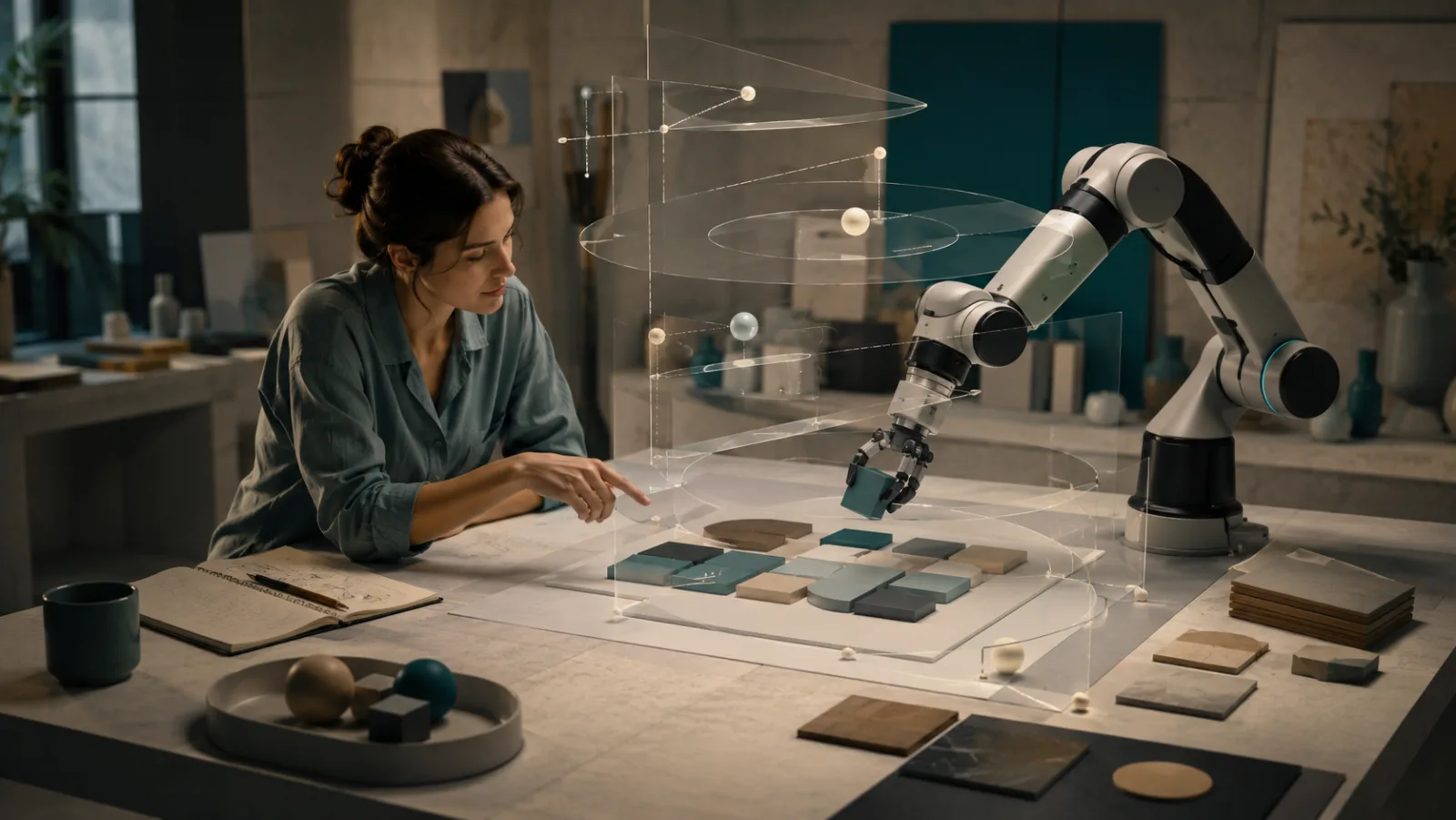
Their proposed architectural mechanism is an accessible, continually updated explicit world model: a representation of environmental state, task context, and human intentions that can function as common ground during collaboration. For product teams, the architectural implication is provisional but concrete: reliability engineering may need to monitor what the robot currently believes the situation means, not just what action it produces. The paper does not test this architecture experimentally, and it leaves unresolved how much social and multimodal context can be represented without making continuous updates too slow or costly.
A consistent robot can still be wrong for its partner
Consider an apparently simple instruction given to a collaborative robot. The words alone may permit several actions. The intended one could become clear only because the person is looking toward one object, gesturing toward another area, continuing a task started moments earlier, or reacting to a change in the environment.
A controller can behave predictably under those conditions and still choose an action that violates the person’s expectation. Nothing necessarily failed inside the controller. The disagreement can instead sit between two interpretations of the same situation.
That is the paper’s central reframing of reliability. In human-robot collaboration, reliability is not exhausted by asking whether the model behaves consistently under defined inputs. The relevant human has goals and expectations that change with interaction context. A robot that cannot maintain an adequately compatible interpretation may remain technically predictable while becoming operationally unreliable.
This shifts attention from only controlling model behaviour toward maintaining alignment over the state from which behaviour is chosen.
Shared understanding needs somewhere to exist
Collaboration requires the human and robot to act from sufficiently compatible understandings of the task and environment. The paper connects this requirement to common ground: information and interpretations that support coordinated action between participants.
The proposed explicit world model gives that shared understanding an architectural form. Rather than leaving the robot’s interpretation entirely implicit inside an end-to-end learned representation, the system would maintain an accessible representation that can be processed, communicated, revised, and used to guide action.
The key word is not simply explicit. It is updated. A static symbolic database would not solve the problem the authors identify. Human intentions change, objects move, tasks progress, misunderstandings become visible, and new cues arrive. The world model is intended to evolve during interaction.
Under the paper’s proposed mechanism, multimodal observations are grounded into this representation; interpretations of state and intent become explicit enough to support reasoning and communication; subsequent observations can then revise them. Reliability emerges from continual mutual updating that reduces ambiguity between robot behaviour and human expectation.
Gaze, gesture, and motion are part of the reliability problem
Once reliability is framed around aligned interpretations, language and visual recognition alone are insufficient descriptions of the input.
The paper emphasizes gaze, gestures, prosody, movement dynamics, language, contextual knowledge, joint attention, and legible behaviour as contributors to common-ground formation. These signals can complement one another because a human partner may communicate intention without encoding it completely in any single modality.
For interaction designers, Cognaptus infers a concrete consequence: multimodal sensing should not be evaluated only as additional perception capability. In collaborative systems, its value may lie in resolving ambiguities that would otherwise produce different human and robot interpretations of the task.
That inference has a boundary. The paper organizes prior research around this argument; it does not provide a new benchmark showing how much each modality improves collaborative reliability or which combination is sufficient for a particular deployment.
Explicit representation does not automatically make a robot reliable
The architectural proposal could be misread as an argument for returning to conventional symbolic AI. The paper’s position is more constrained.
Traditional symbolic world models have desirable properties for this problem: they can represent structured relationships explicitly and remain accessible to logical and cognitive processing. Their weakness is construction and maintenance. Heavy human handcrafting does not scale comfortably to complex, changing real-world environments.
Learned systems offer greater flexibility, but the paper also notes a grounding problem for LLM- and LMM-based approaches: models trained through mediated data remain disembodied relative to the physical world in which collaboration occurs.
The authors therefore identify neuro-symbolic approaches as a promising research direction. The attraction is the possibility of connecting sensorimotor experience and learned representations with structured knowledge and verifiable reasoning, allowing explicit models to develop rather than being specified entirely by hand.
This is a research agenda, not a demonstrated solution. The paper provides neither a formal specification for the proposed shared world model nor an implemented architecture whose reliability can be compared against end-to-end alternatives.
Product reliability may require inspecting interpretation, not only action
For collaborative-robot products, the strongest operational implication concerns observability.
If behaviour depends on a continuously changing interpretation of environment, task, and human intent, then recording only the final command or trajectory leaves part of the failure mechanism hidden. An inspectable shared state could expose the interpretation from which an action was selected.
Cognaptus sees four potential uses:
| Product decision | Potential role of explicit shared state | Boundary |
|---|---|---|
| Coordination | Expose task context and inferred intent that shape the robot’s next action | The paper does not establish which representation is sufficient |
| Debugging | Distinguish an execution failure from a mistaken interpretation of the situation | No validated diagnostic architecture is presented |
| Explanation and review | Make committed state and intention hypotheses available for human inspection | Accessibility does not itself establish correctness |
| Interaction design | Combine language, gaze, gesture, movement, and context when resolving ambiguity | Relative value of individual modalities is not quantified |
The affected users are robot operators, system integrators, safety or reliability reviewers, and product teams deciding how much internal state must remain observable during human-facing operation. The relevant condition is close collaboration under changing or ambiguous context. This argument should not be generalized automatically to autonomous systems where human expectations are not part of the immediate control loop.
The unresolved engineering problem is how much world model can run in the loop
The proposal creates a difficult implementation constraint. A shared representation must be rich enough to capture social and multimodal context, yet lightweight enough to change as the interaction changes.
More detail can improve the representation of intentions, relationships, environmental state, and interaction history. But each additional structure may increase sensing requirements, inference work, synchronization complexity, and update latency. A representation that cannot remain current during interaction undermines the reason for maintaining it.
The paper identifies this real-time-versus-richness tradeoff but does not resolve it. Nor does it provide a new experiment, benchmark, or quantitative comparison demonstrating that an explicit-world-model architecture produces higher reliability than competing designs.
That places the work at the architectural-question stage. It provides a coherent target for future systems and evaluation: not simply whether a robot succeeds, but whether the human and robot maintain a sufficiently aligned and revisable representation while acting together.
Reliability becomes a property of the interaction
The paper does not diminish the value of predictable controllers, robustness testing, or formal verification. Its narrower argument is that these properties do not completely characterize reliability when acceptable behaviour is determined jointly by a machine, a human, and a changing situation.
If that framing holds, collaborative-robot architecture needs another observable object: the robot’s current interpretation of the shared task world and the human intentions within it.
Whether explicit world models can provide that object without becoming rigid, expensive, or stale remains unanswered. But the paper identifies a precise gap in how reliability is commonly framed. A robot can execute exactly as designed while acting on an interpretation its human partner does not share.
Cognaptus: Automate the Present, Incubate the Future.
-
Kenneth Kwok and Basura Fernando and Qianli Xu and Vigneshwaran Subbaraju and Dongkyu Choi and Boon Kiat Quek (2026). Explicit World Models for Reliable Human-Robot Collaboration. arXiv:2601.01705. https://arxiv.org/abs/2601.01705 ↩︎