TL;DR for operators
A safety team may need to conceal workers before video leaves a trusted environment, yet hiding appearance can also remove the geometry needed to detect whether someone is beneath a suspended load. SynthSite tests that conflict directly.1 Across 55 synthetic clips, cartooning produced the highest F2 against human safe/unsafe labels at 0.767, while Canny-edge produced the highest F2 for reproducing the raw-video pipeline at 0.964.
Those are two different objectives. A transformation can preserve an existing model’s behavior without best preserving the underlying safety judgment. The benchmark also shows that obfuscation often damages utility by making workers disappear from detection: worker retention ranged from 88.9% with cartooning to 41.4% with blur, while localization drift for workers that remained detectable stayed between 1.35% and 2.17%.
For organizations working with sensitive surveillance video, the operational implication is to evaluate privacy transformations as part of the sensing pipeline. Measure whether task-relevant structure survives, compare against human-grounded labels rather than only baseline outputs, and keep the trust boundary explicit. The paper does not establish that any transformation provides sufficient privacy, nor that the resulting detector is ready for real construction sites.
Hiding appearance can remove the evidence the safety task needs
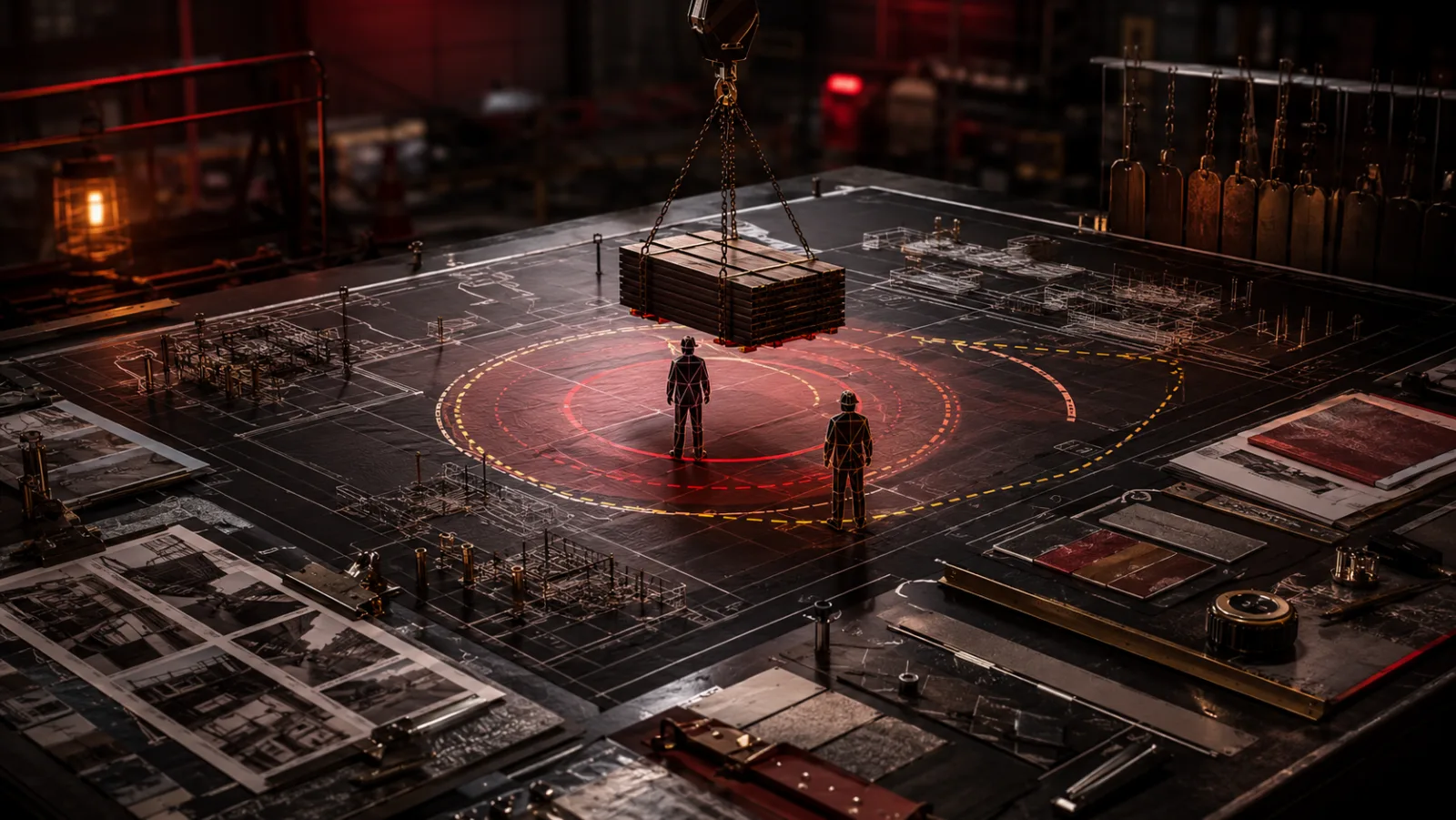
Detecting a worker and detecting a suspended load are not enough. The safety judgment depends on their relationship: whether the load is actually elevated, whether a worker lies inside an estimated fall zone, and whether that condition persists through time.
This makes anonymization unusually consequential. A face can disappear while the task still works. A body silhouette, worker footpoint, or spatial extent disappearing may break the geometric chain that produces the hazard decision.
The paper’s lightweight evaluation pipeline makes this dependence explicit. It detects workers and loads, uses nearby worker feet as a ground proxy, estimates whether a load is suspended, constructs a fall-zone approximation, and aggregates frame-level hazard evidence temporally. This is an evaluation proxy rather than a calibrated physical-risk model, but it provides a controlled way to ask which visual transformations preserve the information the task consumes.
SynthSite supplies 55 synthetic clips for that test: 28 safe and 27 unsafe, each lasting 5–10 seconds. Two annotators independently labeled every clip under a rubric requiring a visible suspended load and a worker within its fall zone for at least one second, with a third annotator resolving disagreements.
The main failure mode is lost workers, not wildly displaced workers
The paired benchmark applies four whole-body transformations using shared segmentation masks: Canny-edge, cartooning, pixelation, and blur. Because the masks are held fixed, the comparison is aimed at the transformation itself rather than differences in segmentation.
The results point to detectability as the main utility bottleneck.
| Condition | Worker retention | Worker jitter | Human-label F2 |
|---|---|---|---|
| Canny-edge | 80.2% | 2.17% | 0.742 |
| Cartooning | 88.9% | 1.35% | 0.767 |
| Pixelation | 63.1% | 1.82% | 0.762 |
| Blur | 41.4% | 1.44% | 0.671 |
Blur does not mainly fail because surviving worker boxes move dramatically. It fails because far fewer workers survive detection at all. Cartooning preserves almost twice the worker retention of blur while also producing the best human-label F2 in this benchmark.
That supports a narrower mechanism than “less distortion is better.” The task does not require photorealistic worker texture, but it does require stable body extent and geometry. Structure-preserving transformations can therefore suppress appearance while retaining enough shape for relational reasoning.
There is a second effect worth noticing. Load retention also changed—from 86.8% under pixelation to 77.2% under blur—even though the load itself was not obfuscated. Altering workers can perturb detection elsewhere in the scene. Privacy transformations are therefore not necessarily local in their downstream consequences.
Matching the raw pipeline is not the same as preserving the safety judgment
One evaluation question asks whether transformed video causes the existing pipeline to change its decisions. On that measure, Canny-edge performs best, with a raw-reference F2 of 0.964, narrowly ahead of cartooning at 0.963.
A different question asks whether those decisions agree with the adjudicated human safe/unsafe labels. Here the ranking changes: cartooning reaches 0.767, raw video 0.757, pixelation 0.762, Canny-edge 0.742, and blur 0.671.
The cartooning-versus-raw difference is small, and the source package reports no statistical uncertainty or significance testing. The useful result is therefore not that cartooning has been proven superior to raw video. It is that baseline consistency and human-grounded correctness produce different rankings.
Appendix precision-recall results make the mechanism clearer. Raw, Canny-edge, cartooning, and pixelation all achieve 0.852 recall against human labels. Their F2 differences arise mainly from precision: cartooning reaches 0.548, compared with 0.523 for raw and 0.489 for Canny-edge. Blur is the exception, with recall falling to 0.741 as well as low precision.
For benchmark governance, this changes what needs to be optimized. If an anonymization layer is scored only by how faithfully it reproduces the unmodified model, it can inherit that model’s errors as part of the target. Human-grounded task labels provide a separate reference point.
The trust boundary is as important as the obfuscation method
SynthSite’s second contribution concerns how sensitive source material enters a synthetic-data workflow.
Raw construction footage remains inside a trusted environment. A locally run vision-language model produces approved textual intermediaries; external image and video generators then operate on those intermediaries rather than receiving the source footage. The paper also demonstrates an internal-generation branch by LoRA-adapting a locally deployable video model using eight curated, shareable synthetic videos.
For an organization with sensitive CCTV, the architecture suggests a practical separation of responsibilities:
Paper evidence: raw visual data can remain local while approved semantic representations cross the boundary and support synthetic generation.
Cognaptus inference: security and data-governance teams can make the intermediate representation itself an auditable interface—controlling what visual information may leave the protected environment rather than relying only on downstream redaction.
Unresolved uncertainty: the study does not test whether those intermediaries leak identity, attributes, site information, or other sensitive facts. “Privacy-aware” describes the workflow architecture here; it is not a formal privacy guarantee.
What teams can use now—and what still needs validation
For safety-analytics teams building rare-event test sets, SynthSite supports three concrete practices.
First, synthetic generation can provide controlled coverage for hazardous situations that are scarce, unsafe to stage, or difficult to release from operating sites. The paper’s own generation process required substantial curation—roughly half of candidate clips were discarded for severe synthesis failures—so synthetic data does not remove quality-control work.
Second, select obfuscation methods by the information required by the downstream task. For worker-under-suspended-load detection, coarse body structure and worker-load geometry appear more valuable than photorealistic appearance. That conclusion should not automatically carry over to PPE detection or other tasks that depend on small, appearance-sensitive details.
Third, evaluate transformed data against more than the existing model. Retention, localization stability, baseline consistency, and human-label accuracy answer different questions and together expose failures that one aggregate score can hide.
The boundary is equally concrete. SynthSite contains 55 synthetic clips, evaluates only one parameterization of each obfuscation family, directly measures utility rather than privacy risk, and includes no real-CCTV deployment test. Its hazard pipeline is also a monocular 2D approximation vulnerable to occlusion, perspective, small workers, load mislocalization, and depth ambiguity.
The practical contribution is therefore an evaluation design, not a deployment certificate. Before a site operator relies on this approach for live safety monitoring, the open work includes real-camera validation, stronger suspended-load detection, depth-aware geometry, privacy-risk measurement, and broader testing across transformation strengths.
SynthSite’s most transferable lesson is not that cartooning wins. It is that a privacy transformation changes what the downstream system can perceive. Once that happens, preserving the old model’s answers is only one test. The harder requirement is preserving the evidence needed to make the right safety judgment.
Cognaptus: Automate the Present, Incubate the Future.
-
Anshu Singh and Alejandro Seif (2026). Privacy-Aware Synthetic Video Benchmarking and Relational Evaluation for Worker-Under-Suspended-Load Detection. arXiv:2607.16351. https://arxiv.org/abs/2607.16351 ↩︎