TL;DR for operators
The useful part of this paper is not that it makes label-free microscopy look like H&E. That is the easy headline, and also the easiest way to misunderstand the work.
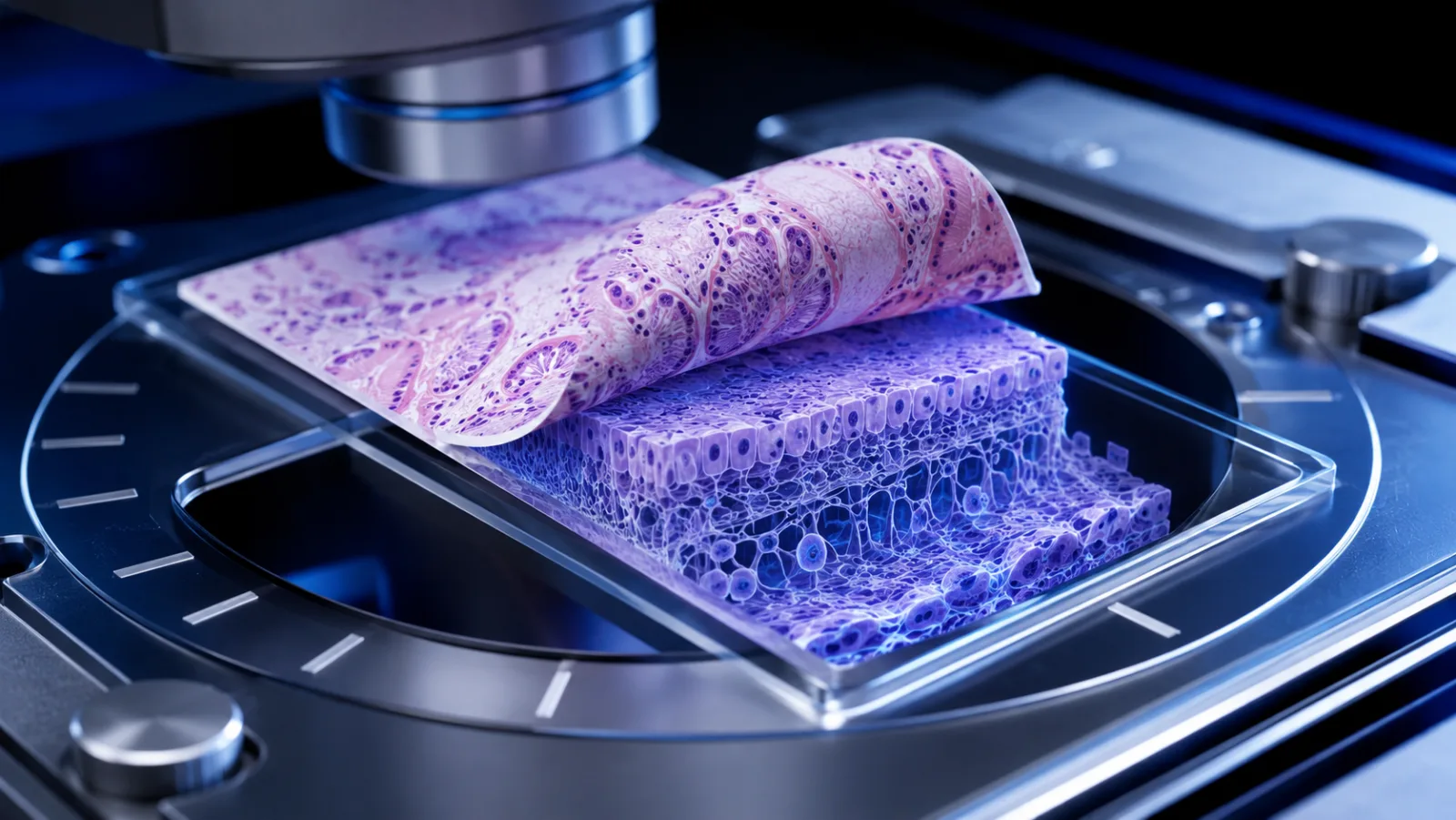
The paper introduces HistoBIT3D, a dataset that pairs phase-contrast Back-illumination Interference Tomography, or BIT, with voxel-wise registered fluorescence-labelled nuclei in 3D tissue volumes.1 That matters because virtual staining has a basic governance problem: a generated image can look histological while quietly moving, deleting, or inventing cellular structure. In pathology, that is not a charming hallucination. It is the sort of thing that gets written up after the incident review.
The authors use HistoBIT3D to validate a virtual staining model that translates label-free BIT volumes into H&E-like images. Their model builds on a ViT-CycleGAN architecture, adds bidirectional multiscale content consistency to protect tissue geometry, and uses cross-domain style fusion to reuse learned H&E style features without requiring paired H&E images at inference. The reported results improve both perceptual image metrics and structural nuclear metrics: FID falls to 60.69, KID to 0.0417, 3D Dice rises to 0.594, HD95 falls to 4.04 µm, and mean nuclear volume lands close to fluorescence ground truth at 408.3 µm³ versus 405.6 µm³.
For business readers, the paper points toward a practical route for slide-free volumetric histology: faster tissue imaging, less destructive preparation, and potentially better 3D context than conventional 2D slicing. The near-term relevance is strongest for research workflows, computational pathology tooling, and instrumentation strategy. The clinical translation story is promising but not yet proven. The paper does not show diagnostic equivalence across diseases, institutions, stains, scanners, or pathologist decision tasks. It shows something narrower and more valuable than a demo: a way to start measuring whether a virtual stain preserves the anatomy it is pretending to display.
The problem is not making tissue look pink
Histology has a familiar business bottleneck. Tissue is collected, processed, sectioned, stained, imaged, interpreted, stored, and sometimes reprocessed when the first view was not enough. The workflow is powerful, standardised, and deeply embedded. It is also slow, physically destructive, and fundamentally 2D.
The 2D part is not a trivial inconvenience. A tissue slice is a thin view through a three-dimensional object. Tumour boundaries, glandular organisation, vascular structure, and cellular neighbourhoods do not politely arrange themselves on a single plane for the comfort of the microscope. Traditional pathology works because it has accumulated a vast interpretive discipline around these slices. But the tissue itself remains volumetric. Biology has not been waiting for the glass slide to catch up.
That is why 3D pathology is attractive. It promises richer structural context and fewer compromises imposed by sectioning. The catch is that many 3D histopathology methods still require difficult preparation, staining, clearing, or specialised workflows. BIT sits in the alternative camp: a label-free phase microscopy technology for rapid, non-destructive volumetric imaging of unprocessed tissue.
The technical obstacle is that BIT does not look like H&E. It measures phase contrast arising from refractive index gradients. H&E staining reflects chemical and molecular stain interactions. Those are not the same visual language. A pathologist trained on H&E is not automatically given an interpretable diagnostic view just because a microscope produced a beautiful phase volume.
So the obvious AI move is image translation: take BIT, generate H&E-like imagery, and enjoy the slide-free future. Naturally, this is where the trouble starts.
A virtual stain can be visually plausible and structurally untrustworthy. It can have the right shade of nuclear blue, the right pink cytoplasm, the right general texture, and still fail the only question that matters operationally: did it preserve the tissue content? A fake H&E image that wins a beauty contest but loses nuclei is not a diagnostic aid. It is a very elegant liability.
This paper’s contribution is built around that distinction.
The paper’s first real contribution is the measuring stick
The accepted plan for this article puts evidence first, and that is the right frame. The paper’s main strategic move is not the generator architecture. It is the validation setup that makes the generator worth discussing.
HistoBIT3D combines BIT volumes with voxel-wise paired fluorescence imaging of nuclei and cytoplasmic structures, plus unpaired 2D FFPE H&E images used as the target style domain. The paired BIT–fluorescence component is crucial because it gives the authors a way to ask whether virtual H&E output preserves actual nuclear distributions in 3D. Without that, the evaluation would lean heavily on perceptual metrics such as FID and KID, which may tell us whether generated images resemble a target distribution but not whether nuclei stayed where biology put them.
The dataset includes paired BIT–nuclear fluorescence duodenum volumes with corresponding unpaired 2D H&E, additional 3D BIT-only duodenum datasets covering crypts and muscularis with matched 2D H&E, and a 2D normal and cancer kidney dataset for cross-tissue generalisation. Each subset contains approximately 5,000 images of 512 × 512 pixels. Volumetric stacks span 30–50 µm.
That sounds like a dataset detail. It is actually the assurance layer.
Most virtual staining systems face a painful evaluation gap. Supervised methods need precisely aligned input-target image pairs, which are hard to obtain because tissue can degrade, staining can vary, and hardware alignment is unforgiving. Unsupervised methods avoid paired H&E requirements, but then have an awkward validation problem: if the target H&E is unpaired, how do we know the generated image preserved the source tissue? The model may be translating, or it may be improvising in a medically convincing accent.
HistoBIT3D sidesteps part of that trap by using fluorescence nuclei as a structural reference. It does not create paired H&E ground truth. Instead, it creates a way to validate whether generated H&E-like volumes contain nuclear structures consistent with registered fluorescence. That is narrower than full diagnostic truth, but it is much better than staring at a pink image and nodding thoughtfully.
What the evidence is trying to prove
The paper uses a compact experimental design. It is worth separating the evidence types, because not every figure is doing the same job.
| Paper component | Likely purpose | What it supports | What it does not prove |
|---|---|---|---|
| Figure 1: pipeline overview | Implementation and evaluation framing | Shows the workflow from BIT acquisition to virtual H&E generation and 3D nuclei comparison | Does not itself validate clinical performance |
| Figure 2: model architecture | Mechanism explanation | Shows how multiscale content consistency and AdaIN style injection fit into the generator | Does not prove each component is necessary without ablation |
| Figure 3, rows 1–2 | Main qualitative evidence | Compares generated H&E appearance and zero-shot Cellpose segmentation against fluorescence nuclei | Does not establish pathologist diagnostic equivalence |
| Figure 3, rows 3–4 | Exploratory extension / qualitative diversity | Shows virtual staining examples across duodenum, normal kidney, and tumour kidney samples | Does not provide a full cross-tissue robustness benchmark |
| Table 1: SOTA comparison | Main quantitative comparison with prior work | Compares realism and 3D fidelity against CycleGAN, STABLE, CycleDiffusion, and UVCGANv2 | Does not show multi-site, multi-disease clinical generalisation |
| Table 1: Base → Base+Style → Full model | Ablation | Estimates the contribution of style fusion and multiscale consistency | Does not fully isolate every hyperparameter or architecture choice |
This is not a huge experimental suite. It is a short paper with one central quantitative table. But the table is doing more than a conventional “our model beats baselines” ritual. It combines two evaluation regimes: image realism and structural preservation. That pairing is the paper’s main business-relevant idea.
The realism metrics, FID and KID, ask whether the generated H&E-like images resemble the target H&E distribution. Lower is better. The structural metrics ask whether nuclear content survives translation. Dice measures overlap between segmented nuclear volumes; higher is better. HD95 measures a robust boundary-distance error; lower is better. Mean per-instance nuclear volume checks whether generated nuclear morphology is in the right neighbourhood compared with fluorescence ground truth.
The key is that no single metric is enough. FID and KID can reward visual style while ignoring biological fidelity. Dice and HD95 can reward structural preservation while saying less about whether the output looks like something a downstream histology tool would recognise. The paper’s evaluation works because it refuses to let either side declare victory alone.
The model protects content before it decorates style
The model is a ViT-CycleGAN framework based on UVCGANv2. That means it uses an unsupervised image-to-image translation setup with generators moving between BIT and H&E domains, but with a vision transformer generator architecture that can model longer-range spatial relationships than a purely local convolutional system.
This matters because virtual staining is not ordinary style transfer. In ordinary consumer style transfer, if a building edge becomes slightly impressionistic, nobody calls risk management. In computational pathology, the transformation is supposed to change appearance while preserving morphology. The model should learn “make this interpretable as H&E,” not “create something that belongs in the H&E distribution.”
The authors address this with two main mechanisms.
First, they introduce bidirectional multiscale content consistency. The model aligns intermediate generator features across both translation cycles at multiple scales: full resolution for fine nuclear boundaries and micro-texture, intermediate scales for mid-level morphology, and the transformer bottleneck for global tissue organisation. The bidirectional part matters because both BIT-to-H&E and H&E-to-BIT paths are constrained. The stop-gradient operator treats one branch as a fixed target during updates, which is intended to stabilise training rather than letting both branches chase each other into creative nonsense.
The practical interpretation is simple: the model is not only told to reconstruct an image after a cycle. It is asked to keep internal representations of tissue content aligned while it translates between domains.
Second, the model uses cross-domain style fusion. UVCGANv2 separates spatial content and style-like representations at the transformer bottleneck. The authors exploit that separation by extracting a running H&E style prototype from real H&E samples and injecting it into the BIT-to-H&E pathway using Adaptive Instance Normalization, or AdaIN. A style-statistics loss then encourages generated style tokens to match real H&E style statistics.
Here the operational point is also straightforward. The model needs H&E appearance, but H&E appearance must not hijack tissue geometry. Style fusion gives the generator a more stable target-domain aesthetic signal. Content consistency tells it not to pay for that aesthetic by rearranging the anatomy. One could call this disciplined borrowing. The model borrows the stain’s look, not the tissue’s facts.
The numbers show why the validation design matters
The central quantitative result is Table 1. The authors compare their model against CycleGAN, STABLE, CycleDiffusion, and UVCGANv2, then include an ablation from the UVCGANv2 base model to Base+Style and the full model.
| Method | FID ↓ | KID ↓ | 3D Dice ↑ | Nuclear volume, µm³ | HD95, µm ↓ |
|---|---|---|---|---|---|
| CycleGAN | 136.01 | 0.1556 | 0.360 | 377.2 | 5.59 |
| STABLE | 86.54 | 0.0684 | 0.418 | 331.9 | 5.38 |
| CycleDiffusion | 106.83 | 0.1138 | 0.359 | 233.2 | 4.77 |
| UVCGANv2 | 95.80 | 0.0821 | 0.515 | 386.7 | 4.67 |
| Base+Style | 62.45 | 0.0434 | 0.583 | 416.6 | 4.22 |
| Full model | 60.69 | 0.0417 | 0.594 | 408.3 | 4.04 |
| Fluorescence ground truth | — | — | — | 405.6 | — |
The strongest jump is not from the final multiscale component alone. It comes when style fusion is added to the UVCGANv2 base. FID improves from 95.80 to 62.45, KID from 0.0821 to 0.0434, Dice from 0.515 to 0.583, and HD95 from 4.67 µm to 4.22 µm. That suggests style fusion is not merely making images prettier. It appears to help generated H&E become more recognisable to zero-shot Cellpose while retaining better nuclear structure.
The full model then adds multiscale content consistency and improves further: FID to 60.69, KID to 0.0417, Dice to 0.594, HD95 to 4.04 µm, and nuclear volume to 408.3 µm³, very close to the fluorescence ground-truth mean of 405.6 µm³.
The magnitude is worth reading carefully. The final step from Base+Style to the full model is incremental but directionally consistent across all reported metrics. That is exactly what one would expect if the style mechanism solves a large part of the realism problem and multiscale content consistency adds structural tightening rather than a theatrical leap. Not every useful technical component arrives carrying fireworks. Some merely stop nuclei from drifting. In this domain, that is a respectable occupation.
Against prior methods, the full model performs best across all reported metrics. CycleGAN has the weakest realism metrics and low Dice. STABLE improves realism and Dice relative to CycleGAN but has a much lower mean nuclear volume than ground truth. CycleDiffusion has better HD95 than CycleGAN and STABLE but weak Dice and a nuclear volume far below ground truth. UVCGANv2 improves structural metrics but remains weaker on realism. The full model is strongest because it improves both sides of the evaluation: stain-like appearance and 3D nuclear structure.
That combined improvement is the point. A pathology-oriented image translation model that optimises only for visual realism risks becoming a cosmetic instrument. A model that preserves structure but does not produce recognisable H&E may fail to integrate with existing workflows. The paper is trying to satisfy both constraints at once.
Zero-shot Cellpose is a proxy, not a pathologist
One elegant feature of the evaluation is the use of zero-shot Cellpose segmentation. The authors segment nuclei in generated virtual H&E volumes and compare those segmentations with registered fluorescence-labelled nuclei. Because Cellpose is used without task-specific tuning, successful segmentation suggests that the generated images are realistic enough to be interpreted by a generalist cell segmentation model.
This is useful evidence, but it should not be oversold.
Zero-shot Cellpose is a proxy for computational recognisability of nuclei, not a substitute for clinical diagnosis. It says the virtual H&E images preserve enough nuclear signal for a known segmentation model to perform better than on baseline outputs. It does not say a pathologist would make the same diagnosis from the virtual images as from conventional H&E. It does not show diagnostic sensitivity, specificity, grading agreement, margin assessment, or inter-reader reliability. It is also not a regulatory validation protocol, despite being far more informative than “looks good to me.”
The evaluation volume used for 3D assessment is reported as 130 µm × 83 µm × 20 µm. That is valuable for measuring local nuclear structure, but still small relative to the scale of many real pathology questions. Tissue heterogeneity is not a polite statistical detail. It is often the case.
So the right interpretation is not “virtual H&E is clinically ready.” The right interpretation is: the paper provides a technically credible measurement bridge between label-free 3D imaging and structurally validated virtual staining. That bridge is useful precisely because it is not pretending to be the whole hospital.
The business value is workflow compression, not model novelty
For operators, the business question is not whether a ViT-CycleGAN with AdaIN style fusion is academically neat. It is whether the approach points toward a workflow with better speed, cost, throughput, or decision quality.
The plausible value chain looks like this:
Unprocessed tissue
        ↓
Rapid label-free 3D BIT imaging
        ↓
Virtual H&E generation
        ↓
3D structural validation against nuclei-informed benchmarks
        ↓
Research, triage, intraoperative support, or future diagnostic workflows
The paper directly supports the middle of this chain. It shows a way to translate BIT volumes into H&E-like imagery while checking nuclear preservation. Cognaptus’ business inference is that this could reduce dependence on labour-intensive physical sectioning and staining in settings where rapid volumetric insight has value.
The most immediate commercial relevance is probably not full diagnostic replacement. That would be the usual AI fantasy: leap directly from a promising model to a reimbursable clinical endpoint, pausing only to add a slide with a hockey-stick market forecast. The more realistic early value sits in research pathology, instrument differentiation, preclinical tissue analysis, intraoperative exploration, and computational pathology platforms that need 3D morphology without destroying the sample.
| Business use case | What the paper supports | What remains unproven |
|---|---|---|
| Research volumetric histology | Label-free BIT can be translated into H&E-like 3D views with measured nuclear fidelity | Performance across broader tissue types, protocols, and biological variability |
| Instrument differentiation | BIT gains a route to pathologist-familiar visualisation rather than remaining an unfamiliar phase modality | Whether users prefer or trust virtual H&E in real workflows |
| Intraoperative or rapid assessment | Non-destructive, stain-free imaging plus virtual staining suggests a faster workflow pathway | Turnaround time, operating room integration, diagnostic reliability, and regulatory approval |
| Computational pathology tooling | The dataset creates a benchmark for content preservation in virtual staining | Generalisation beyond the reported dataset and segmentation proxy |
| In-vivo imaging ambition | BIT’s label-free nature is directionally compatible with less invasive imaging | The paper does not demonstrate in-vivo clinical use |
The ROI argument, if one eventually exists, will not come from cheaper model training. It will come from compressing tissue preparation, reducing sample destruction, expanding volumetric context, and enabling downstream analysis earlier in the clinical or research process. The model is a means to make BIT outputs interpretable within an H&E-shaped mental model. The dataset is what makes that means auditable.
The paper quietly argues for a new validation standard
The misconception to remove is simple: a convincing virtual H&E image is not automatically useful. That belief survives because humans are bad at separating familiar appearance from factual reliability. Medicine is particularly vulnerable because visual expertise is real. When an image looks like the thing experts normally read, it is tempting to treat it as a member of that evidentiary family.
The paper’s better claim is that virtual staining should be evaluated as a structural preservation problem. The generated image must satisfy at least two conditions:
- It should resemble the target histology style enough to be interpretable by human or computational downstream systems.
- It should preserve the source tissue morphology closely enough that the generated appearance does not become synthetic evidence.
That second condition is where many virtual staining demos become uncomfortable. In unpaired translation, the model is not anchored to a paired H&E target. It learns from distributions. Distribution learning is powerful, but it is also perfectly capable of learning how H&E usually looks and applying that look in ways that smooth over rare, ambiguous, or diagnostically important structures.
This is why HistoBIT3D matters. By registering fluorescence nuclei to BIT volumes, the authors create a quantitative check against structural drift. It does not solve every validation problem, but it moves the conversation from perceptual plausibility toward measurable content fidelity. That is a governance upgrade.
For AI businesses in medical imaging, the larger lesson is transferable. Whenever a model transforms data into a more familiar representation, the validation target must include preservation of task-critical structure. In pathology, that may be nuclear morphology. In radiology, it may be lesion boundaries. In finance, it may be event timing and counterparty identity. In operations, it may be sequence constraints. The domain changes. The failure pattern does not.
The model is 2D translation stacked into 3D evidence
One technical boundary deserves attention: the model performs 2D-to-2D virtual staining of an axial stack, which enables a 3D volume downstream. It is not described as a fully 3D generative model that directly reasons over volumetric context during generation.
That distinction matters. Slice-wise translation can produce coherent-looking volume stacks, especially when the source data is well aligned and the model preserves local structure. But true 3D consistency remains a harder problem. Nuclear continuity, glandular geometry, and tissue boundaries are volumetric phenomena. A model that processes slices can still struggle with cross-slice coherence, depending on architecture and data.
The authors partially address this through the evaluation pipeline: they assemble 2D masks into a 3D volume using u-Segment3D and then compute 3D Dice, HD95, and nuclear volume metrics. That means the evidence is 3D at the evaluation stage, even if the translation itself is slice-wise.
For business deployment, this distinction affects risk. If a workflow relies on volumetric morphology, the system should be tested for volume-level consistency, not just per-slice plausibility. This paper takes a meaningful step by reporting 3D metrics. A production system would need more: larger volumes, more tissues, more scanning conditions, and task-specific performance endpoints.
The ablation says style is not merely cosmetic
The ablation is one of the more interesting parts of the paper because it complicates a lazy interpretation.
A reader might assume that “style fusion” improves only FID and KID while “content consistency” improves only Dice and HD95. The results are not that clean. Adding style fusion to the base UVCGANv2 improves both realism and structural metrics substantially. The full multiscale model then improves both categories again, but by a smaller margin.
There are several plausible readings. The most cautious is that better target-domain style makes nuclei more legible to Cellpose, improving segmentation metrics even if underlying geometry is mostly preserved by the base model. Another is that style and structure are less separable in practice than the architecture diagram suggests. A nucleus is not just a location; it is also a visual signal. If the generated stain fails to express that signal in a recognisable way, the structural content may be present but not usable.
This is important for product teams. In medical AI, “cosmetic” improvements are not always cosmetic. A better visual representation can improve downstream computational extraction and human interpretation. The reverse is also true: a beautiful representation can degrade the evidence if it changes structure. The useful question is not whether style matters. It is whether style is constrained by ground truth.
The paper’s full model earns attention because it uses style injection under structural discipline. That is the right order. First, do not corrupt the tissue. Then make it readable. Apparently this still needs to be said.
Where the result applies, and where it does not
The paper is strongest as a proof of concept for quantitatively validated 3D virtual staining from BIT. It is not a universal pathology platform.
The authors evaluate on specific HistoBIT3D subsets, including duodenum and kidney examples, and report a limited but meaningful set of realism and structural metrics. They also state future work areas: addressing contrast discrepancies between fluorescence and BIT, incorporating fluorescence-guided semi-supervision, and refining downstream segmentation with task-specific tuning.
Those future-work items are not ceremonial. They point to real boundaries.
First, BIT has shift-variant contrast: nuclei can appear dark or light depending on focal-plane position. The model addresses this partly through the three-channel input design—original, inverted, original—and through multiscale content consistency. But shift-variant contrast remains a core difficulty, not a solved footnote.
Second, fluorescence nuclei are a strong structural reference, but they are not full H&E ground truth. Hoechst-labelled nuclei give a credible anchor for nuclear distributions. They do not validate every histological feature, stain nuance, cytoplasmic pattern, stromal structure, artefact, or disease-specific morphology.
Third, the use of unpaired FFPE H&E as a style domain is practical, but it means the generated outputs inherit a learned H&E appearance distribution rather than a paired target for the same tissue. This is the point of the unsupervised setup, but also its governance risk.
Fourth, zero-shot segmentation is not clinical validation. A downstream model recognising nuclei is encouraging; a clinician making a correct decision under regulated conditions is a different threshold.
Finally, cross-tissue examples are promising but not the same as a systematic generalisation study. The paper includes normal kidney and tumour kidney samples qualitatively, but the main evidence remains much narrower than “works across pathology.”
These boundaries do not weaken the paper. They prevent it from being inflated into something it is not. A precise result is more useful than a heroic one with marketing fog attached.
What Cognaptus would watch next
The next useful experiments are not mysterious.
A stronger follow-up would test larger 3D volumes across more tissue types and pathological conditions, with explicit cross-slice consistency metrics. It would compare virtual H&E against conventional H&E in reader studies, not just segmentation proxies. It would test robustness across acquisition settings, staining references, institutions, and tissue preparation variability. It would also separate model performance on normal structure from performance on diagnostically difficult abnormal structure, because business risk tends to hide in the latter.
For productisation, the key question is whether the system can support a bounded workflow before it supports a full diagnostic claim. For example: research volumetric review, pre-screening, margin exploration, specimen triage, or computational feature extraction. A system can be commercially useful before it becomes a primary diagnostic instrument. The market often forgets this because “AI replaces the pathologist” is a cleaner headline than “AI improves a constrained pre-analytical workflow under audited structural metrics.” The second one is less cinematic. It is also more likely to survive procurement.
The paper’s real contribution is an assurance pattern:
Do not ask only:
"Does the generated image look like the target domain?"

Ask:
"Which biological structures must be preserved,
how are they independently measured,
and do improvements in realism preserve or damage them?"
That pattern is bigger than BIT and H&E. It is a template for any AI system that translates one representation into another. The output must be familiar enough to use and faithful enough to trust. In high-stakes domains, those are separate tests. Yes, inconvenient. Reality often is.
Conclusion: virtual staining needs evidence, not applause
This paper is a useful correction to a common AI habit. It refuses to treat visual plausibility as the endpoint. HistoBIT3D gives virtual staining a structural benchmark; the ViT-CycleGAN framework then uses multiscale content consistency and H&E style reuse to improve both appearance and nuclear fidelity. The reported results show a model that is better than strong baselines on FID, KID, 3D Dice, HD95, and nuclear volume alignment.
The business implication is not that hospitals should immediately replace H&E slides with generated volumes. That would be an impressive way to misunderstand the evidence. The better implication is that slide-free volumetric pathology needs validation infrastructure before it needs bigger claims. If BIT and similar modalities are to become operationally useful, they must produce interpretable outputs while preserving the biological structures that make interpretation meaningful.
Pretty pink images are easy to admire. Structurally faithful virtual histology is harder to build, harder to validate, and far more interesting.
Cognaptus: Automate the Present, Incubate the Future.
-
Anthony A. Song, Boyan Zhou, Mayank Golhar, Marisa Morakis, Alexander Baras, and Nicholas J. Durr, “Virtual 3D H&E Staining from Phase-contrast Back-illumination Interference Tomography,” arXiv:2605.22000v1, 21 May 2026, https://arxiv.org/abs/2605.22000. ↩︎