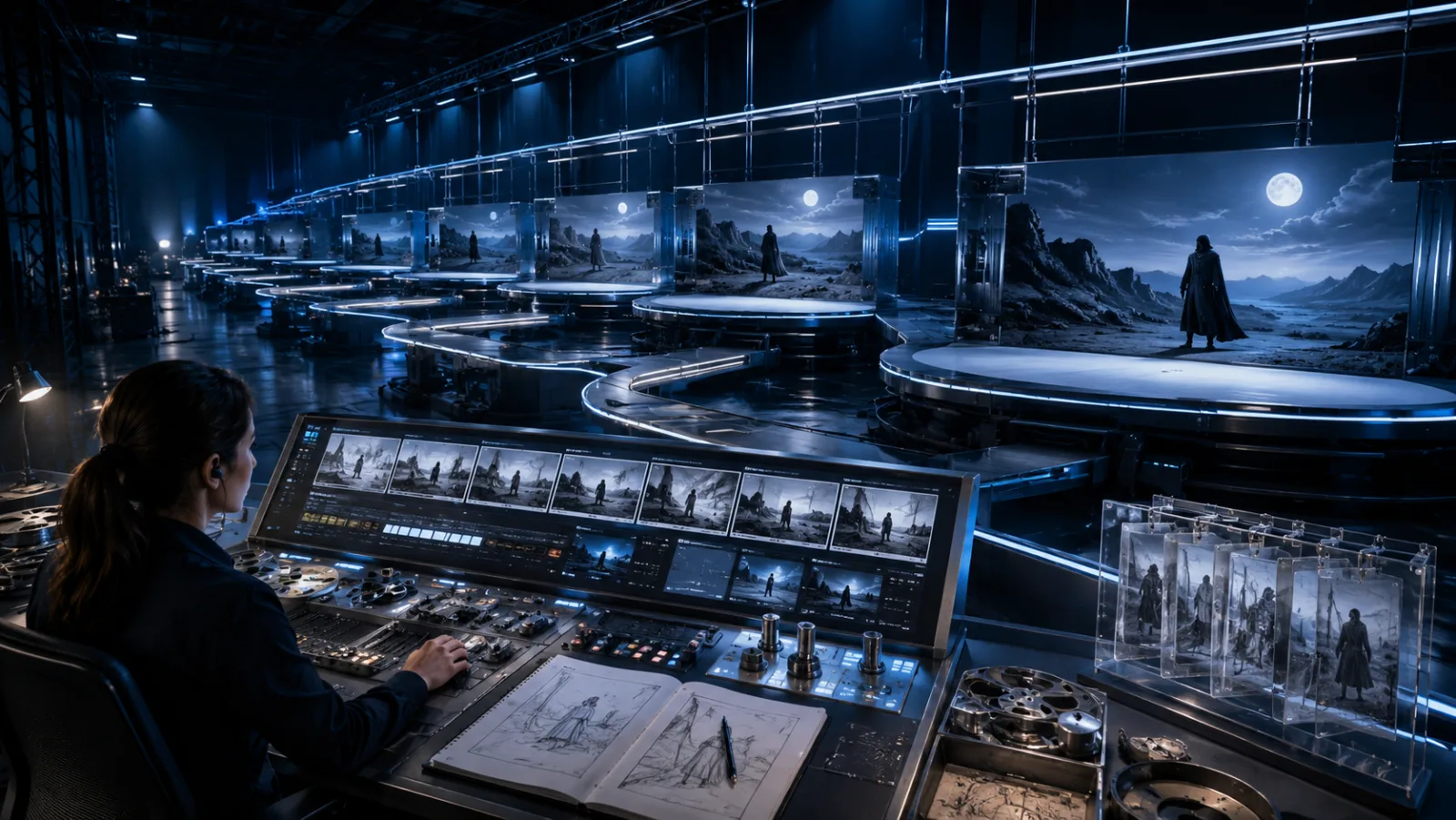
Storyboard, Not Slot Machine: Why AI Video Needs Control Infrastructure
Storyboard.
That is the easiest way to understand what SmartDirector is trying to bring into AI video generation. Not a better prompt box. Not a prettier demo reel. Not another mystical “cinematic” adjective sprinkled onto a text prompt like cheap paprika.
In normal production, a storyboard does two things at once. It specifies visual anchors — who appears, where they stand, what the camera sees — and it controls pacing — when the story moves, when it cuts, when the viewer should notice a change. Current video generation systems are reasonably good at producing attractive short clips, but they are still awkward when a user wants to say: start here, pass through this middle beat, end there, and do not turn my cat into a different cat halfway through the scene.
The paper behind SmartDirector frames this as multi-keyframe-conditioned cinematic video generation.1 The important word is not “cinematic.” That word has been overworked in AI demos and deserves a long vacation. The important word is “conditioned”: the user provides multiple keyframes, and the system must generate the video around them while preserving identity, motion continuity, camera logic, and narrative pacing.
The paper’s core contribution is not simply that it uses more keyframes. That would be the naive reading. The real contribution is that it explains why keyframe control is structurally difficult inside modern video generation pipelines, then designs around that difficulty.
The business lesson is therefore also structural: controllable AI video will not become production-ready just because models get larger or prompts get longer. It needs a control surface that matches how the model internally represents time.
The problem is not missing reference images; it is broken temporal representation
A reader might reasonably assume that multi-keyframe video generation should be straightforward. If image generation can follow reference images, why not insert a few keyframes into a video model and let the denoising process connect them?
The paper argues that this direct approach breaks against a less obvious technical detail: the causal structure of the temporal VAE.
Modern video generation systems often compress video into latent representations using a 3D VAE. In the setup described by the paper, the first frame is encoded independently, while later frames are encoded in groups with dependence on preceding frames. This is computationally useful, but it means a frame’s latent representation is not always an isolated object that can be replaced freely. Insert a keyframe latent at an arbitrary temporal position, and the model may be asked to reconcile a new visual anchor with a representation that was built under causal assumptions from previous frames.
That mismatch produces the failures users recognize immediately, even if they do not know the word “VAE”: discontinuity near the keyframe, unnatural jumps, copy-paste artifacts, identity drift, flicker, and pacing that feels like an intern edited the timeline at 3 a.m.
SmartDirector’s mechanism-first argument starts here. The control problem is not only semantic — “does the generated video follow the prompt?” It is representational — “does the inserted control signal enter the model at a position where the model can legally and smoothly use it?”
That distinction matters. A prompt interface can make users feel in control. A representation-aware architecture can actually give them some control. The two are occasionally related, but only on polite days.
SmartDirector turns keyframes into chunk boundaries
SmartDirector’s first stage, Director-Gen, generates a low-resolution video conditioned on provided keyframes. The important trick is the Multi-Chunk VAE strategy.
Instead of encoding a full video as one continuous latent sequence and then replacing arbitrary positions with keyframe latents, SmartDirector splits the video at keyframe positions. Each keyframe becomes the first frame of its own chunk. Because first frames are encoded independently in the causal VAE setup, each keyframe can enter the latent representation cleanly rather than contaminating or being contaminated by preceding latent context.
That alone would create another problem. If every chunk is treated too independently, the output risks looking like stitched mini-clips. The paper explicitly rejects the naive pairwise strategy: generate a clip between every adjacent keyframe, concatenate the clips, and hope the audience is forgiving. Hope is not a production architecture.
So SmartDirector processes the concatenated chunk tokens with a Diffusion Transformer using full spatio-temporal attention across chunks. The chunks are independently anchored, but not blind to one another. Each chunk can attend globally, preserving cross-shot context and narrative continuity.
A simplified view looks like this:
| Design choice | Mechanism | Operational consequence |
|---|---|---|
| Split video at keyframe positions | Each keyframe becomes the first frame of a chunk | Keyframes enter the VAE in a causally compatible position |
| Encode chunks independently | Prevents arbitrary latent replacement from violating temporal dependency | Reduces discontinuity and copy-paste artifacts near keyframes |
| Apply full spatio-temporal attention across chunks | Allows chunks to exchange global context | Preserves identity, layout, and narrative coherence across the whole video |
| Use MC-RoPE temporal indexing | Assigns fractional temporal positions at keyframe boundaries | Keeps positional encoding smooth instead of making chunk boundaries feel like hard resets |
This is why the accepted framing for the paper should be mechanism-first. A summary that says “SmartDirector uses multiple keyframes to control video” misses the engineering point. The paper’s claim is closer to: keyframe control works only when the model’s temporal compression, attention, and positional encoding agree about where those keyframes live.
MC-RoPE is the small detail that prevents the chunks from feeling chopped
Once the video is split into chunks, there is still a subtle timing problem. Diffusion Transformers use positional embeddings to understand where tokens sit in space and time. If the system assigns a single continuous timeline over all chunks, it may ignore the special status of keyframe boundaries. If it resets the temporal index for each chunk, it creates a discontinuity at every boundary.
SmartDirector introduces Multi-Chunk RoPE, or MC-RoPE, to handle this. The paper describes it as assigning fractional temporal indices to keyframe positions, preserving temporal smoothness across chunk boundaries. In the PDF formula, normal latent steps increment by 1, while keyframe positions use a smaller fractional increment.
This sounds like a minor coordinate-system choice. It is not.
For video generation, positional encoding is part of how the model “knows” whether motion should continue, pause, restart, or cut. If the coordinate system says the timeline has broken, the model may behave as if it has broken. MC-RoPE is therefore not decorative math; it is part of the control contract.
The broader lesson: in production AI systems, small representation choices often decide whether a user-facing feature behaves like a feature or like a casino lever with a nicer icon.
Director-SR uses keyframes as semantic anchors, not just sharper pixels
SmartDirector is a two-stage system. Director-Gen creates the conditioned video at low resolution, such as 480p. Director-SR then upsamples it to high definition, such as 1080p, using high-resolution keyframes as anchors.
The distinction between ordinary super-resolution and Director-SR is important. Conventional video super-resolution often treats the task as restoration: take low-resolution frames and make them sharper. SmartDirector’s authors argue that this is insufficient for generated video because the low-resolution first stage may contain semantic artifacts: distorted faces, broken text, or fine details that were never represented cleanly.
Director-SR therefore uses high-resolution keyframes not merely as visual examples, but as semantic references. In training, low-resolution latents are upsampled to match high-resolution latent dimensions; at keyframe positions, low-resolution latents are replaced with the corresponding high-resolution latents. The model then learns to map the low-resolution video toward the high-resolution target under keyframe guidance.
This matters commercially because most video users do not pay for “slightly better PSNR.” They care whether the person’s face remains recognizable, whether a product logo survives, whether text is readable, and whether the generated clip can be shown to a client without the small print turning into alien pasta.
Director-SR directly targets that production pain. It is less glamorous than saying “native 1080p generation,” but more honest. Native high-resolution generation is expensive. A two-stage pipeline is a compromise: generate cheaper first, then restore intelligently using the strongest available anchors.
The data pipeline makes narrative control learnable
SmartDirector also builds a data curation pipeline for cinematic video. This part is easy to underestimate because architecture tends to steal the attention. But the pipeline shows what the model must learn if it is supposed to handle multi-shot narratives instead of isolated pretty clips.
The paper describes three broad steps:
- Collect cinematic videos from publicly available sources and split them into single-shot clips.
- Aggregate consecutive shots that share scene and storyline into coherent multi-shot sequences using vision-language models.
- Generate structured captions that include global narrative, per-shot descriptions, camera motion, character appearance, active characters, and scene-level information.
This is not generic captioning. It is production-oriented annotation. The model is being trained not only on “a man in a room,” but on shot timing, camera motion, character continuity, and transitions. In other words, the data pipeline teaches the system the vocabulary of directed video.
For business readers, this is the quieter but durable part of the paper. If companies want controllable AI media generation, their data assets cannot be just piles of clips and loose captions. They need structured creative metadata: scenes, shots, identities, camera moves, visual anchors, and timing information.
The boring database field becomes the future editing handle. Terrible news for people who thought metadata was beneath them.
The main evidence compares control quality, not just visual prettiness
The experiments are best read as a layered evaluation, not as one scoreboard.
The paper compares SmartDirector mainly against Dreamina Multiframes, described as a representative closed-source system supporting multi-keyframe conditioning. The benchmark contains 250 single-shot and 250 multi-shot videos from movies, TV series, and animations, with durations from 3 to 15 seconds, rendered at 24 FPS and at least 1080p. The paper randomly samples keyframes as conditioning signals.
The comparison uses three kinds of evidence: FVD for distributional fidelity, Gemini-based semantic scoring across five dimensions, and a blind human study using pairwise Good/Same/Bad judgments.
| Evidence | Likely purpose | What it supports | What it does not prove |
|---|---|---|---|
| FVD comparison against Dreamina | Main quantitative evidence | SmartDirector’s generated videos are closer to real-video distribution under the benchmark setup | It does not isolate which component caused the gain |
| Gemini-based scoring | Main semantic evaluation | The outputs better satisfy instruction-following, narrative coherence, physical consistency, quality, and aesthetics | It depends on a model-based evaluator, so it should not be treated as a perfect human proxy |
| Human GSB study | Perceptual validation | Human raters prefer SmartDirector across identity, pacing, keyframe adherence, and overall quality | The study is pairwise against one main baseline, not a universal market test |
| Qualitative comparison | Error diagnosis and comparison with prior work | Dreamina examples show artifacts, identity drift, and flicker between keyframes | Qualitative examples are illustrative, not statistically exhaustive |
| Director-SR benchmark against SparkVSR | Module-specific evidence | The SR stage improves perceptual similarity and artifact restoration | It isolates SR performance rather than full end-to-end generation |
| Ablation study | Mechanism validation | Multi-Chunk design prevents direct-insertion drift and replication stutter | It is focused on specific variants, not every possible keyframe architecture |
The main table is striking. In the single-shot setting, FVD drops from 226.85 ± 3.44 for Dreamina to 41.12 ± 1.01 for SmartDirector. In the multi-shot setting, FVD drops from 251.83 ± 5.87 to 65.65 ± 2.46.
The semantic evaluation tells a more relevant story for the paper’s thesis. Single-shot average score improves from 83.87 to 91.30. Multi-shot average score improves from 59.32 to 88.48. The multi-shot gap is the more revealing one, because multi-shot video is where identity, pacing, scene transitions, and temporal continuity become genuinely difficult.
A model that looks decent for one shot can still fail when asked to preserve a story across cuts. SmartDirector’s larger multi-shot improvement is therefore not just “better video.” It is evidence that the architecture addresses the paper’s central difficulty: maintaining coherence when keyframes are distributed across a narrative sequence.
The human study shows where users actually feel the improvement
The human evaluation is particularly useful because it asks about dimensions that matter in production: identity consistency, narrative pacing, keyframe adherence, and overall quality.
Thirty participants evaluated 500 video pairs generated by SmartDirector and Dreamina. The paper reports a GSB score based on wins, losses, and ties:
The detailed appendix table makes the pattern clearer. Across all scenarios, SmartDirector is rated significantly or slightly better in 62.89% of overall-quality comparisons, with 16.32% neutral and 20.79% favoring Dreamina. In the multi-shot setting, the advantage becomes stronger: SmartDirector is preferred in 71.58% of overall-quality comparisons, with 11.58% neutral and 16.85% favoring Dreamina.
The multi-shot narrative pacing result is also important. SmartDirector is rated better in 65.82% of multi-shot narrative-pacing comparisons, neutral in 22.15%, and worse in about 12.02%. That is exactly the dimension the method claims to improve.
The evidence is not perfect, but it is aligned. The architecture says: keyframe-aligned chunks plus global attention should improve continuity. The user study says: viewers notice better pacing and overall quality, especially in multi-shot cases. That is the kind of agreement one wants between mechanism and measurement.
Not always common in AI papers. A small miracle, really.
The ablation is the paper’s most important diagnostic evidence
The ablation study matters more than a casual reader might think.
The authors compare SmartDirector against two variants. The first removes the Multi-Chunk strategy and directly inserts keyframes into the input latents, violating the causal VAE structure. The second replicates each keyframe along the temporal axis to fill its chunk, which respects the VAE more than direct insertion but introduces temporal redundancy.
The failures are revealing:
| Variant | Failure mode | Interpretation |
|---|---|---|
| Without Multi-Chunk strategy | Abrupt motion jump and direct copy-paste from later keyframes | Confirms that arbitrary latent insertion conflicts with the causal VAE |
| Keyframe replication | Static repeated motion and visible stuttering | Shows that respecting causality by brute-force repetition still damages motion dynamics |
| Full SmartDirector | Smooth transitions and coherent narrative in the shown example | Suggests the chunking strategy balances causality and motion continuity |
This is the evidence that supports the paper’s central mechanism. The main benchmark says SmartDirector performs better. The ablation explains why the particular design is needed.
For enterprise readers, this is where the lesson generalizes. When an AI workflow fails, the bad solution is often to add more input. More rules. More examples. More reference images. More “guidance.” But if the input enters the system through the wrong representation boundary, more input can make the failure sharper rather than smaller.
Control is not just quantity. Control is placement.
Director-SR wins on perceptual restoration, not uniformly on every metric
The Director-SR evaluation compares SmartDirector with SparkVSR across UDM10, SPMCS, YouHQ40, and RealVSR. The result should be read carefully.
SmartDirector does not dominate every metric. On UDM10 and RealVSR, SparkVSR has higher PSNR and SSIM. But SmartDirector delivers lower LPIPS on all four datasets: 0.2016 vs. 0.3548 on UDM10, 0.2235 vs. 0.3387 on SPMCS, 0.1366 vs. 0.3501 on YouHQ40, and 0.1462 vs. 0.2165 on RealVSR.
That pattern supports a specific claim, not a universal one. SmartDirector’s SR stage appears stronger on perceptual similarity and qualitative restoration of degraded semantic details, especially faces and text, while not always winning traditional distortion metrics.
This is relevant because generative-video restoration is not exactly the same as restoring a naturally degraded camera video. Generated low-resolution frames may contain semantic errors, not only missing pixels. Director-SR’s keyframe conditioning is designed to propagate high-resolution semantic information through the sequence.
So the practical takeaway is not “SmartDirector is the best VSR model.” The practical takeaway is narrower and more useful: when low-resolution generation loses face, text, or identity details, high-resolution keyframes can serve as anchors for semantic repair.
What businesses can infer, and what they cannot
SmartDirector points toward a plausible workflow for AI-assisted video production:
- A creative team defines key story beats as keyframes.
- The model generates intermediate motion and shot continuity.
- A keyframe-aware SR stage restores production-facing detail.
- Human editors review, select, and refine outputs instead of regenerating entire clips blindly.
This could reduce iteration cost in advertising, branded content, game cinematics, previsualization, short-form media, education, and concept pitching. The key value is not that the model replaces directors. The key value is that it turns vague generation into something closer to controlled drafting.
That distinction is important. A director does not merely ask for “a dramatic scene.” A director controls blocking, timing, shot order, camera motion, identity continuity, and visual emphasis. SmartDirector does not solve all of that, but it moves the control surface closer to how creative work is actually specified.
The business interpretation should be separated into three layers:
| Layer | What the paper directly shows | Cognaptus interpretation |
|---|---|---|
| Technical layer | Multi-keyframe conditioning works better when keyframes align with causal VAE chunk boundaries | Control features must be designed around internal model representations |
| Workflow layer | Single-shot, multi-shot, and video-extension scenarios can be supported in one framework | Storyboard-like interfaces may become practical for AI video drafting |
| Economic layer | SmartDirector reduces artifacts and improves evaluated coherence against Dreamina in the paper’s benchmark | Teams may reduce regeneration cycles, but real ROI depends on integration, review time, licensing, and output acceptance standards |
The last row is where hype usually sneaks in wearing a blazer. The paper does not measure agency production cost, client approval rates, editing labor, or legal risk. It shows technical and perceptual gains under a controlled benchmark. Business value is an inference, not a directly measured result.
Still, it is a reasonable inference. Video production cost often comes from iteration, not just rendering. If a model can preserve identity, pacing, and visual anchors across keyframes, teams can spend less time pleading with randomness and more time editing coherent candidates.
The boundaries are practical, not cosmetic
The limitations are not generic “AI may fail” wallpaper. They affect how this kind of system would be deployed.
First, the system uses a two-stage 480p-to-1080p style pipeline. That reduces computational pressure compared with direct native high-resolution generation, but it creates an information bottleneck. Director-SR mitigates this by using high-resolution keyframes, yet the paper acknowledges that a marginal fidelity gap remains compared with an ideal one-stage high-resolution generator.
Second, the temporal VAE imposes a discretization constraint. The number of frames in each chunk must follow a $4n + 1$ structure. The authors argue that the resulting temporal misalignment is bounded and perceptually negligible, but this still means “arbitrary keyframe placement” is practically approximate, not mathematically absolute.
Third, the main generation comparison is largely against Dreamina Multiframes because prior work on keyframe-conditioned video generation is scarce. That is understandable, but it limits the scope of competitive claims. The baseline is meaningful, not exhaustive.
Fourth, Director-Gen uses a 32B internal diffusion model similar in architecture to Wan-2.1-T2V, while the authors say they plan to release a 14B variant for broader accessibility. That matters for reproducibility, deployment cost, and whether smaller organizations can realistically adapt the method.
Fifth, the benchmark uses movie, TV, and animation sources. That makes sense for cinematic generation, but results should not be casually generalized to every operational video domain: product demos, industrial inspection footage, medical video, legal evidence review, or training simulations may impose different consistency requirements.
These boundaries do not weaken the paper’s main point. They keep it in the correct box. SmartDirector is a strong technical proposal for keyframe-conditioned cinematic generation, not a magic production department in a trench coat.
The deeper shift: video generation is becoming an editing system
The most interesting implication of SmartDirector is not that videos look better. Many systems will make videos look better. The deeper shift is that video generation is slowly moving from prompt-driven synthesis toward edit-aware control.
In a prompt-only workflow, the user asks for an outcome and hopes the model’s latent imagination lands nearby. In a storyboard-like workflow, the user specifies anchors and lets the model fill the motion between them. That changes the relationship between user and model. The model is no longer just producing a clip. It is completing a controlled temporal structure.
That is why the causal VAE issue matters so much. The future of AI video is not only about bigger visual backbones. It is about how creative intent enters the system: as text, as frames, as masks, as camera paths, as characters, as edits, as constraints, and as reviewable timelines.
SmartDirector’s contribution is a concrete version of that argument. It says: if keyframes are the storyboard, then the model’s representation must treat them as structural anchors, not pasted decorations.
That is the difference between “generate me a scene” and “help me direct one.”
Conclusion: the next AI video interface will be built around control surfaces
SmartDirector is valuable because it attacks a real production bottleneck: narrative control. It does not pretend that prompts alone can manage identity, pacing, motion continuity, shot transitions, and high-resolution detail. It builds a system where keyframes enter at causally compatible chunk boundaries, where chunks still share global context, where positional encoding smooths the timeline, and where super-resolution uses high-resolution references as semantic anchors.
The paper’s evidence is strongest when read as a mechanism story. The FVD and semantic scores show benchmark gains. The human study shows perceptual preference, especially in multi-shot scenarios. The Director-SR tests show perceptual restoration strength. The ablation explains why direct keyframe insertion and brute-force replication fail.
For businesses, the lesson is simple but not simplistic: AI video becomes useful when creative control becomes inspectable, repeatable, and aligned with the model’s internal machinery. Storyboards are not just artistic artifacts. In AI production, they may become the interface layer between human intent and generative computation.
Prompts are still useful. But for serious video work, prompts alone are a little like handing a director a fortune cookie and asking for final cut.
Cognaptus: Automate the Present, Incubate the Future.
-
Zhida Zhang, Jie Ma, Zhan Peng, Haoxue Wu, Yang Han, Jun Liang, Jie Cao, and Jing Li, “SmartDirector: Keyframe-Conditioned Cinematic Video Generation with Narrative Pacing Control,” arXiv:2605.27891, 2026, https://arxiv.org/abs/2605.27891. ↩︎