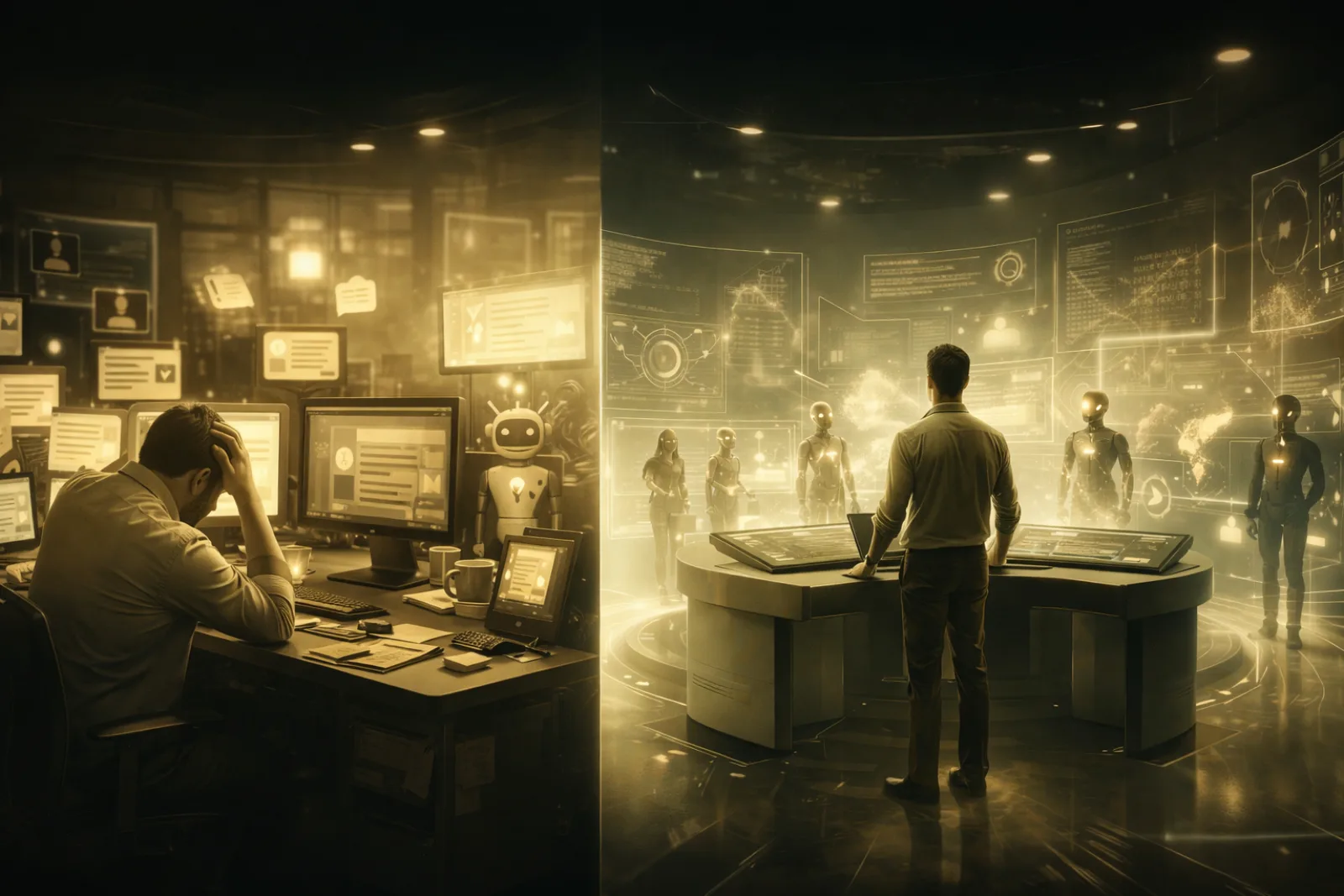
Bookings are not glamorous.
They arrive through email, booking platforms, supplier messages, customer updates, and last-minute changes that somehow always appear after the plan has already been “finalized.” Someone reads them. Someone reconciles them. Someone checks activity availability. Someone checks transport capacity. Someone updates the planning sheet. Someone notices that one family needs pickup from a different location. Someone quietly prevents tomorrow morning from becoming a small logistical circus.
This is exactly the kind of work most AI strategy presentations skip because it does not look futuristic enough. That is a mistake. In A Practical Guide to Agentic AI Transition in Organizations, Bandara and co-authors use tourism SME operations to make a sharper point: the transition to agentic AI is not mainly a story about better chatbots, better prompts, or more heroic engineering teams. It is a story about moving manual, coordination-heavy business processes into modular, human-supervised agentic workflows.1
That makes the tourism case a useful starting point. It is ordinary enough to be real, messy enough to be interesting, and operational enough to expose the difference between “AI helps an employee” and “AI performs a workflow under human supervision.”
A chatbot can summarize a booking email. Nice. A copilot can help draft a reply. Also nice. But the administrative burden remains with the human: read, compare, infer, decide, update, coordinate, publish, and check whether anything broke.
Agentic AI changes the question. Instead of asking, “How can AI help this employee perform a task faster?”, the organization asks, “Which parts of this workflow can be delegated to specialized agents, and where should humans remain in control?”
That sounds like a technical architecture question. It is not. Or at least, not mostly.
It is an operating model question wearing a hoodie.
The tourism case shows the real unit of automation: the workflow
The paper’s most concrete example is a daily planning workflow in tourism SMEs. Administrative staff need to generate operational planning sheets from scattered booking information. The manual process involves reading booking inquiries, filtering changes, reconciling updates, checking activity availability, checking transport availability, assigning customers to activities and transport options, and producing a consolidated planning sheet in a shared system.
There is nothing exotic here. That is precisely why it matters.
Most organizations are full of these workflows. They are not usually described as “AI opportunities.” They are called admin work, coordination, follow-up, scheduling, checking, reporting, routing, reconciliation, or, in the brutally honest language of operations, “the things that keep the business from embarrassing itself.”
The paper argues that these workflows are strong candidates for agentic automation because they share several traits:
| Workflow trait | Why it matters for agentic AI |
|---|---|
| Manual and repetitive | The process recurs often enough for automation to matter. |
| Decision-intensive | It requires judgment, not only mechanical data transfer. |
| Cross-system | Information lives across emails, platforms, suppliers, spreadsheets, and shared folders. |
| Context-sensitive | The right answer depends on timing, capacity, constraints, and exceptions. |
| Operationally consequential | Mistakes affect customers, staff, suppliers, or revenue. |
This is where many organizations misread agentic AI. They look first for technically elegant use cases. The paper pushes in the opposite direction: look for business processes that are manual, repetitive, decision-heavy, and spread across systems.
That shift sounds simple. It is not. It moves use-case discovery away from the engineering department and toward operations, finance, compliance, customer support, logistics, supply chains, and other places where tacit knowledge lives. Engineering teams may know how to build the system. They often do not know which workflow is worth building.
The tourist booking office, in other words, is not a cute example. It is a diagnostic instrument.
The agentic move is decomposition, not chatbot decoration
The planning workflow is not automated by throwing one large model at the whole problem and hoping it behaves like a very polite intern.
The paper describes decomposition into specialized agents. In the planning workflow, the manual process is translated into a coordinated agentic system with roles such as email reading, booking filtering, activity availability retrieval, transport context retrieval, planning sheet generation, and publishing.
The important point is not the exact list of agents. Another industry would have different names. The deeper principle is that agentic automation starts by identifying the cognitive responsibilities inside the workflow.
A human does not merely “make a planning sheet.” The human extracts information, filters noise, interprets changes, checks constraints, compares options, resolves conflicts, synthesizes a plan, and publishes the result. The planning sheet is the artifact. The workflow is the reasoning chain.
Agentic AI becomes useful when the organization can decompose that reasoning chain.
| Manual responsibility | Agentic equivalent | Business interpretation |
|---|---|---|
| Read scattered booking messages | Information ingestion agent | Convert unstructured inputs into usable workflow context. |
| Filter updates and changes | Booking normalization agent | Reduce noise before downstream decisions. |
| Check activity availability | Availability agent | Connect planning to operational capacity. |
| Check transport constraints | Transport context agent | Prevent plans that look good but cannot be executed. |
| Generate planning sheet | Synthesis agent | Produce a usable operational artifact. |
| Store output for staff review | Publishing agent | Make the result part of the actual workflow, not a demo. |
This is the section where the paper is most useful for business readers. It implies that the first deliverable of an agentic AI project should not be a model selection memo. It should be a workflow map.
Not a decorative process diagram. A real one.
Who receives the input? What counts as an exception? Which information is trusted? What is inferred? What must be confirmed? Which action creates risk? Which output is reviewed? Which decision must remain human-owned? Which system receives the final artifact?
That kind of mapping feels slower than building a prototype. It is usually faster than rebuilding the wrong prototype three times while everyone politely calls it “iteration.”
Humans become orchestrators, not decorative approvers
The paper’s human-in-the-loop argument is more specific than the usual governance slogan.
The human is not imagined as someone who manually checks every micro-action. That would defeat the point. Nor is the human removed from the process entirely. That would be brave in the same way removing brakes from a bus is brave.
Instead, the human becomes an orchestrator of agentic workflows. The paper describes workflows exposed through MCP servers and accessed through MCP-enabled tools such as LM Studio. In practical terms, this lets a human coordinator invoke and supervise multiple agentic workflows through a common interface.
The important operational shift is this:
Humans stop being the default execution layer and become the control layer.
That means their work changes from constant coordination to selective supervision. They specify goals, trigger workflows, review outputs, and intervene when risk, uncertainty, or business impact requires judgment.
This distinction matters because many companies design human-in-the-loop systems badly. They keep humans in the loop by forcing them to babysit the machine. The result is neither automation nor accountability. It is just a more expensive queue.
A better design asks three questions:
- Where can the agent act autonomously?
- Where must the human validate before action?
- Where should the system escalate because uncertainty or risk is too high?
The paper does not solve this problem with a universal governance formula. Good. Universal governance formulas are where nuance goes to die. Instead, it frames human orchestration as part of workflow design. The boundary between agent autonomy and human review must be defined around business impact, not around abstract comfort levels.
For the tourism SME case, this is intuitive. An agent can generate a planning sheet. Staff can review it. The workflow can publish it to a shared repository. But if transport capacity is uncertain, a supplier confirmation is missing, or a weather disruption changes feasibility, the system should support human decision-making rather than pretending uncertainty is a rounding error.
The evaluation is workflow evidence, not a benchmark leaderboard
The paper’s evaluation section is easy to overread. It should not be treated as a controlled experiment proving that agentic AI produces a fixed percentage improvement across tourism operations. It does not provide that kind of evidence.
The evaluation examines two workflows in the tourism SME case: the Planning Workflow and the Transport Management Workflow. The Planning Workflow uses multiple specialized agents and focuses on the Planning Sheet Generation Agent as the final reasoning and synthesis step. The Transport Management Workflow uses agents such as fleet context, route reasoning, constraint evaluation, and transport schedule generation, with the final output consumed by operations staff.
The paper evaluates these workflows by looking at reasoning correctness, output consistency, operational usefulness, interpretability for supervisors, efficiency gains compared with manual processes, and alignment with responsible AI principles. The examples show that the planning agent can structure daily operational plans from unstructured booking data and that the transport agent can generate schedules with vehicle assignments, routing decisions, timing constraints, and contingency notes.
That is meaningful. It is also bounded.
| Evidence element | Likely purpose | What it supports | What it does not prove |
|---|---|---|---|
| Tourism SME planning workflow | Main case evidence | Manual coordination work can be decomposed into specialized agents. | Universal performance across industries. |
| Planning sheet generation output | Workflow-level demonstration | Agents can synthesize structured operational artifacts from messy booking inputs. | Statistically measured accuracy under broad test distributions. |
| Transport scheduling workflow | Second case evidence | Agentic workflows can reason across capacity, routing, timing, and contingency constraints. | Guaranteed optimization quality versus specialized routing software. |
| Use of Claude Code, OpenAI Agents SDK, MCP servers, and LM Studio | Implementation detail | Small teams can build and expose workflows using current AI-native tooling. | That these exact tools are required or always best. |
| Discussion of small teams and AI-assisted development | Operational inference from deployment experience | Engineering effort may shift toward supervision, validation, and domain design. | A universal staffing ratio for every company. |
The paper’s strongest evidence is qualitative and operational. It shows how a manual workflow is transformed into a modular agentic one and how humans supervise the resulting system. It does not give a clean before-after table with labor hours saved, cost reductions, error rates, customer satisfaction, or long-term adoption metrics.
That is not a fatal weakness, but it matters for interpretation.
For business readers, the right conclusion is not “agentic AI has now been quantitatively proven to automate operations.” The better conclusion is: “Here is a plausible operating pattern for moving from AI-assisted tasks to AI-delegated workflows, with a real case showing what that transition looks like.”
In research terms, this is a practical guide supported by case-based deployment experience. In management terms, it is closer to an operating playbook than a benchmark paper.
The bottleneck moves from coding to domain understanding
One of the paper’s sharper claims is that engineering is no longer the primary bottleneck. That will irritate some engineers, which is healthy. Irritation is often the sound of a useful distinction being made.
The authors are not saying engineering no longer matters. Agentic systems still need architecture, integration, monitoring, security, testing, and failure handling. Reality has not been deprecated.
The claim is narrower and more interesting: AI-assisted development tools reduce the marginal effort of implementation enough that the harder constraint shifts toward problem framing, workflow design, domain knowledge, and human-agent collaboration.
In the tourism SME case, the paper describes an engineering effort consisting of a single engineer augmented by agentic AI development tools such as Claude Code and Codex. The broader team still needed deep interaction with business stakeholders to understand operational constraints, seasonal variability, business objectives, and existing manual workflows.
That combination is the important part. Small team does not mean engineering-only team. It means a compact, cross-functional unit where domain knowledge is not thrown over the wall as “requirements.”
Traditional software development often follows a handoff model:
Business explains requirements. Engineering builds. Business reacts. Engineering revises. Everyone discovers that the original requirements were a polite fiction.
Agentic AI makes that model worse, not better, because agent behavior is exploratory, probabilistic, and context-sensitive. Many requirements only become visible after the agent interacts with real workflow data and edge cases.
The paper’s replacement model is continuous collaboration. Business stakeholders help define what should be automated, how agents should reason, where supervision belongs, and what outputs are actually usable. Engineers build and adjust the agentic system while learning the domain. AI-assisted development tools accelerate implementation, but they do not replace domain interrogation.
This is where the organizational leap sits. The company is not just adding AI to a process. It is changing who owns the process, who understands it, who supervises it, and how it evolves.
“Small teams” only work when the work is redesigned
The paper argues that small, autonomous teams of no more than three to four members can be sufficient to design, build, and deploy production-ready agentic workflows when supported by AI-assisted development. That is a provocative claim, but it should be interpreted carefully.
It does not mean companies can fire the software department and hand operations to three enthusiastic people with subscriptions.
It means the production function of AI workflow development may be changing. If AI tools can generate agents, prompts, workflow components, integrations, and MCP server pieces, then human effort can move upward. The scarce resource becomes the ability to define useful goals, evaluate behavior, constrain failure, and align the system with real operational work.
Small teams work when they are close to the business process. They fail when they are merely small.
A compact agentic AI team needs three forms of competence:
| Competence | What it contributes | Failure mode if missing |
|---|---|---|
| Domain understanding | Identifies valuable workflows, constraints, exceptions, and usable outputs. | The system automates the wrong thing elegantly. |
| AI-native engineering | Builds modular agents, tool integrations, orchestration, and evaluation loops. | The workflow remains a slide deck with ambition. |
| Operational ownership | Maintains feedback, supervision, improvement, and adoption after launch. | The prototype survives the demo and dies in production. |
This is why the paper’s team model is not just a staffing suggestion. It is a governance suggestion.
Agentic AI workflows are not one-time software deliveries. They are living operational assets. Someone must own their behavior, monitor drift, collect user feedback, adjust prompts and tools, decide when to escalate, and keep the workflow aligned with changing business conditions.
Without that ownership, organizations get what they usually get from fashionable technology adoption: a pilot, a celebratory internal post, and then a quiet folder named “archive.”
The business lesson: start with coordination pain, not AI enthusiasm
The practical business pathway from the paper can be summarized as follows:
- Find a manual workflow where people repeatedly coordinate across information sources, systems, and stakeholders.
- Decompose the workflow into cognitive responsibilities.
- Assign those responsibilities to specialized agents with clear inputs, outputs, tools, and boundaries.
- Expose the workflow through an interface where humans can trigger, supervise, and review.
- Keep improving the workflow through business-engineering collaboration.
- Treat the workflow as an operational capability, not a finished software artifact.
This is a useful antidote to the usual AI adoption theater.
A company should not begin with, “We need agents.” That is like saying, “We need a forklift,” before knowing whether the problem is warehouse movement, inventory accuracy, or the fact that no one knows where the loading bay keys are.
A better starting question is:
Which workflow currently depends on human coordination because information is fragmented, rules are tacit, decisions are repetitive, and exceptions are frequent?
That question points toward operations, not demos.
For Cognaptus readers, especially managers thinking about business process automation, the paper suggests a screening framework:
| Question | Good sign for agentic AI | Bad sign |
|---|---|---|
| Is the workflow repeated often? | Daily or weekly recurrence. | One-off strategic judgment. |
| Does it involve multiple systems or sources? | Email, spreadsheets, platforms, databases, suppliers, customers. | Single clean database query. |
| Does it require reasoning across constraints? | Capacity, timing, priority, exceptions, eligibility, risk. | Simple rule-based routing. |
| Is the output operationally useful? | A schedule, plan, recommendation, report, action list, or completed transaction. | A summary no one uses. |
| Can humans supervise at meaningful checkpoints? | Clear review, escalation, approval, and override points. | Either full manual checking or blind automation. |
| Is there a domain owner available? | Operations staff can explain edge cases and validate outputs. | Engineering must guess the business logic. |
This framework also reveals where agentic AI is not the best first move. If the process is already deterministic and cleanly structured, conventional automation may be cheaper and safer. If the process is rare, high-stakes, and heavily judgment-dependent, agentic AI may still help with preparation or analysis, but full workflow delegation may be premature.
The paper is most relevant in the middle: complex enough for reasoning, repeated enough to matter, structured enough to supervise, and messy enough that traditional automation has struggled.
That is a very large middle.
The misconception to retire: “agentic AI means better bots”
The weak version of agentic AI adoption says: add a chatbot, connect a few tools, call it an agent, and wait for transformation to arrive.
Transformation, being busy, does not arrive.
The paper’s better framing is that agentic AI adoption is an organizational transition. Companies must shift from tool-centric AI to workflow-centric AI. That requires a different view of work, teams, interfaces, and accountability.
The old model looks like this:
| Copilot model | Agentic workflow model |
|---|---|
| AI assists an individual. | AI performs parts of a business process. |
| Human remains the main execution layer. | Human becomes orchestrator and exception handler. |
| Productivity gain is local. | Automation value is workflow-level. |
| Use cases are often selected by technical feasibility. | Use cases are selected by operational leverage. |
| Requirements are specified upfront. | Workflow behavior is refined through iteration. |
| Engineering owns implementation. | Business and engineering share workflow ownership. |
This is why the phrase “from copilots to colleagues” is useful, as long as we do not take it too literally. Agents are not colleagues in the human sense. They do not understand accountability, loyalty, customer relationships, or the quiet panic of a supplier calling at 7:10 a.m.
But they can become operational actors inside workflows. They can take on defined responsibilities. They can coordinate with tools. They can produce artifacts that humans review and use. They can reduce the amount of manual glue work that silently consumes organizational capacity.
The managerial task, then, is not to “hire AI employees.” That metaphor becomes silly very quickly. The task is to design roles, boundaries, supervision, escalation, and ownership for non-human workflow participants.
Less science fiction. More org chart, but with APIs.
The boundary: useful guide, limited proof
The paper is valuable because it is practical. Its limitation is also that it is practical.
The evidence comes from deployment experience and workflow examples, especially the tourism SME planning and transport workflows. The paper does not provide controlled experiments, broad industry comparisons, longitudinal adoption data, or detailed quantitative ROI measurement. It does not tell us how much labor time was saved, how error rates changed over months, how employees adapted, or how performance varied under unusual disruption.
Those are not minor questions. They are exactly the questions business leaders should ask before scaling.
A stronger future evaluation would include:
- before-and-after labor time per workflow;
- exception frequency and resolution time;
- output error rates under different types of booking changes;
- human review burden;
- user trust and adoption over time;
- cost of maintaining agents as business rules change;
- failure modes by workflow type;
- comparison against traditional automation or specialized optimization tools.
The paper itself points toward future work on additional real-world use cases, governance models, collaboration strategies, failure modes, and operational impact metrics. That is the right direction.
For now, the paper should be read as a transition guide with case-based evidence. It is strong in mechanism and operating model. It is weaker in quantified business proof.
That distinction is not a complaint. It is a map.
The real leap is organizational memory becoming executable
The most interesting implication of the paper is not that agents can generate planning sheets or transport schedules. Useful, yes. Revolutionary, no.
The deeper implication is that organizations may begin converting tacit workflow knowledge into executable agentic systems.
Today, much operational intelligence lives in people’s heads. The senior admin knows which supplier replies late. The transport coordinator knows which route looks short on paper but fails in bad weather. The finance assistant knows which invoice exception means “wait” and which means “call now.” The customer support lead knows which complaint needs escalation before it becomes a public review.
Traditional software struggles with this knowledge because it is informal, contextual, and exception-rich. Agentic AI does not magically solve that problem, but it gives organizations a new way to encode, test, and operationalize parts of it.
That is why the transition is not merely technical. When a workflow becomes agentic, the organization must decide what it actually knows, who is allowed to define that knowledge, how exceptions are handled, and how the system should change when reality changes.
This is organizational memory becoming executable.
And that is also why sloppy adoption is dangerous. If the workflow map is wrong, the agentic system scales the wrong understanding. If domain experts are excluded, the system automates surface behavior while missing operational logic. If humans are left as passive approvers, accountability becomes ceremonial. If no one owns iteration, the workflow decays.
The agentic organization is not the one with the most agents. It is the one that knows which workflows deserve delegation, which decisions require supervision, and which humans are accountable for the system’s evolution.
Conclusion: managing agents is becoming a management discipline
The paper’s contribution is not a new model architecture. It is a practical reframing of agentic AI adoption as organizational redesign.
That is less glamorous than a benchmark win, but more useful for companies trying to move beyond isolated AI tools.
The tourism SME case shows the pattern clearly. Start with a real workflow. Understand the domain. Decompose the work into reasoning responsibilities. Delegate those responsibilities to specialized agents. Keep humans as orchestrators. Use AI-assisted development to reduce implementation friction. Build small cross-functional teams. Maintain ownership after deployment.
The hidden difficulty is that none of this can be solved by buying a larger model and hoping operations reorganizes itself out of respect.
Agentic AI makes automation more flexible, but it also makes organizational design more important. The companies that benefit will not be the ones that merely add agents to old workflows. They will be the ones that learn how to delegate work to agents while preserving human judgment, accountability, and adaptation.
The next management discipline may not be managing people versus managing software.
It may be managing workflows where people, agents, tools, and business rules continuously negotiate who does what.
A little less “AI magic.” A little more operational adulthood.
Cognaptus: Automate the Present, Incubate the Future.
-
Eranga Bandara et al., “A Practical Guide to Agentic AI Transition in Organizations,” arXiv:2602.10122, 2026. https://arxiv.org/abs/2602.10122 ↩︎