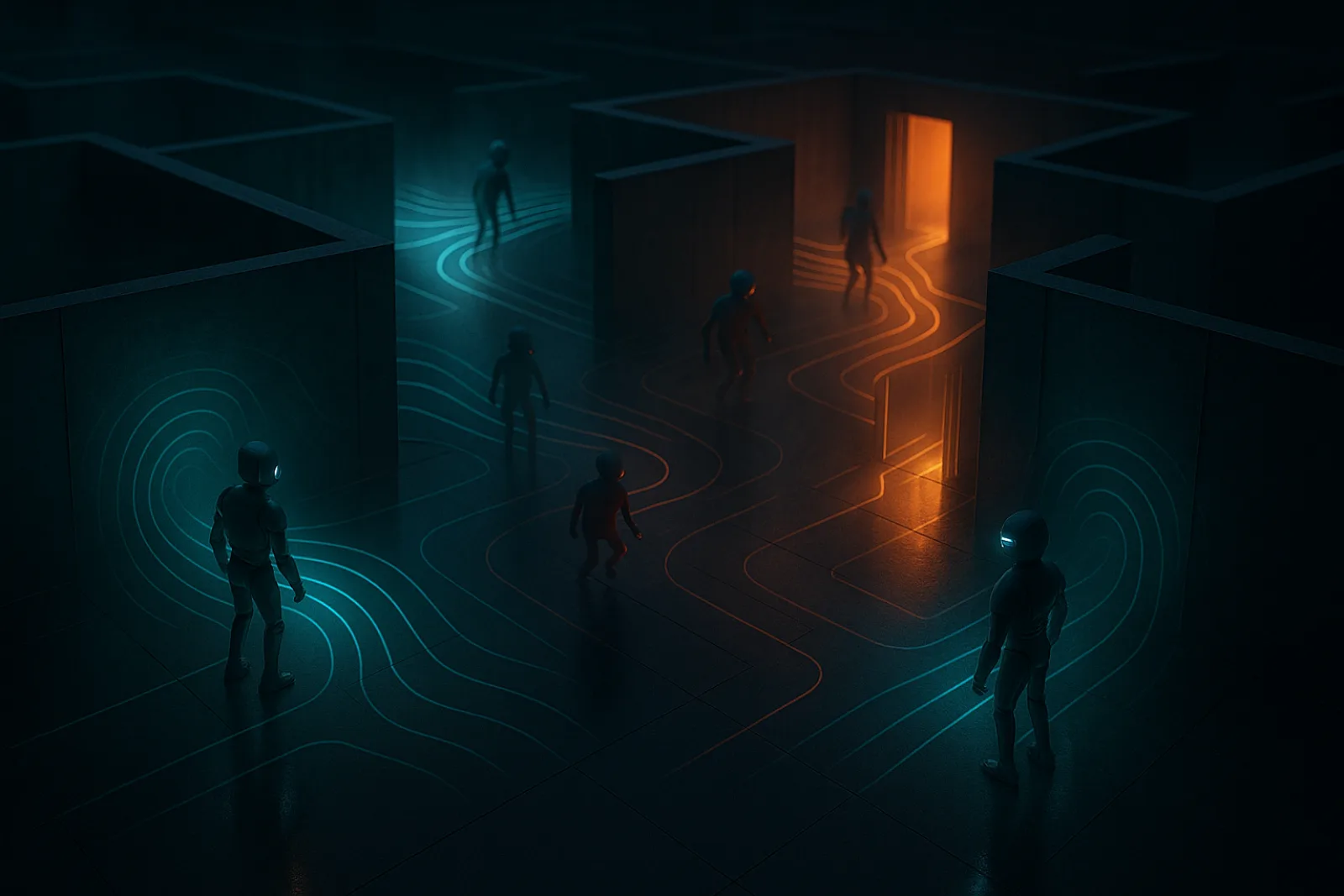
Doors are excellent teachers.
A locked door in a maze looks trivial to a human observer. One agent opens it. Another agent walks through it. Everyone goes home, preferably before the training budget quietly evaporates. But for reinforcement-learning agents, especially in sparse-reward environments, that door is not a door. It is a credit-assignment trap wearing blue paint.
The agent that opens the door may not receive an immediate external reward. The teammate who later reaches the goal may be the one whose observation visibly changes. A standard curiosity reward can encourage each agent to seek its own novelty, but it may still miss the cooperative move that changes someone else’s opportunity set. So the team wanders. The GPU fans spin. The reward remains zero. Everyone pretends this is “emergent coordination.” Very elegant. Deeply useless.
That is the useful contribution of Chen et al.’s paper, MIR: Efficient Exploration in Episodic Multi-Agent Reinforcement Learning via Mutual Intrinsic Reward.1 The paper proposes Mutual Intrinsic Reward, or MIR, a reward-coupling mechanism that encourages an agent to take exploratory actions that alter its teammates’ observations. The idea is simple enough to explain without ceremonial mathematics: do not reward only “what was new to me”; also reward “what I did that made the world newly visible to you.”
This matters because multi-agent reinforcement learning often inherits exploration tools designed for single-agent systems. In a single-agent task, curiosity can be mostly self-centered: visit unfamiliar states, reduce prediction error, chase novelty. In a cooperative multi-agent task, useful exploration is often relational. One agent’s valuable action may be valuable precisely because it changes what another agent can see, reach, unlock, or learn.
MIR is not a claim that curiosity alone solves cooperation. It is more modest and therefore more interesting: when exploration is already being shaped by intrinsic reward methods such as DEIR or NovelD, MIR adds a mutual signal that redirects exploration toward teammate-impacting actions. The paper then evaluates this idea in MiniGrid-MA, a new multi-agent extension of MiniGrid with sparse cooperative rewards.
The headline is not “agents become smarter because they are curious.” That is the motivational-poster version. The better reading is this: in team environments, exploration itself needs a coordination channel.
Ordinary curiosity rewards the agent that sees something new
Intrinsic reward methods are a practical workaround for sparse external rewards. If an environment gives a reward only at the end of a task, the agent may spend most of training receiving no useful feedback. Intrinsic rewards provide auxiliary signals: novelty, prediction error, state visitation, surprise, or other proxies that make exploration less blind.
The paper positions MIR around two existing exploration methods:
| Method | What it roughly rewards | How the paper uses it |
|---|---|---|
| NovelD | Observation novelty based on Random Network Distillation-style prediction error | Used as one base intrinsic reward method, then enhanced with MIR |
| DEIR | Novelty derived from learned observation and trajectory embeddings through a discrimination model | Used as another base intrinsic reward method, then enhanced with MIR |
| MIR | The novelty induced in teammates’ observations | Added as a mutual reward component on top of the base method |
The misconception MIR attacks is straightforward: if each agent has its own curiosity reward, surely the team will eventually coordinate. Sometimes yes. Often no. Local novelty can pull agents toward individually interesting states while missing actions that are instrumentally useful for others.
In the paper’s motivating example, a blue agent must unlock a door so a red agent can reach the endpoint. A conventional intrinsic reward may focus on unexplored regions from the acting agent’s own perspective. MIR instead asks whether the action changes the teammate’s observation — for example, whether unlocking the door alters the red agent’s accessible state. This is the shift from self-novelty to teammate-impact.
That distinction is small in wording and large in training dynamics.
A team can fail not because no agent explores, but because the wrong kind of exploration is being rewarded. One agent may discover new corners of its own local world while never performing the boring-but-crucial action that expands the teammate’s world. MIR gives that boring action a chance to become interesting.
MIR rewards influence, not just novelty
The core reward structure in the paper has three layers.
First, each agent receives environmental reward. In MiniGrid-MA, this external reward is extremely sparse: the team receives it only when all agents complete the task. No intermediate reward is given while agents are merely moving, unlocking, positioning, or preparing the way.
Second, the agent receives an intrinsic reward from a base method such as DEIR or NovelD. This is the familiar single-agent-style curiosity component.
Third, MIR adds a mutual intrinsic reward. Instead of measuring only whether agent $k$ sees something novel, MIR measures whether other agents’ observations become novel. In simplified form, the agent’s reward is built from:
Here, $r^E_t$ is the external environmental reward, $r^I_{k,t}$ is the base intrinsic reward for agent $k$, and $r^M_{k,t}$ is the mutual intrinsic reward derived from teammate observation novelty. The coefficients determine how much each component matters.
The mechanism is easier to see as a causal loop:
| Step | What happens | Why it matters |
|---|---|---|
| 1 | Agent $k$ acts in the environment | The action may or may not change the team state |
| 2 | A teammate’s observation changes | MIR treats this as a sign of inter-agent influence |
| 3 | The teammate’s new observation is compared with prior observation embeddings or novelty estimates | Existing intrinsic-reward machinery is reused |
| 4 | Agent $k$ receives mutual intrinsic reward | The acting agent is encouraged to explore actions that affect teammates |
| 5 | The mutual reward is mixed with ordinary intrinsic reward | The agent is not allowed to become purely teammate-obsessed |
That last row matters. A naive version of mutual curiosity could become pathological. If every agent is rewarded only for changing others’ observations, agents might chase noisy influence rather than task progress. MIR therefore uses a softmax-based mixing function: agents with relatively high intrinsic reward receive higher weighted mutual reward. The stated purpose is to prevent the team from being driven solely by mutual intrinsic reward while neglecting individual exploration.
This is a useful design instinct. The method does not replace individual exploration with collective meddling. It tries to couple the two.
That coupling is the actual technical insight. In cooperative exploration, “I found something new” and “I made something new available to you” are different signals. MIR makes the second signal trainable.
MiniGrid-MA makes the coordination failure visible
The paper evaluates MIR in MiniGrid-MA, an extension of MiniGrid designed for sparse-reward multi-agent tasks. MiniGrid is a controlled gridworld environment with objects such as walls, keys, tiles, and doors. The authors extend it into cooperative multi-agent settings with shared objects and team rewards.
This is not meant to be a realistic robot warehouse, traffic system, or enterprise workflow. It is a deliberately simplified environment where the relevant failure mode can be isolated. That is good experimental hygiene, not a weakness by itself. We do not test thermometers by throwing them into volcanoes first.
The benchmark includes two-agent and three-agent tasks:
| Environment family | Requires teamwork | Number of agents | Map sizes |
|---|---|---|---|
| DoorKeyB | Yes | 2 | 6, 8 |
| DoorSwitchA | Yes | 2 | 8, 12, 16 |
| DoorSwitchB | Yes | 2 | 8, 10, 16 |
| DoorSwitchC | Yes | 3 | 8, 12, 16 |
| DoorSwitchD | Yes | 3 | 10, 12, 14 |
The external reward is given only when all agents reach the target. The reward also depends on completion time:
This matters for interpreting the results. The reported metric is not simply “success rate,” nor is it a direct measure of deployment value. The paper reports the highest average episode reward obtained across different runs for each method and environment. A higher score generally suggests better task completion and/or faster completion, but it should not be read as a universal efficiency metric.
The test setup is doing one specific job: asking whether MIR helps intrinsic reward methods discover cooperative behavior under sparse completion rewards.
The results support the mechanism, but not as a magic spell
The main experimental table compares MAPPO without an intrinsic model, RND, NGU, NovelD, NovelD-MIR, DEIR, and DEIR-MIR across the MiniGrid-MA environments. The key comparison is not just “MIR versus everything.” It is “base intrinsic reward method versus the same method enhanced with MIR.”
That distinction keeps the interpretation clean. MIR is not introduced as a full replacement for DEIR or NovelD. It is an enhancement layer.
The results are directionally strong, especially for DEIR-MIR:
| Comparison | Result pattern | Interpretation |
|---|---|---|
| NovelD-MIR vs NovelD | NovelD-MIR improves in 10 of 15 environments, ties in 1, and performs worse in 4 | MIR often helps NovelD, but the effect is not uniform |
| DEIR-MIR vs DEIR | DEIR-MIR improves in 14 of 15 environments and performs worse in 1 | MIR appears especially compatible with DEIR in these environments |
| MAPPO / RND / NGU baselines | Often near zero in harder larger maps | Plain policy optimization or direct intrinsic reward transfer can struggle under sparse cooperative reward |
Some examples show why the result is interesting. In DoorSwitch12x12, DEIR rises from 0.13 to 1.44 with MIR. In DoorSwitch8x8, DEIR rises from 0.40 to 1.54. In DoorSwitch16x16, NovelD rises from 0.44 to 1.25. In DoorSwitchB16x16, NovelD rises from 0.03 to 0.42, while DEIR rises from 0.00 to 0.18.
These are not tiny cosmetic improvements in a table margin. They suggest that teammate-observation novelty can make the exploration process meaningfully less blind in cooperative sparse-reward tasks.
But the table also contains useful friction. NovelD-MIR underperforms NovelD in several environments, including DoorSwitch8x8, DoorSwitchB8x8, DoorSwitchC8x8, and DoorSwitchB10x10. DEIR-MIR is much more consistent, but even there, DoorSwitchD14x14 falls from 0.01 to 0.00.
Those exceptions are not editorial inconveniences. They are clues. MIR is a reward-shaping mechanism, and reward shaping can misallocate attention when the mutual signal is not aligned with task progress. If teammate observation changes are sometimes noisy, misleading, or insufficiently connected to completion, rewarding them can hurt.
So the right reading is not “MIR wins.” The right reading is “MIR often improves exploration when cooperative state-changing actions are the bottleneck, especially when paired with a compatible intrinsic reward model.”
Less catchy. More useful. Tragic, really.
The evidence stack is mostly main comparison, not a full diagnosis
The paper says it conducts ablation experiments on the mixing method and MAPPO techniques. In the accessible paper text, however, the detailed separately reported ablation tables are not visible. The main published evidence is the cross-environment comparison table showing base methods and MIR-enhanced methods.
That affects how we should read the result.
| Evidence element | Likely purpose | What it supports | What it does not prove |
|---|---|---|---|
| MiniGrid-MA environment design | Benchmark construction / implementation detail | The tasks require sparse-reward teamwork across different map sizes and agent counts | That MIR generalizes to robotics, logistics, or enterprise agents |
| MAPPO, RND, NGU, NovelD, DEIR comparison | Comparison with prior methods | Existing intrinsic reward methods can struggle when directly transferred to cooperative sparse-reward MARL | That all competing MARL exploration methods have been exhausted |
| NovelD-MIR and DEIR-MIR rows | Main evidence | Adding MIR often improves best episode reward over the base intrinsic method | That MIR is always beneficial |
| Softmax-weighted mixing | Mechanism / implementation detail | The authors try to balance individual exploration with mutual influence | That this is the optimal weighting strategy |
| Stated limitations in discussion | Boundary condition | MIR may hurt tasks not requiring collaboration and has difficulty rewarding long-term joint-action effects | That the method is deployment-ready |
This distinction is important for business readers. A paper can be promising without being operationally complete. MIR gives a strong mechanism and encouraging controlled evidence. It does not give a mature engineering playbook for all multi-agent systems.
The absence of detailed ablation evidence also means we should be careful about assigning causality to each subcomponent. The results suggest that MIR helps. They do not fully isolate whether the gains come mostly from teammate-observation novelty, the softmax weighting design, the DEIR encoder compatibility, the environment structure, or interactions among all of the above.
That is not a fatal flaw. It is simply the difference between “this is a promising mechanism” and “we have diagnosed every gear in the machine.”
The business value is better exploration design, not instant autonomous teams
For business interpretation, the practical pathway is not that companies should immediately implement MIR in production agents. Please do not let your procurement team read one gridworld table and buy a robot fleet. They are excitable enough already.
The more useful business lesson is architectural: multi-agent systems need reward and evaluation signals that capture how one agent changes another agent’s working context.
That applies across several domains.
| Domain | MIR-like business interpretation | Uncertainty boundary |
|---|---|---|
| Warehouse or robot teams | Reward actions that open paths, move obstacles, or create access for other robots | The paper tests gridworld agents, not physical robots with noisy sensors and safety constraints |
| Traffic or fleet coordination | Reward local actions that improve other agents’ reachable options or information state | Real systems involve continuous dynamics, regulation, and non-stationary human behavior |
| Game AI and simulation | Encourage agents to create opportunities for teammates rather than only chasing local novelty | Game environments may be richer but also easier to instrument than real businesses |
| Multi-agent workflow automation | Measure whether one agent’s output changes another agent’s useful decision state | LLM agents do not have the same observation embeddings or reward loops as MiniGrid agents |
| Training synthetic agent teams | Use teammate-state change as an auxiliary reward during simulation | Requires careful design of what counts as “useful change,” not merely “any change” |
The enterprise analogy should be handled carefully. In a business workflow, one agent may gather data, another may draft analysis, another may validate compliance, and another may execute a transaction. The system can fail when each agent optimizes its own local task without improving the next agent’s usable state.
A MIR-like design would ask: did this agent’s action make the next agent’s job materially easier, more informed, or more constrained in the right way?
That is a good question for agentic workflow design. It is not the same as directly applying the MIR formula from MiniGrid-MA to an LLM orchestration system. Business processes rarely provide clean observation embeddings, deterministic grid transitions, or simple completion rewards. Also, “changed another agent’s observation” is not always good. Sending a colleague 47 irrelevant documents also changes their state. Usually toward despair.
The operational lesson is therefore measurement discipline. Reward handoffs that improve downstream capability, not just handoffs that create downstream activity.
Where MIR should not be over-read
The paper’s own limitation section is refreshingly relevant. The authors note that MIR may compromise performance on hard tasks that do not require collaboration. That makes sense. If a task is mostly individual, rewarding teammate observation changes can distract the agent from the real objective.
They also note that the current method has difficulty directly rewarding joint actions that modify teammates’ observations over the long term. This is a serious boundary. Many valuable cooperative strategies are delayed, distributed, and hard to attribute. One agent may prepare a condition now that helps another agent much later. MIR, as presented, is closer to rewarding immediate or near-term teammate observation novelty than solving long-horizon joint credit assignment.
The experimental boundary is also narrow. The evidence comes from MiniGrid-MA tasks with two or three agents, sparse completion rewards, discrete gridworld actions, and controlled environment structures. That is exactly the right place to test a clean mechanism. It is not enough to claim general superiority across all MARL settings.
The metric also deserves restraint. The paper reports mean best episode reward, with each cell representing the highest average reward obtained across runs. That is useful for seeing whether a method can reach good performance. It is less informative about stability, sample efficiency, variance, computational cost, or final deployed policy reliability.
So the boundary is:
| What the paper directly shows | What Cognaptus infers | What remains uncertain |
|---|---|---|
| MIR can be combined with DEIR and NovelD under a MAPPO/CTDE-style setup | Cooperative exploration benefits from rewarding actions that change teammates’ state space | Whether the same mechanism scales to richer, noisier, continuous, or LLM-based multi-agent systems |
| MIR-enhanced methods usually improve best episode reward in MiniGrid-MA | Rewarding useful handoffs may improve agent-team training in simulations | How to distinguish useful teammate-state change from distracting activity |
| DEIR-MIR is especially consistent in the reported table | MIR may work best when the base intrinsic model produces compatible embeddings | Whether the softmax weighting strategy is optimal or merely adequate |
| MIR can hurt or fail in some cases | Mutual reward must be task-gated | How to automate that gating reliably |
This is the sober version of “promising.” Not boring. Just solvent.
Reward the handoff, not only the hero agent
MIR’s most business-relevant idea is not hidden in the algorithmic machinery. It is the shift in what counts as progress.
Traditional automation dashboards often reward the visible agent: the one that completes the task, produces the answer, closes the ticket, or reaches the endpoint. But in real multi-agent systems, the valuable action is often preparatory. Someone cleans the data. Someone opens the access path. Someone turns a vague request into a structured object. Someone makes the next decision possible.
In single-agent framing, that preparatory action may look unrewarded. In multi-agent framing, it may be the bottleneck.
MIR gives reinforcement learning a small but important vocabulary for that idea. It says: if agent $A$ changes what agent $B$ can observe, that influence can be part of the reward signal. Not because influence is always good, but because in cooperative sparse-reward tasks, useful influence is often invisible to ordinary curiosity.
For AI product teams, the immediate lesson is not “copy MIR.” It is to audit whether your multi-agent system can see handoff value at all.
Ask three questions:
| Design question | Bad answer | Better answer |
|---|---|---|
| What does each agent optimize? | Its own local output | Its contribution to downstream decision quality |
| How is cooperation measured? | Whether all tasks eventually finish | Whether one agent improves another agent’s actionable state |
| What counts as exploration? | Any new state or output | New states that unlock team progress |
This is especially relevant for companies experimenting with agentic systems. Many prototypes fail not because agents lack capability, but because the system has no reliable signal for interdependence. Agents act like clever interns working in parallel tabs. Everyone produces something. Nobody coordinates the conditions for success.
MIR is a reminder that teamwork is not parallelism. Teamwork is structured influence.
Conclusion: contagious curiosity needs a filter
The charm of MIR is that it does not overcomplicate the problem. It notices that in multi-agent exploration, curiosity should sometimes be contagious. If my action makes your world more informative, reachable, or newly structured, that may be worth rewarding.
The paper’s evidence supports this mechanism in controlled sparse-reward cooperative environments. DEIR-MIR is particularly consistent across the reported MiniGrid-MA tasks, and NovelD-MIR also shows substantial gains in many settings, though with more exceptions. The benchmark contribution also matters: MiniGrid-MA gives researchers a clearer way to test sparse-reward MARL exploration without immediately drowning in real-world mess.
The practical lesson for business is narrower but valuable. Multi-agent AI systems should not evaluate agents only by local novelty or final task completion. They should measure whether one agent creates usable opportunity for another. That can mean opening a door in a gridworld, clearing a route for a robot, improving a downstream model’s information state, or producing a structured artifact that makes the next agent less confused.
Of course, rewarding influence without filtering for usefulness can create noise. MIR’s softmax-weighted mixing is one attempt to keep mutual curiosity tied to individual exploration. Future work will need stronger methods for long-horizon joint credit, task-specific weighting, and deployment beyond small cooperative gridworlds.
Still, the mechanism is worth remembering. In teams, curiosity should not be purely private. Sometimes the best exploration is the move that lets someone else finally see the path.
Cognaptus: Automate the Present, Incubate the Future.
-
Kesheng Chen, Wenjian Luo, Bang Zhang, Zeping Yin, and Zipeng Ye, “MIR: Efficient Exploration in Episodic Multi-Agent Reinforcement Learning via Mutual Intrinsic Reward,” arXiv:2511.17165, 2025. https://arxiv.org/pdf/2511.17165 ↩︎