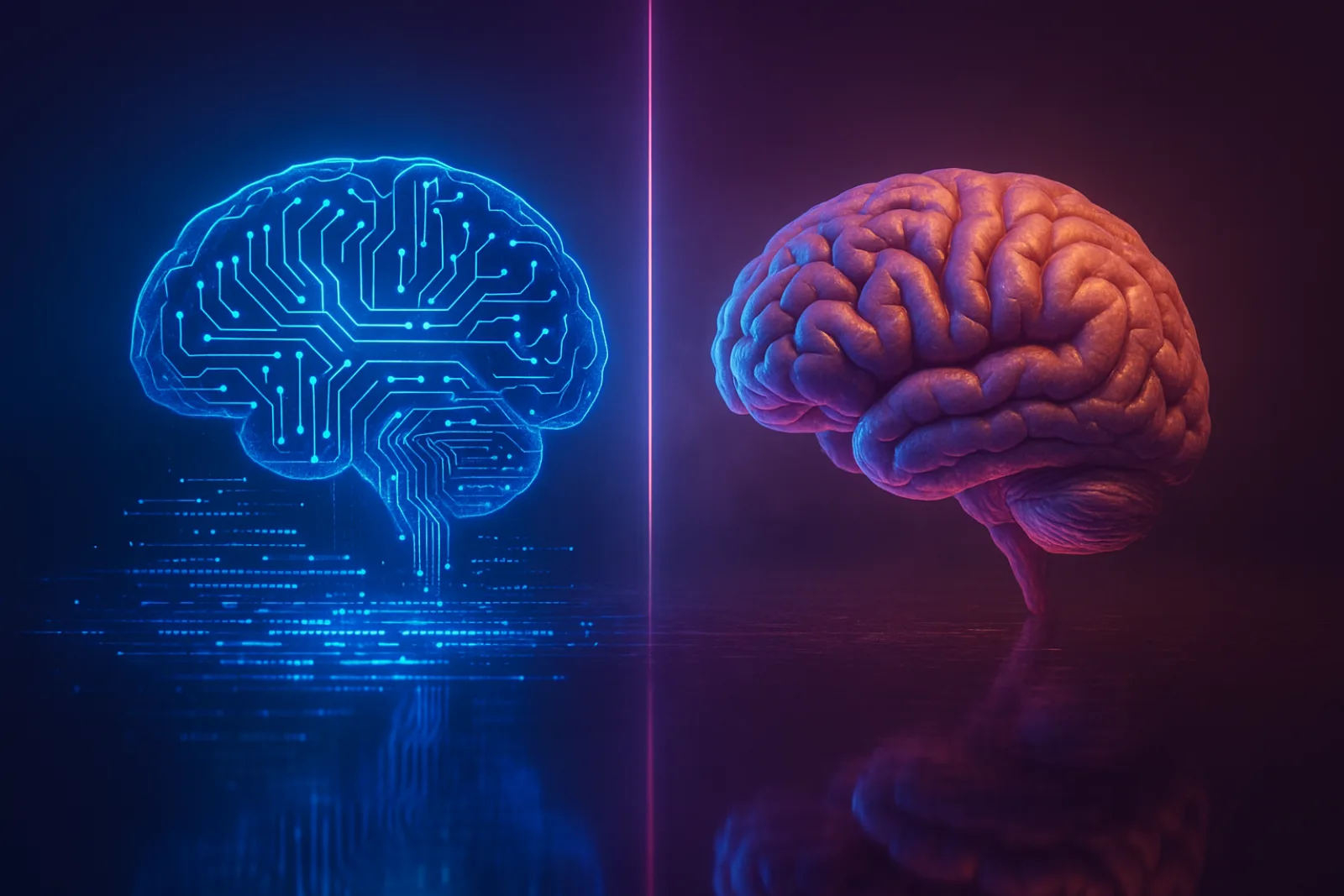
Mind the Model: When Generative AI Teaches Neuroscience New Tricks
A model is not a mind. This should not need saying, but then again, neither should “do not use benchmark scores as a personality test,” and here we are.
The more useful point is subtler. Modern generative AI does not matter to neuroscience because transformers are secretly brains in a hoodie. It matters because machine learning has turned several once-vague ideas about cognition into working engineering mechanisms. Not perfect mechanisms. Not biological mechanisms by default. But mechanisms clear enough to test, stress, reject, adapt, or steal with appropriate academic manners.
That is the central value of Claudius Gros’s perspective paper, From generative AI to the brain: five takeaways.1 The paper is not an experimental neuroscience paper. It does not present a new brain dataset, an fMRI result, a lesion model, or a behavioural benchmark. Its evidence is conceptual and comparative: take five generative-AI principles that have become operationally important in machine learning, then ask whether cognitive neuroscience should investigate analogous principles in biological information processing.
The answer is not “LLMs are brains.” The answer is more annoying, and therefore more useful: AI may have become a theory generator for neuroscience.
The actual claim is not resemblance; it is conjecture quality
The lazy reading is obvious. Generative AI produces language. Humans produce language. Therefore, perhaps LLMs are cognitive models.
That is not the paper’s serious argument.
The stronger argument is that machine learning has recently produced working examples of systems where cognition-adjacent functions are not described poetically but implemented operationally. World modelling, post-training, self-generated intermediate reasoning, attention coupling, parameter scaling, and quantized weights are not merely metaphors inside AI. They are design choices with observable consequences.
That makes them useful to neuroscience in a specific way. They can become conjectures.
A conjecture is not a conclusion. It is not a TED Talk wearing a lab coat. It is a candidate mechanism that can be made precise enough to test. Gros’s paper argues that cognitive neuroscience should treat successful generative-AI principles as such candidates: some may parallel old neuroscience frameworks, some may extend them, and some may turn out to be biologically irrelevant after serious inspection. Fine. Rejection is still progress, provided the hypothesis was sharp enough to be worth rejecting.
The mechanism-first reading matters because the paper’s five sections are not five independent curiosities. They form a sequence about what a cognitive system must solve:
| Mechanism from generative AI | What it solves in machine learning | Candidate neuroscience question | Practical boundary |
|---|---|---|---|
| World modelling plus fine-tuning | Converts next-token competence into useful interaction | Does the brain combine broad unsupervised modelling with reinforcement-shaped task behaviour? | AI training phases are cleanly separated; biological learning is likely concurrent and embodied |
| Chain-of-thought and Chain-of-X | Uses self-generated intermediate states to improve outputs | Can thought be modelled as generated latent structure, compression, or composite construction? | CoT text is not the same thing as human conscious thought |
| Attention with self-consistency | Couples signal generation with downstream processing | Should attention be studied as a closed loop, not as a detached modulation signal? | Transformer self-attention is not identical to human attention |
| Neural scaling laws | Links model size, performance, data, and training compute | Could brain size and development face analogous scaling constraints? | Biological development includes metabolism, embodiment, selection, and plasticity |
| Quantization | Reduces weight precision while preserving useful computation | What are the computational consequences of discrete synaptic strength? | Synapses are not GPU registers, however much Silicon Valley would enjoy the branding |
This is the paper’s deeper structure: not “AI resembles the brain,” but “AI exposes mechanisms that make brain questions more disciplined.”
World modelling is necessary, but not yet cognition
The first mechanism is almost embarrassingly important: prediction is not enough.
In neuroscience, predictive coding has long treated the brain as a system that anticipates sensory input and updates internal models when reality misbehaves. In language modelling, autoregressive training asks a model to predict the next token. Both are world-modelling procedures in a broad sense. They build internal structure by learning what tends to follow what.
The paper’s useful move is to point out what modern LLMs have made painfully clear: a world model alone is not a usable cognitive agent.
A base model trained only on next-token prediction may contain enormous statistical knowledge about language and the world reflected in language. But its native task is continuation. It does not inherently know that a user has asked a question, that an answer should be direct, that refusal may be appropriate, that a task has constraints, or that style matters. Those interactional behaviours emerge through secondary training processes: supervised fine-tuning, preference tuning, task-specific tuning, and other post-training rituals by which a text-completion engine is reshaped into something people can actually use without needing a handler and a prayer.
The paper’s neuroscience conjecture is clean: perhaps the brain also combines broad world modelling with supervisory shaping. The difference is temporal. In machine learning, pretraining and fine-tuning are usually staged. In the brain, environmental prediction, reinforcement, social feedback, motor action, habit formation, and goal learning are likely interleaved.
That distinction matters. The paper is not saying “the brain is pretrained, then fine-tuned.” Biology does not pause childhood, run a gradient update, and ship version 1.1. The more careful claim is that cognition may require both general predictive structure and behavioural shaping. A system that only predicts the world may know what tends to happen. A system that is also shaped by goals, feedback, and context can decide what to do with that knowledge.
For business readers, this is the first operational lesson: raw capability is not product behaviour. Enterprises keep relearning this with each wave of generative AI deployment. A model that “knows” a domain is not yet a system that handles customers, follows policy, escalates uncertainty, or respects workflow boundaries. World modelling gives competence. Fine-tuning and control layers give usable conduct. Confusing the two is how companies end up with a very expensive autocomplete engine sitting inside a compliance process, looking innocent.
Chain-of-thought is interesting because it creates intermediate structure
The second mechanism is more delicate because it invites overclaiming. Chain-of-thought does not prove that LLMs think like humans. It does show that output quality can improve when a model generates intermediate representations before finalising an answer.
Gros focuses on the generative principle beneath CoT and its broader family, Chain-of-X methods. A model can append self-generated intermediate content to the original input, then use the expanded context to produce the final output. The mechanism is not magic. It changes the computational path between input and output.
The paper discusses one interpretation through the information bottleneck framework. In that view, the intermediate “thought” should reduce dependence on irrelevant surface features of the input while preserving information useful for the output. Put simply, the chain should abstract away noise and keep what matters.
The paper also notes an alternative interpretation: CoT-type reasoning can be seen as constructing a composite object, the final response. That opens the door to algorithms from diverse object generation, such as GFlowNet-style approaches, where the target is not a single deterministic continuation but a structured construction process.
This is not presented as new experimental evidence about human reasoning. It is an invitation to take the mechanism seriously enough to ask better questions. Are human thoughts usefully modelled as intermediate generated states? Do they compress input? Do they reorganise task-relevant variables? Do different forms of thinking correspond to different objective functions or construction processes?
The commercial implication is not “make every agent think out loud.” That would be a lawsuit with punctuation.
The better implication is architectural: intermediate reasoning states are control surfaces. They can help a system decompose tasks, check assumptions, expose uncertainty, route evidence, or decide when not to act. But they are also risky. Visible reasoning traces may leak sensitive information, fabricate rationalisations, or create a false sense of auditability. A chain is only useful if the system design specifies what role it plays: scratchpad, proof, plan, explanation, diagnostic trace, or internal compression layer.
Most deployments blur those categories. Then everyone acts surprised when the “reasoning” looks confident but is not faithful. Charming, in the way a smoke alarm that sings opera is charming.
Attention should be studied as a loop, not a detached signal
Attention is where the paper’s mechanism-first framing becomes especially useful.
In neuroscience, attention is often separated into top-down and bottom-up processes. Top-down attention involves higher-level control signals modulating sensory processing. Bottom-up attention involves salient features in the input capturing processing priority. These distinctions are useful, but the paper highlights a structural issue: neuroscience often studies the generation of attention signals separately from the way those signals are processed downstream.
Machine learning offers a useful provocation because transformers do not treat attention as a detached instruction floating above the system. Self-attention is learned end-to-end with the representations it acts on. The attention mechanism and the representational space co-adapt. Components trained separately may fail to share a compatible internal “language,” so large systems are typically trained as integrated systems rather than assembled from independent cognitive widgets.
The paper’s takeaway is that attention needs a self-consistency loop: the generation of attention signals and their subsequent processing should be understood together.
This does not collapse human attention into transformer self-attention. The paper explicitly avoids the phenomenology of human attention and the contested issue of how attention should be defined in psychology or neuroscience. That restraint is important. The point is not identity. The point is coupling.
For enterprise AI, the same lesson appears in less glamorous clothing. Routing, retrieval, ranking, tool selection, and context management are all forms of attention. They determine what the model sees, what it ignores, and what receives computational priority. If these processes are designed separately from the model’s downstream behaviour, reliability suffers. The retriever optimises one objective, the generator optimises another, the evaluator arrives late with a clipboard, and the product team calls it “agentic.”
A self-consistency view asks a better question: does the system that selects context co-evolve, calibrate, or at least align with the system that uses context? If not, attention becomes theatre. The spotlight moves, but the actor has no idea why.
Scaling laws turn “bigger is better” into a developmental constraint
The fourth mechanism is the most provocative because it transfers a machine-learning regularity into an evolutionary thought experiment.
Neural scaling laws describe how performance and training requirements change with model size, data, and compute. Gros uses a simplified comparison between two fully trained models that differ mainly in parameter count. In the paper’s approximation, relative performance scales with relative adaptable parameters:
where $N_A$ and $N_B$ are parameter counts and $P_A$ and $P_B$ are corresponding performances.
The second piece is more consequential: training compute scales roughly quadratically with model size,
From there, the paper offers a biological hypothesis. Suppose one human brain is standard size and another is twice as large. If a standard brain takes roughly 15 years to train into adult-level competence, then a brain twice as large might require four times as long under the quadratic scaling assumption: about 60 years. The larger brain may eventually outperform the standard one, but if performance remains flat for much of training and rises late, it could underperform for decades. Evolution is not famously patient with organisms that need half a century of adolescence before becoming useful.
This is not a proof of why human brains are the size they are. Gros notes other constraints, including metabolic costs. The value is narrower and sharper: scaling may impose developmental constraints, not just resource constraints.
For AI strategy, this is a useful antidote to parameter-count romanticism. Larger systems may have better asymptotic capability, but they also impose training, adaptation, latency, cost, and governance burdens. In deployed business systems, the question is rarely “what is the largest model we can afford?” It is “what is the smallest system that reaches operational reliability within the time, data, compute, and risk budget available?”
That question sounds less glamorous on a conference slide. It is also the one that determines whether a product survives contact with procurement.
Quantization makes representation a resource problem
The fifth mechanism is quantization, and it deserves more attention than it usually gets outside infrastructure teams.
Large models have many adaptable parameters. Storing and operating on those parameters at high precision is expensive. Machine learning has therefore moved aggressively toward lower-bit representations, including INT4 hardware, where a weight may take only $2^4 = 16$ possible values. The paper points out the biological echo: synaptic strength may also be quantized, though the number of expressed states remains debated.
This is not merely a hardware footnote. Quantization forces a deeper question: how much precision does an adaptive information-processing system actually need?
In AI, low-bit computation is a trade-off among memory, speed, accuracy, energy, and deployability. In biology, discrete synaptic states may shape stability, plasticity, memory capacity, and noise tolerance. The bridge is practical because artificial neural networks already give researchers a way to study the computational consequences of quantized weights.
The business relevance is obvious but often under-theorised. Production AI is not judged only by peak intelligence. It is judged by cost per task, latency, deployment footprint, privacy boundary, device compatibility, and operational resilience. Quantization turns capability into an engineering portfolio rather than a single score. A slightly less precise model that runs locally, cheaply, and reliably may be more valuable than a giant model that needs a data-centre pilgrimage for every answer.
The neuroscience parallel is not that synapses are INT4 chips. Please do not put that on a strategy deck. The useful parallel is that intelligent systems may exploit constrained representations rather than merely tolerate them.
The paper’s evidence is conceptual, not experimental
Because this is a perspective paper, its evidentiary structure should be read correctly. There are no ablation studies, no benchmark tables, no variant tests, no brain-imaging comparisons, and no robustness experiments. That is not a flaw; it is the genre.
The paper’s claims are built through mechanism comparison:
| Paper element | Likely purpose | What it supports | What it does not prove |
|---|---|---|---|
| Predictive coding vs autoregressive modelling | Conceptual bridge | World modelling is a shared computational theme | That LLM pretraining is biologically equivalent to predictive coding |
| Fine-tuning after base modelling | Mechanism contrast | World knowledge and usable interaction are separable in AI | That the brain has a literal pretraining/fine-tuning pipeline |
| CoT as information bottleneck | Interpretive mechanism | Intermediate generated states can be treated as compression and relevance filters | That human thought is CoT |
| Attention self-consistency | Architectural analogy | Signal generation and signal use may need joint modelling | That transformer attention explains conscious attention |
| Scaling-law thought experiment | Exploratory extension | Larger brains may face developmental time constraints | That brain size evolved because of AI-like quadratic compute laws |
| Quantization comparison | Cross-domain mechanism | Discrete weight states have computational consequences in both AI and biology | That synapses operate like low-bit GPU weights |
That distinction matters because the business reader may be tempted to extract direct deployment rules from the paper. Resist the temptation, heroically if necessary. The paper is not telling firms how to build the next AI agent. It is telling researchers and strategists which mechanisms have become important enough that ignoring them looks increasingly lazy.
What businesses can infer, carefully
The direct scientific claim is modest: cognitive neuroscience should investigate whether generative-AI principles are relevant to biological information processing.
The business inference is broader but still bounded. Generative AI has clarified a set of design principles that now recur across intelligent systems: broad modelling is not enough; intermediate reasoning can act as a control surface; attention must be coupled to representation; scaling creates training and deployment constraints; quantization changes the economics of capability.
Those principles matter for firms building or buying AI systems.
First, organisations should distinguish knowledge from behaviour. A model with domain exposure is not automatically aligned with a workflow. Post-training, retrieval design, policy constraints, escalation rules, and evaluation loops are not decorative accessories. They are the difference between a model that can complete text about compliance and a system that can participate safely in compliance work.
Second, reasoning traces should be treated as infrastructure, not performance art. Intermediate steps may improve task quality, but only when their role is defined. Are they for planning? Audit? Decomposition? Verification? User explanation? Internal compression? Each role has different risk.
Third, context routing deserves executive attention. The attention mechanism in deployed systems is not only inside the transformer. It is in the retrieval layer, the tool router, the memory policy, the ranking function, and the interface design. If those components are not calibrated together, the system may optimise local relevance while destroying global reliability.
Fourth, scaling should be assessed through total adaptation cost. Bigger systems may perform better, but they can also require more training data, more evaluation, more monitoring, more inference budget, and more organisational discipline. The biological analogy is useful precisely because it reframes size as a developmental burden, not just an asset.
Fifth, representation efficiency is strategy. Quantization, compression, local inference, and smaller specialised models are not merely cost-saving tricks. They determine where intelligence can be deployed: in the cloud, on-device, at the edge, inside regulated environments, or under low-latency constraints.
None of this proves that business AI should imitate the brain. The better conclusion is that both AI and neuroscience are now circling similar system questions: how to learn from the world, shape behaviour, allocate attention, scale capacity, and compress representation without collapsing competence.
The boundary: useful analogy, not biological proof
The paper’s strongest feature is also its main boundary. It is a conceptual bridge, not an empirical bridge.
That means the article should not be read as evidence that transformers explain human cognition. The mechanisms discussed are candidates for neuroscientific inquiry. Some may map well to biology; others may be misleading once tested against anatomy, development, embodiment, affect, social learning, or metabolic constraints.
The most important boundary is directionality. For decades, AI borrowed from neuroscience: neurons, networks, attention, reinforcement, memory. Gros asks whether the traffic should now run the other way. That is plausible, but it must be done with discipline. Engineering success does not automatically imply biological realism. Many mechanisms work because they are convenient for silicon, gradient descent, and internet-scale data. The brain has different materials, constraints, objectives, and evolutionary history.
Still, dismissing AI mechanisms because they are artificial would be equally careless. Airplanes do not flap like birds, but aerodynamics still teaches something about flight. The analogy is imperfect, which is what makes it useful rather than devotional.
The new trick is asking sharper questions
The paper’s contribution is not that it solves neuroscience. It does something more strategically useful: it improves the question set.
Instead of asking whether AI is “like the brain,” we can ask:
- What forms of world modelling are insufficient without behavioural shaping?
- When do self-generated intermediate states improve cognition, and why?
- How tightly must attention signals be coupled to the representations they modulate?
- Do scaling constraints shape not only machine training but biological development?
- What computational advantages emerge from low-precision adaptive weights?
Those are better questions than the usual fog about machine minds. They are mechanism-level, testable, and operationally relevant.
For Cognaptus readers, the business lesson is similarly sober. Generative AI is no longer just a tool category. It is producing working hypotheses about intelligence as an engineered process. The firms that benefit will not be the ones shouting that models are brains, or that brains are models, or whatever the next conference-panel nonsense becomes. They will be the ones that understand the mechanisms well enough to build systems around them: modelling, shaping, reasoning, attending, scaling, and compressing.
The brain may not be a transformer. But generative AI has become good enough to make neuroscience uncomfortable in productive ways.
That is usually where the interesting work starts.
Cognaptus: Automate the Present, Incubate the Future.
-
Claudius Gros, “From generative AI to the brain: five takeaways,” arXiv:2511.16432, 2025, https://arxiv.org/abs/2511.16432. ↩︎