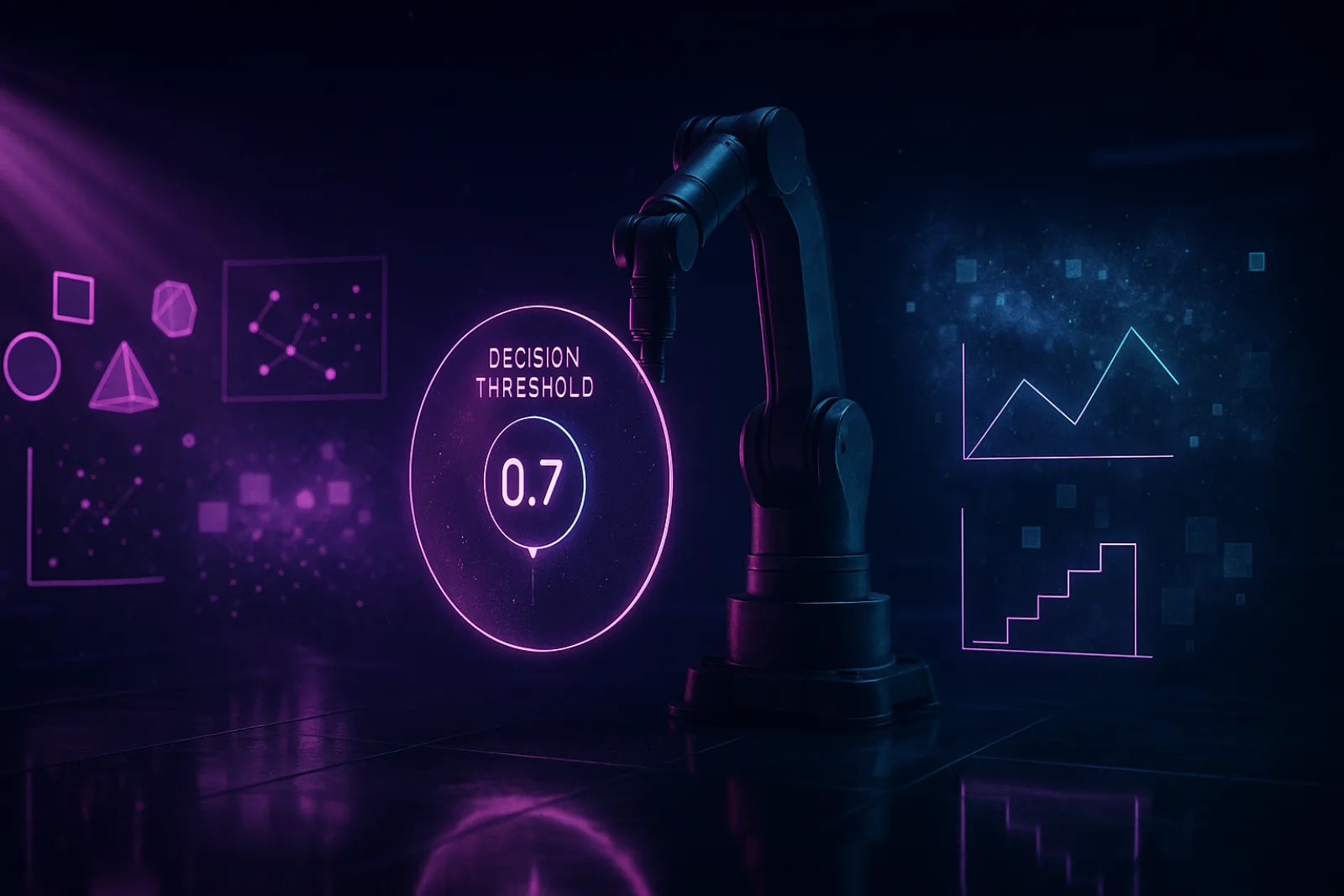
A robot pauses in front of a table.
There is a block, a can, a box, and something that is either on top of something else or merely enjoying a close and misleading friendship. A camera sends pixels. A perception model sends predictions. A planner wants a symbolic fact: On(A, B) or not. The expensive mistake is pretending that this last step is clean.
This is where many automation systems quietly fail. They do not fail because the neural model sees nothing. They fail because the planner treats a fuzzy perception output as if it were a notarised statement from physics itself. The machine does not say, “I am 54% sure the blue object is on the red one.” It says, “The blue object is on the red one,” and then proceeds to make contact with reality, which tends to be rude.
The paper behind this article, A Neuro-Symbolic Framework for Reasoning under Perceptual Uncertainty, proposes a more disciplined loop: convert perception into symbolic predicates, keep uncertainty attached to those predicates, calibrate that uncertainty, and let the planner decide whether to act or gather more information.1 It is a robotics paper on the surface. Underneath, it is about a more general operational problem: when should an AI system stop checking and start doing?
That is not a philosophical question. It is a throughput question, a reliability question, and occasionally a “why did the robot knock over the stack?” question.
The real problem is not perception; it is premature certainty
Classical symbolic planning is wonderfully crisp. It wants predicates, actions, preconditions, and goals. If Clear(B) and Holding(A), then perhaps Place(A, B) is allowed. The logic is tidy. Unfortunately, cameras are not tidy.
End-to-end neural systems dodge this symbolic bottleneck by mapping observations directly to actions. That can work, but it usually pays in data hunger, weak interpretability, and awkward generalisation. Traditional neuro-symbolic systems try to split the difference: neural perception extracts symbols, symbolic planning reasons over them. Better. But often still brittle, because the extracted symbols become binary facts too early.
The paper’s central move is to delay that premature hardening. It represents the world as a probabilistic symbolic state: predicates such as On, LeftOf, CloseTo, and Clear are not merely true or false. Each comes with a confidence score.
That sounds modest. It is not. The moment confidence becomes part of the symbolic state, the planner can behave differently. It can commit when confidence is high, ask for more information when uncertainty is strategically important, and avoid wasting sensing actions when more looking would add little value.
In other words: uncertainty stops being a nuisance and becomes an input to control.
The mechanism: perception becomes predicates, but the doubt stays attached
The system has three important layers.
First, a neural-symbolic translator processes visual observations. In the paper’s implementation, this uses a ResNet-18 backbone, multi-head self-attention for variable object counts, and a graph neural network for relation prediction. The GNN matters because relations are not just labels attached to individual objects. “On” is relational. “LeftOf” is relational. “CloseTo” is relational. Pretending otherwise is how systems graduate from “AI” to “expensive sorting accident.”
The graph module uses geometric edge features between object pairs: relative positions, distances, size ratios, bounding-box overlap, and, where available, 3D spatial information. These features help the model learn relations between objects rather than merely classify isolated blobs.
Second, the translator outputs probabilistic predicates. It does not simply say that object A is on object B. It estimates a confidence for that predicate. The system then applies relation-specific thresholds. This is important because different predicates behave differently. A LeftOf relation is often easier to detect from a single view than an On relation, which can be distorted by occlusion, contact ambiguity, and small vertical differences. One threshold for every relation is administratively convenient and technically lazy.
Third, the planner consumes these probabilistic symbols. It uses a PDDL-style action domain with manipulation actions such as picking and placing, plus information-gathering actions such as looking closer or pushing an obstacle to reveal occluded objects. If a predicate critical to the plan is uncertain, the system can gather information before acting.
Here is the loop in business language:
| Stage | Technical role | Operational meaning |
|---|---|---|
| Perception | Extract object and relation evidence from visual input | “What does the system think it sees?” |
| Probabilistic predicates | Attach confidence to symbolic facts | “How much should planning trust this?” |
| Dependency modelling | Account for relations among predicates | “Does one belief make another belief more or less plausible?” |
| Thresholded planning | Decide whether confidence is sufficient | “Can we act, or do we need another check?” |
| Information gathering | Reduce uncertainty when it affects the plan | “Spend sensing budget only when it buys reliability.” |
This is the article’s main point: the contribution is not just a better robot stacker. The contribution is a mechanism for deciding when uncertainty should slow down execution.
Thresholds are the steering wheel, not the engine
The paper’s most memorable number is the planning confidence threshold. In the main experiments, the best threshold is around 0.7. Lower thresholds act too soon. Higher thresholds overthink. Somewhere in the middle, the system achieves the best balance between task success and extra sensing effort.
The threshold sweep makes the trade-off concrete:
| Planning confidence threshold | Success rate | Information actions |
|---|---|---|
| 0.5 | 82.0% | 0.5 |
| 0.6 | 88.0% | 0.8 |
| 0.7 | 90.7% | 1.1 |
| 0.8 | 85.0% | 1.8 |
| 0.9 | 78.0% | 3.0 |
The shape matters more than the exact decimal. Too low, and the planner accepts risky symbolic states. Too high, and the system burns time gathering information, sometimes without improving execution enough to justify the delay. Very modern: the robot discovers that anxiety is not a strategy.
The authors also derive an analytical threshold-selection argument: success rises with confidence up to a point, while planning and information-gathering costs also rise. The optimal threshold is the one that balances those curves. The paper reports that its theoretical optimum aligns with the empirically strong range.
This is useful, but it should not be romanticised. The 0.7 value is not a universal constant of robot wisdom. In the YCB-Video complex stack experiment, the best threshold is reported around 0.6, reflecting higher perceptual uncertainty in that setting. The practical lesson is not “always set confidence to 0.7.” It is “treat thresholds as domain-calibrated operating parameters, not folklore.”
The main evidence is stronger than a demo, weaker than deployment proof
The experiments use tabletop manipulation in PyBullet with YCB-style objects. The translator is trained on 10,047 synthetic scenes with 3 to 10 objects. The main task benchmarks include Simple Stack, Deep Stack, and Clear+Stack, each run for 50 trials.
The headline results are solid within that controlled setup:
| Scenario | Proposed method | DESPOT | POMCP | Symbolic+DL | SAC |
|---|---|---|---|---|---|
| Simple Stack | 94.0% | 86.0% | 82.0% | 74.0% | 68.0% |
| Deep Stack | 90.0% | 78.0% | 76.0% | 70.0% | 66.0% |
| Clear+Stack | 88.0% | 76.0% | 74.0% | 68.0% | 62.0% |
| Average | 90.7% | 80.0% | 77.3% | 70.7% | 65.3% |
The paper reports that the method stays within roughly 10–15 ms of planning time, while DESPOT and POMCP take 100+ ms per decision. That matters because slow planning can destroy the business case for autonomy even when benchmark accuracy looks respectable. Real automation is not a Kaggle leaderboard with a gripper attached.
The strongest comparison is against the POMDP-style baselines. POMDPs are principled about uncertainty, but they often pay heavily when operating closer to raw high-dimensional observations. This paper’s system moves uncertainty into symbolic space, where planning can remain interpretable and computationally cheaper.
That is the architectural bet: do not reason over every pixel-level possibility. Translate perception into a compact symbolic state, but keep calibrated uncertainty in that state.
The least flattering number is the most useful one
The translator’s overall predicate F1 is reported as 0.68. By relation type, the paper gives:
| Relation | Precision | Recall | F1 |
|---|---|---|---|
| On | 0.48 | 0.56 | 0.52 |
| LeftOf | 0.65 | 0.71 | 0.68 |
| CloseTo | 0.52 | 0.65 | 0.58 |
| Clear | 0.95 | 0.62 | 0.75 |
| Overall | 0.58 | 0.65 | 0.68 |
This table is where the paper becomes more interesting, not less.
A shallow reading might say: “F1 of 0.68? That does not sound production-ready.” Correct. It does not, by itself. But the point of the architecture is that the planner is not forced to pretend perception is perfect. The system is designed for a world where predicates are uncertain and uneven. Clear is relatively strong. On is difficult. The planner therefore needs to treat them differently.
The On relation is especially revealing. It is the relation most central to stacking, and it is also the most vulnerable to occlusion and geometry. This explains why relation-specific thresholding and information gathering matter. If all predicates were easy, the paper would be solving a toy problem with extra ceremony. They are not easy. That is why the uncertainty loop exists.
The ablation results reinforce this. Adaptive thresholds improve overall F1 from 0.28 with a fixed 0.5 threshold to 0.68. Information gathering raises average task success from 86.0% to 90.7% in the main benchmarks, and from 78.0% to 88.0% in the YCB complex stack setting. The value of information gathering grows when perception gets harder. Astonishingly, asking for more evidence is more useful when evidence is less reliable. Someone alert the strategy deck.
The ablations explain what is doing the work
The paper includes several ablations and variant tests. They are not all the same kind of evidence. Some support the main mechanism; others clarify engineering trade-offs.
| Test | Likely purpose | What it supports | What it does not prove |
|---|---|---|---|
| Main stacking benchmarks | Main evidence | The full uncertainty-aware loop improves task success against baselines in simulation | Real-world robustness |
| No information gathering | Ablation | Active sensing contributes measurable success gains | That the specific simulated sensing actions transfer to robots unchanged |
| Fixed vs adaptive thresholds | Ablation | Relation-specific thresholds are crucial for predicate quality | That the chosen thresholds generalise without recalibration |
| Confidence threshold sweep | Sensitivity test | There is a practical sweet spot between premature action and over-checking | That 0.7 is universally optimal |
| ResNet-18 vs ResNet-50 | Implementation trade-off | Larger backbone gives small success gain but slower inference | That architecture scaling is the primary lever |
| YCB complex stack | Comparison / extension | The approach remains useful in a more challenging object setting | Full sim-to-real validation |
The architecture comparison is a particularly nice anti-bigger-is-always-better detail. ResNet-50 improves success from 90.7% to 91.8%, but inference time rises from 15.2 ms to 21.3 ms. For a real-time system, that may be a bad trade unless the incremental reliability is worth the latency.
This is the kind of result businesses should care about. The best model is not the one that wins a static metric by 1.1 percentage points. The best model is the one that meets the operational envelope.
The theory is not just math garnish
The paper also builds a theoretical layer around uncertainty propagation, calibration, dependency modelling, and threshold selection.
The useful part is not that the paper contains theorems. Many papers contain theorems. Some even survive contact with the notation. The useful part is that the theory is tied to measurable system behaviour.
There are three core ideas.
First, uncertainty can propagate through symbolic state estimation. If several predicates are uncertain, the planner should reason about state-level uncertainty, not just isolated confidence scores. The paper starts with an independence formulation, then moves to a Markov Random Field to account for predicate dependencies such as mutual exclusion and implication.
Second, calibration quality affects planning guarantees. If a model says 0.8 confidence but is only correct 60% of the time, the planner is not risk-aware. It is risk-decorated. The paper reports calibration checks, including an Expected Calibration Error of 0.073 in simulation, and links calibration quality to convergence behaviour.
Third, information gathering is modelled as uncertainty reduction. The simplified recurrence is:
where $U_k$ is uncertainty after $k$ information-gathering steps and $\alpha$ is the reduction rate. The paper empirically tests whether this reduction assumption is reasonable in its manipulation setting. It also reports that observed convergence differs from the theoretical bound by at most about one step.
For business readers, the significance is simple: the paper is not merely saying “our robot looks again when confused.” It is trying to make “looking again” part of a measurable control policy.
That matters well beyond robotics.
The business pathway is operational confidence management
What the paper directly shows is limited and useful: in simulated tabletop manipulation, a neuro-symbolic system with calibrated predicate uncertainty, adaptive thresholds, and information-gathering actions outperforms several baselines on stacking-style tasks.
What Cognaptus infers is broader: many operational AI systems need the same pattern.
A warehouse robot deciding whether an item is safe to pick has a perception-to-action uncertainty problem. An inspection system deciding whether a defect requires escalation has a perception-to-decision uncertainty problem. A document automation agent deciding whether an invoice field is correct has a model-to-workflow uncertainty problem. A customer operations agent deciding whether to execute a policy change has a state-to-action uncertainty problem.
In each case, the architecture question is similar:
- Can the system express uncertainty at the level where decisions are made?
- Can it distinguish cheap uncertainty from dangerous uncertainty?
- Can it gather more information when doing so changes the expected outcome?
- Can it avoid infinite verification theatre?
The answer is rarely “use a larger model and hope.” Hope is not an operating procedure, despite impressive adoption rates.
The practical design pattern looks like this:
| Paper mechanism | Business analogue | ROI relevance |
|---|---|---|
| Probabilistic predicates | Confidence-bearing business state | Fewer blind commits |
| Relation-specific thresholds | Risk-specific decision thresholds | Less one-size-fits-all governance |
| Information gathering | Escalation, re-checking, human review, extra sensing | Better use of costly verification |
| Calibration checks | Reliability monitoring | Avoids overconfident automation |
| Planning threshold | Action policy | Balances throughput and error cost |
This is not a promise that the paper’s robot system transfers directly into a warehouse, hospital, factory, or back office. It is a claim that its control logic is worth copying: uncertainty should be represented where actions are chosen, not buried inside a neural score.
The boundary: this is not proof of real-world robot robustness
The main misconception to avoid is that the paper proves real-world robotic reliability. It does not.
The study is heavily simulation-based. It uses PyBullet, synthetic scenes, fixed viewpoints, simplified sensing actions, known object models, and constrained tabletop tasks with up to 10 objects. The paper itself is unusually explicit about this boundary. Real robots introduce messier sensor noise, lighting variation, calibration drift, reflective or transparent objects, dynamic occlusions, imperfect grasp execution, contact dynamics, deformable materials, and state transitions that do not map cleanly into discrete predicates.
The On relation is the warning label. It reaches F1 = 0.52 in the reported predicate results and remains a major source of residual failures. In a real robot setting, On is not merely a visual relation. It is a stability relation, a contact relation, a geometry relation, and sometimes an argument with gravity. Single-view perception will struggle when objects occlude one another or when “touching,” “leaning,” and “stably stacked” differ by millimetres.
The information-gathering actions also need caution. In simulation, “look closer” and “push obstacle” can be represented cleanly. In deployment, moving closer changes field of view and motion timing; pushing requires force limits, compliance, reversibility, and safety guarantees. A careless information-gathering action can damage the scene it was supposed to clarify. Excellent metaphor, poor operating principle.
So the correct business interpretation is disciplined:
- Direct result: the framework improves simulated tabletop manipulation performance under perceptual uncertainty.
- Reasonable inference: calibrated symbolic uncertainty and thresholded information gathering are valuable design principles for operational AI.
- Unresolved question: how well this specific implementation survives real sensors, real contact physics, dynamic environments, and broader action spaces.
That boundary does not weaken the paper. It prevents bad procurement.
The real lesson is knowing when confidence is expensive
The best part of this paper is not that it combines neural perception with symbolic planning. That theme has been around long enough to have its own furniture.
The better contribution is subtler: it treats confidence as an operational resource. Too little confidence, and the system acts recklessly. Too much required confidence, and the system becomes slow, fussy, and economically annoying. The task is not to maximise certainty. The task is to buy just enough certainty for the next action.
That is a useful lesson for robotics. It is also useful for enterprise AI systems now being asked to execute workflows, inspect documents, triage cases, recommend interventions, and trigger actions across software stacks.
The next generation of agents will not be judged only by whether they can reason. They will be judged by whether they know when their reasoning is good enough to act—and when another look is cheaper than a mistake.
Sometimes intelligence is not thinking harder.
Sometimes it is knowing when not to overthink the robot.
Cognaptus: Automate the Present, Incubate the Future.
-
Jiahao Wu and Shengwen Yu, “A Neuro-Symbolic Framework for Reasoning under Perceptual Uncertainty: Bridging Continuous Perception and Discrete Symbolic Planning,” arXiv:2511.14533, https://arxiv.org/html/2511.14533. ↩︎