A browser agent does not usually fail like a heroic machine confronting the limits of intelligence. It fails like an intern on a badly designed website.
It opens the wrong listing. It misses the tiny sort option. It clicks around because the page has too much visual noise and not enough obvious structure. It sees the button but not the pattern. Then, because the agent has no lasting operational memory of the stumble, the next task sends it back into the same swamp with a fresh pair of shoes.
The paper behind Recon-Act takes this unglamorous failure mode seriously.1 Its central move is simple but important: when a browser-use agent fails, do not merely ask it to try again. Send in a reconnaissance process, compare failed and successful trajectories, extract the lesson, and turn that lesson into a reusable tool.
That is the part worth reading slowly. Recon-Act is not just another benchmark entrant with a slightly larger score and a victory lap in Table 1. The interesting claim is architectural. Web agents improve when failures are converted into operational artefacts: hints, navigation shortcuts, sorters, image finders, voting tools, author finders, and other small pieces of procedural knowledge that can be invoked later.
In other words, the browser agent stops treating every website as a new existential crisis. Progress.
The real problem is not action; it is undiagnosed failure
Browser-use benchmarks look like action problems. The agent must click, type, search, compare, vote, sort, navigate, and answer. So the obvious instinct is to improve the action policy: better planning, better search, better multimodal grounding, more candidate actions, more simulation.
Recon-Act starts from a slightly different diagnosis. In many web tasks, the agent is not merely choosing the wrong action in isolation. It lacks a compact understanding of what kind of page it is dealing with and what local procedure would make the task easy.
A human on a shopping site may immediately realise: “sort by price, then inspect the relevant item.” On a classifieds page, a human may switch layouts because thumbnails are too small. On Reddit-like pages, a human may know that author history, post time, or image similarity is the relevant shortcut. The task is not solved by generic intelligence alone. It is solved by recognising the small procedural affordances of a particular environment.
Recon-Act calls this missing phase “reconnaissance.” The word sounds militaristic, but the mechanism is plain: gather targeted information from an unfamiliar web environment, identify what blocked execution, and produce guidance that makes the next execution easier.
The important distinction is that reconnaissance is not the final task execution. It is diagnosis before execution improves. That separation is the paper’s main contribution.
Recon-Act splits the agent into people who inspect the mess and agents that act on it
The system is organised into two teams.
The Reconnaissance Team is responsible for learning from failures. It receives failed trajectories, successful trajectories, and browser contexts. It then compares them at the step level, identifies the cause of failure, and proposes a remedy. In the Level 3 implementation reported by the paper, this team contains an Analyst and a Coder. The Analyst is still human-driven; the Coder is powered by GPT-5-Chat.
The Action Team is responsible for solving user tasks during execution. It contains a Master, a Tool Manager, and an Execution Agent. The Master interprets the user query and decides whether to invoke a tool. The Tool Manager registers and maintains tools. The Execution Agent supplies a fallback action when no tool is suitable or a tool call fails.
A simplified view looks like this:
| Component | Role in the loop | Business translation |
|---|---|---|
| Failed trajectory | Shows where the agent broke down | Incident log |
| Successful trajectory | Shows what a workable route looks like | Reference workflow |
| Analyst | Compares failure and success, identifies the blockage | Process analyst |
| Coder | Turns the remedy into tool code | Automation engineer |
| Tool Manager | Registers, merges, and maintains tools | Tool governance layer |
| Master | Selects which tool or agent should act | Workflow router |
| Execution Agent | Produces browser actions when tools do not decide | General fallback operator |
This is why a mechanism-first reading matters. If we jump straight to the benchmark number, we miss the paper’s more durable idea: Recon-Act moves part of agent improvement out of the model’s hidden reasoning and into an explicit tool archive.
That archive is where the system accumulates operational knowledge. It is also where enterprise readers should pay attention, because explicit tools can be reviewed, versioned, merged, retired, audited, and tested. “The model got smarter” is a difficult governance story. “The agent now has a price-sorter tool with known invocation conditions” is at least something a process owner can inspect without squinting into the void.
The loop is Rollout, Evaluate, Generate, Update
The training process follows a closed loop.
First, the Action Team attempts tasks and produces trajectories. Some succeed; some fail. The evaluator identifies whether the trajectory solved the task. Failed trajectories are not thrown away as embarrassing little corpses. They become raw material.
Second, the Reconnaissance Team compares failed and successful cases. The Analyst looks for the step where the wrong behaviour emerged. Was the agent missing page structure? Was the target item visible but too small? Did the agent need a sorting operation? Did it fail to navigate to an author page? Did it need a direct URL pattern rather than unreliable clicks?
Third, the Coder maps the remedy into a tool. The paper uses a broad definition of “generalized tools.” These can be executable decision tools or hint tools. The point is not whether every tool is a classical API. The point is that the lesson from failure is packaged into an invocable object.
Fourth, the Tool Manager registers the tool and the Action Team runs again with the augmented toolset. The loop continues until the team can no longer improve the toolset or repeated updates stop improving training accuracy.
This is the paper’s practical insight: browser agents need something between raw experience and model retraining. Recon-Act’s answer is a tool-generation layer that turns observed failure modes into operational scaffolding.
A more fashionable phrasing would be “self-evolution.” A more accurate phrasing is “curated procedural memory with partial automation.” Less glamorous, more useful.
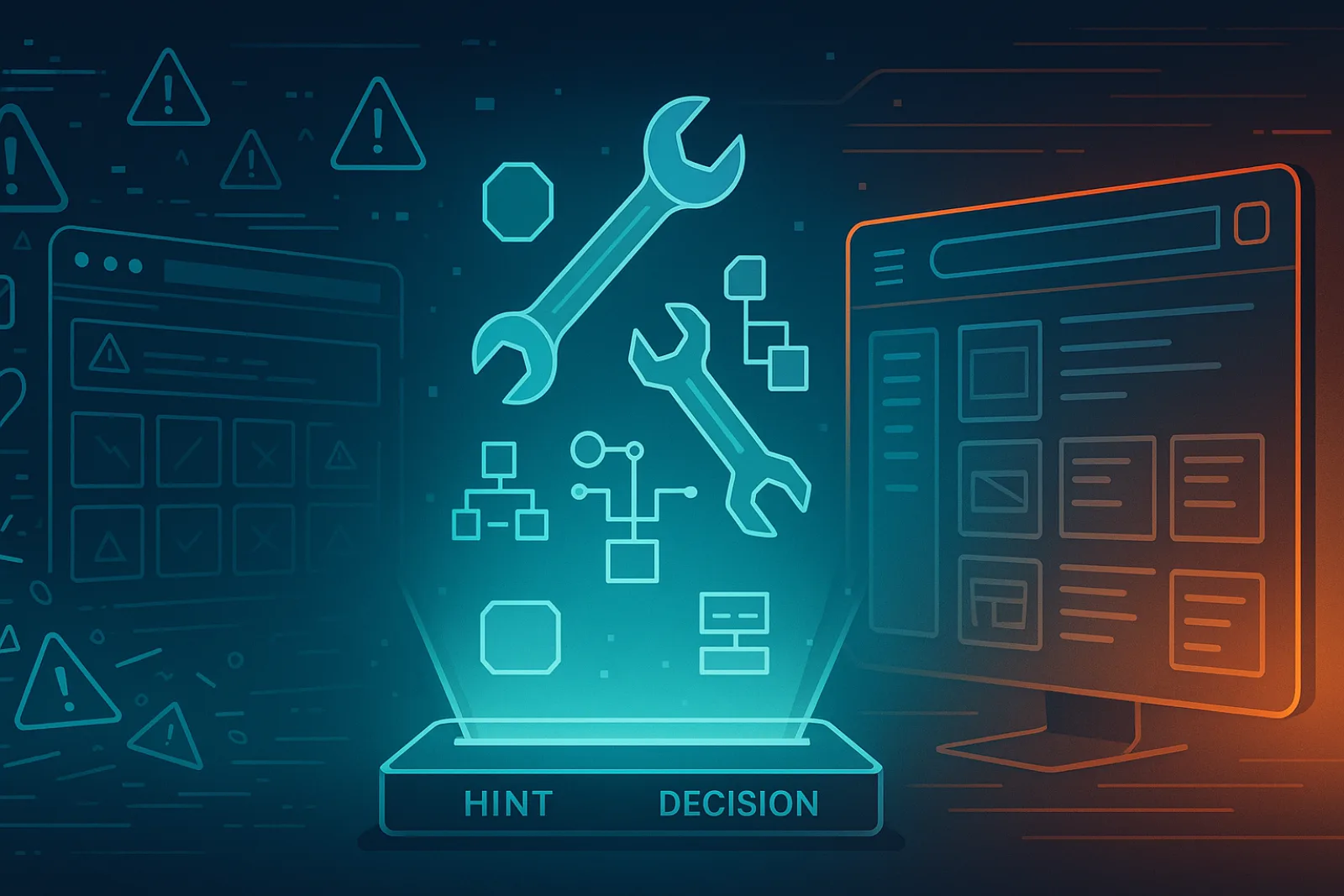
Hint tools and decision tools behave differently, and that difference matters
Recon-Act’s tools come in two modes.
A Hint-mode tool returns information that helps the Execution Agent decide what to do. It does not directly command the next browser action. For example, a tool might describe an image in a Reddit post or extract a post time. These are reconnaissance signals: useful, but not always deterministic.
A Decision-mode tool directly emits an action from the browser action space. When such a tool produces an action, the system treats it as authoritative and executes it. For example, tools in the paper include shopping and classifieds price sorters, category navigation tools, image searchers, author finders, subreddit navigators, and upvote/downvote tools.
This distinction is operationally important. Not every learned procedure should have the right to act. Some tools should inform the agent. Others can safely automate a specific action. Mixing those two categories would be a fine way to build a browser agent that is confidently wrong at higher speed, which is apparently still considered undesirable in some circles.
| Tool mode | What it returns | When it fits | Operational risk |
|---|---|---|---|
| Hint | Additional context or distilled observation | Ambiguous, context-sensitive tasks | Agent may still misinterpret the hint |
| Decision | A concrete browser action | Stable, repeatable local procedure | Wrong tool invocation can directly cause wrong action |
For business use, this is a useful governance pattern. A claims-processing agent, procurement agent, or web research agent might begin with hint tools for high-variance situations and graduate selected procedures into decision tools only after reliability is established. Recon-Act does not fully solve that governance problem, but it points at the right shape of it.
The tools are small, site-aware, and slightly messy
One of the paper’s most revealing implementation details is the tool list. Recon-Act creates 11 tools across the reported system. They include AuthorFinder, CategoryGuide, ClassifiedsPriceSorter, ImageSearcher, ShoppingImageFinder, ShoppingPriceSorter, SubRedditNavigator, UpVoter, DownVoter, PostTimeFinder, and RedditImageDescriptor.
The authors openly note that the tool names are “a bit chaos,” keeping the original names and descriptions as used by the Master. That small admission is more informative than a polished diagram. It reveals the uncomfortable middle state of practical agent engineering: the system is not purely hand-coded automation, but neither is it a clean autonomous optimiser. It is a growing workbench of local procedures, names, branches, and conditions.
This messiness is not incidental. The paper explains that automatically generated tools can be narrow and fragmented. A price sorter built for “cheapest item” may fail when the next query asks for “most expensive item.” A voting tool may be labelled too broadly. A sorter may support only one sorting direction. A site-specific tool may need conditional logic so that new behaviour does not break old behaviour.
That is why the Tool Manager remains human-driven in the reported Level 3 system. Humans handle naming, merging, feature branches, and tool maintenance.
This is also where the business lesson becomes sharp. The hard part of agentic automation is not merely producing a clever action once. It is maintaining a growing library of semi-general procedures without letting it become a junk drawer with an API.
The benchmark result is real evidence, but not a clean ablation
Recon-Act is evaluated on VisualWebArena, a benchmark of realistic visual web tasks across classifieds, shopping, and Reddit-style forums. The benchmark includes roughly 910 queries and requires agents to reason over text, images, page structure, and task-specific goals.
The reported result is strong. Recon-Act, using GPT-5-Chat, achieves a 36.48% overall success rate. The cited previous best, R-MCTS MAD with GPT-4o, reports 33.74%. Human performance is 88.70%.
Here is the useful summary:
| Domain | Recon-Act success rate | Best cited automated baseline | Human performance | Interpretation |
|---|---|---|---|---|
| Classifieds | 39.32% | 41.00% | 91.07% | Competitive, but not the strongest in this subdomain |
| 27.14% | 28.70% | 87.10% | Competitive, but still slightly behind the best baseline | |
| Shopping | 39.27% | 32.30% | 88.39% | Clear reported gain over prior automated systems |
| Overall | 36.48% | 33.74% | 88.70% | New reported state of the art, with a very large human gap |
The shopping result is the most persuasive part of the table. It fits the mechanism. Shopping sites often contain repeatable local procedures: category navigation, price sorting, image matching, product detail inspection. These are exactly the kinds of behaviours that can be captured in decision tools.
The overall improvement is also meaningful, but it should not be overread. The comparison is not a clean architecture-only ablation. Recon-Act uses GPT-5-Chat, while many cited baselines use earlier models such as GPT-4o or other VLMs. The paper’s main result is best read as a comparison with prior work and as evidence that the tool-centric reconnaissance loop can be competitive at the frontier. It does not isolate how much of the gain comes from the architecture, the base model, the manually curated tool process, or the particular site patterns.
That is not a fatal flaw. It is simply the difference between “this system performs best in the reported benchmark table” and “we have causally decomposed every source of improvement.” The first claim is supported. The second would require ablations the paper does not provide.
The implementation details are not footnotes; they are the thesis with a hard hat on
The paper’s implementation details materially change how the result should be interpreted.
First, Recon-Act does not use random-walk autonomous exploration. Instead, the authors manually author a small training set with fewer than 10 examples per domain. Their argument is that random exploration can generate large, redundant corpora, whereas the goal here is efficient curation.
Second, the reported system is Level 3 on the authors’ six-level roadmap. The Master, Execution Agent, and Coder are model-driven. The Analyst and Tool Manager still involve humans. This means the most judgement-heavy parts of the loop—failure analysis and tool consolidation—are not fully automated.
Third, the system is evaluated on a fixed set of websites. The authors explicitly state that current reconnaissance works successfully only in this bounded setting and has not yet generalized to a broader, more heterogeneous web environment.
These are not generic limitations to be sprinkled politely at the end. They define the system.
| Paper element | Likely purpose | What it supports | What it does not prove |
|---|---|---|---|
| VisualWebArena results | Main evidence and comparison with prior work | Recon-Act is competitive and reports a new overall benchmark high | Architecture-only superiority independent of model choice |
| Tool list | Implementation detail | Failures can be converted into concrete, site-aware tools | Automatically generated tools are already clean and scalable |
| Fewer than 10 examples per domain | Implementation detail and efficiency claim | The system can improve from a small curated training set | Broad open-web generalisation |
| Level 3 roadmap status | Boundary condition | Human-AI collaboration can make the loop work today | Fully autonomous self-improvement |
| Fixed website scope | Limitation | Recon-Act can exploit repeated site patterns | Robust performance across arbitrary websites |
The paper is strongest when read as an engineering pattern: use targeted reconnaissance to turn repeat failures into reusable tools. It is weaker if read as a declaration that browser agents can now autonomously improve themselves across the open web. They cannot. Or, more precisely, this paper does not show that they can.
The business value is cheaper diagnosis, not magical autonomy
For enterprise automation, the immediate value of Recon-Act is not that it removes people from the loop. It changes where people sit in the loop.
Traditional browser automation often fails in two boring ways. Hard-coded scripts break when the site changes. General agents wander when the workflow contains page-specific conventions. Recon-Act suggests a middle path: let agents attempt tasks, capture failures, then have a reconnaissance process convert recurring obstacles into governed tools.
That matters for workflows such as:
- procurement agents comparing products across supplier portals;
- customer support agents navigating account dashboards;
- compliance teams collecting evidence from semi-structured web systems;
- market intelligence agents browsing classifieds, listings, forums, or review sites;
- internal operations agents using legacy browser-based software that nobody wants to admit still runs the company.
The Cognaptus inference is this: Recon-Act points toward tool-mediated agent operations. Instead of asking whether an agent can complete every workflow end-to-end, ask which failures are repeated enough to deserve tool creation.
A practical deployment pattern might look like this:
- Run the browser agent on real but low-risk tasks.
- Store successful and failed trajectories.
- Cluster recurring failure modes.
- Convert high-frequency failures into hint tools first.
- Promote stable procedures into decision tools only after testing.
- Maintain the tool archive with ownership, naming standards, regression tests, and retirement rules.
This is less romantic than “autonomous enterprise agent.” It is also more likely to survive contact with a procurement portal designed during someone’s lunch break in 2011.
The misconception: “self-evolving” does not mean self-governing
The phrase “self-evolving” invites a predictable misreading. It sounds as if Recon-Act discovers failures, diagnoses them, writes tools, merges them, and maintains its own tool ecosystem without human intervention.
That is not what the reported system does.
At Level 3, humans still drive the Analyst and Tool Manager. The Analyst compares trajectories and proposes remedial strategies. The Tool Manager decides whether to add or update tools, handles naming, adjusts feature branches, and merges capabilities where appropriate. These are not clerical details. They are central to whether the tool library becomes a usable operational layer or a growing pile of brittle shortcuts.
The authors are clear about this. Moving beyond Level 3 would require stronger reasoning in the Analyst and stronger coding and branch-management ability in the Tool Manager. They also identify the need for broader reconnaissance capabilities beyond fixed websites.
So the correct business reading is not: “We can now let agents rewrite their own tools unsupervised.”
The correct reading is: “A structured human-AI loop can turn browser-agent failures into reusable operational assets, and parts of that loop can be model-assisted.”
That distinction is not pedantry. It is the difference between a manageable automation programme and a very expensive way to manufacture new failure modes at scale.
Reconnaissance changes what should be measured
Recon-Act also nudges evaluation in a useful direction. Browser agents are often judged by final task success. That is necessary, but incomplete. A system like Recon-Act creates intermediate assets: tools, hints, corrected workflows, merged procedures, and routing logic. Those assets may matter even when a single run fails.
For business settings, the evaluation question should expand:
| Measurement question | Why it matters |
|---|---|
| Which failures repeat across workflows? | Repetition identifies candidates for tool creation |
| Which tools improve more than one task? | Reuse separates operational learning from one-off patching |
| How often does the Master select the right tool? | Tool quality is useless if routing fails |
| How often does a decision tool act incorrectly? | Direct-action tools require higher confidence |
| How much human maintenance does the tool archive require? | Labour cost determines whether the loop scales |
| Do tools survive website changes? | Browser environments are not polite enough to remain stable |
This is where Recon-Act becomes more than a benchmark paper. It suggests that agent quality is partly a property of the surrounding learning system. The agent is not just the model. It is the model plus the trajectories, evaluator, analyst process, tool generator, registry, router, and maintenance discipline.
Naturally, this makes procurement forms less exciting. It also makes them more honest.
Where the result applies, and where it does not
Recon-Act is most relevant when three conditions hold.
First, the environment has repeated structure. Shopping, classifieds, forums, dashboards, and portals are good candidates because local procedures recur. If every task takes place on a radically different website with no stable affordances, tool reuse becomes harder.
Second, failure data is available. The system needs trajectories, successful comparisons, and browser context. Without enough failed and successful cases, reconnaissance has little to contrast.
Third, human governance is acceptable. At least in the reported system, humans still handle the judgement-heavy parts. This is suitable for enterprise automation teams that already expect process owners, QA reviewers, and automation engineers. It is less suitable for anyone seeking a fully autonomous open-web agent that improves while everyone goes for coffee.
The major boundaries are clear:
- The benchmark success rate is still far below human performance.
- The architecture is not isolated from the base model choice.
- The tool archive depends on human naming, merging, and maintenance.
- The training examples are manually curated and small.
- The current system is designed around fixed websites, not the whole messy web.
- The paper does not provide a deep ablation showing which component contributes how much.
These boundaries do not make the work unimportant. They make it legible. Recon-Act is valuable precisely because it shows a plausible engineering route between brittle scripts and dreamy end-to-end autonomy.
The takeaway: the stumble is the product
Recon-Act’s best idea is not that a browser agent can score 36.48% on VisualWebArena. That number is useful, but it will age. Benchmark tables always do. Someone will add a stronger model, more search, more tools, more post-processing, and the leaderboard will dutifully reshuffle itself like a nervous spreadsheet.
The more durable idea is that browser-agent failures should be mined, not merely regretted. A failed trajectory is not just evidence that the model is weak. It is a diagnostic trace. Compared against a successful route, it can reveal the missing local procedure. Encapsulated as a tool, that procedure becomes reusable.
For businesses, that reframes agentic automation. The question is not whether an agent can magically handle every web workflow on day one. It is whether the organisation can build a disciplined loop that converts repeated stumbles into governed capabilities.
Recon first. Act second. Wreck the roadblocks only after you understand them.
A shocking concept, apparently.
Cognaptus: Automate the Present, Incubate the Future.
-
Kaiwen He, Zhiwei Wang, Chenyi Zhuang, and Jinjie Gu, “Recon-Act: A Self-Evolving Multi-Agent Browser-Use System via Web Reconnaissance, Tool Generation, and Task Execution,” arXiv:2509.21072, 2025, https://arxiv.org/abs/2509.21072. ↩︎