Clicking is easy. Unclicking is the expensive part.
That is the uncomfortable reality behind industrial GUI automation. In a normal office workflow, a bad click might open the wrong spreadsheet, submit the wrong form, or annoy finance. In a data center management console, the same class of error can modify a rack asset, delete a server entry, trigger a control flow, or send a human operator into that special emotional state known as “please tell me the backup exists.”
This is why the usual pitch for GUI agents — “the model can see the screen and use the computer like a person” — feels faintly deranged in mission-critical environments. Data center infrastructure management software, industrial control panels, power management dashboards, and vendor-specific operational consoles are not consumer apps with friendly affordances. They are dense, customized, nested, partially undocumented, and full of actions that should not be discovered through adventurous clicking.
The InfraMind paper tackles exactly this problem: how to make a GUI agent useful in industrial management software without pretending that a bigger vision-language model magically becomes a reliable operator.1 Its answer is not “more prompting.” Mercifully. It is a mechanism: explore the software inside a reversible sandbox, convert the exploration into structured operational knowledge, deploy a smaller offline model that reuses that knowledge, and put hazardous actions behind layered safety controls.
That makes InfraMind interesting less as a benchmark entry and more as a design pattern. The paper is about data center infrastructure management, but the deeper lesson is broader: in serious operational software, agent intelligence has to become procedural memory, not improvisational theatre.
The wrong mental model is “drop in a better GUI agent”
The tempting misconception is straightforward: if generic GUI agents are getting better, then industrial GUI automation is mostly a model-selection problem. Use a stronger VLM, give it a screenshot, maybe add a few tools, and let it navigate.
InfraMind argues the opposite. Industrial management software breaks that assumption in five practical ways.
First, the interface elements are often unfamiliar. Proprietary icons, vendor-specific panels, custom buttons, and dense operational layouts do not carry the semantic cues that general-purpose web or office agents have learned.
Second, precision and efficiency matter more than casual adaptability. A consumer agent can wander around a few screens and still be considered “autonomous.” An industrial agent that wanders during an incident is just a very expensive intern with root-adjacent anxiety.
Third, desktop industrial GUIs often lack clean state identifiers. Web agents get URLs, DOM trees, and addressable browser states. DCIM applications may present nested asset trees and visual panels without any explicit “you are here” marker.
Fourth, deployment is constrained. Many industrial environments are network-isolated, air-gapped, or simply unwilling to route operational control through cloud APIs. This makes frontier-model dependency awkward at best and disqualifying at worst.
Fifth, safety is not decorative. Industrial software contains hazardous actions. “Delete,” “reset,” “override,” and “power” are not just words. They are business-continuity risks wearing UI labels.
InfraMind’s contribution is to treat these constraints as first-class system requirements rather than annoying edge cases. The result is a mechanism-first architecture built around reversible exploration, workflow memory, state graphs, structured knowledge transfer, and safety gating.
Snapshot rollback turns exploration from danger into evidence
The central idea is almost embarrassingly sensible: before an agent operates, let it explore — but only in an environment where mistakes can be rolled back.
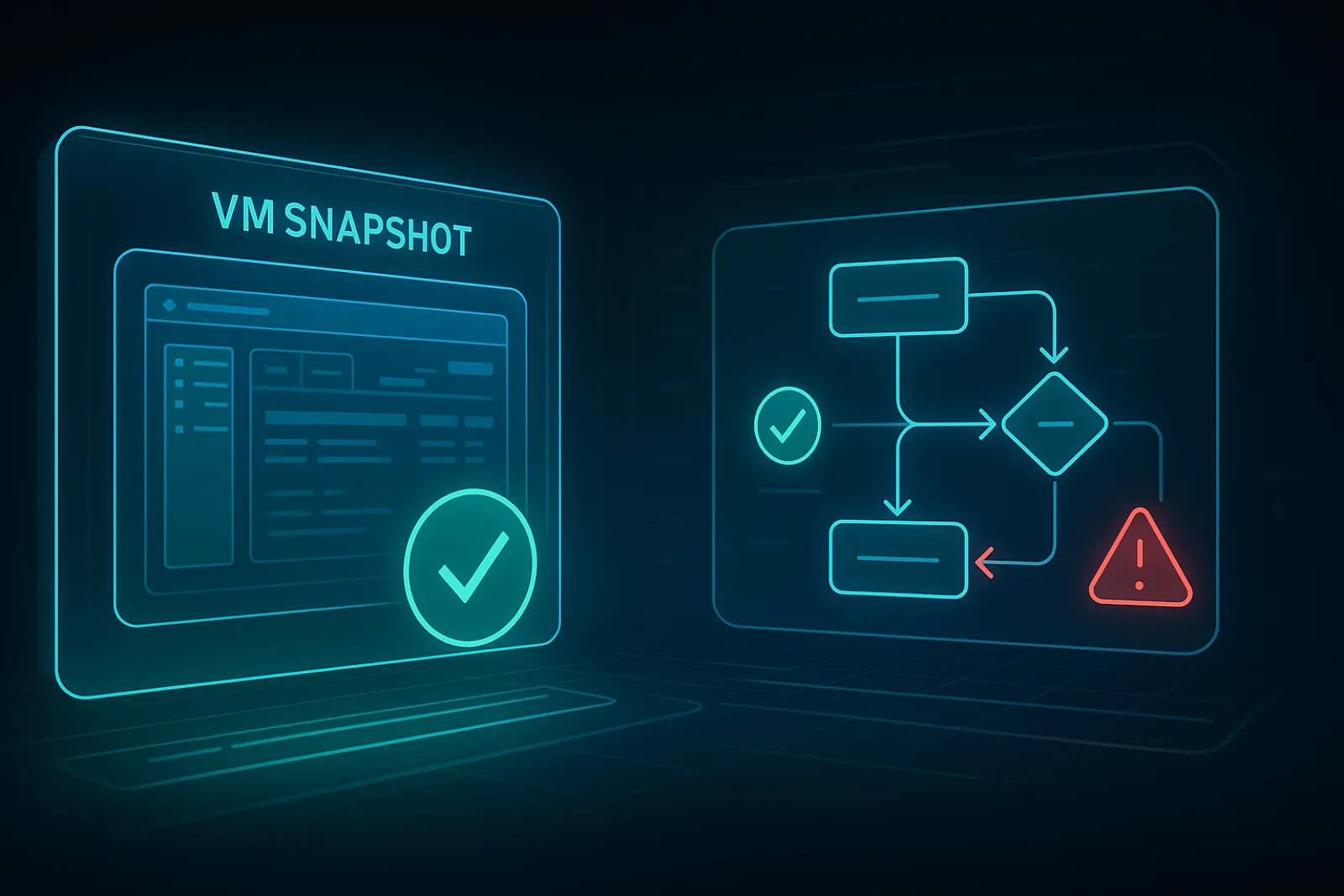
InfraMind runs systematic GUI exploration inside a virtual machine. At each discovered GUI state, the agent takes a snapshot, interacts with detected clickable elements, observes the resulting screen change, records the transition, and then restores the VM snapshot. The paper describes both breadth-first and depth-first exploration variants. The search strategy matters less than the operating principle: every exploratory click is wrapped in a reversible state.
That design addresses a basic problem in GUI-agent learning. Interfaces are not passive documents. Clicking changes the world. A button may open a panel, trigger a modal, submit a form, delete an object, or move the system into a state that is hard to recover. In conventional GUI exploration, trial and error is contaminated by irreversibility. InfraMind’s snapshot-and-rollback loop converts those risky trials into repeatable observations.
The output of this phase is not merely a trace log. InfraMind uses before-and-after screenshots to infer what unfamiliar elements do. An Element Learning Agent compares the pre-action and post-action states and generates candidate captions for icons and controls. These icon-caption pairs become a software-specific knowledge base.
The paper then strengthens this knowledge base in two ways: by using collected icon-caption pairs to fine-tune the visual parsing stack, and by using CLIP-style visual similarity matching to retrieve known captions for visually similar icons during inference. In plain terms, the system learns that this weird sidebar glyph means that operational function in this DCIM environment. Very artisanal. Also exactly what generic GUI agents usually lack.
The important business interpretation is not that every production system should immediately let agents crawl its management console. It is that exploration should be separated from execution. The risky learning phase belongs in a sandbox. The operational phase should reuse the resulting map.
Memory turns successful clicks into operational routes
Exploration alone is not enough. A system that learns what buttons do but still replans from scratch every time is merely better-informed chaos.
InfraMind’s second mechanism is memory-driven planning. During task-specific learning, the system attempts representative tasks and stores successful trajectories as action-flow trees. In these trees, nodes represent GUI-observable states and edges represent actions. Successful task paths become reusable routes through the software.
This is the paper’s most business-relevant move. Many operational workflows are not conceptually hard; they are procedurally annoying. Locate a data center, drill into a rack, find a device, inspect an alert, modify an asset, confirm a status. The value is not philosophical reasoning. It is reaching the right panel reliably, with fewer steps, lower variance, and less operator supervision.
At deployment time, InfraMind retrieves relevant prior experience, identifies a short successful trajectory, and uses it as a global plan. The agent is no longer discovering the interface live. It is following learned operational routes while still retaining the ability to adjust.
That distinction matters. Traditional RPA stores scripts. InfraMind stores learned state-action structure. RPA says, “Click coordinate X, then button Y, assuming nothing moved.” InfraMind says, “This task has historically passed through these interface states using these actions; localize the current state, then follow the proven path.” Still not magic. Much less brittle.
A state graph gives desktop software the thing web agents take for granted
For web automation, the URL is a gift. It gives an agent a crude but useful state identifier. Industrial desktop software does not always provide that gift. It may have hierarchical panes, tree views, tabs, dashboards, pop-ups, and panels whose visual differences are subtle but operationally significant.
InfraMind addresses this with a State Identification Agent. During exploration, the system generates textual descriptions of each interface state and also encodes visual representations using similarity models. The resulting states are organized into a directed state transition graph.
This graph is the agent’s substitute for a navigational map. It helps the system determine where it is, track workflow progress, resume after interruptions, recover from wrong turns, and plan a route to a target state.
For business operators, this is not an academic nicety. State localization is the difference between “the agent is probably in the right area” and “the agent can explain which workflow state it occupies and what transition it intends to take next.” In operational environments, that difference is where auditability begins.
A useful way to read InfraMind is as a conversion engine:
| Raw GUI experience | Structured artifact | Operational consequence |
|---|---|---|
| Unknown icons and controls | Icon-caption knowledge base | The agent can ground proprietary UI elements |
| Successful task attempts | Action-flow trees | The agent can reuse proven workflows |
| Screen transitions | State transition graph | The agent can localize, recover, and plan |
| Large-model exploration | Lightweight deployment package | The agent can run offline with smaller models |
| Hazardous controls | Blacklists, confirmations, risk checks | The agent is less likely to perform dangerous actions silently |
That table is the whole paper in miniature. The agent is not just “using a GUI.” It is turning GUI exposure into operational infrastructure.
The deployment lesson is architecture beats model size, sometimes
InfraMind’s knowledge transfer story is practical. The paper explicitly recognizes that cloud frontier models are often a poor fit for industrial deployment. Many environments require offline operation, and even when local deployment is possible, large models may be too slow or resource-heavy.
The authors therefore separate the heavy learning phase from the deployment phase. Large models are used to explore, reason, caption, and construct the structured artifacts. At runtime, a smaller model can consult the learned icon-caption base, action-flow trees, and state graph.
The experimental results support this design choice. On OpenDCIM, InfraMind with Qwen2.5-VL-32B achieves an 83.3% success rate with 7.1 average steps. The Qwen2.5-VL-7B version reaches 80.0% with 7.5 average steps. On EcoStruxure IT, the 32B version reaches 76.7% with 7.5 steps, while the 7B version reaches 66.7% with 8.6 steps.
That is not identical performance, and nobody should round it up into “small models are solved.” The drop on EcoStruxure IT is real. But the result is still strategically important. With the right structured knowledge around it, a smaller offline model can become operationally plausible in a domain where direct frontier-model access may be impossible.
This is a recurring lesson in applied AI systems: if the environment is stable enough to map, architecture can reduce the burden placed on model intelligence. In other words, do not ask the model to rediscover the building every time it needs to find the server room. Build a map. Radical stuff.
The evidence: strong benchmark gains, with a narrow runway
The paper evaluates InfraMind on two DCIM platforms: OpenDCIM, an open-source system, and Schneider Electric’s EcoStruxure IT, a commercial platform. The benchmark contains 10 tasks per platform, spanning easy, medium, and hard tasks. Each task is executed three times per agent. A run that fails to complete within 20 steps is marked as a failure and assigned 20 steps for averaging. Human annotators verify whether the final system state matches the expected outcome.
The main comparison is against OmniTool with GPT-4o, Agent S2 with Claude-3.7-Sonnet, and UI-TARS-1.5.
| System | OpenDCIM success / avg. steps | EcoStruxure IT success / avg. steps | Likely role in the paper |
|---|---|---|---|
| OmniTool (V2 + GPT-4o) | 50.0% / 11.5 | 36.7% / 13.8 | Comparison with prior GUI-agent tooling |
| Agent S2 (Claude-3.7-Sonnet) | 60.0% / 12.9 | 33.3% / 16.2 | Comparison with generalist-specialist GUI agents |
| UI-TARS-1.5 | 43.3% / 14.5 | 20.0% / 16.7 | Comparison with open-source screenshot-based GUI agents |
| InfraMind (Qwen2.5-VL-32B) | 83.3% / 7.1 | 76.7% / 7.5 | Main evidence for the full framework |
| InfraMind (Qwen2.5-VL-7B) | 80.0% / 7.5 | 66.7% / 8.6 | Evidence for lightweight offline viability |
The result is not subtle. InfraMind completes more tasks and uses fewer steps. The efficiency result matters because industrial GUI automation is not only about final success. A system that reaches the right state in 7 steps rather than 14 is not merely faster; it creates fewer opportunities for state drift, operator confusion, and hazardous intermediate actions.
The task-level heatmaps add another useful interpretation. Easy and medium tasks show more consistent completion. Hard tasks are where baselines degrade sharply, especially on the commercial EcoStruxure IT platform. InfraMind still struggles more there than on easier tasks, but it degrades less severely. That is what one would expect if the main advantage comes from accumulated interface-specific knowledge rather than generic screenshot reasoning.
The ablations show the system is not just riding on a strong model
The ablation results are important because they test whether InfraMind’s gains come from its architecture or merely from model choice.
On OpenDCIM, the full Qwen2.5-VL-32B InfraMind system achieves 83.3% success with 7.1 average steps. Removing planning drops performance to 50.0% success and 11.7 steps. Removing both planning and exploration drops it further to 36.7% success and 13.7 steps.
The smaller Qwen2.5-VL-7B version shows the same pattern: full InfraMind reaches 80.0% success with 7.5 steps; without planning it falls to 40.0% and 13.2 steps; without both planning and exploration it falls to 23.3% and 15.7 steps.
That is the architectural argument in numbers. Planning and exploration are not ornamental modules attached to a model demo. They appear to carry much of the system’s operational advantage.
| Test | Likely purpose | What it supports | What it does not prove |
|---|---|---|---|
| Main benchmark across two DCIM platforms | Main evidence | InfraMind outperforms tested GUI-agent baselines on success rate and steps | Universal reliability across all industrial software |
| Removal of planning | Ablation | Memory-driven action-flow reuse materially improves success and efficiency | Planning alone is sufficient |
| Removal of planning and exploration | Ablation | Systematic exploration is central to domain adaptation | Exploration will scale cheaply to every GUI |
| Multiple VLM backbones | Robustness / model-variant test | The framework works across several model choices | Model choice no longer matters |
| Navigation and deletion case studies | Exploratory case evidence | Learned routes and safety gates can improve practical behavior | Full safety assurance under production hazards |
The most interesting ablation is the 7B result. A smaller model without the system scaffolding performs poorly. A smaller model with exploration and planning becomes competitive with much larger deployments. That is not “distillation” in the narrow sense of compressing parameters. It is knowledge transfer through structured artifacts: icons, flows, and states.
For enterprises, this is the useful framing. The question is not only “which model should we buy?” It is “what operational memory can we build so the model does less guessing?”
Safety is layered because one guardrail is just a polite suggestion
InfraMind’s safety design has three layers.
The first is a GUI element blacklist. During exploration and execution, detected interface elements are compared against blacklisted high-risk controls using visual similarity. If an element resembles a prohibited item, the system excludes it from candidate actions.
The second is a hazard confirmation module. If InfraMind is about to perform a potentially hazardous action, it triggers a human confirmation step. The operator can approve, reject, or take over.
The third is LLM-based semantic risk detection. Before executing planned instructions, an LLM-as-judge evaluates whether the instruction or action sequence appears harmful, hazardous, or outside safe bounds.
This is not a formal safety proof. It is a pragmatic layered defense. And in industrial settings, pragmatic layered defenses are usually what adults use while waiting for theory to catch up.
The paper’s deletion case study illustrates the distinction. When asked to delete a server, InfraMind detects the dangerous operation and prompts for confirmation. UI-TARS proceeds without comparable intervention. The point is not that InfraMind has solved industrial safety. The point is that safety is designed into the control loop rather than stapled onto the press release.
That distinction matters for adoption. Operators do not need an agent that claims to be careful. They need one that exposes risky transitions before committing them.
What this means for automation roadmaps
InfraMind’s most practical contribution is a roadmap shape.
A serious pilot should not begin with production execution. It should begin with a mirrored environment where the agent can explore safely. The first deliverable is not an autonomous operator. It is a knowledge package: learned element semantics, workflow trajectories, and state graphs.
Only after that should a team move into read-only dry runs, then guarded write operations, then progressively broader workflows. The business metrics should also reflect the mechanism, not just the demo.
Useful pilot metrics include task success rate, average steps per completed task, state-localization failures, recovery success after induced navigation errors, human intervention rate, confirmation accept/reject patterns, and drift between learned UI captions and current interface behavior.
The ROI case is therefore not “replace operators.” That framing is both lazy and politically doomed. The better case is operational leverage: fewer repetitive navigation steps, less dependence on scarce expert memory, faster execution of routine procedures, better workflow auditability, and more consistent handling of risky actions.
A practical adoption framework looks like this:
| Phase | Goal | Output | Stop condition |
|---|---|---|---|
| Sandbox mapping | Learn the interface without production risk | Icon-caption base, state graph, action-flow trees | Missing critical elements or unsafe exploration paths |
| Read-only operation | Validate navigation and information retrieval | Success rate, step count, localization accuracy | Repeated wrong-state execution |
| Guarded write actions | Test controlled modifications | Confirmation logs, denied-action records, rollback procedures | Ambiguous hazard classification |
| Production assist | Support operators, not replace them | Auditable action traces and operator overrides | Unexplained state transitions |
| Continuous drift monitoring | Keep knowledge current | UI-diff alerts and re-exploration triggers | Caption/flow mismatch above threshold |
The unglamorous phrase here is “production assist.” That is where this kind of agent belongs first. It should help operators navigate, retrieve, verify, prepare, and execute guarded workflows. Full autonomy can wait until the agent has earned the right not to terrify everyone.
The boundaries are narrow, and that is fine
The evidence is promising, but it has clear boundaries.
The benchmark uses two DCIM systems, 10 tasks per platform, and three runs per task. That is enough to support the paper’s claim that InfraMind improves performance in this evaluated setting. It is not enough to claim universal industrial readiness across power grids, water systems, HVAC consoles, rail systems, hospital infrastructure, or every vendor’s lovingly eccentric dashboard.
The paper’s own discussion points to perception limits. InfraMind relies on GUI element detection and visual parsing methods, including OmniParser-style components, which can miss buttons, text boxes, or other important controls. If perception fails, the downstream planning and safety modules inherit the problem. A beautifully structured state graph is less beautiful when the agent never saw the dangerous button.
Exploration cost is another practical boundary. Systematic exploration is valuable, but industrial interfaces can be large, dynamic, role-dependent, and configuration-specific. Snapshot rollback makes exploration safer; it does not make it free. Real deployments would need scoping, prioritization, human review, and change-management discipline.
The safety story is also preliminary. Blacklists, confirmations, and semantic risk checks are useful layers, not guarantees. They reduce certain classes of risk, especially obvious hazardous controls and explicit dangerous instructions. They do not eliminate all subtle failure modes, stale mappings, permission mistakes, or context-specific hazards.
Finally, the paper’s strongest quantitative evidence is benchmark-based. The authors discuss real-world data center deployment relevance, but the publicly reported numbers are from the constructed DCIM benchmark. That distinction matters. Benchmarks can show comparative capability; production environments reveal long-tail weirdness. And industrial software has enough long-tail weirdness to deserve its own endangered species list.
The deeper lesson: agents need operational memory before autonomy
InfraMind is not important because it says GUI agents can automate data center software. Many papers say agents can do things. Some of them even use tables.
It is important because it shows what has to surround the model before that claim becomes operationally believable.
The model needs a reversible way to learn the interface. It needs a memory of successful workflows. It needs state localization. It needs a deployment path that does not assume cloud access. It needs safety gates that activate before irreversible actions. And it needs evaluation that measures both success and the cost of getting there.
That is the shift from agent-as-clicker to agent-as-control-plane component.
For Cognaptus readers, the business takeaway is simple: mission-critical GUI automation should start with infrastructure, not bravado. Build the sandbox. Learn the interface. Store the routes. Track the states. Gate the hazards. Then let the model operate inside that discipline.
Because in industrial automation, the goal is not a computer that can click like a human.
The goal is a system that knows when not to.
Cognaptus: Automate the Present, Incubate the Future.
-
Liangtao Lin, Zhaomeng Zhu, Tianwei Zhang, and Yonggang Wen, “InfraMind: A Novel Exploration-based GUI Agentic Framework for Mission-critical Industrial Management,” arXiv:2509.13704, 2025. ↩︎