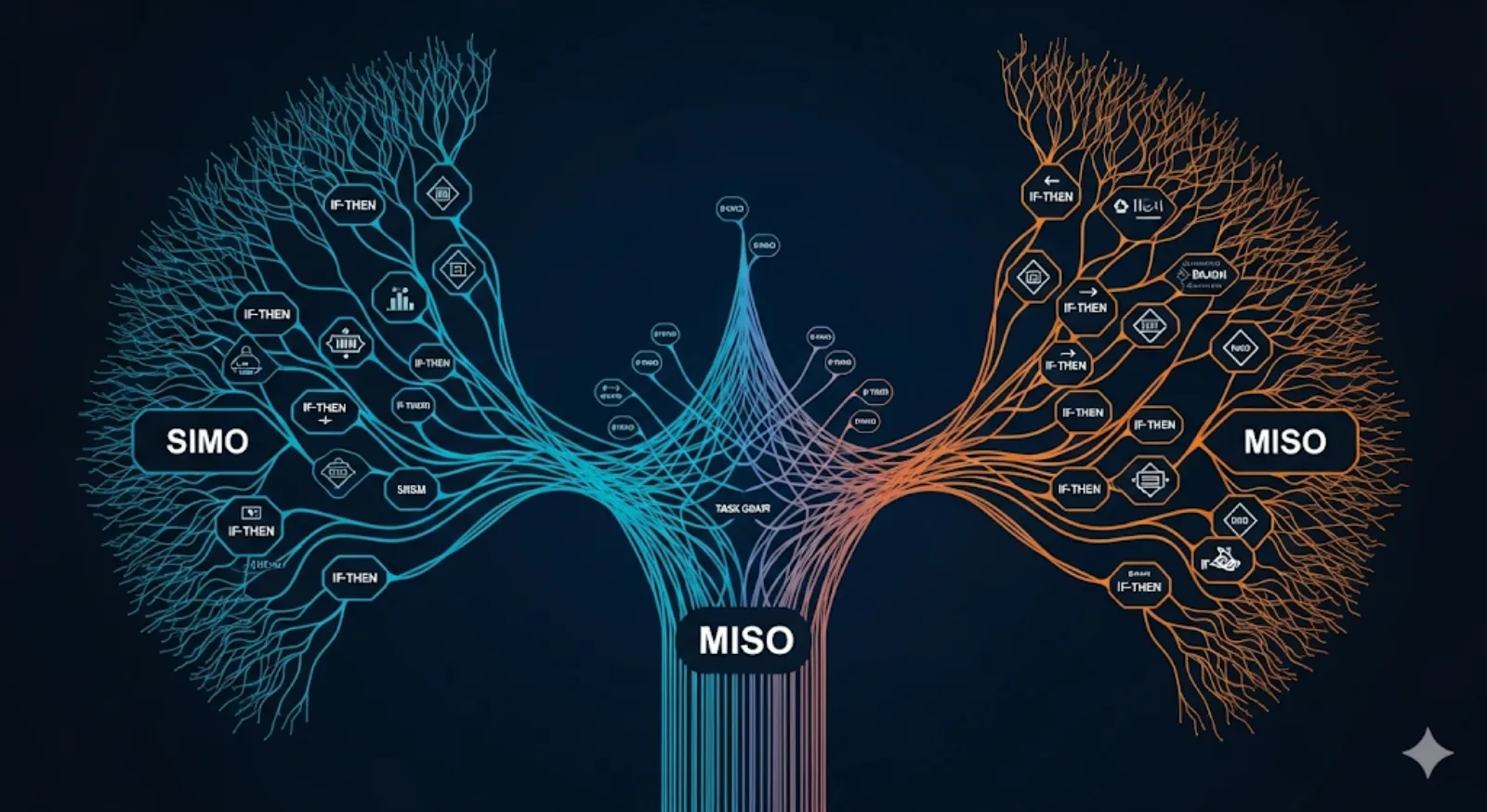
A bad agent stack often looks suspiciously like a bad committee.
One agent proposes a plan. Another wanders into a neighbouring topic. A third confidently supplies a detail that is almost right, which is a particularly expensive genre of wrong. Then the system fuses the outputs, declares victory, and leaves the human operator to discover that “collaboration” was just error propagation wearing a nicer blazer.
The XAgents paper tries to fix a very specific part of that mess: not by adding more agents, and not by hoping that debate magically produces truth, but by putting structure around the collaboration loop.1 Its recipe is simple enough to describe and awkward enough to implement: fork the task into multiple paths, process subtasks through domain-specific IF-THEN rules, fuse the answers, check them against a global goal, and rebuild the path when the output does not align.
That matters because enterprise AI does not merely need agents that can “think.” It needs agents whose work can be inspected, constrained, retried, and audited. The office does not need five more interns with excellent vocabulary. It needs a workflow that knows when one intern has gone feral.
XAgents is not “more agents”; it is a control loop for agent work
The easy misconception is that XAgents proves multi-agent systems win because there are more agents in the room. That is not the paper’s claim.
The paper proposes XAgents, a framework built around two main mechanisms:
- Multipolar Task Processing Graph, or MTPG: a directed acyclic task graph that splits uncertain tasks into subtasks and then fuses the results.
- IF-THEN Rule-based Decision Mechanism, or ITRDM: a rule layer that assigns domain relevance, routes subtasks to domain expert agents, resolves semantic conflicts, and checks whether intermediate results still match the global goal.
The distinction matters. Multi-agent systems already have plenty of ways to distribute work. XAgents is more interested in where the work branches, how specialised outputs are constrained, and when the system decides the current path is bad enough to revise.
A simplified view looks like this:
Original task
   ↓
Planner Agent defines global goal and builds MTPG
   ↓
Task forks into subtasks
   ↓
Domain Analyst Agent generates IF-THEN rules
   ↓
Domain Expert Agents answer through rule-constrained roles
   ↓
Fusion Expert Agent resolves conflicts and combines outputs
   ↓
Global Expert Agent checks alignment
   ↓
If weak: regenerate rules, retry subtask, or reconstruct graph
   ↓
Final fused answer
This is the central move. XAgents treats agent collaboration as a workflow with feedback, not a free-form conversation among synthetic personalities. Thank you, finally.
The graph handles uncertainty by forking before it fuses
The paper borrows a biological metaphor from multipolar neurons: Single Input Multiple Output and Multiple Input Single Output structures. In the framework, this becomes a task-processing pattern.
A task first branches outward. One ambiguous input can produce several subtasks. That is the SIMO side: divergence. Then the system pulls results back together through fusion nodes. That is the MISO side: convergence.
The authors define the MTPG as a directed acyclic graph with unweighted edges that represent dependency relationships. Its node types are straightforward:
| MTPG element | What it does | Operational reading |
|---|---|---|
| Original task node | Holds the uncertain task | The business request before interpretation |
| Subtask nodes | Break the task into smaller pieces | Work packages that can be routed or inspected |
| Fusion node | Combines adjacent subtask outputs | A controlled synthesis step, not a chat-room ending |
The graph is not just a visual convenience. It gives the system a place to make recovery decisions. If a subtask turns out to be irrelevant, it can be removed. If it remains too vague or complex, it can be decomposed into smaller subtasks. In the paper’s email case study, a subtask about analysing a film character’s psychological evolution is split into simpler components: identify the character, describe the psychological evolution, and evaluate the transformation from a critic’s perspective.
That is a useful design instinct. In many real workflows, failures come not from the final synthesis step but from a bad intermediate decomposition. A refund request is treated like a complaint. A compliance review is treated like a tone-editing task. A sales email is handled before the pricing exception is understood. Once the graph is wrong, the rest of the system becomes very efficient at producing the wrong artefact.
XAgents’ contribution is to make the decomposition itself a revisable object.
IF-THEN rules give the agents something firmer than vibes
The second half of XAgents is the rule mechanism. Each subtask is processed through multiple domain rules. A rule has the familiar form:
IF input belongs to Domain X,
THEN Domain Expert Agent X processes it under that role.
The paper uses a Domain Analyst Agent to generate these rules automatically. The IF side is expressed in natural language and used to estimate a domain membership degree. The THEN side initialises the relevant Domain Expert Agent prompt. The output is later fused by a Fusion Expert Agent.
Membership is not represented as a continuous numeric score. Instead, XAgents uses discrete labels:
High, Sub-High, Medium, Mid-Low, Lower, Low
That design choice is practical. LLMs are often better at handling labelled semantic judgements than pretending to be calibrated probability machines. Nobody should confuse these labels with rigorous uncertainty estimates, but they are useful as routing signals inside the workflow.
The global rule is the important addition. It checks whether a fused subtask result still aligns with the overall objective defined by the Planner Agent. If the membership degree falls below the Mid-Low threshold, the system revisits the subtask. The Global Expert Agent produces a difference signal, which is fed back into the Domain Analyst Agent so the rules can be regenerated or adjusted.
That means the system has two kinds of control:
| Control layer | What it constrains | Failure it tries to reduce |
|---|---|---|
| Domain rules | Whether the right expertise is being invoked | Off-domain answers and irrelevant reasoning |
| Global rule | Whether the output still serves the original goal | Local correctness that misses the point |
This distinction is more important than it looks. Many agent systems can produce locally plausible fragments. The harder problem is keeping those fragments aligned with the task the user actually cares about. XAgents makes that alignment check explicit.
Semantic confrontation is conflict resolution, not magic truth detection
The paper’s most memorable mechanism is semantic confrontation. When domain expert agents disagree, XAgents does not simply average the responses or accept the most fluent one. It applies a two-layer conflict rule:
- Prefer the semantic answer with more supporting votes.
- If needed, prefer the answer from rules with higher domain membership.
The email case study makes this concrete. The task asks which film earned Katharine Hepburn her second Oscar. One rule path produces The Lion in Winter. Two other rule paths produce Guess Who’s Coming to Dinner. The fusion mechanism keeps the answer supported by more outputs and stronger membership.
This is not a theorem of truth. It is a governance heuristic. Voting can fail if multiple agents share the same misconception. Membership labels can fail if the Domain Analyst Agent assigns relevance badly. Still, the mechanism is better than the common alternative: whichever answer survives the prompt stew.
For business use, semantic confrontation is best understood as structured disagreement handling. It gives the system a reproducible way to say:
- which answers conflicted;
- which rule paths produced them;
- which domain memberships were assigned;
- why one semantic interpretation survived fusion.
That is exactly the sort of trace one wants when debugging customer support automation, legal intake triage, invoice exception handling, or internal policy Q&A. The value is not that the system becomes incapable of hallucination. The value is that hallucination has fewer places to hide.
The benchmark gains are consistent, modest, and more interesting than they first look
The main evidence is a GPT-4 benchmark comparison across four task settings: TCW5, TCW10, Codenames Collaborative, and Logic Grid Puzzle. TCW is knowledge-oriented trivia creative writing, CC mixes knowledge and logic, and LGP is logic-heavy. The metric is string matching against target answers.
Here is the core result table reported in the paper:
| Method | TCW5 | TCW10 | CC | LGP |
|---|---|---|---|---|
| Standard | 74.6 | 77.0 | 75.4 | 57.7 |
| CoT | 67.1 | 68.5 | 72.7 | 65.8 |
| Self-Refine | 73.9 | 76.9 | 75.3 | 60.0 |
| SPP | 79.9 | 84.7 | 79.0 | 68.3 |
| AutoAgents | 82.0 | 85.3 | 81.4 | 71.8 |
| TDAG | 78.4 | 80.7 | 75.9 | 67.0 |
| AgentNet | 82.1 | 86.1 | 82.3 | 72.1 |
| XAgents | 84.4 | 88.1 | 83.5 | 75.0 |
The right interpretation is not “XAgents destroys the field.” It does not. Against the strongest listed baseline, AgentNet, the gains are 2.3 points on TCW5, 2.0 on TCW10, 1.2 on CC, and 2.9 on LGP. That is meaningful, especially because the improvement is consistent across task types, but it is not a revolution delivered by bar chart.
The more interesting pattern is where different reasoning styles struggle. Chain-of-thought underperforms the Standard baseline on TCW5 and TCW10, suggesting that extra reasoning can damage knowledge-recall tasks. It helps on LGP, where explicit reasoning is more naturally useful. XAgents performs well across both, which supports the paper’s claim that its combination of decomposition and rule-constrained fusion is helpful across knowledge and reasoning demands.
The result is strongest as an orchestration argument: do not blindly add reasoning; add the right control structure around reasoning.
The ablation says both halves matter, with the graph carrying more weight
The ablation test removes the two key components:
- –ITRDM, removing the IF-THEN rule mechanism;
- –MTPG, removing the multipolar graph structure.
The paper reports average performance drops of 11% without ITRDM and 16% without MTPG.
That is an important result because it prevents a lazy reading of XAgents as “rules did everything” or “graph planning did everything.” Both matter. The graph appears more damaging to remove, which makes intuitive sense: if the task is badly decomposed, even well-written rules are operating on compromised work units. Conversely, without the rules, the graph still exists, but the agents lose a major source of behavioural constraint.
For enterprise design, this implies a useful ordering:
- First, make the workflow decomposable and inspectable.
- Then, attach domain rules and policy constraints to the work units.
- Finally, add retry and reconstruction logic when global alignment fails.
Many deployments attempt the reverse: they write a heroic prompt full of rules, then hope the model internally invents a sensible task graph. That is not architecture. That is a motivational poster with API access.
The extra tests are useful, but each supports a different claim
The paper includes several additional analyses. They should not all be treated as equal evidence.
| Test or analysis | Likely purpose | What it supports | What it does not prove |
|---|---|---|---|
| Main GPT-4 benchmark comparison | Main evidence | XAgents outperforms listed single-agent and multi-agent baselines on the selected QA tasks | General production reliability |
| Node and rule distribution analysis | Implementation diagnostic | More complex tasks produce more nodes, rules, regenerations, and path changes | That the generated graph is optimal |
| Email reply case study | Exploratory extension | The mechanism can be illustrated on a more workflow-like task | That it is ready for enterprise email automation |
| Ablation study | Component attribution | Both MTPG and ITRDM contribute to performance | Fine-grained causality for each subcomponent |
| Friedman significance test | Statistical comparison | Reported method differences are statistically significant across evaluated datasets | Practical effect size or robustness under domain shift |
| Computational complexity test | Efficiency comparison | XAgents is cheaper than other multi-agent baselines on the CC setting | Cost profile under long, tool-heavy enterprise workflows |
The complexity result is worth pausing on. On CC, XAgents reports 120.4 seconds, 24.8 MB memory, 0.18% CPU, and 6,010 tokens. Compared with AgentNet’s 136.1 seconds, 44.7 MB memory, 1.01% CPU, and 8,451 tokens, that is a 44.5% memory reduction and 28.8% token reduction.
Again, boundary matters. This is one benchmark setting, not a universal operating-cost law. But it is directionally useful. XAgents is not winning by throwing dramatically more tokens at the problem. The framework’s structure may reduce waste by forcing subtasks, rules, and fusion into narrower lanes.
That is the sort of efficiency gain enterprises can understand. Less agent wandering, fewer token bonfires. A small mercy.
The business value is cheaper diagnosis, not just better answers
The obvious business reading is that XAgents may improve answer quality. True, but incomplete.
The deeper value is diagnosability. XAgents creates several artefacts that operators can inspect:
| Artefact | Why operators care |
|---|---|
| Task graph | Shows how the system interpreted and decomposed the request |
| Domain rules | Shows which expertise and constraints were invoked |
| Membership labels | Shows how relevant each domain path was judged to be |
| Semantic conflicts | Shows where agents disagreed |
| Fusion decisions | Shows why one answer survived |
| Global-goal deltas | Shows why retries or graph edits happened |
This is the difference between an agent output and an agent process. In regulated or operationally sensitive contexts, the process often matters as much as the final answer. A bank, insurer, logistics firm, hospital, or BPO cannot simply say, “The model answered confidently, please clap.” It needs traceability.
XAgents suggests a pattern for turning enterprise policy into orchestration logic:
- Standard operating procedures become IF-THEN rules.
- Departmental expertise becomes domain expert roles.
- Business objectives become global rules.
- Exceptions become retry or reconstruction triggers.
- Logs become evidence of how the system reached its output.
That does not make governance automatic. It does make governance architectable.
Where Cognaptus would pilot the pattern
The framework is most relevant where tasks are ambiguous, multi-domain, and expensive to get wrong. It is less relevant for single-step classification or simple retrieval, where the orchestration overhead would be theatrical.
Good pilot candidates include:
| Workflow | Why XAgents-style orchestration fits |
|---|---|
| Customer complaint handling | Requires tone, policy, product, refund, and escalation logic |
| Contract intake review | Requires legal clauses, commercial terms, risk flags, and routing |
| Compliance-aware email drafting | Requires factual accuracy, policy alignment, and controlled wording |
| Procurement exception handling | Requires vendor, pricing, approval, and risk-rule coordination |
| Internal knowledge Q&A | Requires retrieval, policy interpretation, and role-specific synthesis |
A sensible pilot would not begin with autonomous graph reconstruction in production. It would start with a constrained version:
- Define a small set of repeatable task types.
- Hand-design the first task graph templates.
- Encode 5–15 high-value IF-THEN rules from SOPs.
- Log domain memberships and fusion conflicts.
- Require human approval on low-alignment cases.
- Only then test automatic path reconstruction.
That is less glamorous than “self-improving agent workforce.” It is also how systems survive contact with auditors, customers, and Monday morning.
The boundaries are real: QA benchmarks are not enterprise workflows
The paper’s evidence is promising, but the boundary is narrow.
First, the main experiments are question-answering benchmarks with string-matching evaluation. That is useful for comparing methods, but enterprise workflows often involve partial credit, conflicting objectives, tool permissions, data freshness, and human preference. A string match cannot tell us whether an answer is legally acceptable, commercially sensible, or politically survivable.
Second, the rules are generated by an LLM. That creates a governance wrinkle. If rules are wrong, vague, overlapping, or poorly assigned, the rest of the framework can become confidently structured around flawed constraints. In production, rule generation needs review, versioning, and probably a distinction between model-proposed rules and organisation-approved rules.
Third, the paper’s email case study is illustrative, not operational proof. It shows how the mechanism behaves on a more natural task, including rule regeneration and path reconstruction. It does not prove robustness across messy inboxes, attachments, confidential data, malicious instructions, or tool-using workflows.
Fourth, semantic confrontation reduces certain conflicts; it does not solve shared falsehoods. If several agents inherit the same bad assumption from the base model or context, voting may simply formalise consensus error. Governance logs help diagnosis, but they do not repeal epistemology. Annoying, but traditional.
Finally, latency remains a practical issue. XAgents is cheaper than several multi-agent baselines in the reported CC complexity test, but 120 seconds per task is not casual latency for many business processes. Some workflows can tolerate that. Many cannot.
The real lesson: orchestration needs failure handles
XAgents is useful because it gives failure somewhere to go.
A weak answer can trigger rule regeneration. A misaligned subtask can be revisited. A stubborn subtask can be decomposed. A semantic conflict can be resolved through voting and membership. A final result can be checked against a global goal. None of these mechanisms is perfect. All of them are better than waiting for a giant prompt to behave like a disciplined organisation.
For Cognaptus readers, the takeaway is not to copy XAgents wholesale tomorrow. The takeaway is to steal the architectural instinct:
- fork when the task is uncertain;
- fuse only after preserving disagreement;
- rule the subtask, not just the final prompt;
- check local work against a global goal;
- reconstruct the path when the path is the problem.
That is the difference between an agent demo and an automation system. One performs intelligence. The other gives intelligence a process, a paper trail, and a chance of being useful after the novelty has worn off.
Cognaptus: Automate the Present, Incubate the Future.
-
Hailong Yang, Mingxian Gu, Jianqi Wang, Guanjin Wang, and Zhaohong Deng, “XAgents: A Unified Framework for Multi-Agent Cooperation via IF-THEN Rules and Multipolar Task Processing Graph,” arXiv:2509.10054, 2025, https://arxiv.org/abs/2509.10054. ↩︎