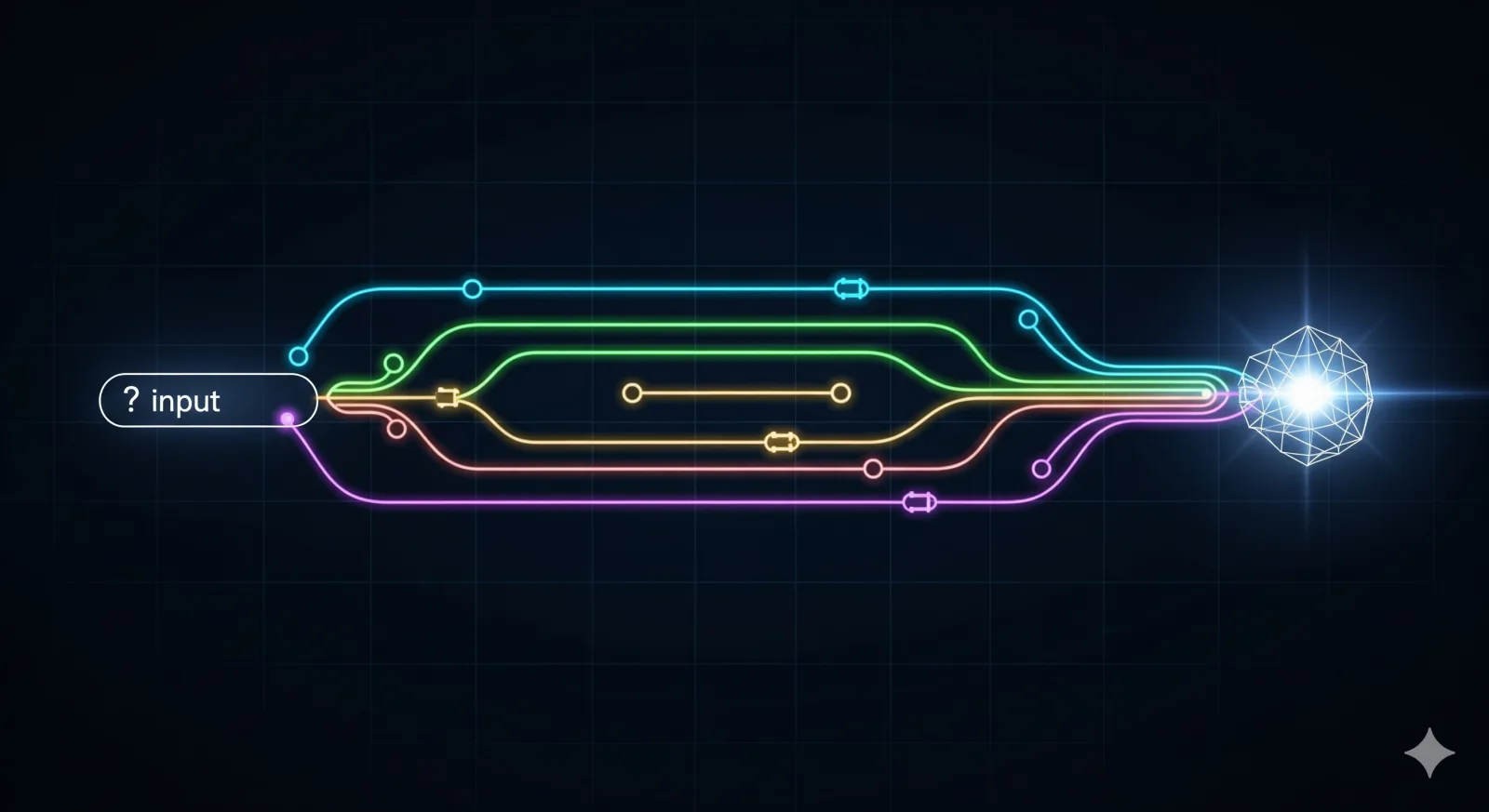
A familiar enterprise AI failure looks less like stupidity and more like stubbornness.
Ask a model to solve a hard problem, and it may begin confidently in the wrong direction. Then it keeps going. It adds details. It self-reflects. It spends tokens. It may even apologise to itself internally, which is apparently what we call progress now. But the core path does not change. The model is not merely short on compute. It is trapped inside its own first guess.
That is the useful idea behind ParaThinker, a paper from Hao Wen, Yifan Su, and colleagues at Tsinghua University’s Institute for AI Industry Research.1 The paper’s headline contribution is not simply “parallel reasoning improves accuracy”. That would be another entry in the growing pile of “call the model several times and hope democracy works” results. The more interesting claim is sharper: the bottleneck in sequential test-time scaling may come from how reasoning compute is arranged, not only from how much is purchased.
The authors call this bottleneck Tunnel Vision. Once a reasoning model begins down a flawed line of thought, more tokens often deepen the trench rather than dig an exit. ParaThinker’s answer is to scale reasoning by width: generate several independent reasoning paths natively, preserve their separation, then summarise them into a final answer while reusing the KV caches produced during reasoning. In less theatrical language: stop asking one internal monologue to become a committee. Build the committee into the inference process.
That matters for business AI because many teams still treat “more reasoning” as a token-budget decision. ParaThinker suggests a different operational question: should the system spend inference compute on one longer chain, or on several shorter, independent attempts that can later be reconciled? The paper does not prove the answer for every enterprise workflow. It tests mathematical reasoning, mostly on Qwen/DeepSeek-derived models and A800/vLLM-style infrastructure. But it does give a disciplined way to think about reasoning reliability: orchestration may matter as much as raw model size.
The bottleneck is not always model capability
The common instinct is simple. If an LLM fails at a hard task, let it think longer. This is the intuition behind much of the recent test-time scaling wave: models generate longer chains of thought, spend more inference compute, and sometimes solve problems that smaller or faster settings miss.
ParaThinker starts by questioning where that strategy saturates. The authors evaluate DeepSeek-R1-Distill-Qwen-1.5B on AIME 2024 under different token budgets. A single sequential reasoning path improves for a while, then plateaus. In the paper’s Figure 2(a), the single-path pass@1 curve reaches roughly the high twenties and stops delivering meaningful gains even as the token budget rises. The plotted sequential result ends around 27.4% accuracy, while majority voting with many parallel samples reaches a much higher maximum, reported as 52.7% with maj@64 under a 2,048K total token budget.
That gap is the first diagnostic result. It does not say the model “knows” the answer in a human sense. It says the model distribution contains better solutions than the single sequential path is finding. When many independent paths are sampled, some of them reach better answers. The capability is not completely absent. The access strategy is poor.
This is where the “overthinking” framing becomes incomplete. If longer reasoning fails, one response is to compress reasoning: make the model use fewer words, avoid pointless deliberation, and stop wasting inference budget on ornamental hesitation. That is useful when the model is verbose without being smarter. ParaThinker’s diagnosis is different. The problem is not only that the model thinks too much. It may be thinking too narrowly.
A business analogy is a failed strategy meeting where the first executive speaks for twenty minutes and everyone else politely optimises around the same bad premise. Extending the meeting does not create diversity. It creates minutes.
Tunnel Vision turns early tokens into destiny
The paper’s central mechanism is Tunnel Vision: early generated tokens can lock the model into a suboptimal reasoning trajectory. The authors test this with a direct intervention. They take incorrect reasoning traces from DeepSeek-R1-Distill-Qwen-1.5B on AIME 2024, extract flawed prefixes of different lengths, then ask the model to continue from those prefixes. Prefix lengths include 0, 100, 200, 400, 800, and 1600 tokens. The result is a clear negative relationship: the longer the misleading prefix, the worse the model’s final accuracy.
This experiment is best read as main diagnostic evidence, not as a benchmark leaderboard. Its purpose is to test whether early reasoning commitments damage later recovery. The answer, in this setup, is yes. Once the model has been pushed far enough into a flawed path, additional budget does not reliably rescue it.
That mechanism is more useful than the slogan. “Think longer” assumes reasoning depth is mostly additive. Tunnel Vision says reasoning depth can become path-dependent. A wrong first derivation, assumption, decomposition, or search direction changes the distribution of future tokens. The model is not searching a neutral space after each step. It is continuing a story it has already started.
For enterprise systems, this explains a class of failures that often look mysterious in evaluation logs. A model may handle simple cases well, but on complex cases it makes an early classification mistake, chooses the wrong policy branch, misreads a contract clause, or anchors on the wrong data source. The rest of the output becomes locally coherent and globally wrong. More tokens polish the wrong object.
The replacement belief should be precise: longer reasoning is not useless, but single-path longer reasoning is a fragile way to spend compute when the earliest steps are uncertain. The practical unit is no longer just the token. It is the reasoning path.
ParaThinker makes width native, not bolted on
ParaThinker is not merely majority voting with better branding. Majority voting samples multiple independent outputs and chooses the most common answer. That works best when the output can be easily verified or counted: numerical answers, multiple-choice questions, short symbolic results. It is less natural for open-ended tasks where there may not be a single countable answer. “The majority of five draft legal memos says clause 7 is fine” is not governance. It is vibes with arithmetic.
ParaThinker instead trains the model to generate multiple reasoning paths in parallel and then synthesise them. The workflow has two stages.
First, the model enters a parallel reasoning stage. It generates several distinct reasoning trajectories for the same input. Each path is guided by a special trainable control token such as <think i>, with matching closing tokens. These tokens are meant to encourage different reasoning directions rather than duplicate the same chain with minor stochastic seasoning.
Second, the model enters a summarisation stage. It attends over the prompt and the generated reasoning paths, then produces a final answer enclosed by summary tokens. Crucially, ParaThinker reuses the KV caches from the parallel reasoning stage. It does not need to concatenate all reasoning text and prefill the entire context again. That is one of the reasons the paper treats the method as an inference-engine design, not only a prompting style.
The architecture addresses two technical problems that matter operationally:
| Design problem | ParaThinker component | Operational consequence |
|---|---|---|
| Parallel paths may collapse into similar reasoning | Trainable <think i> control tokens |
Encourages path diversity without relying only on sampling temperature |
| Tokens at the same relative position across paths become ambiguous | Thought-specific positional embeddings | Lets the summariser distinguish which path a token came from |
| Paths may contaminate one another during generation | Two-phase attention mask | Keeps paths independent during reasoning, then allows integration during summary |
| Summarisation can become expensive if paths are reloaded as text | KV-cache reuse through the inference engine | Avoids costly re-prefilling and makes parallel width more deployable |
The thought-specific positional embedding is particularly important. If several reasoning paths are generated in parallel, tokens can share the same relative positions. A naïve flattening approach can assign unique positions across all paths, but that creates very large positional gaps and interacts poorly with RoPE-style positional encoding. Earlier paths can become disadvantaged when the summary attends across a long flattened sequence. ParaThinker adds learnable path identity information to the key and value representations, giving the summariser a cleaner signal about where each token came from.
That detail may sound like plumbing. It is not. Without path identity, the model is asked to integrate multiple lines of reasoning while being slightly confused about their provenance. Enterprise readers should recognise the pattern. A system that mixes evidence without source identity is not “holistic”. It is a filing cabinet after an earthquake.
The evidence says width helps, especially after sequential depth saturates
The main performance evidence comes from four mathematical reasoning benchmarks: AIME 2024, AIME 2025, AMC 2023, and MATH-500. The authors evaluate 1.5B and 7B Qwen-2.5 models distilled from DeepSeek-R1, with ParaThinker trained via supervised fine-tuning on a 6.2K-problem parallel reasoning dataset. The teacher setup uses gpt-oss-20b to enrich solution diversity, producing six reasoning paths per problem.
The headline result is straightforward. With eight parallel paths, ParaThinker improves average accuracy over sequential baselines by 12.3 percentage points for the 1.5B model and 7.5 points for the 7B model. Against majority voting, ParaThinker improves average accuracy by 4.3 points for 1.5B and 2.0 points for 7B.
The table below compresses the key results from the paper’s Table 1.
| Model setting | AIME 2024 | AIME 2025 | AMC 2023 | MATH-500 | Average |
|---|---|---|---|---|---|
| Sequential 1.5B, 32K | 28.3 | 24.5 | 68.9 | 81.8 | 50.9 |
| Majority 1.5B, 8×16K | 41.0 | 31.8 | 79.8 | 89.0 | 60.4 |
| ParaThinker 1.5B, 8×16K | 48.1 | 31.9 | 83.1 | 89.7 | 63.2 |
| Sequential 7B, 64K | 56.0 | 39.6 | 89.8 | 92.5 | 69.5 |
| Majority 7B, 8×16K | 68.8 | 49.6 | 93.1 | 94.2 | 76.4 |
| ParaThinker 7B, 8×16K | 68.8 | 51.3 | 93.3 | 94.5 | 77.0 |
The interpretation needs care. The biggest story is not that ParaThinker crushes majority voting everywhere. On the 7B model, the average advantage over majority voting is modest. On AIME 2024, ParaThinker-7B with eight paths matches majority voting at 68.8. The more robust point is that native aggregation often beats or matches external vote counting while remaining conceptually applicable to settings where vote counting is not natural.
The second story is scaling shape. In Table 2, the authors vary both total token budget and number of paths on AIME 2024 for ParaThinker-1.5B. Sequential reasoning, treated as $P=1$, peaks around 28.3 at a 32K budget and does not keep improving. ParaThinker with more paths continues to gain at larger budgets, reaching 48.1 with $P=8$ at 128K total token budget. That supports the paper’s claim that width can extend useful test-time scaling after sequential depth has flattened.
This is main evidence for the paper’s practical thesis. It shows that spending compute on independent paths can produce better returns than spending the same broad budget on one line of thought. The exact numbers should not be blindly ported into enterprise procurement spreadsheets. Still, the shape of the result is valuable: if a reasoning process is path-dependent, then parallel exploration is not waste. It is risk management.
The efficiency result is about hardware utilisation, not magic latency removal
A lazy reading of ParaThinker would say: “Eight paths for almost the latency of one.” That is too strong. The paper’s actual efficiency argument is more specific and more interesting.
LLM decoding is often memory-bandwidth-bound. Loading parameters and moving KV-cache data can dominate raw computation. If multiple paths are decoded in a batch, the GPU may do more useful arithmetic per memory movement. In other words, parallel reasoning can improve arithmetic intensity. This is why path count does not necessarily multiply latency linearly.
The paper uses vLLM on a single A800 GPU to test parallel decoding efficiency. In Figure 2(c), decoding 16 parallel paths of length 32K is far slower than decoding one path, but nowhere near 16 times slower. The plotted latency is roughly one and a half times the single-path latency at that length. In Figure 4, ParaThinker-1.5B latency increases as budgets rise from 2K to 16K, and higher path counts add overhead, but the curves do not explode linearly with $P$.
This is implementation evidence, not universal physics. It depends on batching, model size, GPU memory behaviour, vLLM integration, stopping policy, and batch size. It is also tested in a controlled serving setup, not in a messy multi-tenant production environment where latency SLOs, concurrency, memory pressure, and scheduling policies all develop personalities.
Still, the business implication is concrete. For reasoning-heavy workloads, the cost question should not be framed as:
one path costs $x$, so eight paths cost $8x$.
It should be measured on the actual serving stack. When decoding is memory-bound, some width may be cheaper than expected. This does not make parallel reasoning free. It makes the ROI calculation non-linear, which is exactly the sort of thing procurement spreadsheets enjoy misunderstanding.
The ablations show this is not just “fine-tune harder”
The paper includes several tests that are best treated as ablations and sensitivity checks, not separate theses.
The data ablation asks whether ParaThinker’s gains come merely from supervised fine-tuning on better data. The authors fine-tune the original 1.5B model using an unrolled version of the same parallel dataset, keeping settings comparable. The resulting sequential model does not improve; in fact, its average results are slightly worse than the original in the reported table. Meanwhile, ParaThinker still outperforms the baselines.
That supports the claim that the architecture and inference workflow matter. The gain is not simply “more curated math traces went in, better math answers came out.” As ever, data matters. But the paper’s evidence says the arrangement of reasoning paths is doing real work.
The thought-embedding ablation tests whether path identity helps. On AIME 2024, ParaThinker-1.5B scores 34.8, 43.3, and 48.1 for $P=2$, $P=4$, and $P=8$. Removing the thought embedding reduces those to 33.3, 39.0, and 46.7. The drop is not catastrophic, but it is consistent. The authors also discuss a naïve flattened positional encoding variant that performs worse, especially at larger budgets, supporting their concern about positional decay and path imbalance.
The termination-strategy test is a sensitivity test for the parallel reasoning stage. The authors compare three policies: wait for all paths to finish, stop when half finish, or stop when the first path finishes. Their default, first-finish strategy, performs best on AIME 2024: 34.8 for $P=2$, 43.3 for $P=4$, and 48.1 for $P=8$. The paper’s explanation is that first-finish maintains equal path lengths and prevents a single long path from dominating the summary context. It is also computationally efficient.
That result has a subtle product lesson. More reasoning per path is not automatically better. Balance across paths can matter more than letting one path ramble. The model is not being rewarded for the longest internal essay. Civilisation may yet recover.
What this changes for enterprise AI design
The paper directly shows improved performance on mathematical reasoning benchmarks using a particular trained model design. Cognaptus’ business inference is broader but bounded: enterprise AI teams should evaluate reasoning orchestration as a first-class design variable, not a cosmetic wrapper around the model call.
A useful deployment framework is:
| Enterprise question | Sequential-depth answer | ParaThinker-style answer | What remains uncertain |
|---|---|---|---|
| How should we spend more inference budget? | Increase max tokens or ask for more self-reflection | Allocate budget across independent reasoning paths and summarise | Domain-specific trade-off between width, depth, and latency |
| How do we reduce early anchoring errors? | Add critique prompts after the first answer | Prevent one path from becoming the only path | Whether native path separation transfers outside math |
| How do we aggregate multiple attempts? | Vote, rank, or use an external verifier | Train the model to synthesise paths internally | Reliability of summarisation on ambiguous business outputs |
| How do we control serving cost? | Count total generated tokens | Measure actual latency under batched decoding and KV-cache reuse | Production performance under concurrency and hardware constraints |
This matters most for workflows where early mistakes are expensive and hard to detect later. Examples include financial analysis, legal issue spotting, technical root-cause analysis, complex procurement comparison, scientific literature synthesis, and agent planning. These are not proven ParaThinker use cases. They are plausible places where the paper’s mechanism should make practitioners curious.
The business value is not “better vibes from parallel thoughts”. It is lower anchoring risk per unit of inference time, assuming the production stack can exploit parallel decoding efficiently and the domain benefits from diverse reasoning attempts.
There is also a governance angle. Many enterprise AI systems now bolt on critique stages after an initial answer. That helps, but critique often inherits the first answer’s framing. ParaThinker’s mechanism suggests another design pattern: diversify before commitment, not after. A post-hoc reviewer can still be trapped by the first draft. Independent drafts have a cleaner shot at disagreeing.
Where the paper stops
The boundaries are important because the paper is easy to over-sell.
First, the evidence is mostly mathematical reasoning: AIME 2024, AIME 2025, AMC 2023, and MATH-500. These tasks have crisp answers and reward structured problem-solving. They are useful stress tests, but they are not the same as enterprise document workflows, customer support escalation, contract negotiation, software maintenance, or multi-step tool-using agents.
Second, ParaThinker is not a prompt-only trick. It requires supervised fine-tuning, special tokens, thought-specific embeddings, a two-phase attention mask, and an inference engine that supports parallel generation and KV-cache reuse. A product team cannot reproduce the full method by asking an off-the-shelf API, “Please think in eight parallel universes.” It may get a charming answer, but not this architecture.
Third, the latency claims are infrastructure-dependent. The reported efficiency comes from the memory-bound nature of decoding and the authors’ vLLM-based implementation on A800 GPUs. Actual production latency will depend on model size, hardware, concurrency, batch scheduling, context length, stopping behaviour, and whether the serving system can reuse caches as intended.
Fourth, the paper’s own discussion leaves open future work on more complex open-ended domains such as coding, document generation, and agentic workflows. The authors motivate those domains, but they do not prove ParaThinker there. That distinction should survive contact with the slide deck.
The durable lesson: buy paths, not just tokens
ParaThinker’s most useful contribution is a reframing. Test-time compute is not a single knob labelled “more”. It has geometry. You can spend compute by going deeper down one path, or by exploring several paths in parallel and integrating them.
Sequential depth is still valuable. Some problems need long derivations. But if early-token commitment creates Tunnel Vision, then depth alone becomes a brittle scaling strategy. ParaThinker’s answer is native thought width: independent paths, explicit path identity, controlled integration, and hardware-aware decoding.
For enterprise AI, the immediate lesson is not to wait for ParaThinker to appear as a product checkbox. The lesson is to examine where current systems are letting the first plausible reasoning path dominate the whole workflow. In high-stakes reasoning tasks, the cheapest improvement may not be a larger model or a longer context window. It may be a better-designed contest among alternatives before the system commits.
One mind thinking longer can still be wrong. Several minds thinking separately, then being forced to reconcile, at least have the decency to fail in a more informative way.
Cognaptus: Automate the Present, Incubate the Future.
-
Hao Wen, Yifan Su, Feifei Zhang, Yunxin Liu, Yunhao Liu, Ya-Qin Zhang, and Yuanchun Li, “ParaThinker: Native Parallel Thinking as a New Paradigm to Scale LLM Test-time Compute,” arXiv:2509.04475, 2025. https://arxiv.org/abs/2509.04475 ↩︎