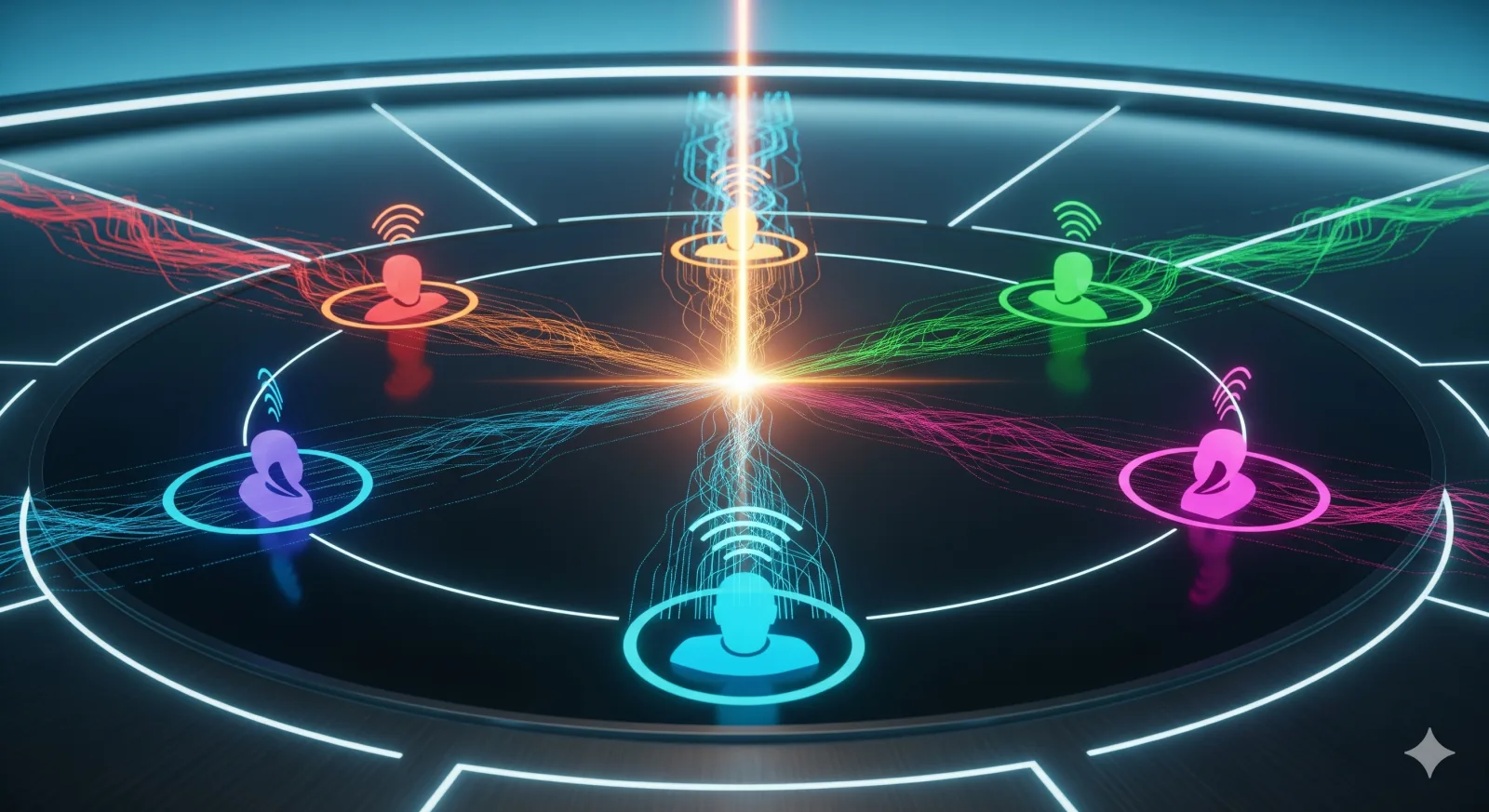
Teams fail quietly before they fail visibly.
The procurement analyst missed a constraint. The legal reviewer assumed a definition. The finance model used a different baseline. Everyone produced competent work. The final report still wobbled because the collaboration layer never asked the obvious question: who knows what, who misunderstands what, and which disagreement is worth resolving before the answer is assembled?
Multi-agent LLM systems have the same problem, only faster and more politely verbose. We select a set of expert agents, let them produce reasoning, perhaps run a debate or discussion protocol, and then ask an aggregator to turn the pile into a final answer. It looks collaborative. Often it is merely parallel work with a chat transcript stapled to the middle.
The OSC paper, OSC: Cognitive Orchestration through Dynamic Knowledge Alignment in Multi-Agent LLM Collaboration, is interesting because it refuses to treat that middle as atmospheric noise.1 Its claim is not simply that “more agents help.” That would be the industry’s favourite kind of conclusion: conveniently expensive and usually under-instrumented. OSC argues for a more specific intervention. Between expert selection and final aggregation, the system should actively model what each agent believes about the others, detect cognitive gaps, and choose targeted communication actions before language is generated.
That sounds abstract. The practical version is simpler: stop letting agents talk just because they have tokens. Make them speak when there is a gap worth closing.
OSC moves the optimisation target into the conversation
Most multi-agent LLM designs optimise two visible ends of the workflow.
First, they optimise who participates. Dynamic routing, expert selection, model mixtures, and capability-aware allocation all try to match the task with the right agents. That matters. A tax analyst agent is more useful than a poetry agent when the problem is VAT classification. Startling revelation, yes.
Second, they optimise how outputs are combined. Voting, ranking, meta-LLM synthesis, debate scoring, and hierarchical aggregation all try to turn multiple partial answers into one better answer.
OSC accepts both layers, then inserts a third: how selected agents communicate before aggregation.
Its mechanism has four moving parts:
-
Collaborator Knowledge Models (CKM). Each agent maintains a learned latent model of each teammate’s cognitive state: likely understanding, confidence, assumptions, reasoning direction, and task interpretation.
-
Learned cognitive gap analysis. The system compares an agent’s own internal state with its CKM-based estimate of another agent’s state. The gap is not a hand-coded distance between text snippets. It is a learned representation of discrepancies that may matter for collaboration.
-
Adaptive communication policy. A reinforcement-learned policy chooses a structured communication action: the objective, the target collaborator or group, the content focus, and style parameters such as detail level or confidence expression.
-
Strategic linguistic realisation. A generative LLM converts that abstract action into fluent language. The LLM is still useful, but it is no longer freelancing the collaboration strategy like a consultant discovering the scope in week six.
The mechanism can be drawn as a loop:
Selected expert agents
        ↓
Each agent models teammate states through CKM
        ↓
Cognitive gaps are detected
        ↓
A learned policy chooses what to say, to whom, and how
        ↓
The base LLM verbalises the chosen action
        ↓
CKMs update from the new dialogue
        ↓
Agents produce refined answers
        ↓
Aggregator synthesises the final output
        ↓
Task reward trains the communication machinery
The important point is where the intelligence is being placed. OSC does not rely on the aggregator to rescue incoherent intermediate work. It tries to make the intermediate work less incoherent in the first place. A bold strategy: prevent the mess instead of hiring a more expensive janitor.
The “cognitive gap” is a business idea hiding inside a technical module
The paper’s term “cognitive gap” risks sounding more philosophical than it is. In operational terms, it means a discrepancy that may reduce team output quality if left unaddressed.
Examples from the paper’s qualitative analysis are pleasantly mundane:
| Gap type | Example from the paper | Operational interpretation |
|---|---|---|
| Method divergence | One agent favours factorisation while another prefers the quadratic formula | Agents may solve the same problem correctly but fail to reconcile method assumptions |
| Timing discrepancy | One planning agent estimates 5 days for a task while another estimates 7 because of testing needs | Agents may disagree because one has surfaced a hidden dependency |
| Priority gap | One argument-generation agent focuses on economic costs while another focuses on environmental benefits | Agents may optimise different objectives without explicitly negotiating trade-offs |
That is the useful translation for enterprise work. OSC is not merely “better agent chat.” It is a proposal for collaboration observability: represent disagreement, uncertainty, missing assumptions, and misaligned priorities as first-class signals before the final answer is written.
For business systems, that matters more than the anthropomorphic framing. Nobody needs agents to “understand each other” in the human sense. They need the workflow to detect that the regulatory agent is using one definition of “material risk” while the financial agent is using another, before the board memo becomes a very confident accident.
The communication policy makes speech an action, not a vibe
A subtle strength of OSC is that it treats communication as an action space.
In many agent systems, messages are generated directly from prompts: “Discuss,” “Critique,” “Refine,” “Debate,” “Reach consensus.” These are useful instructions, but they leave the system with little structured knowledge of why a message was sent. Was it asking for clarification? Challenging an assumption? Aligning a sub-plan? Requesting evidence? Reducing redundancy? Inviting a teammate to waste everyone’s context window with a paragraph that starts, “I agree with the previous points”?
OSC makes the policy choose the communicative intent before the language is produced. The action includes the communication objective, target audience, and style or focus parameters. Then a language model turns that action into a message.
This separation is the design lesson. In production systems, it means the orchestration layer can log and audit not only what agents said, but why the system wanted them to say it. That is valuable for debugging. If an output fails, you can inspect whether the team failed because the wrong agents were selected, because the right agents failed to close a gap, or because the aggregator ignored useful evidence.
Most enterprise AI failure analysis currently looks like transcript archaeology. OSC points toward something more structured: action-level telemetry for collaboration.
The headline results support the mechanism, but do not replace it
The main evidence is benchmark performance. OSC uses the same pool of six strong open-source models as KABB: Qwen2-72B-Instruct, LLaMA-3-70B-Instruct, WizardLM-2-8x22B, Gemma-2-27B, DeepSeek-V3, and DeepSeek-R1, with Qwen2-72B-Instruct serving as aggregator. The primary benchmark is AlpacaEval 2.0, using length-controlled win rate against GPT-4 Preview, with additional evaluation on MT-Bench.
The reported headline numbers are:
| Metric | OSC | Key comparator | Interpretation |
|---|---|---|---|
| AlpacaEval 2.0 LC win rate | 81.4% | KABB: 77.9% | Main evidence that OSC improves over a strong multi-agent coordination baseline |
| AlpacaEval 2.0 standard win rate | 76.2% | KABB: 72.3% | Supports the same direction without length control |
| MT-Bench average | 9.94 | KABB: 9.65; MoA: 9.41 | Suggests gains extend to multi-turn dialogue quality |
| MT-Bench first turn | 9.96 | KABB: 9.85 | Very high absolute scores; marginal differences should be interpreted carefully |
| MT-Bench second turn | 9.73 | KABB: 9.45 | More relevant for collaboration because second-turn coherence is harder |
The correct reading is not “OSC proves multi-agent systems are solved.” Please place that sentence gently in the recycling bin.
The better reading is that a structured communication layer can improve an already strong multi-agent setup when tested on instruction-following and dialogue benchmarks. The result is meaningful because OSC is compared against systems that already use multiple models and aggregation. It is not merely beating a single weak baseline by adding model calls.
Still, the numbers are not the whole argument. AlpacaEval and MT-Bench are useful, but they are benchmark proxies, and parts of the evaluation rely on LLM-based judging. The business question is not whether 81.4% is a magical number. It is whether the mechanism behind that number gives builders a more controllable architecture for agent teams. On that question, OSC is more useful than the scoreboard alone.
The efficiency results are where the business case starts to breathe
The paper’s communication efficiency analysis compares OSC with other multi-agent frameworks using metrics such as average rounds, token count, redundancy, conflict resolution, and task-relevant information density.
| Communication metric | OSC | Next-best value in reported table | Practical reading |
|---|---|---|---|
| Average rounds | 4.6 | TalkHier: 4.9 | Slightly fewer interaction cycles |
| Average tokens | 3.31k | TalkHier: 3.52k | Lower communication volume |
| Redundancy | 14.2% | TalkHier: 15.3% | Less repeated content |
| Conflict resolution | 89.5% | TalkHier: 85.8% | Better handling of detected disagreements |
| Information density | 84.5% | TalkHier: 81.9% | More task-relevant content per token |
These deltas are not astronomical. They are more interesting than that.
In real workflows, small reductions in rounds and tokens can compound when the system is deployed across thousands of tasks, especially where agent conversations involve expensive frontier models or long-context retrieval. But the bigger operational signal is not token reduction alone. It is directed communication. OSC’s efficiency gain comes from avoiding unnecessary chatter while improving conflict resolution.
That combination matters. A naïve cost-cutting policy can reduce tokens by simply forcing everyone to speak less. This is how one gets concise garbage, a format beloved by executives and regretted by downstream teams. OSC’s reward includes both task success and communication cost, with intrinsic shaping for gap reduction and communication objective fulfilment. The system is trained not merely to be brief, but to be usefully brief.
That distinction is the business value.
The ablations say the middle layer is doing real work
The ablation study is not decorative. Its likely purpose is to test whether OSC’s named components matter individually, rather than whether the full system wins by accidental complexity.
The paper reports that removing CKM drops AlpacaEval 2.0 LC win rate from 81.4% to 71.2%. Removing the adaptive communication policy drops it to 69.4%. Removing the learned gap module or intrinsic shaped reward also reduces performance, to 75.8% and 74.1% respectively.
| Test | Likely purpose | What it supports | What it does not prove |
|---|---|---|---|
| Remove CKM | Ablation | Modeling teammate states is central to OSC’s performance | That CKM representations are human-interpretable or always accurate |
| Remove cognitive gap module | Ablation | Learned discrepancy detection adds value beyond generic communication | That every detected gap corresponds to a real semantic disagreement |
| Remove adaptive communication policy | Ablation | Choosing structured communication actions is a major contributor | That PPO is the only viable training method |
| Remove intrinsic shaped reward | Ablation / reward validation | Sparse final task reward alone is insufficient for efficient collaboration | That the chosen shaping signals generalise cleanly to all enterprise tasks |
| Vary number of agents | Scalability / sensitivity test | More agents help only up to a point | That six agents is universally optimal |
| Price-performance analysis | Practical comparison | OSC can trace a cost-quality frontier | That early-2025 API prices remain stable or procurement-relevant |
The ablations support the core thesis: the gains are not just from adding agents or using a strong aggregator. The middle layer is carrying weight.
The strongest warning also comes from these tests. The system depends on shaped rewards and careful hyperparameter choices. When only task reward is used, the paper reports lower LC win rate and more redundant communication. Adding a communication cost penalty improves efficiency. Adding intrinsic shaping produces the best reported combination: 81.4% LC win rate, 4.3 rounds, 2.87k tokens, 12.6% redundancy, and 91.7% conflict resolution.
Translation: OSC is not “plug in agents and receive synergy.” It is “build a reward-shaped collaboration controller and tune it.” Less catchy. More honest.
Six agents is a sweet spot, not a law of nature
The scalability study is one of the more useful parts of the paper because it punctures a common assumption: if multiple agents help, more agents should help more.
OSC peaks at six agents in the reported AlpacaEval 2.0 setup:
| Number of agents | LC win rate | Avg. rounds | Avg. tokens | Redundancy | Conflict resolution |
|---|---|---|---|---|---|
| 2 | 72.3% | 3.8 | 2.45k | 18.2% | 85.1% |
| 4 | 78.9% | 4.1 | 2.72k | 14.5% | 89.3% |
| 6 | 81.4% | 4.3 | 2.87k | 12.6% | 91.7% |
| 8 | 80.2% | 4.6 | 3.15k | 13.8% | 90.5% |
| 10 | 77.5% | 5.2 | 3.62k | 16.7% | 87.8% |
The curve is the lesson. Two agents lack diversity. Four improves coverage. Six performs best. Eight and ten begin paying coordination tax.
The paper reports that with ten agents, CKM update latency rises by approximately 15%, memory consumption per inference step grows by around 30%, and agents sometimes misjudge collaborators’ cognitive states in complex interactions. That is exactly the kind of failure production teams should expect. Every additional agent adds not only capability but modelling burden. If each agent needs to maintain beliefs about every other agent, the social graph becomes a systems problem.
For Cognaptus-style enterprise workflows, this suggests a practical rule: start with a small set of genuinely complementary agents, then scale only when instrumentation shows that new agents reduce unresolved gaps rather than merely adding commentary. Six is not sacred. But “more” is not strategy.
Price-performance is promising, with a footnote large enough to have its own desk
The paper’s price-performance analysis compares OSC configurations with different numbers of active experts against individual models, KABB, and proprietary models, using indicative early-2025 API pricing. OSC with six experts reaches the best reported OSC performance at 81.4% LC win rate and a cost around 0.91 in the paper’s normalised comparison. Smaller OSC configurations, particularly three or four experts, are reported as competitive on cost-performance.
The useful inference is not that OSC will always be cheaper than proprietary models. Pricing changes, inference endpoints differ, enterprise discounts exist, and self-hosting economics enjoy ruining simple charts.
The useful inference is that OSC offers a knob. Instead of choosing between “single model” and “full committee,” builders can vary the number of active experts, the number of communication rounds, token penalties, and gap thresholds. The architecture makes quality-cost trade-offs tunable.
That matters for business deployment because not every task deserves the full orchestra. Contract redline triage may need two specialised agents and strict token budgets. A board-level risk memo may justify six agents and deeper interaction. A customer-support escalation should probably not summon a council of ten models to decide whether to apologise.
What the paper directly shows, and what business should infer
The boundary between paper result and business implication is worth keeping clean.
| Layer | What is supported | Business interpretation | Boundary |
|---|---|---|---|
| Direct paper result | OSC improves reported AlpacaEval 2.0 and MT-Bench scores over selected baselines | Structured communication can improve multi-agent output quality | Benchmark-heavy, partly LLM-judged |
| Direct paper result | OSC reduces rounds, tokens, redundancy, and improves conflict resolution in reported comparisons | Communication efficiency is measurable, not mystical | Metrics depend on definitions and experimental setup |
| Direct paper result | Ablations show CKM and adaptive policy removal strongly hurt performance | The collaboration layer is not cosmetic | Does not prove this exact architecture is optimal |
| Cognaptus inference | Enterprises should log communication actions and gap closures | Agent systems need observability inside the dialogue, not only final answer scoring | Requires domain-specific definitions of useful gaps |
| Cognaptus inference | Teams should scale agents cautiously | Coordination overhead can erase model diversity gains | The optimal agent count will vary by task and model mix |
| Still uncertain | Generalisation to regulated, high-stakes business workflows | Potentially useful, not production-proven | Needs human evaluation, domain benchmarks, security review, and cost testing |
The business pathway is therefore concrete but bounded. OSC suggests that agentic systems should contain a governed communication layer between routing and synthesis. That layer should track inferred teammate state, detect disagreement or missing context, choose explicit communication actions, and reward gap closure under cost constraints.
It does not prove that every enterprise agent team needs CKM exactly as implemented. It does not prove that PPO-trained communication policies are the final answer. It does not eliminate the need for human review in sensitive workflows. It gives system designers a sharper question: where, exactly, is collaboration being optimised?
If the answer is “the agents talk and the aggregator handles it,” congratulations. You have reinvented the meeting.
Implementation lessons for agent builders
A production-minded OSC interpretation leads to five design moves.
First, represent communication actions explicitly. Do not log only messages. Log the intended objective: clarify, challenge, align, request evidence, resolve contradiction, compress plan, or escalate uncertainty. This makes failures diagnosable.
Second, instrument gap closure. Define lightweight probes for whether a gap has actually narrowed. In a due-diligence workflow, this might mean convergence on assumptions, consistent citation of source documents, or explicit resolution of contradictory estimates.
Third, separate strategy from wording. Let a policy or controller decide the purpose and target of communication. Let the LLM phrase it. This reduces the chance that fluent language hides poor collaboration logic.
Fourth, treat agent count as a budgeted design parameter. More agents should be justified by measurable reduction in unresolved gaps or improved final quality, not by architectural enthusiasm.
Fifth, tune rewards for the business process, not the demo. A legal review agent system may reward citation fidelity and unresolved-risk escalation. A procurement analysis system may reward constraint alignment and cost-driver reconciliation. A research synthesis system may reward disagreement surfacing rather than consensus speed. Same pattern, different incentives.
The limitations are not small print; they are deployment instructions
OSC’s own limitations are unusually practical.
The first is scalability. The best reported performance appears around six agents. Larger teams increase communication rounds, tokens, latency, memory use, and state-modelling difficulty. That is not a weakness to wave away. It is a deployment constraint.
The second is reward shaping. OSC works best when the reward includes task success, communication cost, and intrinsic signals for gap reduction or objective fulfilment. In business domains, defining those intrinsic rewards will be non-trivial. “Resolved a cognitive gap” is easy to say and difficult to validate when the task involves legal nuance, messy spreadsheets, or conflicting stakeholder goals. Naturally, the inconvenient part is where the value lives.
The third is benchmark dependence. AlpacaEval 2.0 and MT-Bench are useful for comparing instruction-following and dialogue systems, but enterprise workflows involve source-grounded reasoning, permissions, audit trails, confidential data, domain-specific definitions, and humans who may be annoyed for reasons the benchmark did not simulate.
The fourth is interpretability. CKM states are learned latent representations. They may help the policy, but they are not automatically transparent. If used in high-stakes workflows, the system should expose human-readable summaries of detected gaps and communication objectives, not just embeddings quietly nodding to each other in vector space.
The real contribution is not agent teamwork; it is agent management
OSC is best read as a management paper disguised as a multi-agent LLM paper.
It asks: once the right specialists are in the room, who notices that they are talking past each other? Who decides which disagreement matters? Who prevents repetition? Who pays the cost of another round of discussion? Who tells the polished speaker to stop being polished and answer the actual objection?
The paper’s answer is a learned orchestration layer: CKM for teammate-state modelling, cognitive gap analysis for discrepancy detection, an adaptive communication policy for choosing targeted actions, and reward shaping for balancing quality against communication cost.
That is why the mechanism-first reading matters. The headline performance numbers are respectable, but the deeper lesson is architectural. Multi-agent systems will not become reliable merely by adding more agents, more debate, or more elaborate aggregation. They need managed interaction.
In human organisations, this role is performed by good project leads, editors, analysts, and occasionally the one person in the meeting brave enough to say, “We are not discussing the same assumption.” OSC is an attempt to encode a version of that function inside agent teams.
Not perfect. Not production-proven. But much closer to the actual bottleneck than another round of agent chatter with a fancier name.
Cognaptus: Automate the Present, Incubate the Future.
-
Jusheng Zhang, Yijia Fan, Kaitong Cai, Xiaofei Sun, and Keze Wang, “OSC: Cognitive Orchestration through Dynamic Knowledge Alignment in Multi-Agent LLM Collaboration,” arXiv:2509.04876, 2025, https://arxiv.org/abs/2509.04876. ↩︎