A demo is cheap. Ask an AI agent to build a web app, watch it spin up a cheerful interface, click a few buttons, and everyone briefly pretends software engineering has been solved.
Then production begins.
The app boots but stores nothing. The database schema exists but the handler quietly forgets foreign keys. The UI looks plausible until the first state transition. The test suite passes because it checked the page title, not the workflow. Somewhere, a dashboard reports “success.” Somewhere else, a user discovers the thing is an elegant cardboard storefront.
That is the problem tackled by the app.build paper from Databricks and THWS: full-stack prompt-to-app generation is not mainly a question of giving the model more horsepower. It is a question of building the right environment around the model.1 The paper’s useful contribution is not another round of “frontier model beats open model, civilisation trembles.” It is a production argument: agentic code generation becomes materially more dependable when the model is constrained by staged workflows, sandboxed execution, deterministic validators, and repair loops.
In other words: the model is not the system. The system is the model plus the guard rails. And, annoyingly for anyone hoping to solve engineering by procurement, the guard rails matter.
The mechanism: generate, validate, isolate, repair
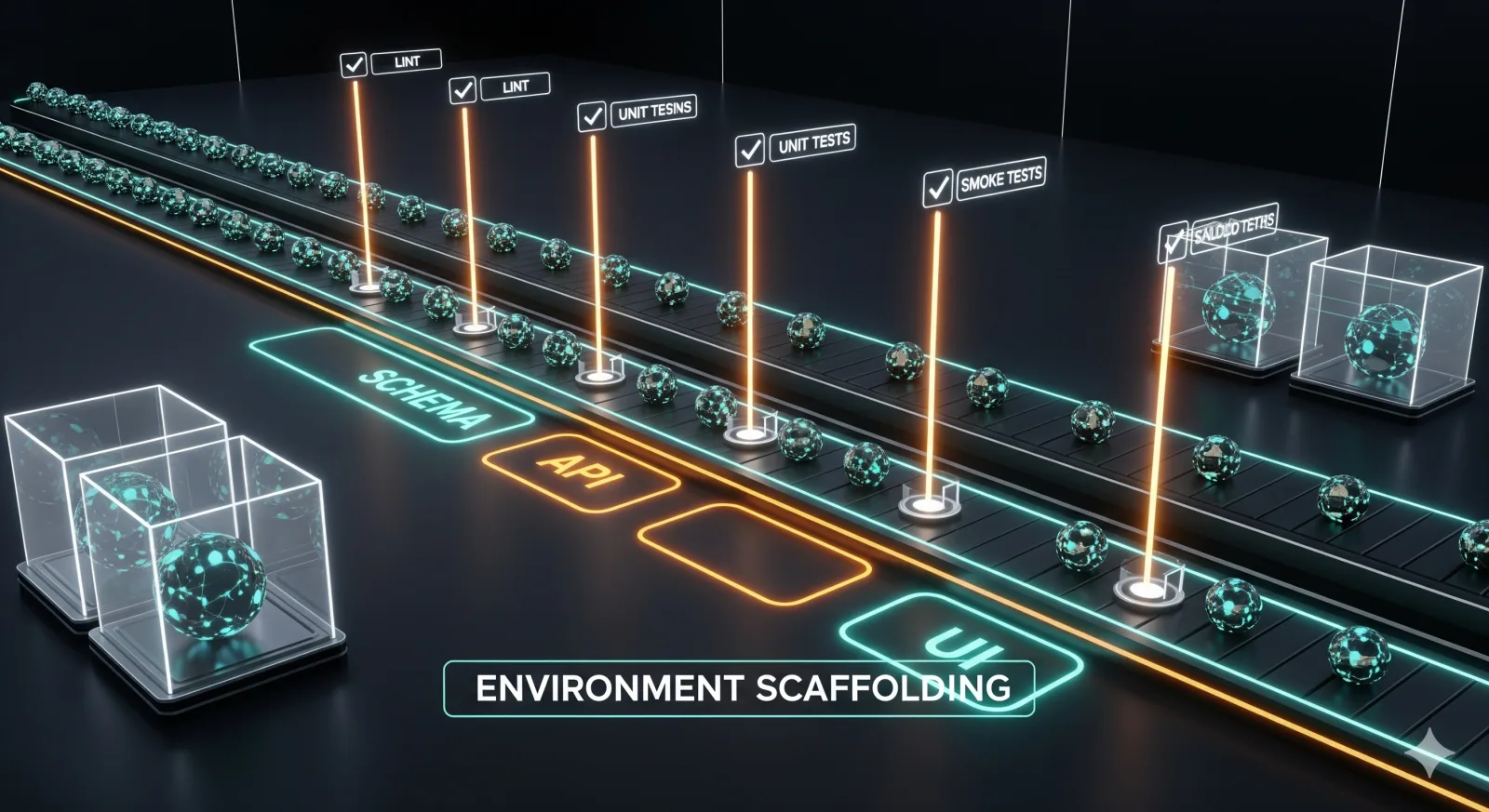
The paper calls its design pattern environment scaffolding. That phrase sounds like something invented in a committee room with excellent coffee, but the underlying idea is straightforward: do not ask a language model to produce an entire application in one heroic leap. Put it inside a structured environment that decomposes the job, checks each step, and feeds back precise failures.
The app.build framework does this through a finite, stack-aware workflow. For the TypeScript/tRPC path emphasised in the evaluation, the system breaks generation into stages such as schema, API, and UI. Each stage has expected artefacts. Generated code is executed in an isolated sandbox. Validators inspect whether it compiles, boots, satisfies basic prompt correspondence, and passes relevant checks. When it fails, the error traces are returned to the model for repair rather than leaving a human developer to play forensic archaeologist.
That mechanism changes the role of the LLM. In a model-centric system, the model is treated as the author of the application and validation arrives late, if at all. In environment scaffolding, the model is one component inside a controlled production loop.
| Layer | What it does | Why it matters operationally |
|---|---|---|
| Structured decomposition | Splits app generation into schema, API, UI, and related stages | Prevents one bad early decision from contaminating the whole build |
| Stack-aware validation | Uses checks appropriate to TypeScript/tRPC, Laravel, or NiceGUI-style stacks | Catches failures at the level where they actually occur |
| Sandboxed execution | Runs generated artefacts in isolated, resettable environments | Makes aggressive trial-and-error safe and reproducible |
| Repair feedback | Sends validator failures back into the generation loop | Converts “it failed” into a targeted correction path |
| Model-agnostic orchestration | Keeps the workflow stable while swapping models | Enables cost-performance tuning instead of vendor theology |
This is the article’s central point: app generation becomes less mystical when the environment supplies the missing discipline. The LLM still generates. It still improvises. It still occasionally wanders into the shrubbery. But the surrounding system constrains where it can wander, checks what it produces, and decides whether the artefact deserves to move forward.
The paper’s evidence is production-flavoured, not benchmark theatre
The paper reports three evidence layers, and they should not be blended together.
First, there is the industrial deployment signal: app.build had generated more than 3,000 user applications over four months of operation, with peak usage above 220 apps per day. The open-source repository also gained substantial community attention, with the paper reporting 650+ stars and 89 forks. This does not prove correctness. Popular tools can be wrong at scale; history is generously stocked with examples. But it does show that the framework was not evaluated only as a laboratory toy.
Second, the authors ran 300 end-to-end generation experiments across baseline, model-comparison, and validation-ablation conditions. These automated runs measured success, health-check pass rates, cost, duration, and token use.
Third, they conducted a human evaluation of 30 representative TypeScript/tRPC applications using a six-check rubric: boot, prompt correspondence, create functionality, view/edit operations, clickable sweep, and performance. This matters because greenfield app generation does not have the clean oracle that function-level coding benchmarks enjoy. A generated app can boot, render, and still fail the task. Humans remain inconveniently useful.
The important distinction is between automated success and actual viability. The paper defines viability as more than “the server starts.” It requires boot success and basic prompt correspondence. That sounds minimal because it is minimal. It is the first gate before anyone should start praising the machine.
The headline numbers are useful, but the definitions are doing the heavy lifting
In the automated experiments, the Claude Sonnet 4 baseline with full validation reached an 86.7% automated success rate, with a 96.7% health-check pass rate, at a reported cohort cost of $110.20 for 30 apps. Qwen3-Coder-480B reached 70.0% success at $12.68 over 90 runs, while GPT-OSS-120B reached 30.0% success at $4.55.
The tempting summary is: “Qwen is cheaper and good enough.” That is not wrong, but it is lazy. The more useful reading is that scaffolding makes cost substitution possible only when the environment catches the right failures.
The paper reports cost per viable app as follows:
| Configuration | Success | Health-check pass | Cost per app | Cost per viable app |
|---|---|---|---|---|
| Baseline Claude | 86.7% | 96.7% | $3.67 | $5.01 |
| No lint | 93.3% | 96.7% | $2.35 | $2.52 |
| No Playwright | 83.3% | 93.3% | $2.87 | $3.45 |
| No tests | 93.3% | 100.0% | $2.37 | $2.54 |
| Qwen3-480B | 70.0% | 86.7% | $0.42 | $0.61 |
| GPT-OSS-120B | 30.0% | 43.3% | $0.15 | $0.51 |
The Qwen result is striking: 70.0% success, roughly 80.8% of the closed-model baseline’s success rate, at a much lower cost per viable app. But the paper also shows why boot checks alone are a trap. GPT-OSS-120B had a 43.3% health-check pass rate but only 30.0% success once prompt correspondence was considered. Some outputs were essentially “Under Construction” placeholders: they loaded, which is nice, in the same way an empty restaurant having lights is nice.
For business teams, this is the difference between cheap generation and cheap viable generation. The former is a token bill. The latter is an operating model.
The human evaluation says: once the gates are cleared, quality clusters high
The detailed human assessment on 30 TypeScript/tRPC apps is where the paper becomes more useful for operators. The authors report that 22 of 30 apps, or 73.3%, achieved viability. Nine of 30, or 30.0%, achieved perfect quality under the rubric. Among viable applications, mean quality was 8.78 out of 10.
That result is not a universal claim about AI building software. It is a claim about a constrained environment, a particular mature stack, a curated prompt set, and a specific definition of viability. Still, it is operationally meaningful. The quality distribution suggests that the main problem is not that every generated app is mediocre. The sharper problem is separating the viable cluster from the broken or misaligned outputs early enough that the workflow remains economical.
The check-level results make this clearer:
| Check | Pass / Warn / Fail / NA | Interpretation |
|---|---|---|
| Boot | 25 / 2 / 3 / 0 | Basic runtime viability is mostly achievable, but not guaranteed |
| Prompt correspondence | 19 / 3 / 5 / 3 | The app can run while still failing the actual request |
| Create functionality | 22 / 2 / 0 / 6 | CRUD creation is a relative strength when scaffolding matches the task |
| View/edit operations | 17 / 1 / 1 / 11 | State and persistence remain more fragile |
| Clickable sweep | 20 / 4 / 1 / 5 | UI interaction defects still leak through |
| Performance | 23 / 3 / 0 / 4 | Initial performance was less problematic in this setting |
The best business reading is not “AI apps are ready.” It is more specific: for structured CRUD-like web applications, a scaffolded agent can produce a meaningful viable subset, and that subset can be high quality after passing early gates. The hard part is engineering gates that reject the right failures without suffocating valid variation.
The ablations are the paper’s most useful section
The paper’s ablation studies are where the “more validation is always better” myth gets politely mugged.
The authors remove different validation layers and observe what happens. This is not the main evidence that app.build works; it is an ablation designed to isolate which validation layers actually contribute to reliability and which ones mainly create friction.
Three findings matter.
First, removing backend handler tests increased apparent viability to 80.0%, up 6.7 percentage points, but reduced real CRUD correctness. The paper reports that view/edit operation pass rates dropped from about 90% to 60%. That is classic measurement rot: the system looks better because the detector went missing. Removing the smoke alarm improves the “no alarms today” metric. Congratulations, the building is still on fire.
Second, removing linting also increased viability to 80.0% and slightly improved mean quality, but with mixed functional regressions. The interpretation is not “linting is bad.” It is that broad lint rules can reject valid implementation variants, especially when generated code solves the task in a structurally different but acceptable way. Linting is useful when it targets correctness, anti-patterns, and type-safety. It is less useful when it becomes a style police force with a quota.
Third, removing Playwright E2E tests produced the most counterintuitive outcome: viability increased to 90.0%, with quality improving by 0.56 points. Manual inspection found brittle selectors, race conditions, and false negatives caused by semantically valid UI variations. An AI-generated app might satisfy the user request with a modal instead of an inline form; a brittle E2E test expecting one DOM structure may call that failure.
This is the real lesson: validation must match probabilistic generation. Tests designed for deterministic human-authored codebases can punish the diversity that LLMs naturally produce. The answer is not “no E2E.” The answer is targeted integration checks for critical user paths, not sweeping browser scripts that confuse implementation preference with correctness.
The validator stack should be shaped like the risk
For practical adoption, the paper implies a layered validation strategy. It does not give enterprises a universal recipe, because universal recipes in software engineering are usually motivational posters in disguise. But it does point toward a sensible default.
| Validation layer | Keep, tune, or avoid? | Business interpretation |
|---|---|---|
| Boot and primary route smoke checks | Keep | Cheaply filters dead artefacts and broken deployments |
| Prompt correspondence checks | Keep and strengthen | Prevents “bootable placeholder” success inflation |
| Backend handler/unit tests | Keep | Catches CRUD and persistence defects that smoke tests miss |
| Static analysis/linting | Tune | Focus on structural correctness, security, and type issues; relax style-only rigidity |
| Broad E2E browser suites | Avoid as inner-loop gates | Too brittle for generated UI variation unless scoped carefully |
| Targeted golden-path integration tests | Add selectively | Useful for high-value flows where false negatives are tolerable |
| Accessibility, security, mobile, load checks | Add for production tiers | Not sufficiently covered by the paper’s evaluated rubric |
This is where business interpretation begins, and where it must be kept separate from what the paper directly proves.
The paper directly shows that, in its evaluated setting, app.build’s structured environment can produce viable TypeScript/tRPC CRUD-oriented apps at meaningful rates; that Qwen3 can be economically competitive under scaffolding; and that validation layers have different reliability-cost profiles.
Cognaptus infers that teams building internal app generators, low-code AI tooling, or agentic SDLC systems should invest first in environment design: typed contracts, sandbox runners, database fixtures, repair loops, smoke tests, backend tests, and observability. Only after that should they spend heavily on model upgrades. Buying a larger model without building the environment is just putting a better engine in a car with no brakes. Exciting, briefly.
What remains uncertain is how far this extends beyond structured app generation. Enterprise integrations, legacy systems, security-sensitive workflows, accessibility compliance, mobile responsiveness, and high-complexity business logic are not solved by this paper. They are future work with a sharper haircut.
Scaffolding helps most when the task fits the scaffold
The prompt complexity analysis is a useful warning against overgeneralising the results. Medium-complexity CRUD prompts performed best because they aligned with the framework’s assumptions: data models, handlers, state transitions, and type-safe API contracts. The environment knew how to help.
Low-complexity UI-only tasks were not always easy. Some failed prompt correspondence because the framework’s database-first workflow overbuilt the solution. A static birthday card does not need a schema, API routes, and a tiny bureaucratic state apparatus. When scaffolding is too strong, it can impose the wrong shape on a simple problem.
High-complexity prompts exposed another boundary. Multi-entity workflows and custom business logic require the model to maintain architectural context across frontend, backend, and state. Validation can catch syntax errors and local defects, but it provides less help with architectural intent. The model may enter repair loops without receiving enough guidance to converge.
That gives us the most honest operating principle: scaffolding is not free intelligence. It encodes assumptions. When the task matches those assumptions, reliability improves. When the task is too simple, the scaffold can over-engineer. When the task is too complex, the scaffold may not encode enough architectural knowledge.
The business value is cheaper diagnosis, not just cheaper generation
The easiest way to misread this paper is to treat it as a cost comparison. Claude costs more; Qwen costs less; therefore use Qwen when you can. Fine, but thin.
The deeper business value is diagnosability. A scaffolded workflow tells the team where the failure occurred: schema, handler, UI wiring, prompt correspondence, boot, persistence, or interaction. It creates artefacts: logs, diffs, validator results, retry counts, and cost traces. That matters because production AI systems are not just judged by success rates. They are judged by whether failures can be found, explained, repaired, and governed.
For a CIO or engineering leader, the investment case is therefore not “AI writes apps.” It is:
- constrain the generation space;
- capture every intermediate artefact;
- validate each layer against the right contract;
- repair with precise feedback;
- route different model classes through the same workflow;
- reserve expensive models for tasks where cheaper models fail the gates.
That is less glamorous than an autonomous agent demo. It is also more likely to survive contact with Monday.
Where this should change an AI delivery roadmap
A team adopting this lesson should not begin with a grand autonomous software engineer. Begin with one stack and one class of application.
For example: internal CRUD portals, lightweight admin tools, data-entry workflows, inventory trackers, simple workflow dashboards, or departmental mini-apps. These are not trivial, but they are structured. They have schemas. They have handlers. They have predictable user journeys. They are exactly where environment scaffolding has a fair chance of converting probabilistic generation into managed delivery.
A 90-day adoption path might look like this:
| Phase | Focus | Practical output |
|---|---|---|
| Weeks 1–3 | Contain and observe | One supported stack, sandboxed runners, seeded database, boot and prompt-fit checks |
| Weeks 4–8 | Tighten repair | Handler tests, validator feedback loops, artefact capture, retry and cost budgets |
| Weeks 9–12 | Govern and scale | Golden-path integration tests, dashboards, model routing, review gates for production use |
The point is not to remove developers. The point is to move developers away from manually discovering whether generated code even runs, and toward designing the contracts, validators, and review policies that make generation useful. Naturally, this is less tweetable than “AI replaces engineering.” It also has the advantage of being plausible.
The boundaries are not footnotes; they are deployment rules
The paper’s limitations are not cosmetic. They define where the result can be responsibly used.
The evaluation is strongest for CRUD-oriented data applications. The detailed human evaluation focuses on the TypeScript/tRPC stack, because that was the framework’s most mature path. The validation pipeline relies on domain-specific heuristics. Human quality assessment is rigorous but not easily scalable. The benchmark is not SWE-bench or HumanEval because the task is different: greenfield full-stack application generation rather than repository bug fixing or function completion.
The paper also identifies blind spots in the evaluated checks: accessibility, mobile responsiveness, load performance, broader security vulnerabilities, and concurrent data consistency. These are not tiny omissions for enterprise deployment. They are the difference between “works in a demo” and “does not embarrass the company in front of customers, regulators, or screen readers.”
So the appropriate business boundary is clear: use scaffolded generation first where the risk is bounded, the workflow is structured, and the validation contract is explicit. Do not use these results as evidence that agents can autonomously produce complex enterprise systems, regulated workflows, or custom integration-heavy platforms without substantial additional controls.
A guard rail is useful because it knows where the road is. If you drive into the ocean, that is not the guard rail’s fault.
Conclusion: bigger models help, but systems win
The app.build paper is valuable because it shifts the discussion from model admiration to system design. Better models matter. The paper does not deny that; Claude outperforms the open alternatives in success rate. But the more durable lesson is that production reliability comes from the environment: staged decomposition, deterministic validation, sandboxed execution, targeted repair, and cost-aware model routing.
For business leaders, the message is blunt. If your AI software-generation strategy is mainly “wait for the next model,” you do not have a strategy. You have a subscription plan.
The practical path is to build the operating environment in which models can be useful: contracts before creativity, validation before victory laps, and repair loops before rollout. Bigger engines are nice. Guard rails are what keep the vehicle on the road.
Cognaptus: Automate the Present, Incubate the Future.
-
Evgenii Kniazev, Arseny Kravchenko, Igor Rekun, James Broadhead, Nikita Shamgunov, Pranav Sah, Pratik Nichite, and Ivan Yamshchikov, “app.build: A Production Framework for Scaling Agentic Prompt-to-App Generation with Environment Scaffolding,” arXiv:2509.03310, https://arxiv.org/abs/2509.03310. ↩︎