TL;DR for operators
MCP-Universe is useful because it punctures a very convenient belief: once an LLM is connected to tools through MCP, the agent is basically “integrated” and therefore close to production-ready. The paper says: adorable, but no.1
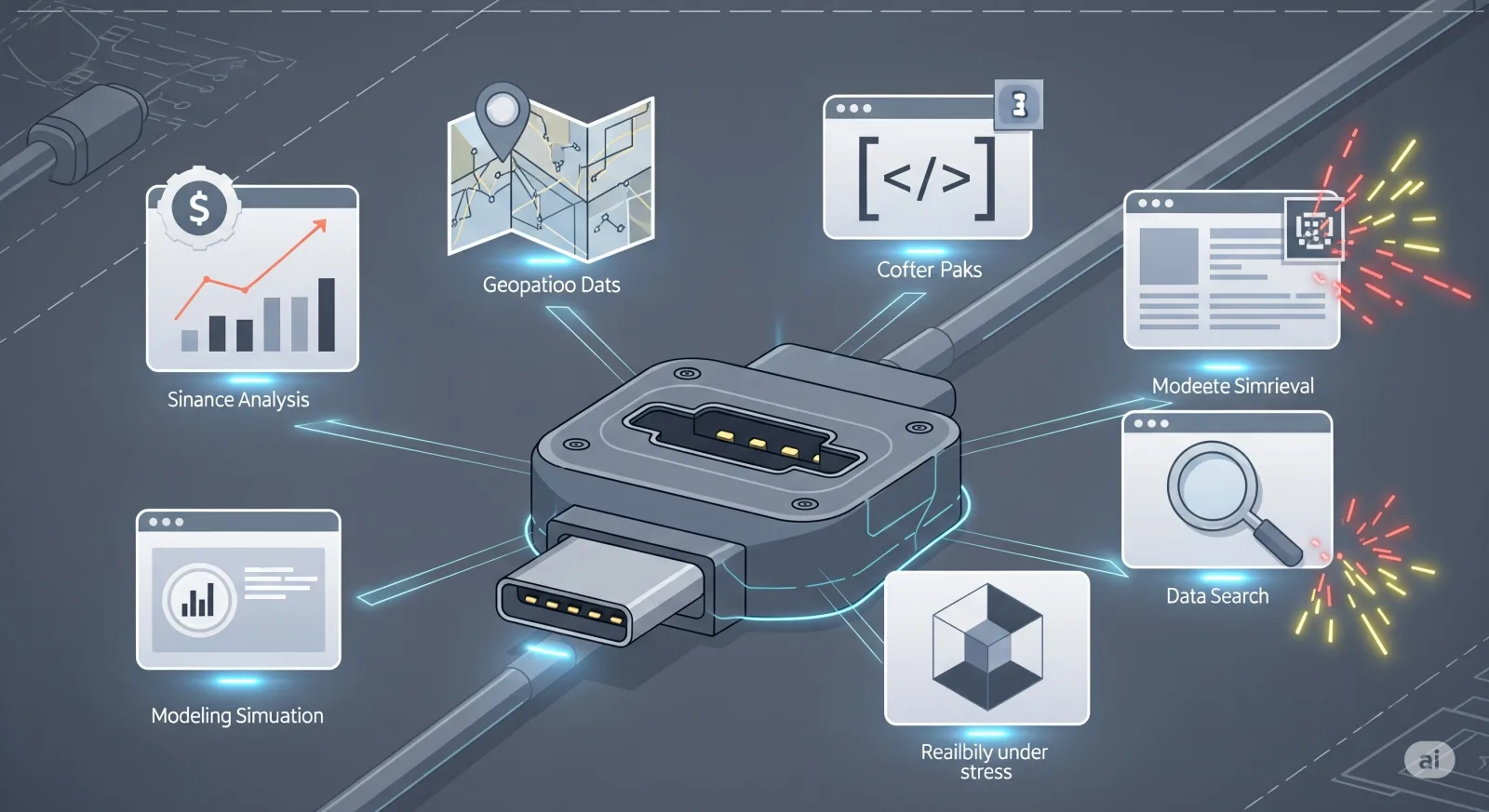
The benchmark tests agents against real MCP servers rather than toy APIs. It covers 231 tasks across Location Navigation, Repository Management, Financial Analysis, 3D Design, Browser Automation, and Web Searching. It uses 11 MCP servers, 133 tools, and 84 execution-based evaluators, including dynamic evaluators that retrieve live ground truth for time-sensitive tasks.
The headline number is harsh: GPT-5 leads the benchmark with a 43.72% overall success rate. Grok-4 reaches 33.33%, Claude-4.0-Sonnet 29.44%, and the best open-source model in the table, GLM-4.5, reaches 24.68%. That is not a minor polishing gap. It is a reliability gap.
The mechanism matters more than the leaderboard. Real MCP workflows fail because tool outputs create long context, tool schemas contain small but fatal interface traps, irrelevant tools create selection noise, live data breaks static evaluation, and agent frameworks interact with model behaviour in non-obvious ways. In other words, the protocol standardises the plug. It does not make the toaster sentient.
For business deployment, the operational lesson is clear: benchmark your real workflows, expose fewer tools than your platform technically allows, validate outputs against execution or ground truth, test model-framework pairings, and treat context compression as a design problem rather than an afterthought.
The boundary is also clear. MCP-Universe is a stress test, not a procurement oracle. Its tasks are manually designed, deliberately difficult, and largely built around public or official MCP-style servers. It should guide diagnosis and architecture decisions, not be mistaken for a universal forecast of every private enterprise workflow.
The connector is not the worker
“USB-C for AI” is a good phrase because executives understand it immediately. One cable. Many devices. Less integration theatre. Fewer bespoke adapters breeding quietly under the desk.
That metaphor is also dangerous, because it makes connection feel like capability.
MCP, the Model Context Protocol, is meant to give AI systems a standard way to connect to external data sources and tools. In business language, it promises fewer one-off integrations and a cleaner path from model to system of record. That is valuable. Fragmented integration is boring, expensive, and astonishingly good at surviving budget reviews.
But a connector standard only answers the first question: can the agent reach the tool? It does not answer the more expensive questions: can the agent choose the right tool, call it with the right parameters, interpret the output, manage the growing context, recover from errors, ignore irrelevant tools, and finish the workflow without quietly wandering into nonsense?
MCP-Universe is important because it tests those second-order questions. It does not ask whether a model can call a neatly described function in a clean benchmark environment. It asks whether current LLM agents can operate real MCP servers across multi-step, noisy, live-data tasks.
The answer is: sometimes. Which is not the same as “yes”.
What MCP-Universe actually builds
MCP-Universe has three core components: an extensible evaluation framework, a set of manually designed task instructions grounded in real MCP server scenarios, and execution-based evaluators that decide whether the task was completed.
The benchmark spans six domains:
| Domain | What the tasks resemble | Why it stresses agents |
|---|---|---|
| Location Navigation | Route planning, stops, place search, meeting-point selection | Geospatial APIs return many candidates; correct answers require constraint satisfaction, not just lookup |
| Repository Management | GitHub project setup, issue tracking, automation, code integration | The agent must change state correctly across repositories, branches, files, and pull requests |
| Financial Analysis | Portfolio analysis, statements, trading rules, holdings, dividends | Live or historical market data requires exact dates, formulas, and tool-specific behaviour |
| 3D Design | Blender object creation, materials, lighting, render settings, hierarchy | Tasks combine procedural precision with stateful environment control |
| Browser Automation | Travel booking, sports analytics, academic research, platform exploration, map navigation | Websites are verbose, dynamic, and not designed for the agent’s emotional comfort |
| Web Searching | Entity identification, metric matching, clue-based lookup, complex factual reasoning | Evidence is scattered and often requires multiple retrieval steps |
The scale matters. MCP-Universe contains 231 tasks, 11 MCP servers, 133 tools, and 84 unique evaluators. The evaluators are split into format evaluators, static evaluators, and dynamic evaluators. That last category is especially important: 48 of the 84 evaluators retrieve real-time ground truth for tasks whose answer may change, such as weather, flight prices, or current GitHub issue counts.
This is a major methodological choice. Many agent benchmarks use an LLM judge because it is cheaper and convenient. MCP-Universe instead uses execution-based checking. That is slower to build, but closer to how businesses should evaluate agents that touch real systems. A customer support agent either closed the right ticket with the right classification or it did not. A finance agent either calculated the right return using the right data or it did not. “The answer looked plausible to another model” is not an audit strategy. It is a séance with JSON.
The task design is also intentionally hard. The authors say they manually designed challenging tasks and replaced tasks that could be easily solved without MCP servers or consistently solved within five retries. That makes the benchmark a stress test rather than an average day in the office. This matters for interpretation: low scores do not mean every MCP deployment is doomed. They mean real-world, multi-step, tool-rich agent tasks are not solved by connectivity alone.
The low ceiling is the main result
The paper evaluates top proprietary and open-source models, mostly under a ReAct-style agent pipeline. The overall success rates are not subtle.
| Model | Overall success rate | Average evaluator score | Average steps on successful tasks |
|---|---|---|---|
| GPT-5 | 43.72% | 60.23% | 8.22 |
| Grok-4 | 33.33% | 49.01% | 7.75 |
| Claude-4.0-Sonnet | 29.44% | 50.61% | 7.46 |
| o3 | 26.41% | 38.95% | 4.82 |
| o4-mini | 25.97% | 40.38% | 7.90 |
| GLM-4.5 | 24.68% | 41.16% | 7.33 |
| GPT-4.1 | 18.18% | 41.32% | 5.24 |
| GPT-4o | 15.58% | 37.03% | 6.03 |
| GPT-OSS-120B | 11.26% | 26.34% | — |
A simple leaderboard reading would say GPT-5 wins. True, but not very interesting. The more useful reading is that the best tested model fails more often than it succeeds.
Even where models pass many individual evaluators, full task success remains difficult. GPT-5 has the highest average evaluator score at 60.23%, but its overall task success is 43.72%. Claude-4.0-Sonnet passes slightly more evaluators than Grok-4, yet Grok-4 has the higher overall success rate. This distinction matters because enterprise workflows usually fail at the workflow level, not at the “some subchecks looked okay” level.
A travel agent that gets the destination right but books the wrong airport has not “mostly succeeded”. A GitHub automation agent that creates the repository but mishandles the branch or pull request has not created a reliable workflow. Partial correctness can be informative during debugging. It is not the same as operational completion.
The domain breakdown also refuses to tell a comforting story. GPT-5 is strong in Financial Analysis at 67.50%, reaches 52.63% in 3D Design, and leads Web Searching at 45.45%. But Location Navigation remains weak across all models, with every model below 35%. Repository Management is also difficult: only GPT-5 exceeds 30%.
This matters because many enterprise deployments are closer to Repository Management than to a clean question-answering task. They are stateful. They involve credentials, mutable artefacts, idempotency, branching, hidden side effects, and the delightful possibility of making the wrong change perfectly.
Real tools make context rot
The first mechanism is context growth.
In a toy tool benchmark, the model calls a function and gets a tidy response. In MCP-Universe, tools return realistic outputs. Google Maps can return detailed place candidates. Playwright can expose large chunks of page content. Yahoo Finance can return daily stock data across a date range. Each observation is added to the agent’s working trace. The longer the workflow, the larger the context.
The paper’s long-context analysis shows average input tokens growing rapidly as interaction steps increase, especially in Location Navigation, Browser Automation, and Financial Analysis. The purpose of this experiment is main diagnostic evidence: it explains why multi-step MCP work becomes difficult even when individual tool calls are technically available.
The obvious patch is summarisation. The authors test that too. They introduce a summarisation agent to compress raw MCP outputs at each step. This is best read as an exploratory mitigation test, not as a second thesis. It asks whether a simple context-compression wrapper can rescue performance.
The answer is mixed. Summarisation improves GPT-4.1 and Claude-4.0-Sonnet in Location Navigation. In the figure, GPT-4.1 rises from 8.89% to 20.00%, while Claude-4.0-Sonnet rises from 22.22% to 24.44%. But in Browser Automation and Financial Analysis, summarisation is neutral or harmful. Claude-4.0-Sonnet drops from 38.46% to 30.77% in Browser Automation and from 55.00% to 42.50% in Financial Analysis.
That result is not a contradiction. It is the point.
Summarisation can remove clutter, but it can also remove the small detail that determines the answer. In location tasks, compressing verbose place data may help the agent focus. In financial tasks, a discarded date, interval, field name, or edge-case value may be fatal. In browser tasks, a “summary” of a page may omit the specific DOM or textual cue needed for the next action.
So the practical lesson is not “add summarisation”. It is: context management is a workflow-specific engineering layer. Compression must preserve the information that evaluators, business rules, and downstream actions actually depend on. Otherwise, it becomes lossy middleware with a positive attitude.
Unfamiliar tools fail at the edges
The second mechanism is tool unfamiliarity.
LLMs may have broad knowledge of common APIs, but MCP servers expose particular tools with particular schemas, constraints, and behaviours. The paper gives a simple failure from Yahoo Finance: to retrieve a stock price, the tool requires start and end dates that differ. Agents often set the same date for both fields, causing an execution error.
That is a small mistake. It is also exactly the kind of small mistake that breaks production automation.
The authors test an exploration phase: before solving the real task, the model can freely interact with the MCP tools to learn their behaviours. This is an ablation or exploratory extension, not the main benchmark result. It tests whether tool familiarisation improves performance.
Again, the answer is mixed. GPT-4.1 improves in Browser Automation from 23.08% to 30.77%. Claude-4.0-Sonnet improves in Financial Analysis from 55.00% to 62.50%. But GPT-4.1 shows no improvement in Financial Analysis, and Claude-4.0-Sonnet declines in Browser Automation from 38.46% to 33.33%.
This is a useful business result because it stops a lazy architectural answer before it becomes a roadmap. “Let the agent explore the tools first” is sometimes useful. It is not a universal cure.
Tool exploration helps when the problem is interface discovery: what does this tool accept, what does it return, what quirks does it have? It may be less useful when the task requires planning through state changes, navigating a browser, or preserving constraints across a long action sequence. Exploration can also add more context, more noise, and more opportunities for the agent to learn the wrong lesson.
For enterprise deployments, the stronger pattern is not free exploration. It is tool training under control: schema examples, negative examples, preflight validation, dry-run modes, constrained parameter builders, typed wrappers, and recovery rules for common tool errors. Agents should not have to discover production API etiquette by poking the machine with a stick.
More tools create noise, not optionality
The third mechanism is tool-space bloat.
In the main MCP-Universe experiments, agents only receive the MCP servers relevant to each task. The authors then run a robustness test where they connect additional unrelated servers: seven MCP servers and 94 tools in total. The purpose of this test is sensitivity analysis. It asks whether performance survives when the tool menu resembles a real enterprise environment, where the agent has access to many systems and half of them are irrelevant to the current job.
Performance drops.
Claude-4.0-Sonnet in Location Navigation falls from 22.22% to 11.11%. GPT-4.1 in Browser Automation falls from 23.08% to 15.38%. GPT-4.1 in Financial Analysis falls from 40.00% to 35.00%. The paper frames this as evidence that MCP-Universe can test robustness under larger unrelated tool spaces.
The business reading is sharper: giving an agent more tools can reduce capability.
This is counterintuitive only if one thinks of tools as passive optional resources. Agents do not experience tools that way. A larger tool space increases search cost, ambiguity, prompt length, irrelevant affordances, and the chance of choosing a plausible but wrong path. In human terms, it is the difference between giving a new employee the exact form they need and giving them the entire shared drive.
The implication is not that enterprises should avoid broad MCP ecosystems. The implication is that runtime tool exposure should be curated. The agent should see the tools relevant to the workflow, the user’s permission scope, and the current state. Tool access should be routed, staged, and permissioned. A universal connector does not require a universal menu.
Agent frameworks are part of the model
The fourth mechanism is framework-model fit.
The paper compares ReAct, Cursor Agent, and OpenAI Agent SDK configurations. This is a framework comparison, not merely a model comparison, and it is one of the most operationally relevant parts of the paper.
| Backbone / framework | Overall success rate | Interpretation |
|---|---|---|
| Claude-4.0-Sonnet + ReAct | 29.44% | Simple ReAct beats Cursor overall for this backbone |
| Claude-4.0-Sonnet + Cursor Agent | 26.41% | Better in Browser Automation, worse in Web Searching |
| o3 + ReAct | 26.41% | ReAct underuses this model in several domains |
| o3 + OpenAI Agent SDK | 31.60% | Better overall, especially Financial Analysis and 3D Design |
The Cursor result is the one likely to annoy people, which means it is worth reading carefully. Cursor Agent with Claude-4.0-Sonnet does better than ReAct in Browser Automation: 43.59% versus 38.46%. But it performs much worse in Web Searching: 7.27% versus 21.82%. The paper suggests Cursor’s reliance on internal tools rather than the benchmark’s MCP servers may contribute to that gap.
The o3 result points in the opposite direction. o3 with OpenAI Agent SDK reaches 31.60%, compared with 26.41% for o3 with ReAct. The Agent SDK improves Financial Analysis from 40.00% to 60.00% and 3D Design from 26.32% to 36.84%.
So the lesson is not “enterprise agents are worse” or “SDKs are better”. The lesson is that the framework is part of the capability surface. It changes what the model sees, how it plans, how it calls tools, how it handles intermediate state, and how it recovers.
This is where many procurement conversations become technically unserious. A company asks, “Which model should we use?” The better question is, “Which model, with which agent framework, exposed to which tools, under which validation regime, for which workflow class?”
Less tidy. More correct.
What each experiment supports — and what it does not
The paper is strongest when read as a mechanism map. Each experiment has a different evidentiary role.
| Paper component | Likely purpose | What it supports | What it does not prove |
|---|---|---|---|
| Main benchmark across 231 tasks | Main evidence | Real MCP workflows remain difficult for leading models | That every enterprise MCP workflow will have the same failure rate |
| Format/static/dynamic evaluator breakdown | Diagnostic evidence | Failures are mostly content and task correctness, not merely formatting | That execution-based evaluation captures every qualitative aspect of usefulness |
| Long-context growth analysis | Main mechanism evidence | Tool traces can rapidly inflate context in realistic workflows | That context length alone explains all failures |
| Summarisation agent test | Exploratory mitigation / ablation | Simple compression helps some domains and hurts others | That summarisation is useless, or that one prompt is the best possible compression method |
| Exploration phase test | Exploratory mitigation / ablation | Tool familiarisation can help, but inconsistently | That agents should freely explore production systems |
| Extra unrelated servers test | Robustness / sensitivity test | Larger irrelevant tool spaces degrade performance | That more tools always hurt, regardless of routing and permissions |
| Framework comparison | Architecture comparison | Model-framework pairing materially affects success | That any one commercial agent framework is generally superior or inferior |
This distinction matters because a careless reader can overfit the wrong lesson. MCP-Universe is not saying “do not use MCP”. It is saying “do not confuse the integration layer with the reliability layer.”
That is a better conclusion, and unfortunately for slide decks, less magical.
What this means for business deployment
The paper directly shows that current LLM agents struggle on hard, realistic MCP-server tasks. Cognaptus infers a deployment discipline from that evidence.
| What the paper shows | Cognaptus business inference | What remains uncertain |
|---|---|---|
| Top models remain below 50% overall success on MCP-Universe | Production MCP agents need workflow-level evaluation before rollout | Exact scores may differ on simpler or narrower internal workflows |
| Dynamic evaluators are necessary for live-data tasks | Businesses should validate against execution, database state, API ground truth, or deterministic checks | Some qualitative tasks still need human review or hybrid evaluation |
| Long context grows with tool interactions | Context budgets and memory policies should be designed per workflow | Better long-context models may reduce but not remove this issue |
| Summarisation gives mixed results | Compression should be task-aware and evaluator-aware | The paper tests one summarisation setup, not all possible context architectures |
| Tool exploration gives mixed results | Tool onboarding should be structured, not left to improvisation | Better exploration policies may help more consistently |
| Extra irrelevant tools reduce performance | Tool access should be routed and minimised at runtime | The ideal routing strategy is domain- and organisation-specific |
| Framework choice changes outcomes | Model selection and agent architecture must be tested together | Results may shift as frameworks and models evolve |
For operators, this becomes a practical checklist.
First, define the workflow, not the agent. “Use MCP to access our systems” is not a workflow. “Given a vendor invoice, match it to a purchase order, check exceptions, update status, and produce an audit note” is closer.
Second, expose only the tools the workflow needs. MCP makes it easy to connect many servers. Resist the urge to show the agent the whole buffet. The buffet is where reliability goes to become a spreadsheet incident.
Third, build evaluators before demos. A useful internal benchmark should include both final-state checks and intermediate invariants. Did the agent call the correct system? Did it use the right date range? Did it avoid unauthorised mutation? Did it close the loop? Did it leave an audit trail?
Fourth, test live-data behaviour. Static gold answers are insufficient for workflows involving prices, inventory, schedules, tickets, claims, filings, or account states. The evaluator needs access to the same changing world the agent is operating in.
Fifth, treat tool schemas as user experience. The “user” is the model. Field names, examples, error messages, default values, and validation rules shape model behaviour. If a tool silently accepts bad parameters or returns a 400-word shrug, the agent will not become wiser out of gratitude.
Sixth, test the model and framework together. A model that performs well under one framework may underperform under another. A commercial agent wrapper may shine in one domain and stumble in another because it routes actions differently or relies on internal tools.
Finally, measure partial correctness separately from task success. Average evaluator score is useful for debugging. It tells you whether the agent is almost right, failing early, or satisfying superficial requirements while missing the workflow. But the business release gate should remain task success. Customers do not pay for “nearly reconciled”.
The benchmark is a stress test, not an oracle
MCP-Universe has real strengths. It uses actual MCP servers. It covers multiple domains. It includes live-data evaluation. It distinguishes format compliance from content correctness. It tests tool bloat, context growth, exploration, summarisation, and framework choice. That is a serious improvement over benchmarks that treat tool use as a polite function-calling exercise.
But the boundaries matter.
The tasks are manually designed and deliberately hard. The authors explicitly filter out tasks that are too easy. This is appropriate for stress testing, but it means the overall success rate should not be interpreted as the average reliability of every possible MCP deployment.
The server set is broad but not equivalent to a private enterprise stack. Google Maps, GitHub, Yahoo Finance, Blender, Playwright, Search, Fetch, Notion, Weather, Date, and Calculator-style servers are useful proxies. They are not SAP, Salesforce custom objects, internal claims systems, legacy databases, procurement portals, or a SharePoint folder maintained by someone named Brian since 2014. Brian is a benchmark of his own.
The evaluators are binary or structured, which is exactly right for many operational tasks. But not every business process has a clean final-state check. Some workflows require judgement, negotiation, prioritisation, or subjective quality review. MCP-Universe does not remove the need for human oversight in those settings.
The models and frameworks are also time-bound. Agent systems are moving quickly. The specific ranking will age. The mechanism will age more slowly. Context growth, tool unfamiliarity, tool overload, live data, and framework-model fit are structural problems. Better models may reduce them; they do not make them disappear by press release.
The real lesson is engineering discipline
MCP-Universe is not anti-MCP. Quite the opposite. It shows why MCP matters: without standardised access to real tools, it is hard to evaluate agents in the environments where businesses actually want to use them.
But it also shows why MCP is only the beginning.
A standard connector gives the agent access. Reliability comes from everything wrapped around that access: task design, tool curation, schema quality, context management, dynamic validation, recovery policies, permissions, observability, and framework selection.
That is the grown-up version of the USB-C metaphor. USB-C made it easier to plug things in. It did not guarantee that the thing you plugged in was useful, safe, charged, compatible, or wise.
For business leaders, the correct conclusion is neither “agents are ready” nor “agents are hopeless”. The correct conclusion is more operational: connected agents need the same engineering discipline as any other system allowed to touch real workflows. MCP reduces integration friction. MCP-Universe shows the remaining friction lives inside the agent loop.
And that is where the actual work begins.
Cognaptus: Automate the Present, Incubate the Future.
-
Ziyang Luo, Zhiqi Shen, Wenzhuo Yang, Zirui Zhao, Prathyusha Jwalapuram, Amrita Saha, Doyen Sahoo, Silvio Savarese, Caiming Xiong, and Junnan Li, “MCP-Universe: Benchmarking Large Language Models with Real-World Model Context Protocol Servers,” arXiv:2508.14704, 2025. ↩︎