TL;DR for operators
AI shopping agents do not simply “find the best product.” They convert a messy human browsing process into a model-mediated allocation system. That allocation system has its own priors, positional quirks, trust cues, and semantic blind spots. Lovely. We automated the customer and discovered a new customer.
The paper introduces ACES, a controlled sandbox for testing AI shopping behaviour. It pairs a browser-use or API-style buying agent with a programmable mock e-commerce site, then randomises product order, prices, ratings, reviews, badges, and product descriptions to estimate what actually moves an AI agent’s choice.1
The surprising result is not that agents sometimes make mistakes. On simple rationality tests, newer models are already close to reliable. The more important result is that near-rational agents still produce unstable markets. The same assortment can produce very different product market shares depending on whether the buyer agent is Claude, GPT, or Gemini. A model upgrade can move demand as if someone changed the storefront, even when the catalogue itself has not changed.
Three platform levers matter especially. First, position still matters, even when the agent is told not to care about it and even when the interface is reduced to a ranked JSON list. Second, “Sponsored” tags tend to reduce selection probability conditional on position, while “Overall Pick” endorsements can create large lifts. Third, listing text matters in a very literal way: moving the right query-aligned words earlier in the product description can cause major market-share shifts.
For sellers, the lesson is not “stuff keywords into everything like it is 2008 SEO with a nicer font.” The lesson is that AI-facing listings need controlled testing across agent families. Query-conditional titles, feature ordering, specification enrichment, and model-specific evaluation become operational capabilities.
For platforms, the lesson is sharper. If AI agents become meaningful demand intermediaries, ranking policy, ad labels, badges, and seller tools need to be audited against agent behaviour, not just human click-through. A marketplace cannot assume that a “top result” means the same thing to every model.
For regulators, ACES points toward a practical method: counterfactual auditing. Do not ask only whether the agent completed the shopping task. Ask how demand would have changed if the same product had appeared elsewhere, carried a different badge, or used a slightly different description. That is where the power moves.
The customer is no longer the only shopper
A normal shopping page is built around a human compromise. The customer sees a grid, scans a few items, trusts some signals, ignores others, gets bored, clicks something, and occasionally pretends this was a rational decision. Platforms have spent years monetising that mess through rankings, sponsored placement, badges, reviews, and recommendation modules.
AI shopping agents change the mess. They do not remove it.
The common assumption is that a delegated shopping agent should behave like a neutral optimiser. Give it a product category, let it inspect the options, and it will choose the cheapest, highest-rated, most suitable item. If that were true, many familiar e-commerce levers would lose power. Ads would matter less. Position would matter less. Listing copy would matter less. Consumers would get cleaner choices, sellers would compete on fundamentals, and marketplaces would become more efficient.
The paper argues something more interesting and less comforting: agentic commerce creates a new demand surface. The buyer is still acting for a consumer, but the decision passes through a model. That model has learned priors. It responds to interface structure. It treats platform signals as information. It can be nudged by phrasing. It changes after provider updates. In other words, the market does not become frictionless. The friction moves into the model.
The mechanism is simple enough to sketch:
Consumer prompt
   ↓
Buyer-agent model prior
   ↓
Platform presentation: rank, row, column, badge, metadata
   ↓
Product listing semantics: title, feature order, query alignment
   ↓
Agent selection
   ↓
Market share under delegation
That chain is the paper’s business contribution. ACES is the measurement tool. The experiments are the evidence. The strategic implication is that sellers, platforms, and regulators now need to understand not only what humans click, but what agents select.
ACES isolates the choice step instead of pretending to test all of shopping
The authors build ACES, short for Agentic e-Commerce Simulator, as a controllable testing environment. It consists of a provider-agnostic shopping agent and a mock e-commerce site. The agent can use a vision-language model to inspect a storefront screenshot, or operate in a “headless” setting where it receives structured product data as a ranked JSON list.
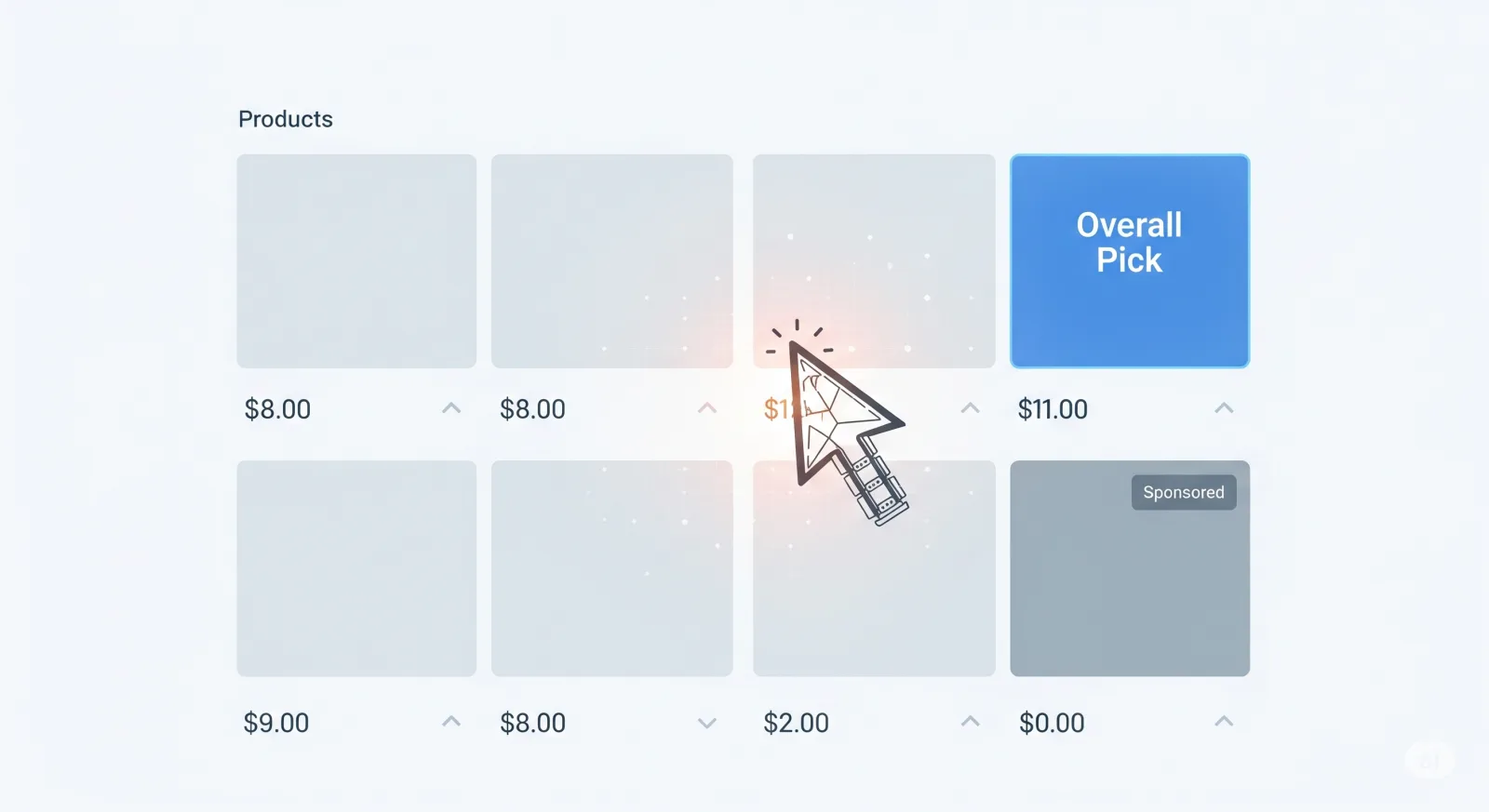
The mock store shows eight products in a two-row, four-column grid. The paper studies eight categories: fitness watches, iPhone 16 Pro covers, mousepads, office lamps, staplers, toilet paper, toothpaste, and washing machines. Product listings are based on public Amazon information, but the experimental environment is synthetic and controllable.
That design matters. Many AI-agent benchmarks test whether an agent can complete a web task end to end: search, click, scroll, read, recover from mistakes, and eventually act. ACES deliberately avoids that mess. The agent opens the mock app, sees the product grid, chooses one item, and the episode ends. The paper calls this “Veni, Vidi, Emi”: I came, I saw, I bought. A little smug, but memorable.
This narrowing is not a weakness for the paper’s question. It is the point. If the goal is to measure how product position, badges, ratings, prices, reviews, and descriptions affect choice, then multi-page browsing would introduce confounds. Did the model choose the wrong item because it liked the product? Because it missed a scroll? Because Selenium had a bad day? Because the screenshot cropped poorly? ACES removes as much of that as possible.
The result is not a complete model of e-commerce. It is a causal microscope for the selection step.
| Experiment layer | Likely purpose | What it supports | What it does not prove |
|---|---|---|---|
| Instruction following and rationality tests | Baseline capability check | Whether agents can handle simple “one correct answer” choices | That agents behave neutrally in real shopping |
| Market-share experiments | Main evidence | Whether delegated choices concentrate and vary by model | Exact real-world market shares |
| Conditional logit choice tests | Main causal evidence | How position, badges, price, ratings, and reviews shift selection | Full marketplace equilibrium |
| Seller-side description edits | Strategic extension | Whether AI-facing listing optimisation can causally move share | That all AI-generated listing edits are beneficial |
| Model drift, headless interface, prompt variants | Robustness and sensitivity tests | Whether effects persist across time, interface type, and prompt changes | That every future agent will show the same coefficients |
The cleanest reading is this: ACES is not a leaderboard. Shopping often has no objectively correct product. ACES instead measures the agent’s choice function. That is more useful for markets, because markets care less about benchmark trophies and more about who gets demand.
The rationality tests are the floor, not the story
The paper first checks whether AI shopping agents can pass simple tests. These are not subtle preference problems. They are cases where there is only one correct choice: pick the product under a stated budget, pick the specified colour, pick the specified brand, choose the unique cheaper product, or choose the unique higher-rated product.
This is the minimum viable condition for delegation. If the agent cannot reliably select the only item under budget, then the platform-design debate can go home early.
The findings are mostly encouraging for newer models. The paper reports a clear improvement trend. Later models such as Claude Opus 4.5, GPT-5.1, and Gemini 3.0 Pro Preview almost eliminate errors on simple one-dimensional comparisons. In rating tests where one product has a small +0.1 advantage, error rates for the December 2025 frontier models fall below 1.7%.
That matters, but it is not the main event. A model can be competent at dominance tests and still behave strangely in a real choice environment. Most commerce is not “one product is identical but 5% cheaper.” It is multi-attribute, noisy, and mediated by presentation. The agent must decide how to weigh price against ratings, reviews, title wording, platform badges, and layout. That is where the market mechanism appears.
The paper’s hidden warning is therefore not “AI agents are dumb.” That would be convenient and increasingly false. The warning is worse: AI agents can be competent enough to be deployed and still biased enough to reshape markets.
Delegated shopping can concentrate demand around modal products
Once the paper moves from rationality tests to generic shopping prompts, the behaviour becomes more economically interesting. Agents are asked to choose a good product for a typical person, without specific user preferences. Product positions are randomised, and selection frequencies are treated as a proxy for market share in a fully delegated setting.
The same assortment produces different market shares across models. In the fitness-watch category, Claude Sonnet 4 selects Fitbit Inspire about 45% of the time, while GPT-4.1 and Gemini 2.5 Flash select it about 25% of the time. After upgrades, the divergence becomes sharper: the Fitbit Inspire share rises to 77% under Claude Opus 4.5 but falls to 6% under GPT-5.1.
This is not a small difference in conversion rate. It is the kind of shift a brand would normally associate with a major campaign, a search-ranking change, or a competitor stockout. Here, the catalogue can stay fixed while the model changes.
The iPhone cover example is even cleaner as a demand-shock story. GPT-4.1 selects Mikeke most often, with a 62.6% share. GPT-5.1 shifts the modal product to ESR, selecting it 95% of the time, while Mikeke drops to 5%. The market does not merely become more automated; it becomes more dependent on the buyer-agent model family and version.
The second pattern is concentration. The authors observe that in some categories, demand collapses onto a few modal products, while other brands are never selected. The paper mentions staplers as one example, where Amazon Basics dominates while Arrow is never selected. This is not necessarily because Arrow is objectively uncompetitive. It may be because the agent’s learned choice function maps the visible attributes and text into a narrow preference distribution.
That is the first major business translation: AI-mediated shopping can reduce consumer search friction while also reducing visible preference diversity. Human shoppers are inconsistent, impatient, brand-biased, budget-constrained, sentimental, and occasionally irrational. That heterogeneity is commercially useful because it spreads demand. A dominant AI assistant could compress heterogeneous demand into a smaller set of repeated “safe” choices.
For marketplaces, that creates a concentration risk. For sellers, it creates model-exposure risk. For consumers, it creates a quieter problem: the agent may be efficiently choosing from a narrower internal imagination of what “good” means.
Position bias survives the arrival of the allegedly rational shopper
The most operationally important part of the paper is the conditional logit analysis. The authors randomise product position, sponsored tags, platform endorsements, scarcity tags, prices, ratings, and review counts. Because these variations are exogenous, the estimated effects can be read causally within the experimental setup.
The agents respond to fundamentals in the expected direction. Higher ratings help. More reviews help. Lower prices help. This is the part one would hope for.
But position matters a lot. In the visual mock-store setting, all three August 2025 frontier models display meaningful position effects, but not the same position effects. GPT-4.1 strongly favours the first column. Claude Sonnet 4 prefers the two middle columns and largely ignores the first column. Gemini 2.5 Flash tilts toward the third and fourth columns.
So the “best” position is not universal. This is awkward for platforms whose entire merchandising logic assumes that rank position has a reasonably stable meaning. A human eye has familiar scanning tendencies. AI agents have model-specific interface priors.
The magnitudes are not decorative. For Claude Sonnet 4, the paper reports that moving a product selected 4.5% of the time in the bottom-right corner to the top row in the second or third column produces a five-fold increase in selection rate. Moving it to the top-left corner helps less. The model does not simply like “higher.” It likes particular spatial patterns.
The newer models preserve the problem while changing its shape. Claude Opus 4.5, GPT-5.1, and Gemini 3.0 Pro Preview still show position effects, but the preferred positions shift after upgrades. The paper notes that GPT-4.1 and GPT-5.1 are almost mirror images: a preferred slot for one becomes the least preferred for the other.
This is where the mechanism becomes uncomfortable. The platform’s layout is no longer just a human attention device. It is an input feature for a black-box buyer. The same row, column, and rank can carry different implied value depending on which agent is shopping.
Badges become machine-readable trust signals
The badge results are equally useful because they separate attention from credibility.
In the visual setting, a sponsored tag reduces selection probability conditional on fixed position and product attributes. For a product with a 10% baseline selection probability, adding a Sponsored tag lowers selection to 8.9% for Claude Sonnet 4, 8.0% for GPT-4.1, and 7.9% for Gemini 2.5 Flash.
That does not mean sponsored ads are useless. The authors are careful here. Sponsorship may still buy premium placement. But given the same position, the label itself creates a credibility cost. The agent seems to discount the sponsored signal.
By contrast, platform endorsement is powerful. The “Overall Pick” tag raises the same 10% baseline to 24.3% for Claude Sonnet 4, 19.9% for GPT-4.1, and 42.6% for Gemini 2.5 Flash. Because the badge assignment is randomised, this is not just better products receiving better labels. It is the label moving the agent.
The price-equivalent analysis makes this concrete. For the August 2025 models, moving from the second row to the first row is worth approximately +112.6% price headroom for Claude Sonnet 4, +91.2% for GPT-4.1, and +17.0% for Gemini 2.5 Flash. The Overall Pick tag is worth +92.2%, +64.5%, and +137.8%, respectively. A +0.1 rating increase is worth +35.4%, +67.3%, and +27.9%. Doubling reviews is worth +19.4%, +37.4%, and +17.2%.
Read that again as a platform operator. A badge can be worth more than a price cut. Not metaphorically. In the model’s estimated utility trade-off.
For newer models, the pattern remains but the numbers shift. The Overall Pick tag is worth +168.9% price headroom for Claude Opus 4.5, +61.5% for GPT-5.1, and +159.3% for Gemini 3.0 Pro Preview. Sponsored tags continue to impose a penalty, requiring price cuts of roughly 16.5%, 12.4%, and 24.2% to offset their harm.
The obvious conclusion is that badge governance becomes more important in agentic commerce. The less obvious conclusion is that platform endorsements may become more valuable precisely because agents are trained to treat structured signals as useful evidence. If a model sees “Overall Pick,” it may not experience persuasion. It may experience information.
Headless interfaces do not make ranking bias disappear
A convenient rebuttal would be to blame the visual interface. Perhaps the position effects arise because vision-language models parse screenshots imperfectly. Move to clean API feeds and the problem goes away.
The paper tests that. In the headless version of ACES, the agent receives a ranked JSON list with product attributes and returns a single JSON choice. No images. No visual grid. No row or column layout. Just structured data.
Rank still matters.
For Claude Sonnet 4, moving a product from position 8 to position 1 increases its selection probability from 4.1% to roughly seven times that level. GPT-4.1 shows a position-1 premium with a non-monotone pattern elsewhere. Gemini 2.5 Flash peaks at position 3. Again, the curve is model-specific.
The badge effects also persist and become, in some cases, even more dramatic. In the headless setting, adding a Sponsored tag to a product with a 10% baseline selection probability lowers selection to 5.4% for Claude Sonnet 4, 1.8% for GPT-4.1, and 8.9% for Gemini 2.5 Flash. Adding an Overall Pick endorsement raises selection to 58.4%, 55.6%, and 72.7%, respectively.
That is a useful robustness result because it widens the relevance of the paper. The issue is not merely web-page design. It applies to future agent-commerce protocols where platforms expose product feeds, structured metadata, or agent-readable catalogues. Rank in a JSON list is still rank. The machine still notices.
Prompting helps, but does not solve it. Telling agents to “ignore position” attenuates some effects but does not eliminate them. Telling agents to ignore position and prioritise price makes them much more price-sensitive; in the visual setting, a 10% price decrease raises choice odds by about 81% for Claude Sonnet 4, 165% for GPT-4.1, and 101% for Gemini 2.5 Flash. But position effects remain economically meaningful.
This matters for product design. Preference elicitation is useful. Clear user instructions are useful. But “just prompt it better” is not a governance strategy. It is a sticky note on a machine.
Seller-side AI turns listing copy into a live control surface
The paper then adds the other half of the market: sellers.
The authors choose one focal product in each category, provide a seller-side AI agent with product details, competitor information, and simulated market-share data, then ask it to improve the product description. The buyer-agent experiments are run again using the same product shuffles. The only change is the focal product’s description. That makes the measured effect causally attributable to the listing edit within the experiment.
The average results are substantial but heterogeneous. Across six buyer models, five show statistically significant average gains for the focal product after one AI-generated description edit: +3.66 percentage points for Claude Sonnet 4, +8.37 for GPT-4.1, +14.79 for Gemini 2.5 Flash, +7.38 for Claude Opus 4.5, and +14.89 for GPT-5.1. Gemini 3.0 Pro Preview shows only +0.32 percentage points and is not statistically significant. The authors also report that 33% of the category-model experiments produce statistically significant gains.
This is not magic copywriting. The strongest examples are almost embarrassingly concrete.
In the office-lamp case, the original SUNMORY title began with “Floor Lamps for Living Room…” even though the query was “office lamp.” The word “Office” appeared late enough to be truncated or de-emphasised. The seller agent moved “Office” to the front: “SUNMORY Office Floor Lamp…” or similar variants.
That single semantic repair produced large gains across models: +80.4 percentage points for GPT-5.1, +52.0 for Gemini 2.5 Flash, +41.0 for Claude Opus 4.5, +25.8 for Claude Sonnet 4, and +7.1 for Gemini 3.0 Pro Preview.
The authors identify several recurring intervention types:
| Seller intervention | Mechanism | Example from the paper | Business reading |
|---|---|---|---|
| Keyword front-loading | Move query-relevant terms earlier | “Office Floor Lamp” instead of “Floor Lamps for Living Room…” | Agents overweight early semantic alignment |
| Category injection | Add the category vocabulary used by the buyer prompt | “GPS Running Watch” becomes more explicitly “Fitness” aligned | Listings should match agent query language, not only human category intuition |
| Feature reordering | Move important benefits earlier | Whitening toothpaste benefit moved before flavour wording | Existing information can become more valuable by changing order |
| Specification enrichment | Add concrete product specs | “Top-Load,” “Stainless Steel Tub,” “2-Ply,” “Septic-Safe” | Agents may reward explicit confirmation of suitability |
This is the birth of query-conditional AI SEO. Not the old version where sellers jam keywords into pages and hope the ranking algorithm smiles. A more precise version: sellers test how buyer agents map query intent to listing text, then adapt descriptions to reduce semantic friction.
There is a catch, because there is always a catch and it usually arrives after the budget is approved. Some edits backfire. The paper notes cases where AI-optimised descriptions decrease share for certain model-category pairs. A change that works for GPT-5.1 may be neutral or harmful for Gemini 3.0 Pro Preview. So the operational capability is not “let an LLM rewrite your titles.” The capability is controlled experimentation against the buyer agents that matter.
The market mechanism is not bias alone; it is bias plus delegation
Calling these effects “biases” is accurate but slightly too small. In human e-commerce, position bias affects clicks. In agentic e-commerce, position bias can become delegated purchasing power. The user may not see the full grid, evaluate alternatives, or correct the agent’s assumptions. The agent’s choice becomes the transaction.
That changes the economics of interface design.
In a human marketplace, ranking affects attention. In an AI-mediated marketplace, ranking affects an algorithmic decision rule. The two can look similar in aggregate, but the governance problem is different. A human can scroll, compare, or ignore a badge. A buyer agent may consistently treat a badge as a credible signal, penalise sponsorship, or over-select a particular product type because that pattern sits inside its model prior.
The paper’s most useful business distinction is therefore between three kinds of evidence:
| What the paper directly shows | What Cognaptus infers for operators | What remains uncertain |
|---|---|---|
| Agents pass many simple rationality tests but still show position and badge sensitivity | Competence testing is necessary but insufficient for agent-commerce readiness | How personalised agents behave with rich preference histories |
| Model families produce different market shares on the same assortment | Seller demand exposure will depend on which buyer agents dominate | Which agents will actually dominate consumer shopping flows |
| Model upgrades can reshuffle product shares and position preferences | Foundation-model releases may become demand shocks for sellers | How platforms will buffer or amplify those shocks |
| Seller-side description edits can causally increase share | AI-facing listing optimisation will become a normal commercial function | Whether multi-seller optimisation leads to stable gains or an arms race |
| Headless/API tests preserve rank and badge effects | Structured agent-commerce protocols still need rank and endorsement audits | How multimodal API feeds with images and richer metadata change the effects |
The mechanism-first interpretation is this: agentic commerce converts presentation features into demand allocation through model-specific choice functions. That is why the paper matters beyond e-commerce. Similar mechanisms could appear wherever AI agents choose among suppliers, vendors, routes, financial products, insurance plans, or SaaS tools.
The dangerous phrase is “the agent chose.” It sounds neutral. It may hide a stack of inherited priors and platform levers.
What platforms should do before agents become serious traffic
Platforms have the most complicated job because they control the interface, the badges, the ranking policy, the ad products, and often the data feed exposed to external agents.
The first operational move is to build ACES-like auditing into marketplace experimentation. Every major platform already tests human conversion. Agent conversion needs its own instrumentation. For a given product category and buyer-agent set, the platform should estimate:
- position sensitivity by model;
- badge sensitivity by model;
- sponsored-label penalty conditional on placement;
- price, rating, and review sensitivity;
- concentration metrics under delegated shopping;
- model-version drift over time;
- seller-level exposure to dominant buyer agents.
The second move is to separate placement from label effects. The paper shows that sponsorship can buy attention but impose a credibility cost. If AI agents penalise “Sponsored” while rewarding “Overall Pick,” platforms may face pressure to redesign ad products. That could mean clearer ad semantics, agent-readable explanations, or new paid tools that optimise seller content rather than simply buying slots.
The third move is to audit competitive neutrality. If a model repeatedly excludes certain brands under otherwise reasonable conditions, the platform needs to know whether the cause is rank, metadata, badge structure, image interpretation, or model prior. “The AI did it” will not be a satisfying answer. It is barely an answer now.
The fourth move is to design for multiple agents, not one imaginary average agent. A page layout that is favourable under GPT-5.1 may not be favourable under Claude Opus 4.5 or Gemini 3.0 Pro Preview. The paper’s upgrade evidence makes this especially important. Agent behaviour is not a fixed consumer segment. It is a moving infrastructure dependency.
What sellers should do without embarrassing themselves
For sellers, the paper invites action, but not panic.
The practical lesson is to build an AI-facing listing test loop. Start with the queries that matter. Test the product title and description against the buyer agents that are likely to mediate demand. Randomise position where possible. Measure share before and after changes. Track whether gains hold across models. Repeat after major model updates.
The content strategy should be boring in the right way:
- Put the query-relevant category early.
- Use the vocabulary the buyer agent is likely to receive from the consumer prompt.
- Move decisive benefits before decorative adjectives.
- Add factual specifications that confirm suitability.
- Avoid unsupported keyword stuffing, because the paper’s seller-agent prompt explicitly restricts the agent to provided product facts.
This is not a brand voice exercise. It is semantic alignment under measurement.
The office-lamp example is the cleanest warning. The product already had office relevance. The information existed. It was simply too late in the title, relative to the query and the displayed text. Human shoppers might still infer suitability from the full title or image. The AI buyer often did not. The seller did not need a better product. It needed a more machine-legible product.
That is both useful and slightly ridiculous. Welcome to commerce.
What regulators should notice
The regulatory angle is not that AI agents are unfair because they show bias. Human markets are biased all the way down. The issue is that AI-mediated bias can be centralised, opaque, and scalable.
If millions of consumers delegate purchases to the same agent family, then that agent’s position sensitivity, badge trust, and listing-text priors become market infrastructure. A model update can reallocate demand without any seller changing price, quality, or service. A platform endorsement can carry machine-readable authority. A sponsored label can impose a credibility penalty even after the seller pays for placement.
That suggests a regulatory question different from traditional search ranking: what counterfactuals should an AI shopping intermediary be required to survive?
Possible audit questions include:
- Would the selected product change if product order were randomised?
- Would the same product be selected without the platform badge?
- Do sponsored labels create penalties beyond disclosed ad placement?
- Are niche sellers systematically excluded across model families?
- Do model updates create unexplained demand shocks for specific categories?
- Can sellers test and contest their agent-facing visibility?
ACES is not a regulatory regime. It is a measurement pattern. But measurement patterns often come first. Before anyone can argue about fairness, they need to know what changed when rank, label, or wording changed.
Boundaries: controlled evidence, not a forecast spreadsheet
The paper is careful about scope, and operators should be too.
First, ACES studies mostly one-shot product selection. Real shopping can involve comparison pages, reviews, carts, checkout friction, delivery constraints, returns, user feedback, and follow-up questions. Those stages may amplify or dampen the observed effects.
Second, the agents are mostly tested under generic prompts. Personalised agents with purchase history, explicit budgets, brand exclusions, or learned household preferences could behave differently. The prompt-variation tests show that preferences can change weights, especially price sensitivity, but they do not eliminate all position effects.
Third, the product universe is controlled: eight categories, eight products each, mock storefront presentation, and selected frontier models. That is enough to identify structural mechanisms, not enough to forecast live Amazon share.
Fourth, the seller-response experiment tests one seller, one generated edit, and no full competitive equilibrium. If every seller uses AI optimisation, the gains may shrink, shift, or become an arms race in semantic positioning. The first seller to front-load “Office” wins until everyone discovers the word “Office.” Capitalism, ever poetic.
Fifth, the paper is primarily descriptive. It shows what agents do under controlled conditions; it does not fully explain whether the source is pre-training, post-training, interface processing, reinforcement learning, safety tuning, or hidden provider policy. The model-finalisation evidence suggests post-training can matter, and the headless evidence suggests the visual encoder is not the only cause. But the causal origin inside the model remains open.
These limitations do not weaken the practical claim. They define it. The paper should not be read as “here are tomorrow’s exact market shares.” It should be read as “here is a repeatable way to discover how AI-mediated demand behaves before it surprises you in production.”
The new shelf is inside the model
E-commerce used to fight over the shelf: the top result, the sponsored slot, the badge, the review count, the first screen. Agentic commerce does not abolish the shelf. It moves part of the shelf into the buyer agent.
That is why this paper is useful. It does not merely say AI agents can be biased. It shows how to measure those biases causally, how they vary by model, how they persist across interface modes, and how sellers can respond by changing the semantic structure of listings.
The strategic shift is clear. Platforms will need agent-facing audits. Sellers will need model-aware listing tests. Consumers will need agents that elicit preferences rather than silently imposing defaults. Regulators will need counterfactual tools for markets where the real shopper may be a black box acting politely on someone else’s behalf.
The old question was: where does the product appear on the page?
The new question is: where does the product appear in the model’s decision surface?
That is less visible, more volatile, and probably more valuable.
Cognaptus: Automate the Present, Incubate the Future.
-
Amine Allouah, Omar Besbes, Josué D. Figueroa, Yash Kanoria, and Akshit Kumar, “What Is Your AI Agent Buying? Evaluation, Biases, Model Dependence, & Emerging Implications for Agentic E-Commerce,” arXiv:2508.02630, https://arxiv.org/abs/2508.02630. ↩︎