TL;DR for operators
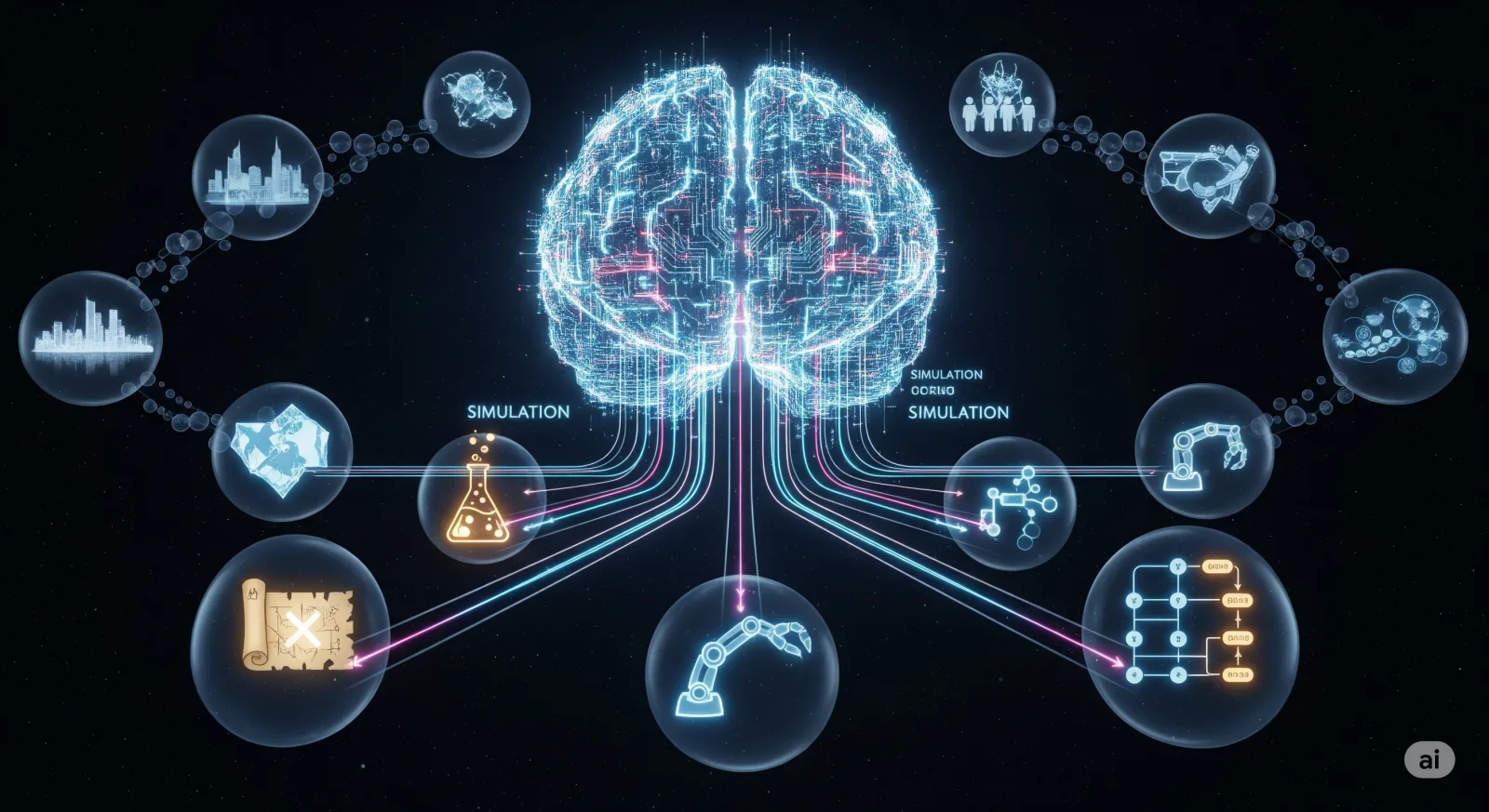
SimuRA is an agent architecture that asks a simple operational question: before an AI agent clicks, searches, filters, submits, or replies, can it cheaply rehearse what might happen next?1 Not in a poetic “the machine imagines” sense, please calm down. In a practical sense: generate candidate actions, simulate their likely outcomes in a compact internal state, score those futures against the goal, and only then execute the first concrete action.
The paper directly shows that this helps in web-agent tasks. On FlightQA, a live flight-search benchmark built by the authors, SimuRA with world-model planning reaches 32.2% correctness, compared with 14.4% for the same architecture using autoregressive planning and 0.0% for the OpenHands BrowsingAgent baseline. On FanOutQA, world-model planning improves accuracy from 20.2% to 29.8% over autoregressive planning. On a 100-task WebArena subset, it improves success from 19.0% to 23.0%.
Cognaptus’ business reading is narrower and more useful than the usual “agents are coming for workflows” confetti cannon. SimuRA suggests that enterprise agents should not be judged only by whether they can act. They should be judged by whether they can preview consequences before acting, expose where the preview was wrong, and recover without smashing into the same button three times like a caffeinated intern with root access.
The uncertainty is not cosmetic. SimuRA is slower than reactive agents, its world model can still simulate the wrong future, and the evaluation is concentrated on browser work rather than physical operations or heavily permissioned enterprise systems. The result is still valuable: it moves agent reliability from prompt style into architecture.
The familiar failure: the agent acts before it understands the room
Anyone who has tested a browser agent has seen the same little tragedy. The model reads the instruction. It opens the page. It notices a search box. It clicks something plausible. Then the page changes, the model loses track of what happened, repeats an action, hallucinates a result, or declares victory over a form it never completed.
This is not always a “bad model” problem. It is often a control problem.
A reactive agent is asked to map the current observation to the next action. That can work when the task is short, the interface is forgiving, and the next action is obvious. It becomes brittle when the agent must handle constraints, compare alternatives, remember partial discoveries, and avoid irreversible steps. Booking travel, filtering procurement options, reconciling account data, navigating a vendor portal: these are not single-action tasks. They are sequences where an early mistake changes the state of the world.
ReAct made the crucial move of interleaving reasoning and acting, allowing language models to think, use tools, observe results, and continue.2 SimuRA keeps that lineage but identifies a remaining weakness. Reasoning before action is not the same as simulating the consequences of alternative actions. A model can produce a beautiful rationale for the wrong click. We have, collectively, automated confidence. A proud moment.
SimuRA’s answer is to insert a deliberative layer between “what can I do?” and “what should I actually do next?”
SimuRA turns next-action prediction into future-state comparison
The core architecture is easier to understand if we strip away the AGI perfume.
A SimuRA-style agent has three broad jobs:
| Component | What it does | Why it matters operationally |
|---|---|---|
| Encoder / perception | Converts the current browser observation into a compact natural-language state | Reduces noise from raw pages and creates a state the planner can reason over |
| Policy and world model | Proposes simulated high-level actions and predicts their likely next states | Lets the agent compare possible futures before touching the environment |
| Critic and actor | Scores simulated futures against the goal, then maps the chosen simulated action into a concrete browser action | Separates strategic intent from low-level execution |
The important distinction is between a simulated action and a concrete action. A concrete action is something like clicking a specific button, typing into a specific field, or selecting a visible option. A simulated action can be more abstract: search for flights matching the constraints, inspect the cheapest valid result, compare arrival times, return only grounded options.
That abstraction matters. If the planner must simulate every low-level click, rollouts become long, fragile, and expensive. If the planner simulates at the level of task intent, it can reason over the structure of the problem while leaving execution details to the actor. This is the architectural bet: use language as a compact latent state, not because prose is magical, but because it can represent the parts of the environment that matter for planning without dragging along every irrelevant pixel, advertisement, and menu flourish.
SimuRA therefore does not merely “think step by step.” It proposes several possible next moves, predicts what each move would likely change, evaluates which future is closer to the goal, and then executes the first step of the selected path. This is closer to model-based planning than to ordinary chain-of-thought narration. RAP, an earlier planning framework, made a related argument by treating reasoning as planning with a world model and search algorithm.3 SimuRA brings that logic into browser-agent control.
The paper’s strongest evidence is not general intelligence; it is better browser discipline
The paper evaluates SimuRA across three web-interaction settings: complex website navigation through FlightQA, multi-hop multi-website question answering through FanOutQA, and general web automation using a WebArena-style setup. WebArena is an important reference point because it was designed to test agents on realistic websites across domains such as shopping, forums, software collaboration, and content management, where even strong GPT-4-based baselines were far below human performance.4
The headline result is FlightQA. The authors create 90 flight-search questions by varying constraint lists from three to eight constraints. That design is useful because it tests whether the agent can handle compositional difficulty: origin, destination, dates, transfers, prices, arrival times, passenger conditions, and so on. A travel search task is mundane enough to be credible and irritating enough to be diagnostic. Excellent benchmark choice, unfortunately for everyone who has ever used an airline website.
The result:
| Method on FlightQA | Correct | Grounded | Relevant | Repetitive actions | Action errors |
|---|---|---|---|---|---|
| OpenHands BrowsingAgent | 0.0% | 0.0% | 0.0% | 0.0% | 93.3% |
| SimuRA with autoregressive planning | 14.4% | 15.6% | 14.4% | 44.4% | 1.1% |
| SimuRA with world-model planning | 32.2% | 36.7% | 32.2% | 18.9% | 1.1% |
There are two readings here, and both are true.
The optimistic reading: world-model planning more than doubles correctness relative to matched autoregressive planning, producing a reported 124% improvement. The agent is not merely better at saying what it intends to do; it is better at choosing actions that survive interaction with the website.
The sober reading: 32.2% correctness is still not “autonomous employee” territory. It is “the architecture is doing something real, but please do not let it book executive travel without review” territory. The result is valuable because it isolates a mechanism, not because it closes the reliability problem.
The same pattern appears elsewhere. On FanOutQA, SimuRA with world-model planning reaches 29.8% accuracy versus 20.2% for autoregressive planning and 17.0% for BrowsingAgent. The paper also reports that world-model planning improves response rate and fact-level accuracy over autoregressive planning by 48.6% and 47.5%, respectively. On the WebArena subset, success rises from 19.0% under autoregressive planning to 23.0% under world-model planning, while BrowsingAgent sits at 12.0%.
That last improvement is smaller, and that matters. SimuRA’s advantage is not a universal multiplier. It is more pronounced where the task benefits from previewing alternatives and tracking constraints. When the task is shorter, more evaluator-sensitive, or more limited by browser tooling, the advantage narrows.
The misconception: simulation is not just longer chain-of-thought
The tempting interpretation is that SimuRA works because it “thinks more.” That is too vague to be useful and too generous to many agents that already generate long internal monologues while failing impressively.
The sharper distinction is this:
| Reader belief | Correction | Why it matters |
|---|---|---|
| More reasoning tokens equal better planning | SimuRA changes the control loop, not just the amount of text | Extra tokens can still commit to one bad trajectory |
| ReAct-style thought-action loops already simulate | ReAct reacts to observations; SimuRA evaluates predicted futures before acting | Prediction changes the decision point |
| A world model means an accurate model of the whole world | SimuRA uses task-relevant natural-language belief states | The model is deliberately compressed, not omniscient |
| Better agents only need stronger base models | The o1 and o3-mini autoregressive planner variants perform near zero on FlightQA | Reasoning strength does not automatically become interactive control |
The o1 and o3-mini result is especially useful for business readers. These models are strong textual reasoners, but in the paper’s FlightQA setting they perform poorly as autoregressive planners. The lesson is not that advanced reasoning models are bad. The lesson is that reasoning ability, when trapped inside a next-action loop, may not translate into robust web interaction.
That is a design lesson. Buying a stronger model may improve the ceiling. It does not remove the need for a control architecture that separates perception, planning, simulation, evaluation, and execution.
The mechanism: compression first, rehearsal second, action last
SimuRA’s internal state is not a full replica of the browser. It is a natural-language summary of the relevant state. This is a practical choice. Raw browser observations contain noise: layout details, repeated elements, irrelevant links, visual distractions, and hidden state. A compact belief state gives the planner a cleaner object to reason over.
The agent then samples candidate simulated actions. These candidates are clustered into distinct options, which prevents the planner from wasting search on several phrasings of the same idea. The world model predicts the next belief state for each candidate. The critic evaluates whether the simulated terminal state satisfies the goal. The planner selects the most promising path and passes only the first simulated action to the actor, which grounds it in the actual browser observation.
The value is not that any individual module is exotic. The value is the separation of concerns.
Perception is allowed to summarize. Planning is allowed to stay abstract. The world model is allowed to speculate. The critic is allowed to compare. The actor is forced to ground the chosen intent in the actual interface. This is less glamorous than “an agent that browses the web like a human,” but it is more operationally meaningful.
A useful analogy is not a genius employee. It is a disciplined operator with a checklist: observe the situation, consider plausible next moves, estimate consequences, choose the least stupid option, then execute. Enterprise software has survived for decades on less.
What the evidence supports, and what it does not
The paper’s results support a specific claim: explicit world-model planning can improve agent performance over autoregressive planning under matched conditions in several web-agent tasks.
They do not prove that SimuRA is a general solution to agent autonomy.
| Claim | Evidence in the paper | Business meaning | Boundary |
|---|---|---|---|
| Simulative planning improves constrained web navigation | FlightQA correctness rises from 14.4% to 32.2% versus matched autoregressive planning | Useful for workflows where agents must compare options under constraints | Absolute reliability remains low |
| Architecture matters beyond base-model strength | o1 and o3-mini variants perform near zero as autoregressive planners on FlightQA | Upgrading the model is not a substitute for better control design | Results depend on the paper’s implementation and prompts |
| Natural-language state summaries reduce operational noise | SimuRA sharply reduces action errors compared with BrowsingAgent | State abstraction can make agent behaviour more coherent | Summaries can omit visual or layout information |
| World-model planning helps multi-hop information gathering | FanOutQA accuracy improves from 20.2% to 29.8% | Useful for research, sourcing, and cross-site information assembly | Browser crashes and tool limitations remain material |
| Benefits shrink in some automation settings | WebArena subset improves from 19.0% to 23.0% | Simulation is not equally valuable for every task | ROI depends on task length, risk, and failure cost |
This is the kind of result operators should like: not magical, but inspectable. The architecture creates places where failures can be diagnosed. Did the perception summary miss the relevant constraint? Did the world model predict the wrong consequence? Did the critic score the wrong future? Did the actor fail to ground the chosen intent? A monolithic next-action agent gives you a transcript and a headache. A modular planner gives you failure surfaces.
The business value is cheaper pre-action error detection
The obvious use case is browser automation. The more interesting business value is pre-action error detection.
In enterprise workflows, the expensive part of an agent mistake is often not the mistake itself. It is the downstream correction: wrong form submission, wrong vendor record, wrong itinerary, wrong support answer, wrong compliance status, wrong customer promise. A system that simulates likely consequences before execution can catch some errors while they are still cheap.
That does not mean every workflow needs SimuRA-style planning. A password reset, invoice download, or simple database lookup may not justify the overhead. A reactive tool call is fine when the world is simple and reversible. Simulative planning becomes more attractive when four conditions appear together:
| Workflow condition | Why simulation helps |
|---|---|
| Multiple constraints must be satisfied simultaneously | The planner can compare futures against the full goal rather than chase one constraint at a time |
| Actions are partially irreversible or costly to correct | The agent can rehearse before committing |
| The environment changes during interaction | The belief state and memory help preserve context |
| Failures are hard to debug after the fact | Modular simulation creates intermediate checkpoints |
Travel search is the paper’s clean example. Procurement is the enterprise cousin. A sourcing agent might need to compare vendors by price, certification, delivery window, region, payment terms, and compliance restrictions. A reactive agent can easily optimise the first visible attribute and miss the constraint that actually matters. A simulative agent can preview candidate paths: inspect vendor A first, filter by certification, compare delivery windows, ask for missing documentation, escalate when no option satisfies all constraints.
Notice the wording: can preview. Not can guarantee. The future remains stubbornly attached to reality.
Where SimuRA fits in an enterprise agent stack
For business adoption, SimuRA should be read less as a finished product and more as an architectural pattern.
A practical enterprise version would need additional layers:
| Layer | SimuRA-style role | Enterprise hardening needed |
|---|---|---|
| Observation | Summarise current state from browser, tools, documents, or APIs | Access controls, logging, multimodal capture, schema validation |
| Candidate generation | Propose high-level actions | Policy constraints, role-based permissions, approved action libraries |
| World model | Predict likely next states | Calibration, domain-specific examples, uncertainty estimates |
| Critic | Score futures against goals | Business rules, compliance checks, risk thresholds |
| Actor | Execute concrete actions | Human approval gates, rollback, sandboxing |
| Memory | Track state across steps | Audit trail, privacy boundaries, retention policy |
The world-model component is the most seductive and the most dangerous. If it predicts plausible nonsense, the critic may confidently select a bad path. Related work on LLM-based world models argues that they can support decision-making, but also finds degradation in long-term decision tasks and instability when multiple world-model functions are combined.5 That is the quiet little footnote under the dream of autonomous agents: prediction quality compounds.
For enterprise teams, this suggests a practical test. Do not only measure task completion. Measure simulated-state accuracy. Before allowing an agent to execute, ask: when it predicts what will happen after action A, how often is that prediction right enough to guide the next step? If the answer is “we do not know,” congratulations, you have built a roulette wheel with a browser extension.
Limitations that actually change the interpretation
The first limitation is speed. SimuRA explores multiple plans before acting, which takes more time than a reactive loop. That cost may be acceptable for high-value or high-risk workflows. It may be absurd for simple tasks. Planning is not free; it is merely cheaper than some mistakes.
The second limitation is observability. The paper’s web implementation uses text from browser observations, especially accessibility-tree-style inputs. That can miss images, layout, occlusions, visual cues, and other interface details. Many real enterprise systems are visually messy. Buttons are disabled without obvious text reasons. Tables hide state in colour. Dashboards encode meaning spatially. A text-only belief state can be clean and incomplete at the same time, the most dangerous combination.
The third limitation is evaluation. FlightQA uses live flight information, so the authors evaluate groundedness and relevance rather than fixed ground truth. That is reasonable, but it introduces dependence on LLM-based judgment. The paper itself notes that hallucinated answers from some autoregressive planner variants can fool the evaluator at significant rates. When the judge is also a language model, one should keep the champagne cork firmly in the bottle.
The fourth limitation is domain transfer. Web browsing is a valuable testbed because it is complex, dynamic, and commercially relevant. It is not the same as robotics, finance execution, healthcare workflow, or industrial operations. SimuRA’s architecture may transfer; the reported numbers do not.
The practical takeaway: agents need rehearsal loops, not just bigger mouths
SimuRA’s contribution is not that it gives machines a mystical mind’s eye. It gives agents a rehearsal loop.
That loop matters because agent failure often begins before execution. The model has already chosen the wrong implicit plan, collapsed the goal into one visible subtask, ignored a constraint, or mistaken a plausible next click for a useful one. By the time the agent acts, the failure is already in motion.
SimuRA interrupts that sequence. It asks the agent to imagine several next states, score them, and act only after comparison. The results are not perfect, but they are meaningfully better in the settings where planning matters most. For operators, that is the point. The near-term path to useful agents is not theatrical autonomy. It is structured hesitation.
A good agent should sometimes move quickly. A better one should know when to pause, simulate, and avoid doing the obviously wrong thing with impressive fluency.
Cognaptus: Automate the Present, Incubate the Future.
-
Mingkai Deng, Jinyu Hou, Yilin Shen, Hongxia Jin, Graham Neubig, Zhiting Hu, and Eric Xing, “SimuRA: A World-Model-Driven Simulative Reasoning Architecture for General Goal-Oriented Agents,” arXiv:2507.23773, 2025. https://arxiv.org/abs/2507.23773 ↩︎
-
Shunyu Yao, Jeffrey Zhao, Dian Yu, Nan Du, Izhak Shafran, Karthik Narasimhan, and Yuan Cao, “ReAct: Synergizing Reasoning and Acting in Language Models,” arXiv:2210.03629, 2022. https://arxiv.org/abs/2210.03629 ↩︎
-
Shibo Hao, Yi Gu, Haodi Ma, Joshua Jiahua Hong, Zhen Wang, Daisy Zhe Wang, and Zhiting Hu, “Reasoning with Language Model is Planning with World Model,” arXiv:2305.14992, 2023. https://arxiv.org/abs/2305.14992 ↩︎
-
Shuyan Zhou, Frank F. Xu, Hao Zhu, Xuhui Zhou, Robert Lo, Abishek Sridhar, Xianyi Cheng, Tianyue Ou, Yonatan Bisk, Daniel Fried, Uri Alon, and Graham Neubig, “WebArena: A Realistic Web Environment for Building Autonomous Agents,” arXiv:2307.13854, 2023. https://arxiv.org/abs/2307.13854 ↩︎
-
Chang Yang, Xinrun Wang, Junzhe Jiang, Qinggang Zhang, and Xiao Huang, “Evaluating World Models with LLM for Decision Making,” arXiv:2411.08794, 2024. https://arxiv.org/abs/2411.08794 ↩︎