TL;DR for operators
Enterprise LLM safety is often discussed as if the main question is whether the model has been trained to “behave”. That is the comforting version of the story. It is also too small.
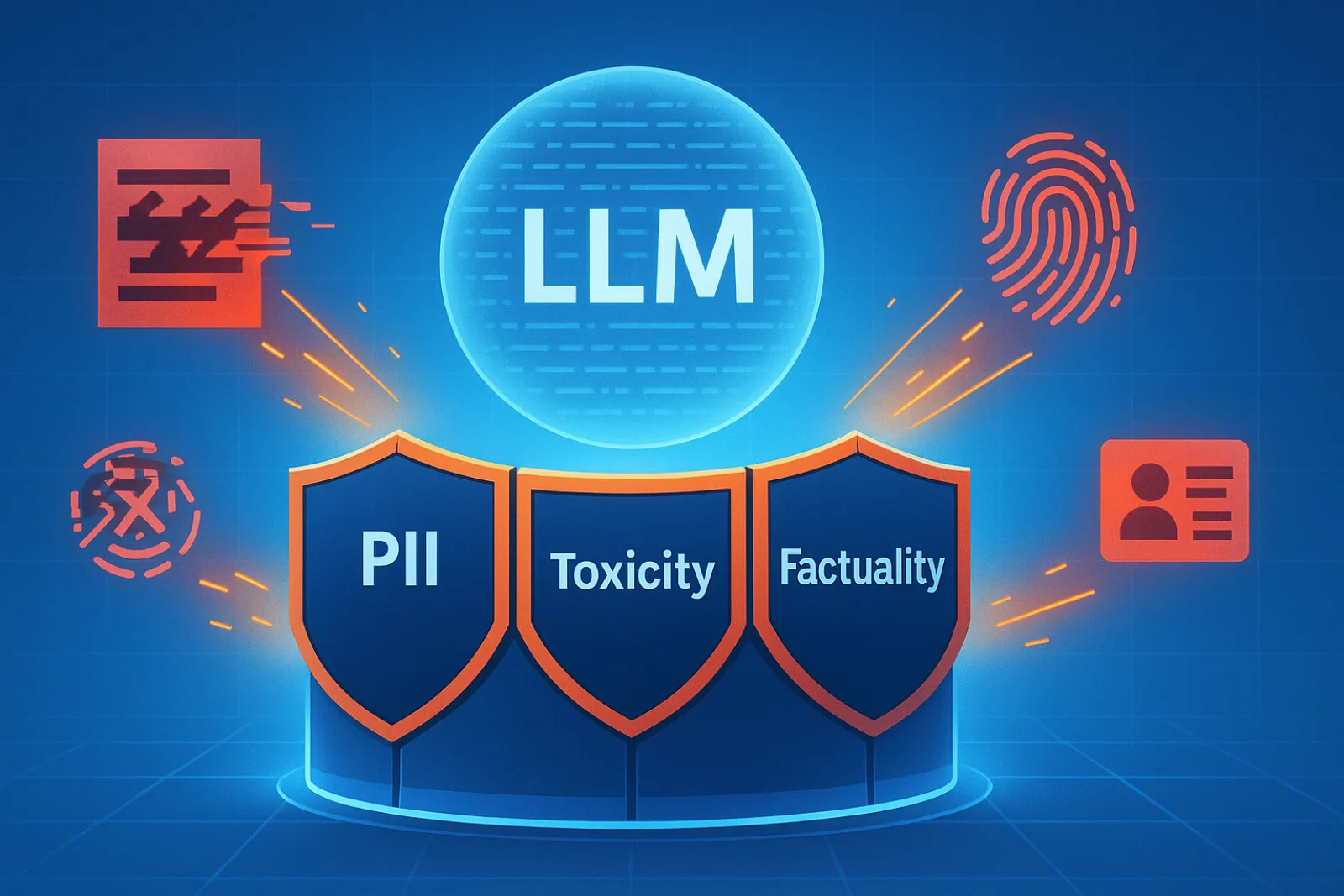
IBM’s OneShield paper argues for a different operating model: treat safety as a separate, model-agnostic guardrail layer that sits around the LLM, runs multiple specialised detectors in parallel, and then applies explicit policy decisions through a separate policy manager.1 In plain business terms, OneShield is less like teaching the model good manners and more like installing a configurable safety-control plane around every AI interaction. Glamorous? Not especially. Operationally useful? Very much so.
The paper’s important contribution is not one detector. It is the separation of jobs. Detectors identify possible risks: health advice, self-harm, hateful or abusive content, adult content, personally identifiable information, text attribution, and factuality issues. The policy manager decides what to do with those findings: allow, mask, block, warn, or escalate depending on context, jurisdiction, and use case. That separation is the mechanism that matters.
The evidence is strongest at the component and deployment level. The health-advice detector reports an F1 score of 87.70% on the HeAL benchmark. The self-harm detector reports 96.49% F1 on its test dataset, though deployment-context precision is much lower in the PR-insights setting. The adult-content classifier reports 93.80% F1. The factuality detector reports 81.2% F1 on a 2,000-item company-intelligence benchmark. OneShield has also been deployed internally in Kubernetes since late 2023 and used in InstructLab pull-request screening, where 8.25% of 1,200+ PRs were flagged and confirmed as potential violations.
For operators, the lesson is direct: do not design LLM governance as a personality trait of the model. Design it as infrastructure. The paper does not prove that OneShield is universally superior to every guardrail suite across every industry workload. It does show why regulated AI deployments need modular detection, explicit policy logic, and deployment telemetry before anyone starts congratulating the chatbot for being “safe”.
The useful firewall is not one wall
A familiar enterprise scene: a team wants to deploy an LLM into a workflow that touches customers, internal documents, regulated data, or employee productivity. Someone asks, “What guardrails do we have?” The room then enters that special corporate fog where moderation, privacy, compliance, hallucination detection, red-teaming, and legal sign-off are all compressed into one word: safety.
OneShield is interesting because it refuses that compression. The paper starts from three gaps in existing LLM guardrails. First, many safety mechanisms are built into the model itself, which risks self-referential blind spots. Second, they are difficult to customise or expand when enterprise policies change. Third, their behaviour can be inconsistent, hard to interpret, or awkward to govern.
That diagnosis is not merely technical. It is organisational. Enterprises do not have one definition of risk. A hospital, a bank, a public-sector agency, and an internal software team may all use the same LLM family, but they do not share the same compliance obligations, escalation rules, tolerance for false positives, or data-handling policies. A one-size-fits-all moderation wrapper is therefore not a governance system. It is a polite bouncer with a laminated checklist.
OneShield’s answer is architectural. The framework consists of containerised microservices: an orchestrator, independent detectors, data stores, and a policy manager. The orchestrator routes text to the relevant components. The detectors annotate risk. Data stores support retrieval and matching. The policy manager receives aggregated findings and applies selected policies before the final action is returned.
That sounds straightforward because good architecture often does. The trick is not that OneShield has detectors. Everyone has detectors now. The trick is that detection and policy action are deliberately decoupled.
OneShield separates three jobs enterprises keep mixing together
A useful way to read the paper is to divide the guardrail problem into three jobs:
| Job | OneShield component | Operational question |
|---|---|---|
| Detect risk | Detector services | What might be wrong with this input or output? |
| Combine context | Orchestrator and aggregation layer | What do all detectors see together? |
| Decide action | Policy manager | Given this use case and jurisdiction, what should happen now? |
This matters because many guardrail conversations collapse the first and third jobs. A classifier says “unsafe”, and the system blocks. Or it says “safe”, and the system passes. That is acceptable for simple content moderation. It is weak for enterprise AI.
Consider a prompt containing a person’s name. In one context, a name is harmless. In another, it may become sensitive when combined with an address, account number, medical reference, or abusive content. The paper uses a similar logic: the policy manager can apply policies that span detector findings. For example, an individual name may be allowed by itself, and slightly edgy content may be allowed by itself, but a name used in a sentence with detected hate may be blocked.
That is the point. Risk is often compositional. The unit of governance is not always a sentence, a label, or a model response. It is the relationship between detected entities, content type, user context, jurisdiction, and business process. A detector can identify a signal. It cannot, by itself, encode a multinational company’s risk appetite. Nor should it try. That way lies the classic enterprise software tragedy: business policy hard-coded into model behaviour, then rediscovered six months later by auditors with the enthusiasm of archaeologists finding a cursed tablet.
The detector layer is a portfolio, not a mascot classifier
The paper groups OneShield detectors into three families: classification detectors, extractor detectors, and comparison detectors. This taxonomy is more important than the individual model choices.
Classification detectors label text as belonging to a risk category. OneShield includes classifiers for health advice, self-harm, hateful/abusive/profane content, and inappropriate content such as adult content. These detectors are trained or integrated as specialised models, often using BERT embeddings or lightweight classification architectures.
Extractor detectors identify sub-portions of text. The main example is personally identifiable information through LLM Privacy Guard, which targets categories such as names, addresses, dates of birth, phone numbers, emails, bank account numbers, credit-card details, tax IDs, government identifiers, and health-related IDs. The output is not just “PII exists”; it is entity-level annotation that can support masking, redaction, blocking, or other downstream action.
Comparison detectors perform retrieval and matching against reference sources. OneShield includes text attribution and factuality detectors. Text attribution checks whether text matches proprietary or copyrighted content, using vector representation to narrow the search before applying text similarity. Factuality detection compares an LLM response against retrieved evidence from an external corpus and uses a BERT-based fact-checking model to predict whether the response is supported.
The business implication is that guardrails are not one problem. They are at least three different problem shapes.
| Detector family | Risk shape | Business use |
|---|---|---|
| Classification | “Does this text belong to a risk category?” | Moderation, domain restriction, harmful-content screening |
| Extraction | “Which exact spans are sensitive?” | PII masking, redaction, privacy compliance, audit trails |
| Comparison | “Does this text match or contradict reference material?” | Copyright leakage checks, proprietary-data protection, factuality control |
This is why the “guardrails are just moderation” misconception is expensive. Moderation catches some content problems. It does not automatically solve privacy leakage, proprietary-data reuse, jurisdictional policy logic, or factual support. OneShield’s design is useful because it treats these as related but distinct control surfaces.
The policy manager is where governance becomes executable
The policy manager is the paper’s most business-relevant component. It turns detector outputs into actions.
The paper describes common actions such as allowing text through unchanged, blocking text entirely, or masking certain portions while preserving context. It also emphasises that policy templates can encode use-case-specific and jurisdiction-specific rules. GDPR and CCPA are named as examples of regulatory regimes whose definitions and treatment of entities can differ.
This is the architecture’s practical hinge. In enterprise AI, governance usually begins in documents: model cards, internal policies, risk registers, compliance memos, approval workflows. Those artefacts matter, but they do not enforce themselves. OneShield’s policy manager is an attempt to move some of that logic closer to runtime.
The shift is from “we have a policy about PII” to “this policy template determines what happens when this class of PII appears in this context”. That is a very different level of operational maturity.
There is also a maintenance advantage. If the law, client requirement, or internal risk appetite changes, an organisation can adjust policy logic without retraining every detector or swapping the underlying LLM. The detectors keep doing narrow recognition tasks. The policy layer changes the response.
That is boring in the best possible way. Mature governance is usually boring. It is repeatable, configurable, inspectable, and slightly allergic to heroic one-off prompt engineering.
Parallel detectors are the latency bet
OneShield is designed for inference-time use. The paper says all detectors run in parallel, so total detection time is bounded by the slowest detector rather than the sum of every detector. The orchestrator waits for all detector responses, aggregates the findings, and passes them to the policy manager.
This is the architectural compromise. Running many specialised checks could become slow if they execute sequentially. Running them in parallel preserves modularity while limiting latency overhead. In OneShield’s implementation, the orchestrator and policy manager are described as lightweight services, each with one instance and 40 threads, while detectors typically run with five instances and 100 threads each. Services support CPU-only execution, with GPU acceleration where available.
The paper reports that the longest-running detector in its implementation is the PII extractor, with an average response time of 0.521 milliseconds for a user prompt of up to 150 tokens, calculated on 1,200 prompts, rising linearly with token count. That number should be read as an implementation detail, not a universal promise. Hardware, detector mix, network topology, input size, and policy complexity will all matter in a production environment. Still, the design principle is clear: modular guardrails are viable only if the orchestration layer prevents modularity from becoming a latency tax.
For operators, the takeaway is not “this exact latency will appear in your stack”. It is “parallel detector orchestration is the right design pattern if you want multiple guardrail capabilities without forcing every interaction through a slow serial gauntlet”. The gauntlet may sound medieval and therefore satisfying. Users will be less charmed when it adds several seconds to every answer.
The evidence supports usefulness, not universal victory
The paper provides several forms of evidence: benchmark results for individual detectors, implementation details, internal deployment history, and an external open-source workflow through InstructLab. These are useful, but they do not all prove the same thing.
| Evidence | Likely purpose | What it supports | What it does not prove |
|---|---|---|---|
| Health-advice detector on HeAL: 85.07% accuracy, 86.64% precision, 88.80% recall, 87.70% F1 | Main component evaluation | The health-advice classifier performs reasonably on a relevant public benchmark | General medical safety, clinical correctness, or safe deployment in healthcare workflows |
| Self-harm detector test set: 96.60% accuracy, 96.04% precision, 96.94% recall, 96.49% F1 | Main component evaluation | The detector performs strongly on its constructed test split | Stable performance under all real-world class distributions |
| Self-harm PR-insights context: high recall but low precision | Deployment-context stress evidence | The detector can prioritise catching risky cases in a triage workflow | Low false-positive burden in every operational setting |
| Adult-content classifier: 94.82% accuracy, 89.52% precision, 98.52% recall, 93.80% F1 | Main component evaluation | The adult-content classifier is strong on the selected public dataset | Broad inappropriate-content coverage across all categories and languages |
| Factuality detector: 87.5% accuracy, 83.2% precision, 79.4% recall, 81.2% F1 on 2,000 company-intelligence items | Focused factuality evaluation | Retrieval-plus-fact-checking can detect unsupported company facts in a defined benchmark | General hallucination detection across open-domain reasoning |
| Internal Kubernetes deployment since late 2023, handling thousands of daily requests | Implementation and deployment evidence | OneShield has been used as production infrastructure inside IBM | External portability, total cost, or performance under unrelated enterprise workloads |
| InstructLab PR screening: 1,200+ PRs, 8.25% confirmed potential violations | Operational use case | Guardrails can support community-contribution triage and data-vetting workflows | Fully automated governance without human review |
This table is where the paper becomes more interesting than its headline. OneShield is not presented as one giant benchmark champion. It is presented as an operational architecture whose parts have measurable performance and whose system has seen real deployment.
That distinction matters. A benchmark-winning detector can still be hard to govern. A well-governed system can still contain imperfect detectors. OneShield’s value proposition is that the system can tolerate and manage detector imperfection by making detector outputs explicit, aggregating them, and applying policy logic.
The self-harm results illustrate the point. On the test dataset, performance is strong. In the PR-insights setting, recall remains 100% across reported contexts, but precision is much lower: 37.5% in PR-insights context, 29.63% for questions, and 35.29% for answers. In a human-triage workflow, that may be acceptable if the objective is to avoid missing serious cases. In a high-volume customer-facing workflow, the false-positive cost could be too high. Same detector, different operational tolerance. There, policy and workflow design decide whether the system is usable.
InstructLab shows guardrails moving upstream
The InstructLab deployment is one of the paper’s more useful examples because it moves guardrails away from the familiar chatbot interface.
InstructLab is an IBM and Red Hat open-source project that lets contributors add knowledge and skills to LLMs through submitted data. Open contribution creates a predictable governance problem: the material used to improve a model may itself contain policy violations, private information, offensive content, or other risks. If unsafe training examples enter the data pipeline, the problem is no longer just a bad model output. It becomes part of the model-development supply chain.
OneShield was used as a GitHub safety bot for InstructLab pull requests. The PRs contained YAML files with seed examples for LLM training, including contexts, questions, and answers. OneShield detectors ran against new PRs, commented on potential violations, and held automatic merge until a human triage team reviewed them. At the time of the paper, OneShield had run on more than 1,200 PRs, with 8.25% identified and confirmed as containing potential violations.
This is a sharper enterprise use case than ordinary content filtering. It frames guardrails as data-governance infrastructure. The system is not merely protecting users from bad answers after deployment. It is helping prevent risky material from entering the model-improvement pipeline in the first place.
That upstream use matters for organisations building internal model factories. The riskiest AI interaction may not be the final chatbot response. It may be a fine-tuning dataset, a synthetic-data generation run, a retrieval corpus, a prompt library, or a community contribution pipeline. Guardrails designed only for live chat miss those entry points.
The business lesson is control-plane design
Cognaptus reads the paper’s business implication as follows: serious LLM deployments need a safety-control plane.
A control plane does not do the main work of the application. It configures, routes, monitors, authorises, and governs the work. In OneShield, the base LLM remains the generative engine. The guardrail layer becomes the governance layer around it.
This creates several practical advantages.
First, it reduces model lock-in. A model-agnostic guardrail layer can, in principle, sit across multiple models. That matters in enterprises where teams experiment with proprietary APIs, open-weight models, internal fine-tunes, and specialised domain systems. If every model requires its own bespoke safety design, governance becomes a museum of exceptions.
Second, it improves auditability. Detectors produce findings. Policies produce actions. That separation gives risk, compliance, and engineering teams a clearer object to inspect. “The model decided not to answer” is weak governance language. “The PII detector found a tax identifier and the active jurisdictional policy masked it” is much better.
Third, it supports policy agility. Regulations change. Business processes change. New risk categories appear. A modular architecture lets organisations add or refine detectors and update policy templates without rebuilding the whole AI stack. This is not just a technical convenience. It is how AI systems survive contact with legal departments, procurement, clients, and reality.
Fourth, it extends governance across the AI lifecycle. OneShield is used for live interaction and for inspecting data used in training and fine-tuning. That is important because AI risk does not politely wait until inference time to appear.
What the paper directly shows, and what Cognaptus infers
It is useful to separate the paper’s claims from the business interpretation.
| Layer | Directly shown in the paper | Cognaptus inference |
|---|---|---|
| Architecture | OneShield is a model-agnostic framework with orchestrator, detector services, data stores, and policy manager | Enterprise AI safety should be built as reusable middleware rather than embedded separately into each application |
| Detector design | Detectors cover classification, extraction, and comparison tasks | Guardrail portfolios should map to different risk shapes, not one generic “unsafe” label |
| Policy handling | The policy manager applies actions based on aggregated detector findings and templates | Runtime policy execution is the bridge between compliance documents and enforceable AI behaviour |
| Deployment | OneShield has been used internally since late 2023 and in InstructLab PR screening | Guardrails are valuable not only for chat moderation but also for model-development supply-chain control |
| Evaluation | Several detectors report useful benchmark performance | The architecture is promising, but enterprise buyers should still require workload-specific validation |
That last row is important. The paper gives enough evidence to take the architecture seriously. It does not remove the need for local testing. Any organisation deploying this kind of guardrail system should evaluate false positives, false negatives, latency, escalation volume, multilingual performance, domain drift, and user experience under its own workload.
That is not a criticism of OneShield specifically. It is the nature of guardrails. A safety system that looks excellent in a benchmark can become intolerable if it blocks too much legitimate work. A detector with modest precision can be valuable if it feeds human triage for rare but serious risks. The right metric depends on the operating context.
The boundaries are where procurement should ask better questions
The paper’s limitations are not fatal, but they are commercially relevant.
First, the evidence is uneven across components. Some detectors receive clear quantitative evaluation. Others, such as the PII extractor and text attribution component, are described architecturally and operationally but not given the same level of published benchmark detail in this paper. The paper states that LLM Privacy Guard has been extensively benchmarked against open-source PII detectors, but the article itself should not treat that as a full comparative result unless those benchmark details are available.
Second, the strongest deployment evidence is IBM-related. Internal Kubernetes use and InstructLab integration are meaningful, but they do not automatically prove portability to every enterprise environment. A bank’s compliance workflow, a hospital’s privacy rules, a government service’s language mix, and a consumer platform’s abuse patterns may stress the system differently.
Third, the paper does not fully quantify the business cost of false positives. This matters because guardrails are not judged only by accuracy. They are judged by how often they interrupt legitimate work, how much human review they create, whether users learn to route around them, and how much latency they add.
Fourth, factuality detection is tested on a defined company-intelligence benchmark built from 20 questions for the top 100 Forbes companies, using Wikipedia answers. That is a useful focused test. It is not the same as general hallucination detection across law, medicine, finance, scientific reasoning, or live operational data.
Finally, English appears to dominate the described detector examples and datasets. Multilingual, code-switching, and local regulatory contexts would need separate validation. Enterprise data has a rude habit of not arriving in the clean language, format, or domain assumed by papers. Very inconsiderate of it.
The practical checklist for enterprises
The paper suggests a useful checklist for organisations building or buying LLM guardrails.
| Question | Why it matters |
|---|---|
| Are detection and policy action separated? | Without separation, governance becomes hard-coded moderation. |
| Can policies span multiple detector findings? | Many risks appear only when signals combine. |
| Can policies differ by use case or jurisdiction? | Compliance obligations are not globally uniform. |
| Can detectors be added or updated independently? | Risk categories and data distributions drift. |
| Does the system work at inference time without unacceptable latency? | Safety that users bypass is not safety. |
| Can the same guardrail layer vet training and fine-tuning data? | Risk enters upstream as well as during live use. |
| Are false positives measured in workflow terms? | Precision is not just a metric; it is operational workload. |
| Is there human review where risk severity demands it? | Automation should reduce triage burden, not pretend judgement disappeared. |
This checklist is less exciting than a demo. That is precisely why it is useful. Enterprise AI does not fail only because models say strange things. It fails because organisations cannot explain, configure, monitor, or update the systems they deploy.
Conclusion: safer models are not enough
OneShield’s real argument is that enterprises should stop treating LLM safety as a virtue inside the model and start treating it as an external operating system for risk.
That does not mean model-level alignment is irrelevant. It means model-level alignment is insufficient. A trained model cannot know every organisation’s regulatory obligations, contractual limits, proprietary-data boundaries, escalation thresholds, or tolerance for false positives. Even if it could today, those rules will change tomorrow. Naturally, tomorrow will arrive after the system has already been deployed, because enterprise life is a comedy written by procurement and compliance.
The paper’s mechanism-first contribution is therefore clear: run specialised detectors in parallel, aggregate their findings, and let a policy manager decide actions based on context. This is a cleaner mental model for enterprise guardrails than “put a moderation model in front of the chatbot and hope”.
The evidence supports the architecture as a serious operational pattern. The component results are respectable. The deployment examples are practical. The InstructLab case usefully expands the guardrail conversation from chatbot outputs to model-development inputs. The boundaries are equally clear: organisations still need workload-specific validation, false-positive analysis, and local policy engineering.
The smarter firewall for LLM risks is not a single wall. It is a configurable system of sensors, routing, policy, and action. Less theatrical than a perfectly behaved model. Much closer to how enterprise AI will actually be governed.
Cognaptus: Automate the Present, Incubate the Future.
-
Chad DeLuca, Anna Lisa Gentile, Shubhi Asthana, Bing Zhang, Pawan Chowdhary, Kellen Cheng, Basel Shbita, Pengyuan Li, Guang-Jie Ren, and Sandeep Gopisetty, “OneShield - the Next Generation of LLM Guardrails,” arXiv:2507.21170, 2025, https://arxiv.org/abs/2507.21170. ↩︎