TL;DR for operators
The paper is not a magic trick that turns an infinite expected value into a finite one. The ordinary St. Petersburg expectation still diverges. Anyone claiming otherwise has either missed the point or found a very ambitious way to lose a philosophy seminar.
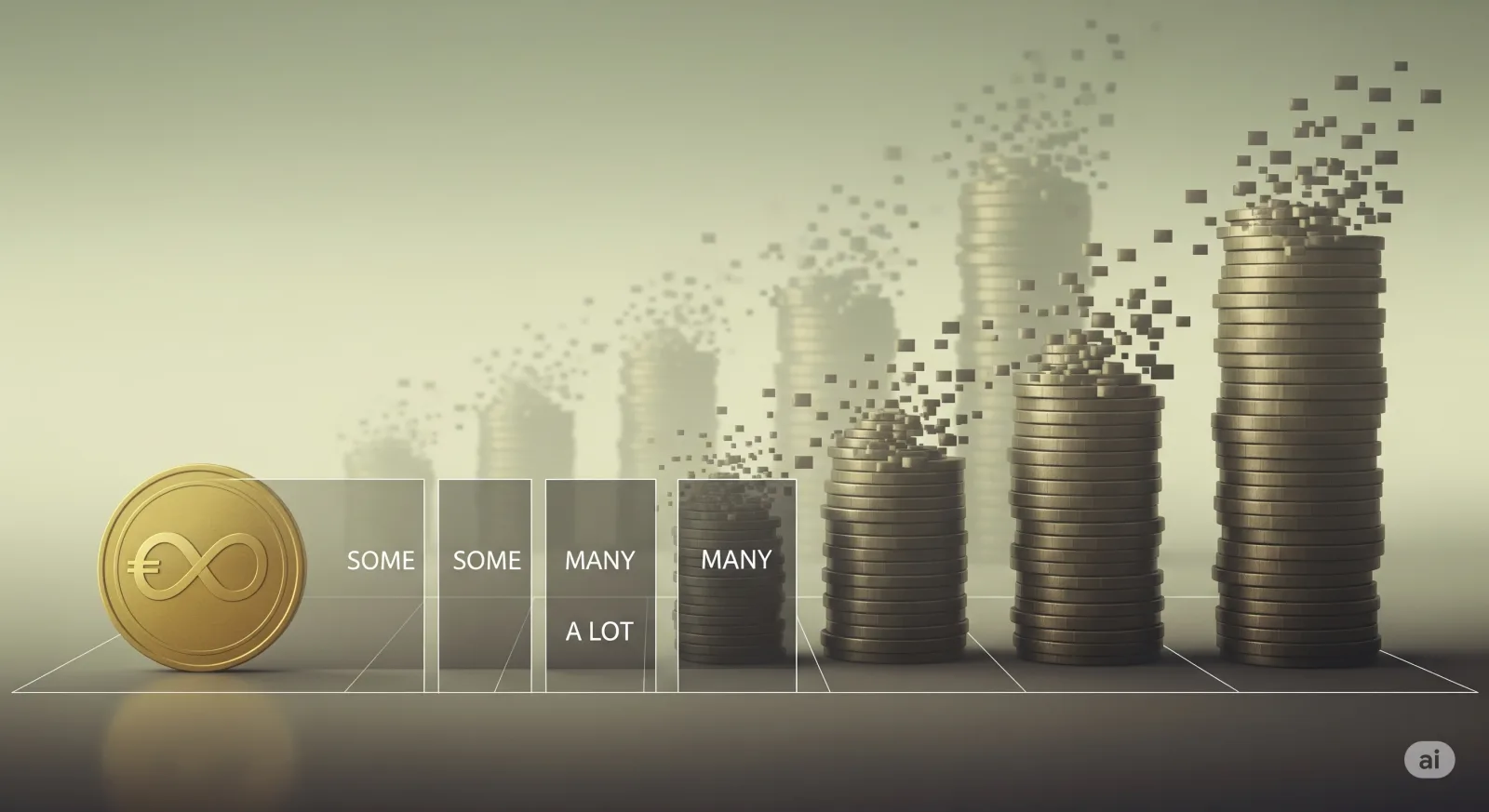
What the paper actually does is more interesting. Takashi Izumo defines a coarse-grained version of arithmetic in which numbers are first mapped into finite “grains,” each grain is represented by a selected internal value, and addition is performed through repeated projection to those representatives.1 Under this operation, an increment can become too small to move the current coarse state. That phenomenon is called absorption. Repeated absorption produces inertness: further additions keep arriving, but the represented total stops changing.
For business readers, the useful translation is this: many real systems do not aggregate information with perfect numerical sensitivity. Customers, managers, voters, traders, and AI agents using bucketed scores often treat additional increments as irrelevant once the current state sits inside a wide enough category. The paper gives a clean mathematical mechanism for that kind of bounded aggregation.
But the boundary is just as important. This is a theoretical construction. It does not estimate how people actually choose mental buckets. It does not validate a behavioural model with data. It does not prove that a particular partition is psychologically natural. Its value lies in formalising a neglected modelling choice: sometimes the aggregation rule, not the utility function, is where bounded rationality enters.
The useful idea is not infinity; it is resolution
The St. Petersburg paradox is usually introduced as a problem about infinite expectation. A fair coin is tossed until a specified stopping event occurs; the payoff doubles as the stopping time lengthens; each term contributes the same positive expected amount; the sum diverges. The mathematics says the expected value is infinite. Human behaviour says nobody sensible pays an infinite entry fee. Excellent. Decision theory has had indigestion ever since.
The familiar responses change the evaluation layer. Bernoulli-style utility bends money into diminishing marginal utility. Discounting reduces later payoffs. Prospect theory changes value and probability weighting. More recent unbounded-utility approaches ask how divergent expectations can still be compared.
Izumo’s move is different. He does not start by asking whether people value money nonlinearly. He asks what happens if the addition itself is not exact.
That sounds heretical only if we assume that aggregation is always a neutral background operation. In actual organisational life, it rarely is. A manager does not perceive $1,000 added to a $10,000 budget in the same way as $1,000 added to a $10 billion sovereign wealth fund. A dashboard does not display every underlying signal; it bins, rounds, colours, thresholds, ranks, and compresses. A credit score, risk grade, customer segment, supplier rating, or investment suitability band is already a coarse representation pretending to be a number because the interface looked tidier that way.
The paper formalises that compression. Its point is not that exact arithmetic is wrong. Its point is that exact arithmetic may not be the operation being performed by a bounded evaluator.
Coarse addition changes the arithmetic, not the lottery
The underlying scale in the paper is $U = \mathbb{N}_0$, the non-negative integers. This scale is partitioned into countably many finite ordered intervals called grains. A grain might be ${0}$, or ${1,2}$, or ${10,11,12,13,14}$. Each exact value belongs to one grain.
Two maps matter.
First, the cell map $\psi_\pi$ sends an exact number to its grain. If $x$ sits in grain $G$, then $\psi_\pi(x)=G$.
Second, the representative map $\phi$ chooses one value from inside each grain. It may choose the minimum, the maximum, the lower median, or another internal representative. The internal requirement matters: the representative is not imported from outside the grain. It is a value the grain actually contains.
Coarse representative addition then works like this:
- Map each input number to its grain.
- Replace each grain by its representative.
- Add the representatives using ordinary addition.
- Map the result back to a grain and select that grain’s representative.
In compact form:
There is also a grain-level operation:
That is the whole machine. It is not discounting. It is not utility curvature. It is not an extended number system. It is lossy arithmetic: every intermediate result is compressed back into a representative state.
This distinction matters because the old article-level temptation is to say, “The paradox dissolves.” It does not. The classical expected value remains infinite. What can vanish is the effect of further increments on the coarse representation. The paradox has not been killed. It has been moved into a different modelling layer, where the evaluator no longer sees exact cumulative growth.
Absorption is the threshold where increments stop moving the state
The first central concept is absorption. A grain $G$ absorbs another grain $H$ if adding $H$ to $G$ leaves the result in $G$:
This is the formal version of “that extra amount does not change the category.” If a procurement risk score is already “high,” another small warning signal may not change the displayed rating. If a customer is already in the “premium” band, one extra purchase may not move them anywhere. If a product review average is shown only as stars, many small changes can disappear into the same visible bucket. The exact value moved. The represented state did not.
The paper gives a simple numerical characterisation. If
then $G$ absorbs $H$ exactly when
The key operational quantity is the absorption margin:
This is the room left above the representative before the sum exits the grain. If the representative of the incoming grain is no larger than that margin,
then, on $U=\mathbb{N}_0$, $G$ absorbs $H$.
The intuition is refreshingly mechanical. A grain has a current representative. If there is still enough space between that representative and the grain’s upper boundary, the incoming increment lands inside the same grain. Once it lands inside the same grain, projection returns the system to the same representative. The update occurred in exact arithmetic, then disappeared during re-granulation. Bureaucracy would be proud.
The paper’s toy example makes this concrete. Take three grains:
with lower median representatives. Then $\phi(G_{\pi,2})=4$ and $\phi(G_{\pi,3})=11$. The absorption margin of $G_{\pi,3}$ is $16-11=5$. Since $4\leq5$, grain $G_{\pi,3}$ absorbs $G_{\pi,2}$. The exact representative sum is $11+4=15$, which still lies inside $G_{\pi,3}$.
So the mechanism is not mystical. It is thresholded category preservation.
Inertness is repeated absorption, not mathematical amnesia
Absorption is a one-step phenomenon. Inertness is what happens when absorption keeps happening.
Because coarse addition is generally non-associative, the paper fixes a left-associative convention for infinite coarse sums. This is not a decorative technicality. If the operation is lossy after each step, then the order in which intermediate sums are projected can change the result. So the paper defines partial sums recursively: add the next grain to the current coarse partial sum, project, and continue.
A sequence is inert at a grain $G^\ast$ if, after some finite step $N$, every later coarse partial sum remains $G^\ast$. On the representative level, the displayed value then remains $\phi(G^\ast)$.
The main sufficient condition is almost painfully practical:
| Mechanism component | Mathematical condition | Plain-language interpretation |
|---|---|---|
| Current coarse state | $S_N^{cell}=G^\ast$ | The process has entered a grain |
| Future increments | $\phi(H_n)\leq\mu_\phi(G^\ast)$ for all later $n$ | Every later increment is small enough to fit inside the remaining margin |
| Result | $S_n^{cell}=G^\ast$ for all $n\geq N$ | The represented state stops changing |
The paper is careful that inertness is not automatic. Some partitions and representative maps allow repeated increments to push the process into new grains forever. Others make increments vanish after a point. That is exactly why the result is useful as a modelling language: the partition is not a harmless detail; it is the behavioural assumption.
In business terms, this is the difference between a metric system that remains sensitive and one that saturates. A customer loyalty score with wide top-end bands may stop reacting to additional purchases. A risk heatmap with coarse categories may stop displaying incremental deterioration after “red.” A performance bonus scheme with capped categories may stop rewarding marginal effort. The problem is not that the data disappeared. The aggregation rule made it inert.
Non-associativity is the cost of projection
The paper’s most important warning is that coarse addition is generally non-associative:
This is not an implementation bug. It is a structural consequence of repeated projection.
Ordinary addition preserves intermediate sums exactly. Coarse addition does not. After every binary operation, the result is mapped back to a grain representative. Information is lost. Once information is lost, different bracketings can produce different future states.
The paper gives a counterexample using grains
with lower median representatives. For $x=3$, $y=3$, and $z=10$, one bracketing yields $15$ while another yields $9$.
That small example carries a large operational warning. If a system aggregates scores through repeated categorisation, the order of aggregation may matter. Combining two departmental risk ratings and then adding a corporate adjustment may not match combining a department with the corporate adjustment first. Aggregating customer signals daily and then monthly may not match aggregating raw signals monthly. Summarising agent outputs step-by-step may not match summarising them all at once.
The paper also identifies a special associative case: consecutive intervals of constant odd width, using the unique median representative. In that narrow setting, grain-level addition behaves regularly:
This exception is valuable because it clarifies the rule. Associativity can be recovered under highly regular structure. But most interesting coarse systems are not that neat. Real scoring systems use uneven bands, asymmetric thresholds, caps, medians, floors, and business-defined exceptions. Naturally, they then act surprised when aggregation order matters. Adorable.
The St. Petersburg application uses a triangular partition, not a miracle
Now the paper turns to the St. Petersburg paradox.
The classical payoff rule is:
So each expected contribution is:
Summing these equal positive increments gives:
Since the paper’s coarse framework is built on $\mathbb{N}_0$, it rescales the equal expected increment sequence by defining
The problem is therefore translated into the constant integer-valued sequence:
This rescaling does not redefine the classical expectation. It simply places the constant expected increment sequence inside the discrete domain where the coarse arithmetic is defined.
The explicit construction uses a triangular partition:
where
The first grains are:
The representative map is the minimum representative:
That detail matters. The construction is not using Fibonacci intervals, and it is not using medians for the St. Petersburg application. It uses triangular grains and minimum representatives. Small change, big difference; the maths is fussy because maths has standards.
Under this map, the absorption margin of the $n$-th triangular grain is:
For every $n\geq2$, that margin is at least $1$. Since the incoming increment is always represented by $1$, every grain from $G_2^\Delta$ onward can absorb the singleton increment.
The constant sequence starts at $1$, which lies in $G_2^\Delta={1,2}$. The minimum representative of $G_2^\Delta$ is $1$, and its margin is also $1$. Therefore $G_2^\Delta$ absorbs itself. The representative partial sums remain:
This is the paper’s St. Petersburg result. It is elegant, but narrow. Under this particular coarse partition and representative map, the rescaled sequence of equal expected increments becomes inert immediately. Ordinary expectation still diverges. The coarse perceived total does not grow.
What the paper proves, and what it merely suggests
The distinction between proof and interpretation is where the article should spend its calories.
| Paper element | Likely purpose | What it supports | What it does not prove |
|---|---|---|---|
| Definitions of grains, cell maps, and representatives | Main formal setup | A rigorous alternative arithmetic can be defined on $\mathbb{N}_0$ | That humans naturally use this exact structure |
| Absorption margin condition | Main mechanism | A sufficient condition for increments to leave a grain unchanged | That all coarse systems become inert |
| Toy absorption and inertness examples | Implementation detail / illustration | The definitions produce concrete, checkable behaviour | Empirical realism |
| Non-associativity counterexample | Structural warning | Projection makes aggregation order matter | That every partition is non-associative |
| Constant odd-width median case | Boundary / special case | Associativity can be recovered under regular design | That associativity is typical |
| Triangular St. Petersburg construction | Main heuristic application | The rescaled equal-increment sequence can be inert under one explicit coarse scheme | A solution to the paradox in standard decision theory |
The paper directly shows that coarse-grained arithmetic can generate absorption, inertness, and non-associativity. It directly constructs one partition under which the rescaled St. Petersburg increment sequence remains stuck at representative value $1$.
Cognaptus infers that this mechanism is useful for thinking about bounded aggregation in organisations, interfaces, behavioural models, and AI agents. That inference is plausible because many real systems compress continuous or fine-grained inputs into categories. But it remains an inference. The paper contains no behavioural experiment, no survey, no field data, no calibration exercise, and no cognitive validation.
What remains uncertain is not a footnote. It is the practical research agenda. Which partitions correspond to actual perception? Which representative maps fit different contexts? Do people use minimums, medians, anchors, aspiration points, or context-dependent reference values? When does aggregation become inert in real decisions, and when do people re-partition the scale because the old categories become useless?
Those questions are outside the paper. They are also where the commercial work would begin.
The business value is threshold design, not lottery pricing
No operator needs a better way to price the St. Petersburg game. If that appears on your quarterly roadmap, please call someone.
The practical value is in systems where increments are repeatedly compressed into categories. Coarse addition offers a way to reason about when those increments stop mattering at the represented level.
Customer behaviour
Customers often react to categories rather than exact amounts. “Under ₱1,000,” “premium,” “enterprise,” “gold tier,” “high risk,” and “almost full” are grains. Pricing, loyalty, and usage plans all use coarse bands.
The absorption question becomes: how much additional value, discount, usage, or friction is needed to move the customer into a different perceived category?
If the answer is “more than the customer will notice,” the increment is commercially inert. You can still put it in the spreadsheet. It may even look busy there.
Incentive design
Many incentive systems accidentally create inert regions. A salesperson whose performance band will not change after another small deal may rationally ignore that deal. A worker whose bonus category is capped may stop responding to marginal rewards. A manager whose KPI dashboard stays green until a wide threshold is crossed may miss gradual deterioration.
Coarse aggregation does not merely describe perception. It can create behaviour. If the reward rule projects effort into coarse categories, effort near category interiors may be absorbed.
Risk and compliance dashboards
Risk systems love colour bands. Green, amber, red. Low, medium, high. Acceptable, watchlist, breach. These are useful because exact detail overwhelms users. They are dangerous because once a status is inside a large grain, additional evidence may not change the displayed state.
This is where non-associativity matters. If risk is aggregated department-by-department, then region-by-region, then globally, the sequence of projections can shape the final category. A “global high” rating produced from already-compressed local scores may not match a global rating computed from raw signals. The difference is not cosmetic. It is a governance issue.
AI-agent scoring and memory
The AI relevance is not the vague claim that “AI should think like humans.” That sentence has done enough damage.
The narrower and stronger point is that agentic systems often aggregate partial scores, retrieved memories, tool outputs, confidence estimates, and user preferences through compressed representations. If an agent uses coarse ratings—say, low/medium/high confidence or integer relevance scores—then repeated projection may create absorption. Later evidence may fail to change the agent’s state because the scoring grain is too wide.
For agent design, this suggests three questions:
| Design question | Why coarse addition makes it visible |
|---|---|
| What are the grains? | The thresholds define what the system can notice |
| Which representative is used? | Minimum, median, maximum, or learned anchors imply different behaviour |
| When is projection applied? | Stepwise projection can create order-dependent outcomes |
The lesson is not “use coarse reasoning everywhere.” It is “stop pretending coarse scoring is exact reasoning with cheaper formatting.”
The boundary conditions are the product requirements
The paper’s limitations are precise enough to be useful.
First, the framework is built on countable discrete partitions of $\mathbb{N}_0$. Many business quantities are continuous, multidimensional, uncertain, or strategically manipulated. Extending the idea is possible, but not automatic.
Second, representatives are internal to each grain. That is mathematically clean. Real organisations often use representatives that are not internal: target scores, regulatory thresholds, symbolic labels, benchmark values, or managerial anchors. Those may behave differently.
Third, all infinite sums are treated left-associatively. In a non-associative system, that convention is not innocent. It is part of the model. For business systems, the equivalent question is workflow design: do we compress after every event, after every day, after every department, or only at the end?
Fourth, the St. Petersburg application depends on the triangular partition and the minimum representative map. Other partitions may not produce inertness. The paper explicitly says the triangular partition is a convenient construction, not the uniquely correct model of human cognition.
Fifth, there is no empirical validation. The paper gives a structural mechanism, not a measured psychological law. Treat it as a candidate language for modelling bounded aggregation, not as a ready-made behavioural parameter set.
These are not weaknesses to be hand-waved away. They are the knobs. Any real deployment would need to choose grains, representatives, projection timing, and validation tests. In other words, the “limitations” are where the product specification lives.
The paradox does not vanish; the represented growth does
The strongest reading of the paper is modest and useful.
It does not rescue expected value theory from the St. Petersburg paradox. It does not prove that people are rational to bid low. It does not replace utility theory, prospect theory, or discounting. It does not claim that infinite value has become finite because someone put it in a clever bucket.
It shows something more surgical: once aggregation itself is made coarse, positive increments can stop changing the represented total. Absorption explains the one-step failure to move categories. Inertness explains the repeated failure. Non-associativity explains why projection order becomes part of the result. The triangular St. Petersburg construction shows that even a divergent equal-increment structure can become inert under a suitable coarse arithmetic.
For decision theory, that is a new formal lens. For business, it is a warning label on every dashboard, score, band, rating, tier, and agent memory system that compresses reality before acting on it.
The spreadsheet may still add forever. The operator may see no change. Both can be true. That is the useful discomfort.
Cognaptus: Automate the Present, Incubate the Future.
-
Takashi Izumo, “Absorption and Inertness in Coarse-Grained Arithmetic: A Heuristic Application to the St. Petersburg Paradox,” arXiv:2507.12475. https://arxiv.org/abs/2507.12475 ↩︎