TL;DR for operators
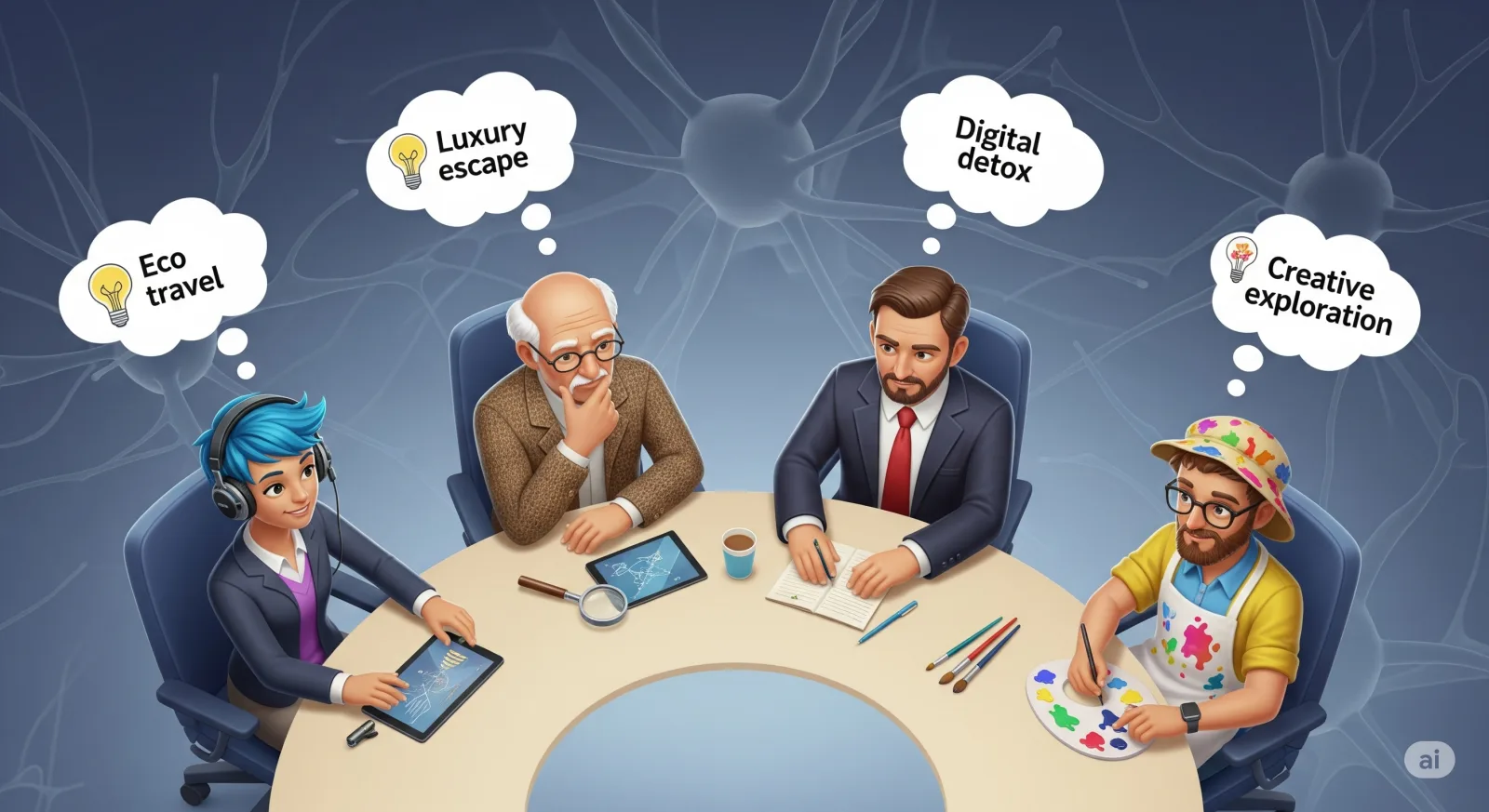
TinyTroupe is not another “let’s make five agents debate the product roadmap” toy. The paper’s useful move is sharper: it treats persona simulation as a different engineering problem from assistive AI.1
Assistive agents are trained to be helpful, polite, comprehensive, and often suspiciously agreeable. Human simulation needs almost the opposite: inconsistency, reluctance, taste, memory, background, class signals, cultural context, and the ability to say “no” for reasons that are not optimised for the user’s happiness. Annoying, yes. Also known as customers.
TinyTroupe addresses this by wrapping LLM agents in a simulation toolkit: rich personas, sampled populations, environments, validators, propositions, stories, interventions, enrichment, extraction, reducers, exporters, and caching. That list sounds like framework soup until the paper’s mechanism becomes clear: each component exists because bare LLM agents drift, converge, simplify, over-cooperate, forget context, and produce outputs that are painful to audit.
The evidence is early but informative. In two market-research comparisons with human control groups, the simulations captured some directionally useful preferences but missed others. For WanderLux, a quiet luxury travel service, simulated singles and couples followed the same broad preference pattern as humans, but simulated families diverged badly because the model appeared to assume parents with young children would be reluctant to travel without them. For bottled gazpacho, the simulated mean interest rating was close to the human mean, 2.62 versus 2.86, but the simulation avoided extreme ratings. Synthetic people, apparently, have discovered the corporate survey midpoint. Tragic, but measurable.
For business use, the implication is narrow and valuable: use synthetic personas as a structured imagination engine, not as a statistically valid replacement for customers. They can help teams generate hypotheses, stress-test concepts, create synthetic office artefacts, explore scenario logic, and identify possible objections before paying for real panels. The dangerous version is using them as automated market truth. That would be cheaper than research in roughly the same way a cardboard helmet is cheaper than insurance.
The real distinction is not “single agent versus many agents”
Most writing about LLM agents still treats multiagent systems as a coordination problem. Give one agent a researcher role, another a critic role, another a product manager role, ask them to chat, and hope that organisational intelligence emerges from the transcript. Hope is not an architecture, but it does produce lively demos.
TinyTroupe starts from a better distinction. The key split is not whether there are one or many agents. It is whether the agent is supposed to help solve a task or simulate a person.
That matters because the incentives are different. A task-solving agent should usually be accurate, cooperative, complete, and responsive to user intent. A simulated person may need to be sceptical, distracted, under-informed, budget-constrained, socially influenced, politically opinionated, or simply uninterested. The paper states the difference directly: problem-solving and assistive AI systems are designed to behave without much personal context, while behaviour simulation needs a wider range of human variability anchored in backstory, experiences, preferences, and real-world context.
This is the paper’s central contribution. TinyTroupe is not merely adding extra prompt fields to agents. It is claiming that simulation requires its own machinery.
That machinery exists because the default LLM prior is not “human”. It is “helpful assistant wearing a human hat”. The hat slips.
Persona detail is a control surface, not character decoration
TinyTroupe’s base agent, TinyPerson, is built around long, detailed persona specifications. These include demographic and biographical features such as nationality, age, education, occupation, personality, beliefs, behaviours, preferences, and style. The paper is explicit that this is not meant to be a short profile. A useful persona is “complex, long and as detailed as possible”.
That sounds expensive until one notices what it is trying to control. The persona is not decorative flavour text. It is a control surface for behavioural variance.
A thin persona — “Maria, 34, marketing manager, likes travel” — mostly invites the LLM to fill in the rest with stereotypes. A thicker persona gives the model more anchors: budget constraints, work rhythms, social obligations, habits, values, and past experiences. Those anchors are what allow a simulated consumer to reject a travel service not because the prompt says “be negative”, but because the offer conflicts with the character’s preferences and practical life.
The paper’s WanderLux example illustrates this. A simulated agent rejects a luxury beach-and-spa travel service because it is too expensive, too fancy, less trustworthy than local options, and misaligned with his preferred simple trips. The interesting part is not the rejection. It is that the rejection has a traceable internal logic.
That traceability is the difference between a synthetic panel and a stochastic comment generator with a LinkedIn bio.
Memory and faculties make personas act inside a simulation, not merely answer surveys
TinyTroupe agents are not just static prompt cards. They receive stimuli, produce actions, and maintain approximate memory structures. The paper distinguishes episodic memory, which stores time-bound sequences of interactions, from semantic memory, which indexes more timeless factual knowledge.
The architecture also supports “mental faculties” through TinyFaculty, including simulated tool use via TinyToolUse. The paper gives TinyWordProcessor as an example, allowing agents to write documents inside the simulation.
This matters operationally because many business questions are not one-shot survey questions. A customer objection may emerge after a discussion. A team’s report may depend on prior simulated meetings. A synthetic office dataset may require people to interact, produce drafts, revise them, and leave artefacts behind.
Without memory and faculties, the simulation stays trapped in Q&A mode. With them, the agent can participate in a process.
That does not make it cognitively real. The paper is clear that these are approximations, not faithful models of human cognition. But for business simulation, the relevant question is often more modest: can the system preserve enough state and tool context to generate useful scenario traces? TinyTroupe’s answer is: sometimes, if the simulation is structured carefully and audited.
Population factories address the boring but fatal sampling problem
A synthetic persona is easy. A population is tedious.
TinyTroupe introduces TinyPersonFactory to generate full agent specifications from short descriptions and to sample from target populations. The paper describes a phased process: the experimenter gives a natural-language sampling-space description, target population size, optional post-processing, and additional traits; the system generates sampling dimensions, creates a sampling plan, flattens that plan into persona combinations, and then generates the actual agents.
This is less glamorous than agents debating philosophy, but much more useful. In business settings, persona simulation usually fails at the sampling layer before it fails at the conversation layer. Teams ask “what would customers think?” while quietly imagining a customer who suspiciously resembles the product team’s preferred buyer.
The factory mechanism does not solve statistical representativeness. The paper does not claim that it does. But it gives experimenters a programmatic way to specify target groups, generate diverse personas, and repeat the setup. That is already a step up from improvising five “typical users” and calling it insight.
For market research, this becomes particularly important. TinyTroupe’s travel example separates singles, couples without children, and families with young children into different environments. The architecture makes segmentation explicit. The evidence later shows why this matters: the family segment is exactly where the simulation fails.
That failure is useful precisely because the population structure makes it visible.
Environments give agents time, context, and each other
Bare agents do not experience the passage of time. They do not autonomously perceive context. They wait for the experimenter to poke them.
TinyTroupe’s TinyWorld supplies an environment where agents can experience time in steps, interact with one another, and act under environment-defined rules. The base world supports a broad interaction medium; specialised environments can constrain interaction, such as through a social network structure.
This is the “simulation” part that many agent demos underbuild. A group of agents chatting in a flat transcript is not yet a simulated world. It is a meeting with no room, no clock, no external pressure, and no organisational memory. Many real behaviours only appear when there is context: deadlines, repeated exposure, social influence, role constraints, fatigue, changing information.
TinyTroupe’s environments are not presented as a complete social physics engine. They are better understood as scaffolding: enough structure for experiments to be run, modified, and inspected.
That scaffolding also creates a place for other mechanisms to attach. Stories can add narrative events. Interventions can trigger when conditions occur. Extractors can inspect trajectories. Validators can evaluate whether agents behaved as intended. In other words, the environment is not just a stage. It is the object that makes the simulation programmable.
Validators and propositions turn “seems realistic” into something testable
The paper’s most practical mechanism may be its least theatrical one: validation.
TinyTroupe includes TinyPersonValidator, which can question agents and score how closely they match expectations. It also introduces propositions: natural-language claims over an agent or environment that can be evaluated as Boolean values or scores from 0 to 9. These propositions can examine simulation context, including prefixes and suffixes of events, and can be used both during simulation and after the fact.
This is where the paper moves beyond prompt craft. Instead of assuming that a detailed persona produces faithful behaviour, TinyTroupe monitors whether behaviour actually adheres to the persona.
The paper’s action-correction example is revealing. A persona is specified as highly uncooperative, unhelpful, and negative. During a product brainstorming session, the LLM nevertheless generates a constructive product idea. That is exactly the kind of failure one should expect from an assistant-tuned model: it wants to help. TinyTroupe’s proposition-based monitor detects low persona adherence, discards the candidate action, and regenerates with feedback about the violation.
The point is not that this fully solves persona drift. The evaluation shows it does not. The point is that the failure becomes operationally visible.
For business users, this is the difference between a synthetic panel that can be audited and one that merely sounds plausible. Plausibility is cheap. Plausibility with failure labels is where the value begins.
| Simulation failure | TinyTroupe mechanism | Operational consequence |
|---|---|---|
| Persona drifts into generic helpfulness | Validators, propositions, action correction | Teams can detect and sometimes repair behaviour inconsistent with the persona |
| Manually writing many personas is too slow | Population factories | Segments can be generated programmatically and reused |
| Agents answer isolated prompts without context | Environments and memory | Simulations can unfold over time rather than as disconnected survey responses |
| Group discussions converge too quickly | Interventions | Experimenters can push sessions toward variety or other target properties |
| Synthetic artefacts are too shallow | Enrichment | Outputs can be expanded without rewriting every tool prompt |
| Results are hard to reuse | Extractors, reducers, exporters | Conversations can be turned into structured outputs, files, counts, or datasets |
| Iteration is costly | Program-constrained caching | Experiments can be modified from a chosen point without rerunning everything |
Stories and interventions are how the experimenter pushes without babysitting
TinyTroupe provides two steering mechanisms: stories and interventions.
TinyStory supports longer simulations by generating narrative continuations. In the paper’s synthetic office-data example, a simulated consulting team receives new customers and problems over time, producing documents across domains such as consumer products, sustainable energy, agriculture supply chain, and shipping logistics. The purpose is not literary elegance. It is keeping the simulated world moving without the experimenter manually inventing every new situation.
Interventions are more local and event-driven. They have preconditions and effects. A precondition can be textual, interpreted by the LLM, or programmatic, expressed as a Boolean function. When the precondition is met, the intervention triggers an effect.
The brainstorming example shows why this matters. The authors observed that brainstorming simulations often converge toward specific ideas rather than diverging, even when the original instruction explicitly asks for many different ideas. This is a familiar failure mode in LLM group simulations: agents produce a socially smooth consensus because the model has been trained on cooperative, coherent text. The result is tidy and not very useful.
TinyTroupe introduces interventions that monitor whether agents are still proposing new ideas. If not, the system injects a thought pushing them to propose additional, genuinely different ideas.
That is a useful mechanism, but the evaluation makes it more interesting: steering works, and it has side effects.
Enrichment, extraction, reducers, and exporters make simulations usable after the conversation ends
The paper includes several mechanisms that are easy to overlook because they sound like implementation plumbing. They are not. They address a common enterprise problem: after an AI system generates a large transcript, someone still has to turn it into usable work.
TinyTroupe includes enrichment through TinyEnricher, introduced after the authors found that synthetic documents could be structurally present but shallow — for example, multiple sections with only one or two paragraphs each. Instead of tuning every tool prompt separately, enrichment becomes a general facility: take content, requirements, optional context, and content type, then expand or improve it.
For downstream use, TinyTroupe distinguishes direct and indirect derivatives. Direct artefacts preserve content while changing form, such as exporting simulation-created documents to .docx or .pdf. Indirect derivatives involve inference or composition over simulation trajectories, such as extracting structured ideas from brainstorming or counting responses in market research.
This is where extractors, reducers, and exporters matter. ResultsExtractor uses LLMs to inspect an agent or environment trajectory and produce information in a requested format. ResultsReducer applies deterministic rules to simulation events, for cases where the experimenter wants less LLM discretion.
The business implication is straightforward: a simulation toolkit must not stop at “interesting transcript”. It needs paths into spreadsheets, reports, test datasets, product briefs, and decision logs. Otherwise the output becomes another chat window archaeology project. Nobody needs more ruins.
The market-research experiments are early evidence, not a synthetic-customer coronation
The paper’s first empirical comparison uses two controlled market-research experiments with real human control groups collected through PickFu. Each target audience had 50 real participants with similar demographics to the simulated agents.
The first experiment asks whether people would use WanderLux, a luxury or romantic vacation service focused on quiet beach and spa getaways. The simulation and the human data agree directionally for singles and couples without children: singles are less likely to say yes than couples. But the family segment diverges sharply. The simulation largely assumes parents with young children are unlikely to travel without them; the human data does not support that assumption.
That is not a minor edge case. It is a demonstration of model-shaped common sense becoming a business error.
The second experiment asks people to rate interest in bottled gazpacho from 1 to 5. Here, the simulated mean is close to the human mean: 2.62 versus 2.86. But the distribution differs. Simulated respondents avoid extreme ratings of 1 and 5, while real humans are more emphatic.
So the market-research evidence says three things at once:
| Paper result | Likely purpose | What it supports | What it does not prove |
|---|---|---|---|
| WanderLux singles and couples follow the same broad preference pattern as humans | Main evidence | Simulations can capture some segment-level directional signals | Synthetic panels are reliable across all customer contexts |
| WanderLux families diverge from humans | Main evidence and bias diagnosis | Simulations expose model assumptions, especially around family behaviour | The family result can be fixed just by adding more personas |
| Bottled gazpacho simulated mean is close to human mean, 2.62 vs. 2.86 | Main evidence | Aggregate interest can sometimes be directionally close | The full preference distribution is realistic |
| Simulations avoid extreme ratings | Bias diagnosis | LLM personas may be conservative or midpoint-biased | Synthetic ratings can replace real survey distributions |
This is why the paper’s “imagination enhancement” framing is well chosen. TinyTroupe is useful when it generates structured hypotheses and makes biases diagnosable. It becomes dangerous when users treat the synthetic average as market fact.
In operator language: use it before customer research, not instead of customer research.
The brainstorming tests show that steering has a price
The second evaluation block is simulation-only. The authors run brainstorming scenarios in various product domains and vary two dimensions: the audience type, regular versus “difficult” customers, and the quality-improvement mechanism, action correction versus variety intervention.
They evaluate five properties: persona adherence, self-consistency, fluency, divergence, and idea quantity. The first four are scored using TinyTroupe propositions on a 0-to-9 scale; idea quantity is a count.
The headline is not simply “interventions improve brainstorming”. The more interesting result is that mechanisms improve the target metric while disturbing other properties.
With average customers, combining action correction and variety intervention leaves persona adherence unchanged at 8.77 in both treatment and control, but increases divergence from 2.63 to 8.07 and idea quantity from 4.31 to 10.11. That is a large improvement in creative spread. But fluency drops from 8.16 to 6.73.
With difficult customers, the trade-offs become harsher. Combining action correction and variety intervention improves persona adherence from 1.76 to 2.99 and increases divergence from 0.60 to 4.67, but self-consistency falls from 8.68 to 3.51 and fluency falls from 8.03 to 5.26. Variety intervention alone produces the highest idea quantity, 12.55 versus 4.07, and raises divergence, but it does little for persona adherence and reduces fluency. Action correction alone improves persona adherence more modestly, from 1.82 to 2.33, and preserves fluency, but idea quantity actually falls from 3.79 to 2.83.
This is the paper’s most operationally useful finding. Steering is not free.
| Mechanism tested | Main gain | Main cost | Business reading |
|---|---|---|---|
| Action correction + variety intervention, average customers | More divergence and more ideas | Lower fluency | Useful for ideation, less ideal for polished synthetic dialogue |
| Action correction + variety intervention, difficult customers | Better persona adherence and divergence | Much lower self-consistency and fluency | Forcing hostile or uncooperative personas to contribute can distort their trajectory |
| Variety intervention only, difficult customers | Highest idea quantity | Lower fluency, little persona-adherence improvement | Good for volume, risky for behavioural realism |
| Action correction only, difficult customers | Some persona-adherence improvement, fluency preserved | Lower idea quantity | Better for role fidelity than brainstorming productivity |
This is exactly what one would expect from a real simulation toolkit rather than a demo. You do not get one dial labelled “better”. You get several dials, and turning one may bend another.
That matters in business practice. If the goal is early ideation, sacrificing some fluency may be acceptable. If the goal is simulating objections from a resistant buyer segment, forcing those personas to brainstorm cheerfully may defeat the point. If the goal is synthetic training data, fluency and consistency may matter more than idea count.
The evaluation does not merely validate TinyTroupe. It teaches users how to think about simulation quality.
TinyTroupe’s real business value is cheaper hypothesis formation
The most tempting business pitch for synthetic personas is also the worst one: “replace customer research”. It is seductive because budgets exist and calendars are rude.
The better use case is upstream. TinyTroupe can help teams form, structure, and stress-test hypotheses before involving real customers. That makes the work cheaper not because it removes reality, but because it reduces the number of lazy questions humans must be paid to answer.
Useful applications include:
| Business workflow | How TinyTroupe helps | Required human validation |
|---|---|---|
| Early product ideation | Generates diverse concepts and objections across persona groups | Test shortlisted concepts with real users or buyers |
| Concept screening | Simulates directional reactions by segment | Validate willingness to pay, adoption barriers, and distributional preferences |
| Market-research design | Reveals possible assumptions, missing segments, and question wording issues | Run real surveys or interviews after refining hypotheses |
| Synthetic office data | Produces documents, conversations, and artefacts for testing workflows | Check realism, privacy requirements, and downstream model effects |
| Sales enablement | Simulates objections from archetypal buyer personas | Calibrate against actual sales calls and CRM notes |
| Scenario planning | Explores how groups may respond under changing context | Treat outputs as scenario narratives, not forecasts |
The pattern is consistent: TinyTroupe is a way to make the first version of thinking less blank. It can widen the team’s imagination, reveal assumptions, and produce structured artefacts. It should not be the final authority on what customers will do with money, time, risk, or children involved.
Especially children, apparently.
The boundary condition is the model’s social prior
The paper is unusually honest about the central limitation: persona simulations can only be as realistic as the underlying LLM allows. The authors used GPT-5-mini for the reported experiments, with earlier development involving GPT-3.5, GPT-4o-mini, and GPT-4.1-mini. They explicitly note that the goal was not to compare model families, but to optimise TinyTroupe’s effectiveness.
That matters because the underlying model is not neutral. Assistant models are shaped to be helpful, polite, and safe. Those traits are valuable in normal use and troublesome in simulation. They make agents over-cooperative. They make difficult personas behave constructively. They make survey respondents moderate. They can turn “unhelpful customer” into “supportive workshop participant with budget concerns”, which is not the same animal.
TinyTroupe’s action correction mechanism is a response to that bias, but the paper’s experiments show correction is partial and costly. It can improve persona adherence, but it may reduce self-consistency or fluency. The authors suggest future work could involve alternative LLMs or fine-tuning models specifically for persona simulation, potentially using TinyTroupe itself to generate training data.
That is a sensible direction. It also reinforces the core lesson: synthetic personas are not just prompts. They are model behaviour under constraints. If the base model’s social instincts are wrong for the task, the simulation inherits the problem.
What Cognaptus would do with this tomorrow morning
For an operator, TinyTroupe suggests a practical four-stage workflow.
First, define the decision. Do not start with “simulate customers”. Start with the business question: pricing reaction, product positioning, feature objections, channel preference, onboarding confusion, enterprise buying committee politics.
Second, create explicit population segments. Use factories for breadth, but keep segment logic visible. The WanderLux family failure is the warning label: segment assumptions are where plausible simulations quietly become wrong.
Third, run simulations with multiple quality metrics. Persona adherence alone is insufficient. Add self-consistency, fluency, divergence, and output quantity where relevant. The paper’s brainstorming results show why: a mechanism can improve ideation while degrading realism.
Fourth, validate the highest-impact claims with humans. Not every synthetic output needs a survey. But any claim that drives pricing, launch, positioning, or resource allocation should face reality before it reaches a slide deck with a logo and false confidence.
The result is not fully automated market research. It is a better research preparation loop.
That is less magical. It is also much more useful.
Conclusion: synthetic personas need engineering, not vibes
TinyTroupe’s contribution is not that LLMs can pretend to be people. We knew that. They have been pretending to be senior strategy consultants for a while now, with mixed consequences for civilisation.
The contribution is that useful persona simulation requires an experiment-oriented toolkit: rich persona anchors, generated populations, environments, validators, propositions, correction, steering, enrichment, extraction, and reusable artefacts. The paper’s mechanisms are interesting because each one corresponds to a practical failure mode.
The evidence is appropriately preliminary. TinyTroupe can produce useful directional signals and richer simulation workflows. It also misreads family travel behaviour, avoids extreme preferences, and shows trade-offs when steering agents toward desired outcomes. These are not footnotes. They are the operating manual.
The right conclusion is neither “synthetic customers are fake” nor “synthetic customers replace research”. The right conclusion is more disciplined: synthetic personas are useful when treated as programmable hypothesis machines with measurable failure modes.
In business, that is already enough. Most bad decisions begin with untested imagination. TinyTroupe offers a way to make that imagination explicit, structured, and inspectable.
Still not reality. But much better than asking five agreeable chatbots whether your product is brilliant.
Cognaptus: Automate the Present, Incubate the Future.
-
Paulo Salem, Robert Sim, Christopher Olsen, Prerit Saxena, Rafael Barcelos, and Yi Ding, “TinyTroupe: An LLM-powered Multiagent Persona Simulation Toolkit,” arXiv:2507.09788. https://arxiv.org/abs/2507.09788 ↩︎