Cover image

Thinking in Circles: How Self-Questioning LLMs Learn Without Labels

TL;DR for operators Self-Questioning Language Models, or SQLM, tests a tempting idea: can a language model improve its reasoning ability without being handed a curated training set of questions and answers? The answer in this paper is: partly, in narrow settings, if the training loop is engineered carefully enough.1 The mechanism is not mystical self-awareness. A model is split into two roles. One role proposes questions from a single topic prompt. The other tries to solve them. Reinforcement learning then updates the system using proxy rewards: majority-vote agreement for arithmetic and algebra, and proposer-generated unit tests for coding. The proposer is rewarded for problems that are not too easy and not too hard; the solver is rewarded for answers that pass the available proxy. ...

August 6, 2025 · 17 min · Zelina
Cover image

The Reasoning Gymnasium: How Zero-Sum Games Shape Smarter LLMs

TL;DR for operators SPIRAL is not interesting because it teaches language models to play TicTacToe, Kuhn Poker, and negotiation games. That would be charming, but not exactly a boardroom emergency. Its real contribution is showing that adaptive competitive pressure can train reasoning behaviours that transfer beyond the game environment.1 The paper’s central lesson is mechanism-first: self-play creates a moving curriculum. The model does not merely imitate expert trajectories or exploit a fixed opponent. It faces a continuously improving version of itself, so yesterday’s shortcut becomes today’s liability. That pressure appears to produce reusable reasoning patterns: case-by-case analysis, expected value calculation, and pattern recognition. ...

July 1, 2025 · 15 min · Zelina
Cover image

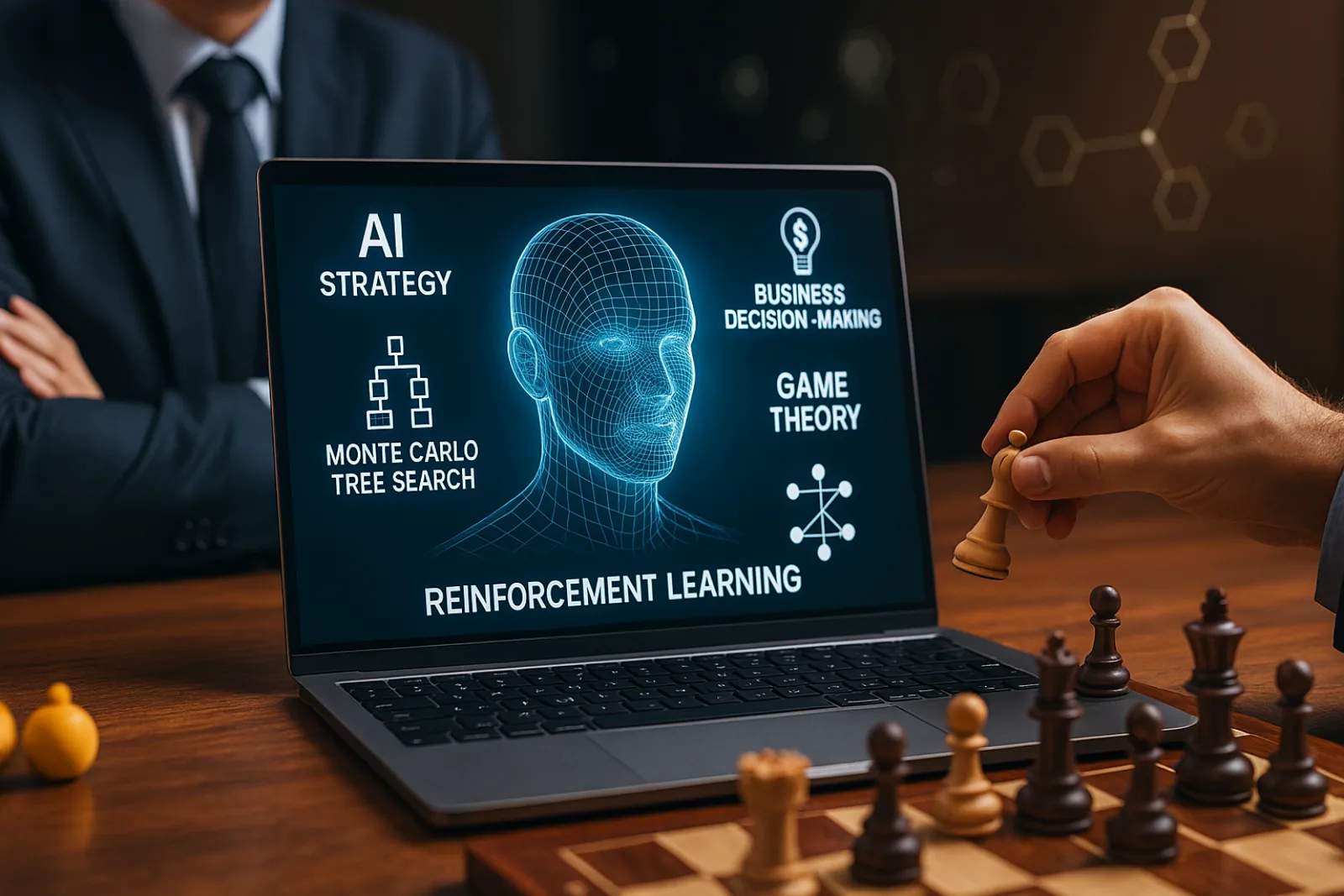
Outrun the Herd, Not the Lion: A Smarter AI Strategy for Business Games

TL;DR for operators Search-contempt is not “AI plays worse so it learns more”. That would be the lazy interpretation, and business strategy already has enough lazy interpretations wearing expensive shoes. The paper introduces a hybrid MCTS method for AlphaZero-like self-play systems. It behaves like standard PUCT search for the player to move, but at opponent nodes it eventually freezes the opponent’s visit distribution after a threshold, $N_{scl}$, and samples from that frozen distribution rather than constantly updating it toward stronger play.1 The effect is subtle but important: the system stops assuming the opponent will always improve its response with more search. ...

April 13, 2025 · 13 min · Zelina