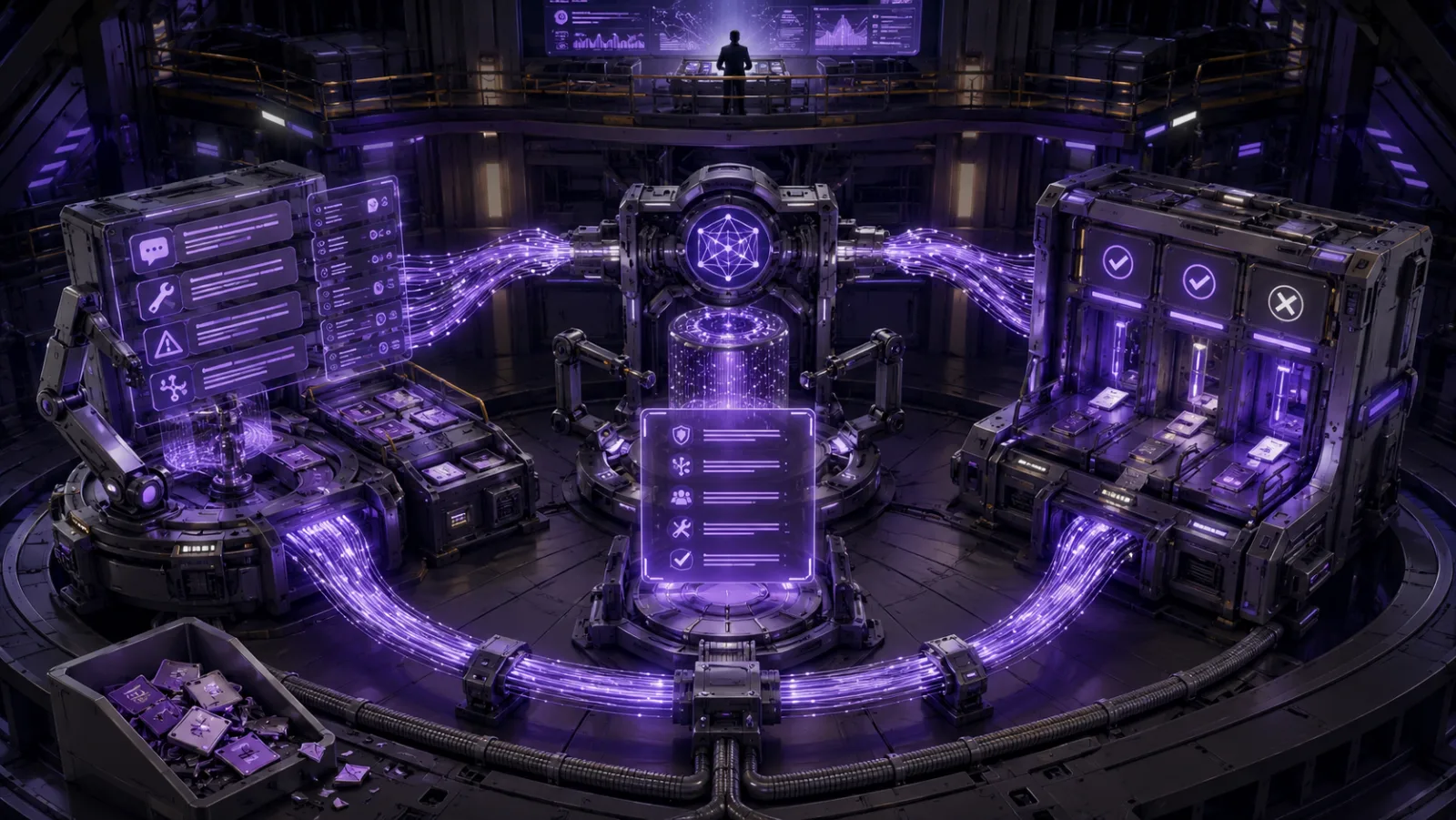
Cover image

Experience Is Not Memory: Why Learning Agents Need a Better Feedback Loop

A support ticket goes wrong. A workflow agent chooses the wrong tool. A finance assistant misses a procedural step. The usual response is familiar: add the failure to memory, rewrite a prompt, perhaps ask the agent to “reflect” before trying again. This is useful, in the same way that putting a sticky note on a broken machine is useful. It may prevent the same mistake next time. It does not prove the machine has learned how to improve. ...


May 29, 2026 · 18 min · Zelina
Cover image

When Seeing Isn’t Understanding: Closing the Multimodal Generation–Understanding Gap

Image generation has become very good at looking confident. That is convenient for demos, investor decks, and social media clips where a dragon, a dashboard, or a product mockup only needs to survive five seconds of human attention. Unfortunately, enterprise systems are less forgiving. A generated image may be beautiful, on-brand, and still wrong. The product is held in the wrong hand. The safety sign is placed behind the hazard. The chart looks plausible but reverses the relationship it was supposed to explain. Charming, as long as nobody uses it. ...

February 25, 2026 · 13 min · Zelina
Cover image

Beyond Chain-of-Thought: When Models Start Arguing with Themselves

The mirror test is more useful than another monologue Mirror. That is where the paper’s argument becomes easy to see. Ask a multimodal model to generate an image of a plush lion in front of a mirror. The generated image may look plausible at first glance. Then ask the same model’s understanding branch whether the image actually matches the prompt. The model may say no: if the lion faces the camera, the mirror should mostly show its back. The generator has produced the scene; the understander has rejected it. ...

February 22, 2026 · 15 min · Zelina
Cover image

When Agents Start Thinking Twice: Teaching Multimodal AI to Doubt Itself

A model that fails its own eye test Mirror. That is where the problem becomes easy to see. Ask a multimodal model to generate an image of a plush lion toy in front of a mirror. The model may produce something plausible at first glance: lion, mirror, warm lighting, adorable synthetic confidence. Then ask the same model, through its understanding branch, whether the image makes physical sense. Suddenly it notices the issue: if the toy faces the camera, the mirror should mostly show its back, not another front-facing lion. ...

February 9, 2026 · 14 min · Zelina
Cover image

When Language Learns to Doubt Itself: Self-Contradiction as an Upgrade Path for Multimodal AI

Image generation has become good enough to be useful and unreliable enough to remain annoying. That is the normal condition of enterprise AI: impressive demos, awkward edge cases, and someone in operations quietly asking whether the model actually understood the instruction or merely produced something that looked plausible from a distance. A user asks for “a red ceramic mug on a wooden desk, next to an open notebook, in morning light.” The model produces a beautiful desk, credible sunlight, maybe even the notebook. The mug is blue. Or metallic. Or missing. If a separate vision model can look at the image and say, “That is not a red ceramic mug,” the failure feels almost rude. The system can see the problem after creating it. Very efficient, in the same way that a committee can discover a typo after approving the brochure. ...

February 3, 2026 · 17 min · Zelina
Cover image

When AI Argues With Itself: Why Self‑Contradiction Is Becoming a Feature, Not a Bug

A model generates an image. Then the same model looks at that image and says, in effect, “No, that is not what the prompt asked for.” Awkward? Yes. Useless? Not necessarily. In normal software engineering, a system contradicting itself is usually a defect report with better manners. In modern AI, especially multimodal systems that both generate and understand images, that contradiction may also be a measurement instrument. The embarrassment is the point. A model that can notice its own generation failed has already exposed a useful asymmetry: its evaluator may be stronger than its producer. ...

December 22, 2025 · 15 min · Zelina
Cover image

Worlds Within Reach: How SIMA 2 Turns Virtual Environments into Training Grounds for Generalist Agents

Games are not toys to an AI lab. They are controlled worlds with messy consequences. A game gives an agent what enterprise software and robotics both struggle to provide at scale: visual ambiguity, delayed goals, menus, navigation, tool use, failure states, and a reset button that does not involve a broken warehouse robot or a furious operations manager. That is why Google DeepMind’s SIMA 2 paper is more interesting than “AI can play games again.” We have had that headline several times. It is getting a little tired, and it should probably hydrate. ...

December 6, 2025 · 16 min · Zelina
Cover image

Scaling Intelligence: Why Kardashev Isn’t Just for Civilizations Anymore

Every AI vendor now wants to sell autonomy. Not “software that helps your team,” which sounds quaintly 2023, but agents that plan, act, recover, learn, orchestrate, and perhaps one day replace half the org chart while politely generating meeting notes about it. The problem is not that autonomy is meaningless. The problem is that it is usually measured like a perfume ad: evocative language, dramatic lighting, very little instrumentation. ...

November 18, 2025 · 17 min · Zelina
Cover image

Evolving Minds: How LLMs Teach Themselves Through Adversarial Cooperation

Training data is the quiet tax on modern AI. Someone has to write the examples, verify the answers, clean the failures, and pretend the spreadsheet is a strategy. Reinforcement learning makes that tax even more visible: if a model is supposed to improve through feedback, then the organisation must either provide ground-truth answers, hire evaluators, or build verifiers that can tell success from nonsense. ...

November 1, 2025 · 14 min · Zelina
Cover image

Mirror, Mirror in the Model: How MLLMs Learn from Their Own Mistakes

TL;DR for operators Image generators fail in a familiar way: the output looks polished, but the prompt was quietly ignored. A product photo misses the specified texture. A campaign image reverses a spatial relation. A science illustration draws the visually plausible version, not the physically correct one. Everyone then discovers, with appropriate corporate surprise, that “high quality” and “correct” are not synonyms. ...

July 23, 2025 · 20 min · Zelina