Cover image

Train the Graph Before You Query It: SelfGraphRAG Turns Structure Into Supervision

TL;DR for operators An internal document collection can contain the relationships needed to answer difficult questions while still lacking the labeled examples needed to teach a retriever which relationships matter. That usually leaves teams choosing between manual annotation and retrieval based mostly on embedding similarity. SelfGraphRAG1 tests a third option: build a knowledge graph, turn its structure into generated question-answer examples, and train the retriever on those examples. On MultiHop-RAG, the resulting system reports F1 of 24.62, compared with 2.60 for RAG, 0.98 for LightRAG, and 0.01 for GraphRAG. ...

September 19, 2026 · 7 min · Zelina
Cover image

The Fourth Hop Changes the Risk Profile: Measuring Reliability in Multi-Step LLM Workflows

TL;DR for operators When one model output becomes input to the next stage, a final accuracy score tells you too little about where reliability is being lost. A workflow may fail because a required fact was never available, because a later composition step is intrinsically harder, or because an earlier mistake was allowed to propagate. Those failure modes call for different controls. ...

September 17, 2026 · 8 min · Zelina
Cover image

One Trajectory, More Recovery: KG-Reasoner Reworks Multi-Hop Graph Reasoning

TL;DR for operators A multi-step knowledge assistant can make a plausible early retrieval choice and only later discover that the branch cannot support the answer. The operational question is whether it can recognize that mistake and change course without restarting the workflow. Modular pipelines make stages easier to separate and inspect, but those boundaries can also discard reasoning context that later steps need. ...

September 16, 2026 · 7 min · Zelina
Cover image

When the Edge Is Missing: HyGRL Keeps the Text in the Graph

TL;DR for operators When a question requires several facts to be connected, improving entity coverage is not enough if the graph still lacks the relations needed to move between those facts. In a 200-query structural-connectivity pilot, pure Freebase connected the required endpoints within three hops in 24.1% of cases. Wikidata raised entity linking from 77.0% to 85.6%, but connectivity reached only 37.6%. Adding document text into the Freebase-based graph raised connectivity to 69.7%. ...

August 22, 2026 · 7 min · Zelina
Cover image

Search the Graph, Not the Model: RSF-GLLM Separates Traversal from Generation

TL;DR for operators An enterprise assistant may need to reach an answer through an internal identifier or intermediary record that shares almost no wording with the user’s question. Semantic similarity can recognize a plausible final answer while suppressing the unremarkable bridge entity needed to reach it. Larger retrieved neighborhoods do not solve this automatically; they can expose more valid paths while adding more convincing distractions. ...

July 27, 2026 · 10 min · Zelina
Cover image

Replace, Don’t Expand: When RAG Learns to Throw Things Away

The inbox problem hiding inside RAG Inbox. That is the easiest way to understand what goes wrong in many retrieval-augmented generation systems. A query arrives. The system retrieves a few documents. The answer is not obvious. So the system retrieves more. Then more. Then perhaps a web search result. Then a rewritten query. Then another bundle of passages. ...

December 12, 2025 · 20 min · Zelina
Cover image

From Snippets to Synthesis: INRAExplorer and the Rise of Agentic RAG

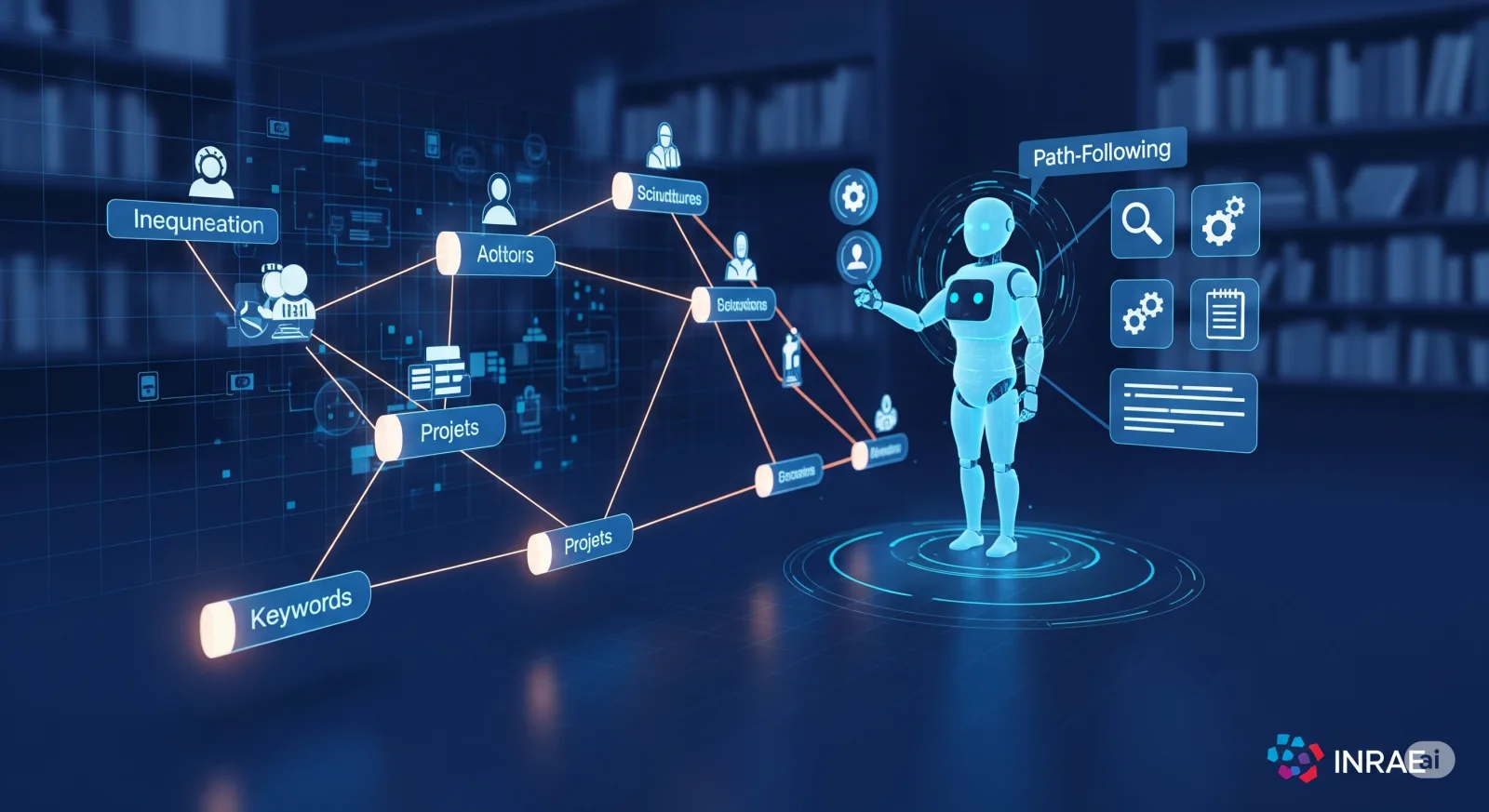
TL;DR for operators Most enterprise RAG systems still behave like diligent interns with a search box: they retrieve a handful of plausible snippets, hand them to a language model, and hope the synthesis does not quietly forget half the question. That works for narrow Q&A. It fails when the user asks for a relationship chain, a complete list, or a decision-ready map of who did what, funded by whom, connected to which topic. ...

July 23, 2025 · 15 min · Zelina