Cover image

The Rule Is the Model: DEM’s Case for Bedside Anomaly Detection Without Explainer Theatre

Alerts are cheap; trusted alerts are not A hospital monitor that screams without explaining itself is not a decision-support system. It is a very expensive doorbell. That is the practical problem behind Singh, Roy, Bose, and Hota’s Distilled Explanation Model, or DEM, for physiological anomaly detection in wireless body area networks.1 The paper is nominally about clinical sensor data: heart rate, oxygen saturation, blood pressure, temperature, stress signals, sensor dropouts, and ICU monitoring. But the more interesting argument is architectural. DEM is not trying to make a black-box model more charming after it has already made a decision. It is trying to make the explanation part of the decision itself. ...

June 14, 2026 · 17 min · Zelina
Cover image

Label Me Twice, Generate Me Once: The New Discipline of Data-Efficient AI

In enterprise AI, the glamorous part is still the model. Bigger context windows, better agents, faster inference, shinier demos—the usual fireworks display. But for many real deployments, especially in healthcare, legal review, insurance, industrial inspection, and compliance, the real bottleneck is less theatrical: labeled data. Not just data. Labeled data. Not just labeled data. Correct labeled data. ...

June 10, 2026 · 15 min · Zelina
Cover image

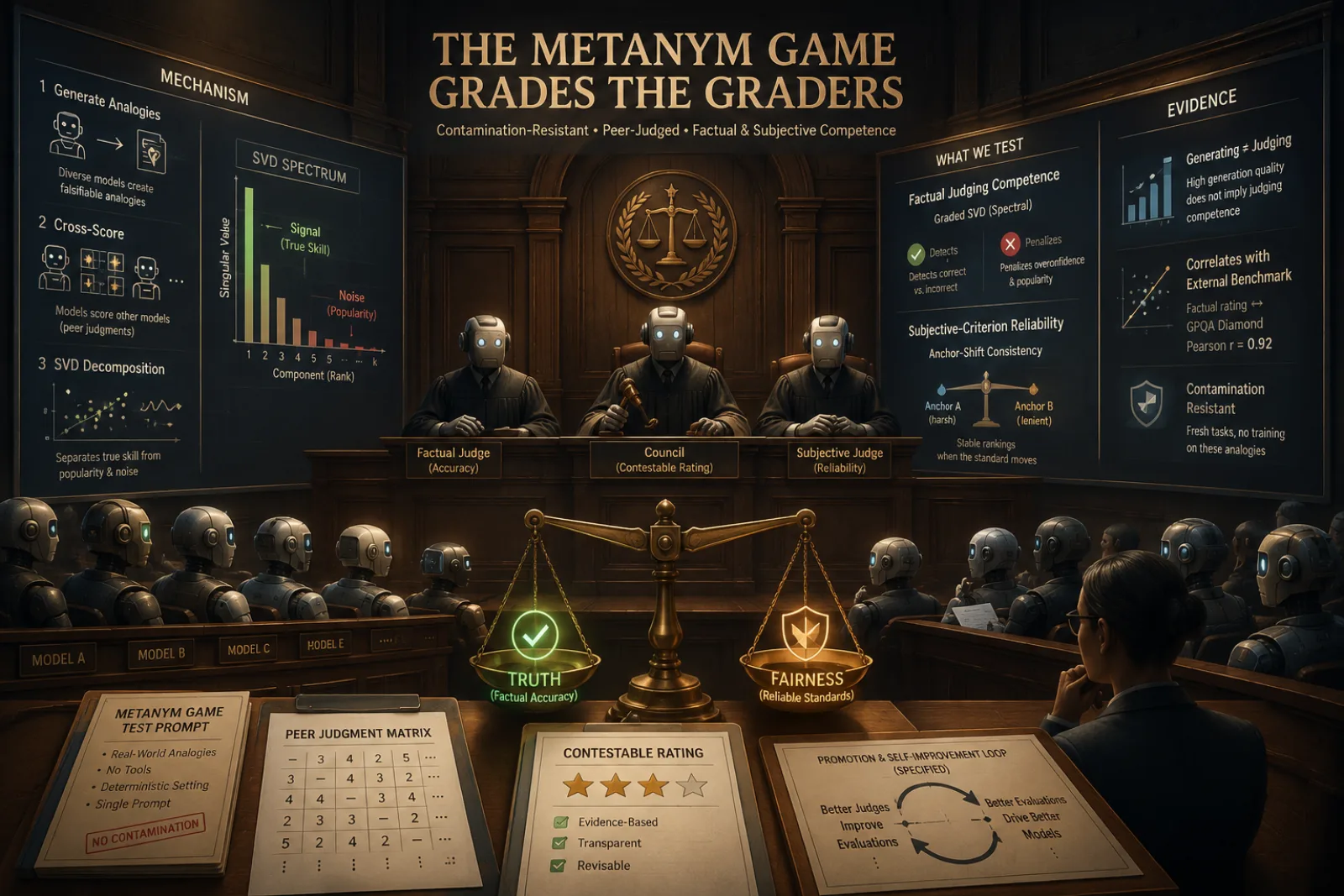
Cache Me If You Can: Why LLM Benchmarks Need Contamination-Resistant Data

The benchmark score is not the product. The test pipeline is. Benchmarks used to feel like neutral scoreboards. A model sat down, answered questions, received a number, and everyone pretended the number meant generalization. That story became less charming once benchmark questions started appearing in the same public data oceans used to train the models being tested. ...

June 3, 2026 · 20 min · Zelina
Cover image

Reasonable Doubt: Why LLM Reasoning Needs Process Control

Why this matters now The business case for LLMs has quietly moved from chatbot answers to agentic work: legal review, compliance checking, market research, document synthesis, internal analytics, coding support, and decision preparation. That shift changes the risk profile. A wrong chatbot answer is annoying. A wrong agent that looks coherent, cites documents, calls tools, updates files, and confidently stops too early is a workflow liability wearing a productivity costume. ...

May 31, 2026 · 12 min · Zelina
Cover image

The Confidence Trick: When Long AI Reasoning Arrives Too Early

A model gives you a long answer. It lists assumptions. It walks through steps. It sounds patient, organized, and slightly overqualified for the task. In a business setting, that style is comforting. A compliance analyst sees a neat explanation. A finance team sees a transparent calculation. A product manager sees “reasoning.” Everyone relaxes a little. ...

May 29, 2026 · 19 min · Zelina
Cover image

Provenance, Not Providence: Why AI Answers Need Receipts

Opening — Why this matters now The current AI market has become very good at producing fluent answers and very bad at explaining where those answers came from. This is not a minor inconvenience. It is the difference between an assistant that can be trusted in an operational workflow and an assistant that merely performs confidence with attractive typography. ...

May 9, 2026 · 14 min · Zelina
Cover image

When RMSE Lies: Why Your AI Model Might Be Quietly Mispricing Risk

A forecast can be wrong in many ways. It can miss by a little. It can miss by a lot. It can be accurate on average while quietly underestimating rare but expensive outcomes. It can give a beautifully low RMSE while assigning laughably thin probability to the event that later eats the budget. This is the sort of mistake that looks harmless in a dashboard and expensive in a board meeting. ...

April 1, 2026 · 14 min · Zelina
Cover image

Thinking Out Loud — Why LLMs Might *Need* Chain‑of‑Thought

Audit trails are boring until something goes wrong. In ordinary business operations, this is not controversial. If a payment approval, legal review, procurement decision, or trading order leaves intermediate records, people can reconstruct what happened. If the whole decision is buried inside a black-box system that simply outputs “approved,” “rejected,” or “buy now,” the audit team has a less glamorous job: guessing which invisible machinery produced the visible answer. Charming, in the way dental surgery is charming. ...

March 11, 2026 · 19 min · Zelina
Cover image

When the Model Knows but Doesn't Remember: The Hidden Blind Spot in LLM Contamination Detection

Audit. That is the word companies like to use when they want uncertainty to sound disciplined. Model audit. Benchmark audit. Contamination audit. The phrase suggests a clean checklist: run the detector, read the score, decide whether the benchmark is safe. The paper behind today’s article makes that picture less comfortable. It studies Contamination Detection via output Distribution, or CDD, on small language models and finds a simple but awkward failure mode: a model can be trained on contaminated benchmark examples, learn from them, and still avoid the kind of verbatim memorization that CDD is designed to catch.1 ...

March 4, 2026 · 14 min · Zelina
Cover image

Cheap Signals, Expensive Insights: Rethinking AI Evaluation with Tensor Factorization

Budget is where evaluation systems usually lose their innocence. A team wants to compare several models across hundreds or thousands of prompts. The obvious answer is human evaluation. The less obvious invoice arrives later: annotator time, reviewer fatigue, prompt coverage gaps, inconsistent judgments, and the slow realization that “we evaluated the model” often means “we averaged away the only differences that mattered.” ...

March 3, 2026 · 16 min · Zelina