
Cover image

Don’t Forget How to Feel: Teaching Motion Models Empathy Without Amnesia

Avatars are easy to make expressive once. That is the boring version of the problem. Give a motion model enough examples of sad walking, angry gesturing, or excited dancing, and it can learn the broad association between text and motion. The harder problem starts later, after the product has already shipped. A game studio adds a new combat animation pack. A VR training company expands from office scenarios to emergency response. A digital-human platform moves from daily-life gestures into sports, performance, musical instruments, and acrobatics. Suddenly “sad” is no longer just a lowered head during walking. It must become a lowered head while jogging, a constrained body during performance, or a professional movement pattern inside a sport. ...

December 23, 2025 · 15 min · Zelina
Cover image

MoE Money, MoE Problems? FinCast Bets Big on Foundation Models for Markets

TL;DR for operators FinCast is a finance-specific time-series foundation model that tries to do for market forecasting what large pretrained models did for language: absorb enough diverse data that new tasks require less bespoke engineering.1 The paper reports strong evidence on forecasting accuracy. In a zero-shot benchmark of 3,632 financial time series and more than 4.38 million scalar time points, FinCast beats general-purpose time-series foundation models on average, with roughly 20% lower MSE and 10% lower MAE. In supervised stock benchmarks, even the zero-shot version beats the listed supervised baselines; lightweight fine-tuning improves the gap further. ...

August 30, 2025 · 16 min · Zelina
Cover image

Fast & Curious: How ‘Speed-First’ LLM Architectures Change the Build vs. Buy Math

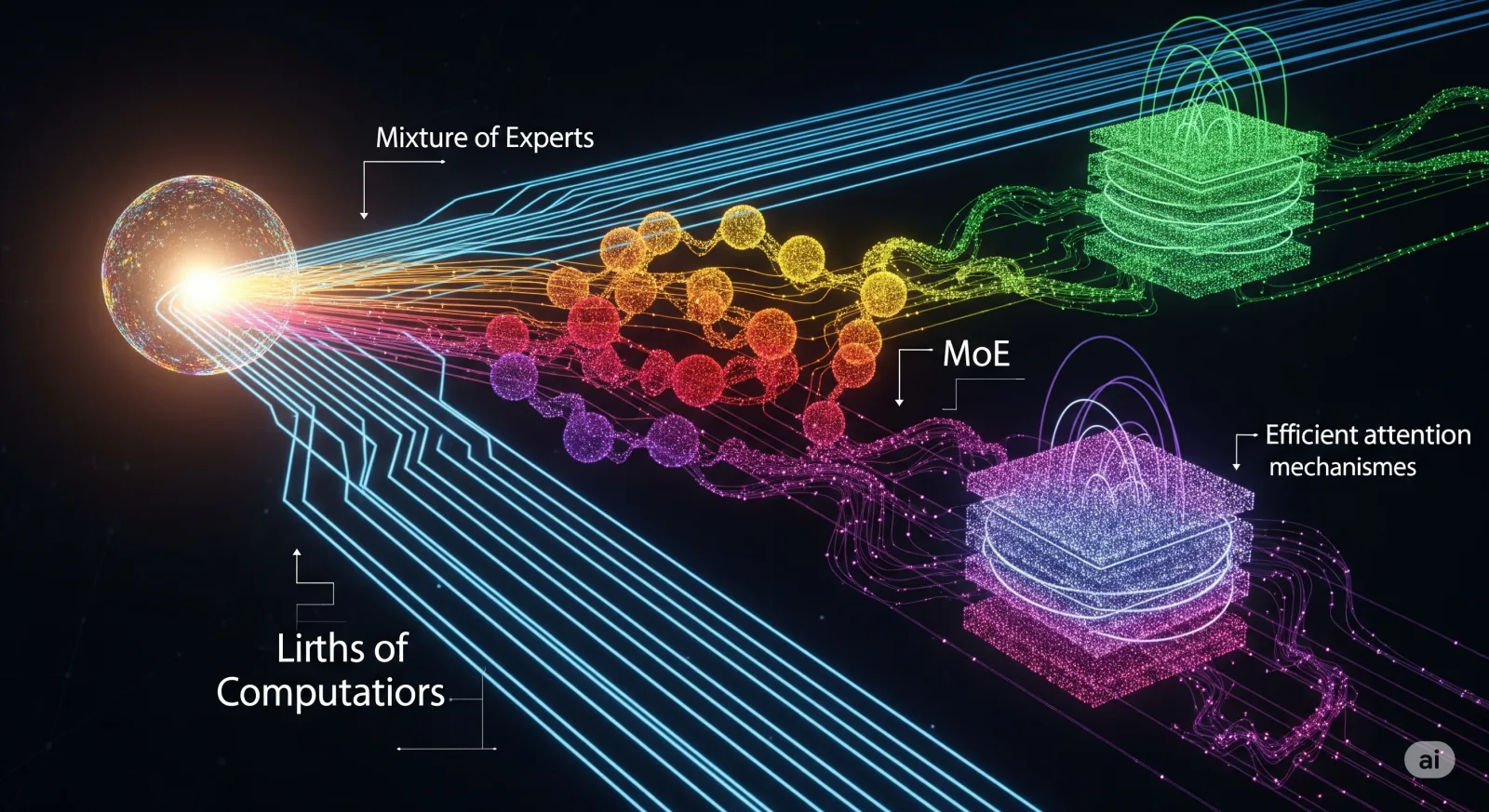
TL;DR for operators Efficient LLMs are not just “smaller Transformers with a haircut.” That is the comfortable misconception, and like many comfortable things in enterprise AI, it becomes expensive once real users arrive. The survey reviewed here maps the major architectural routes for making large language models faster, cheaper, and more deployable: linear sequence models, sparse attention, efficient full attention, sparse mixture-of-experts, hybrid architectures, diffusion LLMs, and multimodal extensions.1 Its practical value is not that it declares a single winner. It does something more useful: it tells operators which bottleneck each family is trying to remove. ...

August 16, 2025 · 20 min · Zelina
Cover image

Divide, Route, and Conquer: DriftMoE's Smart Take on Concept Drift

TL;DR for operators Production data does not politely wait for quarterly retraining. Sensor readings shift, fraud patterns mutate, market microstructure changes, network traffic acquires new habits, and customer behaviour performs its usual interpretive dance. This is concept drift: the model is still running, but the world it learned from has moved on. ...

July 27, 2025 · 15 min · Zelina