Cover image

You Can’t Reweight a Dead End: TRD and the Prefix Failure Problem

TL;DR for operators The paper’s main message is simple: if a reasoning model has already walked into a dead end, per-token distillation often keeps supervising it from inside the dead end. A clever loss cap is not a map. A top-k filter is not a tow truck. Trajectory-Refined Distillation, or TRD, repairs the student’s own rollout before using it for distillation. The pipeline is: sample the student’s attempt, ask a teacher or privileged self-teacher to rewrite the trajectory into a better one, then train on the refined trajectory rather than on the original failed rollout. The technical contribution is not “better prompting”, although prompts are used. It is the shift from token-level correction to trajectory-level correction. ...

June 19, 2026 · 15 min · Zelina
Cover image

Gradient Customs: AlphaToken Checks Which Tokens Are Allowed to Train

Fine-tuning looks deceptively democratic. Every response token gets its little vote in the gradient. The commas, the boilerplate, the obvious connective tissue, the wrong kind of certainty, the genuinely task-bearing step in the middle of the answer: all are invited to update the model. A charmingly egalitarian arrangement. Also a rather efficient way to teach a model to forget things it used to know. ...

June 14, 2026 · 18 min · Zelina
Cover image

Thinking in Circles: How Self-Questioning LLMs Learn Without Labels

TL;DR for operators Self-Questioning Language Models, or SQLM, tests a tempting idea: can a language model improve its reasoning ability without being handed a curated training set of questions and answers? The answer in this paper is: partly, in narrow settings, if the training loop is engineered carefully enough.1 The mechanism is not mystical self-awareness. A model is split into two roles. One role proposes questions from a single topic prompt. The other tries to solve them. Reinforcement learning then updates the system using proxy rewards: majority-vote agreement for arithmetic and algebra, and proposer-generated unit tests for coding. The proposer is rewarded for problems that are not too easy and not too hard; the solver is rewarded for answers that pass the available proxy. ...

August 6, 2025 · 17 min · Zelina
Cover image

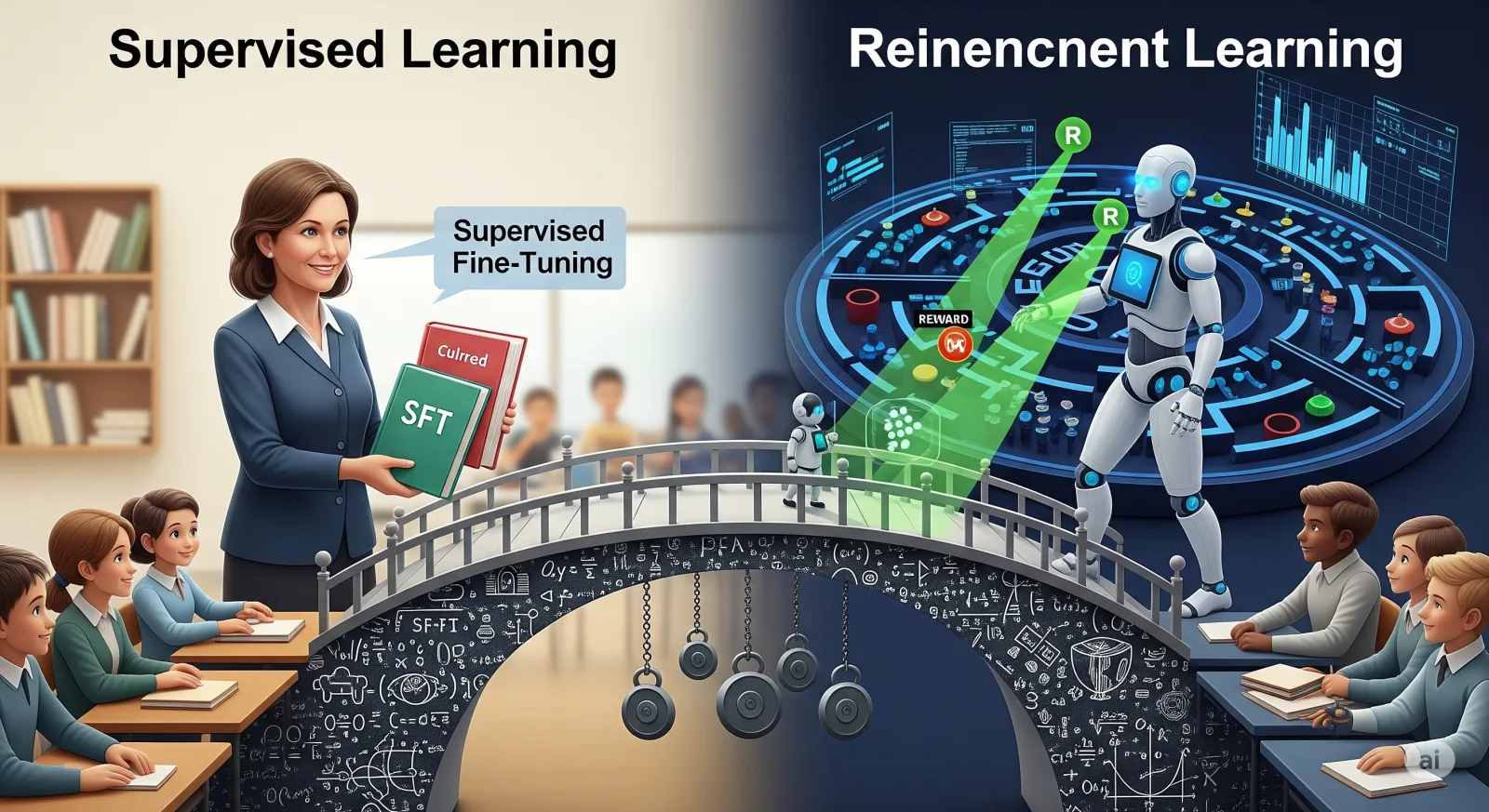
Fine-Tuning Isn’t Just Supervised: Why SFT Is Really RL in Disguise

TL;DR for operators Fine-tuning on curated examples is usually sold as the boring, stable cousin of reinforcement learning. The paper behind this article says that is too neat. When a team filters examples into “good” and “not good,” it has already created a sparse reward function. Standard supervised fine-tuning on the surviving examples is therefore not outside reinforcement learning; it is optimising a lower bound on an RL objective, only without admitting it at the meeting. ...

July 18, 2025 · 18 min · Zelina