Cover image

Grid Guardians: Why AI Needs a Safety Chaperone Before Running the Power Grid

A power grid is not a software demo. If a chatbot hallucinates, someone gets annoyed. If a trading model misfires, someone gets a painful lesson in leverage. If an AI controller sends the wrong command into a transmission grid, the problem is less “model quality” and more “please explain why the lights are off.” The infrastructure does not care that the policy had a promising validation curve. ...

April 16, 2026 · 14 min · Zelina
Cover image

When Sketches Start Running: Generative Digital Twins Come Alive

Factory sketches are usually where industrial simulation begins, not where it runs. An engineer draws the line, marks the queue, places a processor, adds a conveyor, then disappears into the less glamorous work: configuring objects, assigning arrival distributions, wiring routes, and writing platform-specific logic. The sketch is the easy part. The executable twin is the expensive part. ...

December 24, 2025 · 18 min · Zelina
Cover image

Ports, But Make Them Agentic: When LLMs Start Running the Yard

Ports are already full of automation. Cranes move containers, AGVs follow routes, software coordinates flows, dashboards blink reassuringly at managers who are paid to pretend that blinking equals control. Then one terminal changes its layout, closes a road, adds a vehicle restriction, or introduces a new safety corridor. Suddenly the “automated” dispatching system needs engineers, operations researchers, domain experts, test scripts, model reformulation, solver debugging, and several meetings where everyone discovers that “just adjust the rule” was not, in fact, just. ...

December 17, 2025 · 16 min · Zelina
Cover image

Ground and Pound: How Iterative Reasoning Quietly Redefines GUI Grounding

Clicks Are Cheap. Wrong Clicks Are Not. Click. That is the unit where many AI agent demos stop being impressive and start becoming expensive. A planning model can write a beautiful instruction sequence: open the settings panel, choose the correct tab, find the export button, confirm the dialog. Lovely. Then the visual grounding model clicks the button two pixels away from the actual target, or chooses the visually similar icon beside it, or mistakes a disabled control for an active one. Suddenly the “agentic workflow” is not a workflow. It is a small robot poking the wrong part of a screen with great confidence. Very modern. Very avoidable, perhaps. ...

December 2, 2025 · 17 min · Zelina
Cover image

Dirty Data, Clean Machines: How LLM Agents Rewire Predictive Maintenance

Workshop logs are not glamorous. They are where predictive-maintenance dreams go to meet misspelled component names, missing codes, wrong vehicle identifiers, and dates that imply a truck was both under repair and happily accumulating kilometres. Industrial AI, as ever, is less a matter of elegant algorithms than of persuading messy operational records to stop lying. ...

November 10, 2025 · 12 min · Zelina
Cover image

The Grammar and the Glow: Making Sense of Time-Series AI

TL;DR for operators Time-series AI is getting better at recognising patterns across domains: energy demand, ECG signals, traffic sensors, weather readings, equipment logs, and other data streams that behave nothing like nice, polite spreadsheets. Two recent arXiv papers point to a useful combined thesis. The first argues that time-series foundation models work because they learn a kind of “language of time”: recurring temporal patches become motif tokens; motif frequencies follow long-tail patterns; motif sequences show grammar-like constraints.1 The second tackles the adoption problem: even if a model is accurate, people still need to know why it raised a diagnosis, forecast, alarm, or recommendation. It proposes a hybrid ResNet–Transformer system that fuses local Grad-CAM heatmaps with global attention, then turns salient regions into natural-language explanations.2 ...

July 2, 2025 · 14 min · Zelina
Cover image

Catalysts of Thought: How LLM Agents are Reinventing Chemical Process Optimization

TL;DR for operators Chemical-process optimisation does not usually fail because nobody has heard of optimisation. It fails earlier, in the less glamorous swamp where someone has to decide what operating ranges are even allowed. Temperatures, separator conditions, pressure drops, utility trade-offs, convergence behaviour, equipment limits: all the tedious things that make optimisation useful and prevent it from becoming a very fast route to nonsense. ...

June 27, 2025 · 17 min · Zelina
Cover image

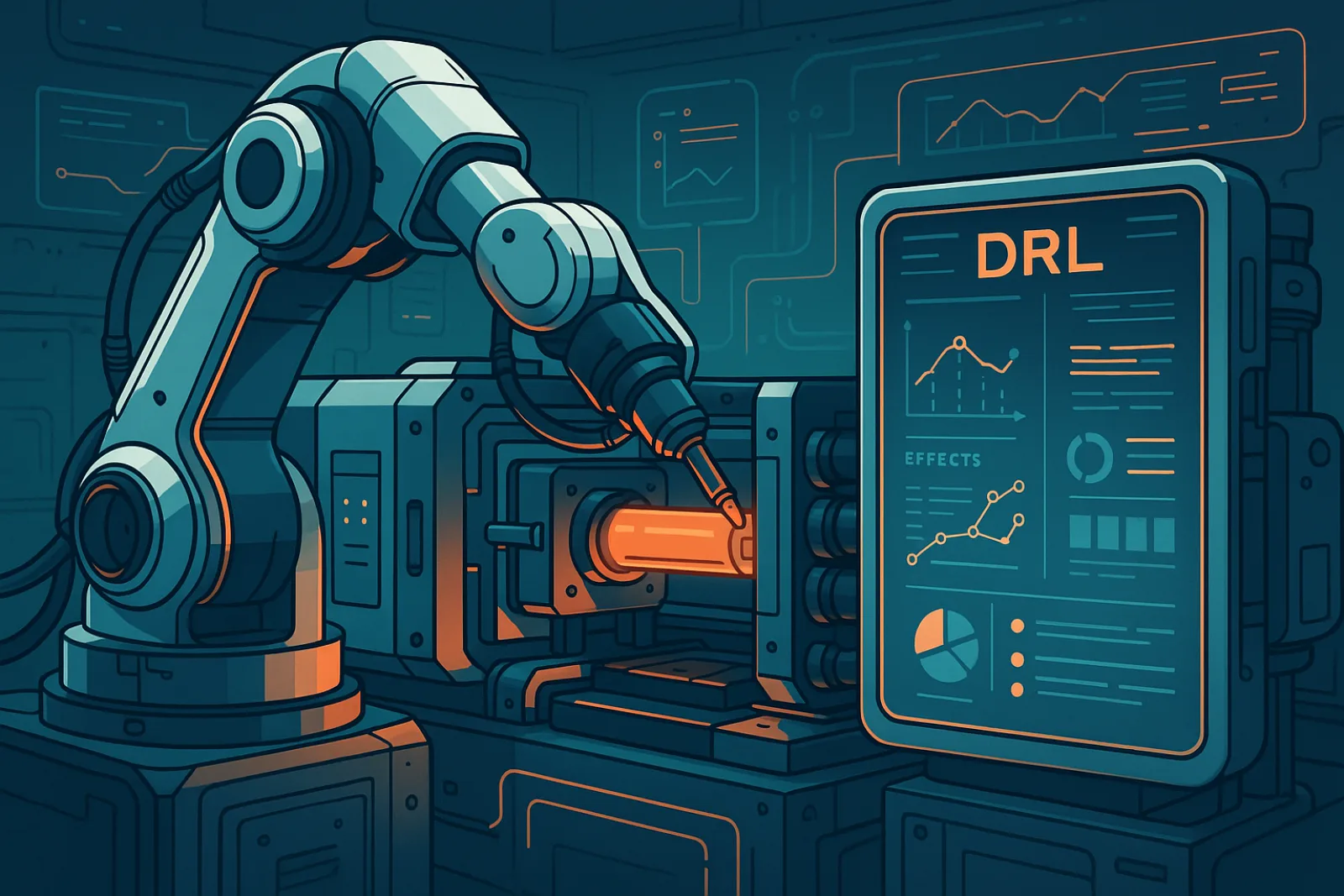
Molding the Future: How DRL is Revolutionizing Process Optimization

TL;DR for operators Factory optimisation usually begins with a polite fiction: if the process makes good parts, the business must be doing well. Injection molding knows better. A technically acceptable part can still be produced at the wrong pressure, at the wrong cycle time, during the wrong electricity tariff window, with just enough mold wear to make the accountant quietly unhappy. ...

May 19, 2025 · 18 min · Zelina