Cover image

Sink or Skill: Why Agent Experience Needs Governance

TL;DR for operators AI agents do not become useful by remembering everything. That is not intelligence; it is a data landfill with a chatbot interface. Two recent arXiv papers, one on medical reasoning agents and one on physically based swimming control, make a shared operational point from very different directions. SkeMex shows how a medical agent can improve after deployment by converting interaction trajectories into structured, evaluated, and governed clinical skills.1 SWIM shows how a simulated swimmer can learn robust control from a single reference motion when body-fluid interaction is represented at the right level and scarce experience is sampled efficiently.2 ...


June 17, 2026 · 17 min · Zelina
Cover image

Think First, Grasp Later: Why Robots Need Reasoning Benchmarks

A robot receives a simple instruction: pick up the blue cup. It approaches the blue cup, positions its gripper badly, and knocks the cup over. Another robot moves smoothly, closes its gripper precisely—and picks up the red cup. On the operations dashboard, both attempts may appear under the same pleasantly uninformative label: task failed. ...

January 3, 2026 · 17 min · Zelina
Cover image

When Models Forget on Purpose: Why Data Selection Matters More Than Data Volume

Training data has become the AI industry’s favorite comfort blanket. When performance stalls, add more tokens. When a benchmark looks stubborn, add more tokens. When the model behaves badly, add more tokens and call it a roadmap. This worked well enough to become a reflex. Unfortunately, reflexes are not strategies. The uncomfortable question is no longer whether data matters. Of course it matters. The better question is whether every token deserves the same vote during training. ...

December 31, 2025 · 17 min · Zelina
Cover image

Spin Doctors: Why RL Fine‑Tuning Mostly Rotates, Not Reinvents

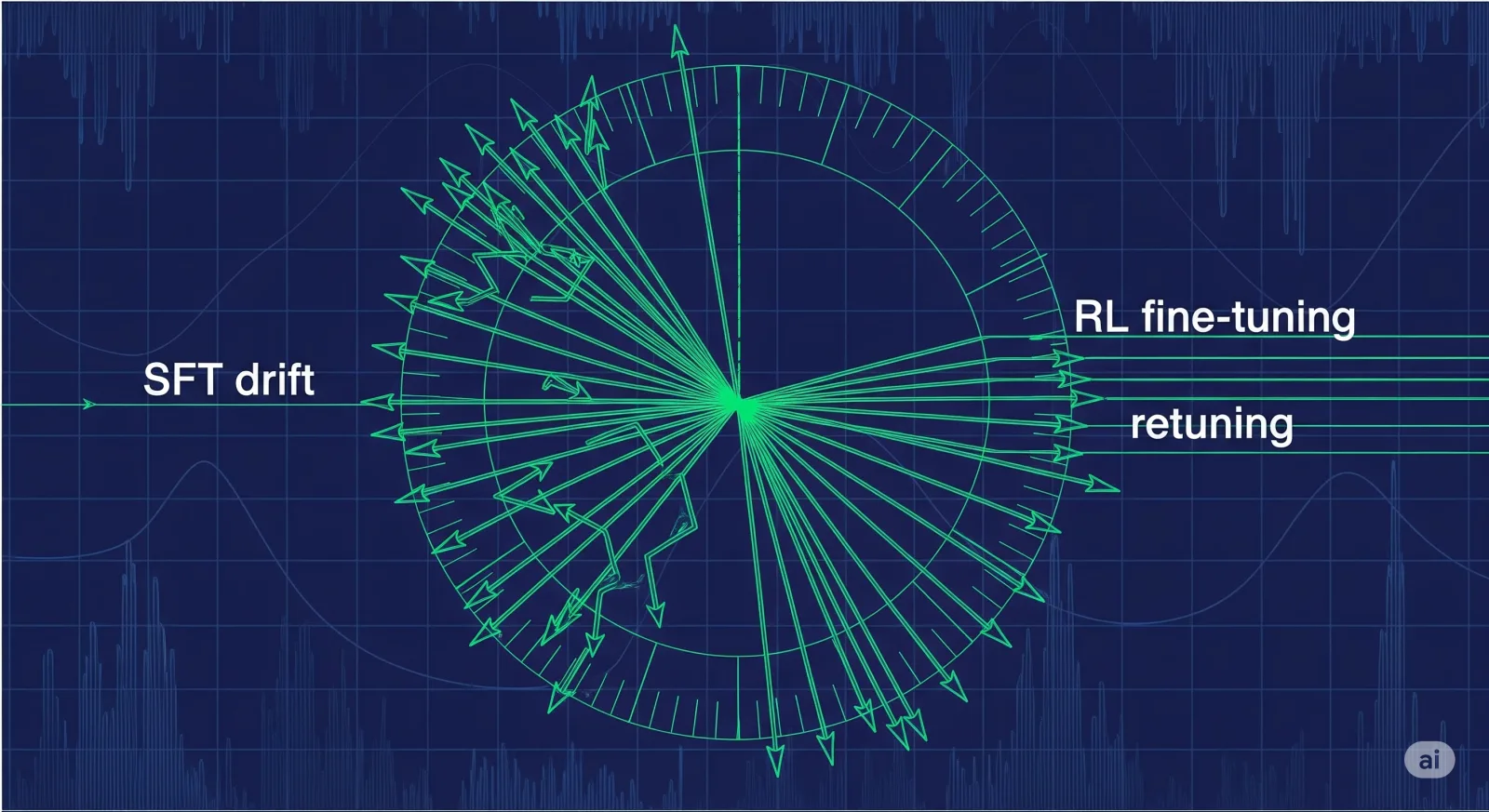
TL;DR for operators If your fine-tuned model gets better on the training task while quietly becoming worse outside it, the problem may not be that the model “lost intelligence”. It may have rotated its useful internal directions away from broadly generalizable behaviour. The paper behind this article studies SFT followed by PPO-style RL on two open LLMs using a controlled arithmetic benchmark, then inspects the weight matrices through singular-value decomposition.1 The pattern is clean enough to be operationally interesting: OOD performance peaks early during SFT, falls as SFT continues, and can be substantially restored by RL when the SFT checkpoint is only moderately degraded. But if SFT pushes the model too far into a specialized regime, RL is no longer a reliable rescue crew. Apparently even reinforcement learning has limits. Who knew. ...

August 25, 2025 · 14 min · Zelina
Cover image

Brains with Gradients: Why Energy-Based Transformers Might Be the Future of Thinking Machines

TL;DR for operators Energy-Based Transformers are not another prompt trick, reasoning wrapper, or RL-flavoured attempt to make a chatbot show more homework. They change the model’s job. Instead of directly predicting the next token, frame, or image patch in one forward pass, an EBT learns a scalar energy function that scores whether a candidate prediction is compatible with its context. Lower energy means “this fits better.” Inference then becomes optimisation: start with a rough or random candidate, compute the gradient of the energy with respect to that candidate, and iteratively move toward a lower-energy prediction. ...

July 4, 2025 · 16 min · Zelina