Cover image

Causality Pays: A Smarter Take on Volatility-Based Trading

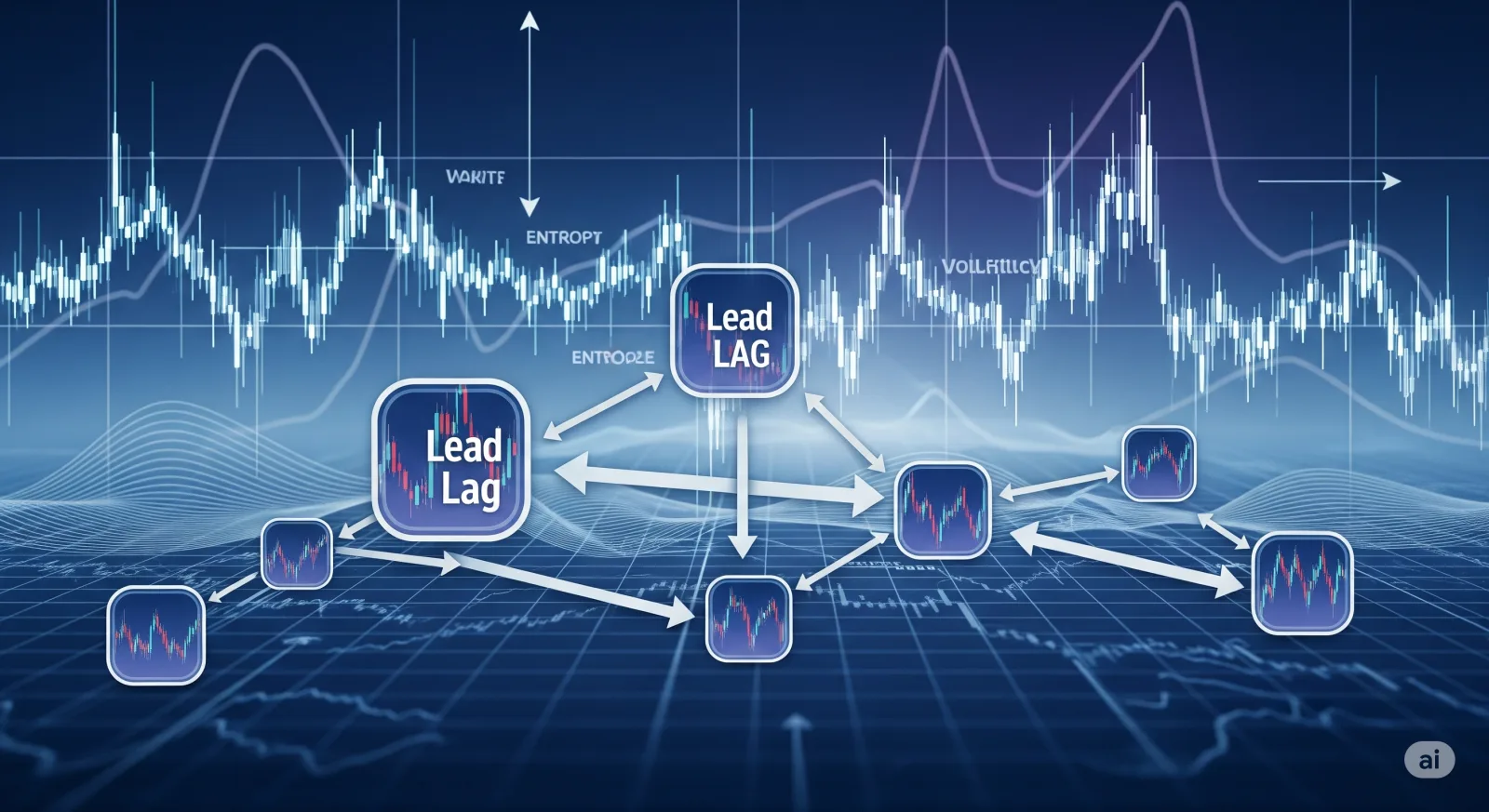
TL;DR for operators Volatility is usually treated as a risk input: measure it, size positions around it, and try not to get mugged by it before lunch. This paper treats volatility differently. It uses mid-range volatility to select stocks that are neither comatose nor explosive, then applies a causal-inference stack to find which stocks appear to move before others. ...

July 15, 2025 · 15 min · Zelina
Cover image

From Trendlines to Transformers: DeepSupp Redefines Support Level Detection

TL;DR for operators Support levels are usually treated as chart objects: a line, a zone, a Fibonacci retracement, a moving average, perhaps a hand-drawn artefact with suspicious confidence. DeepSupp reframes them as latent market states: patterns in how price, volume, VWAP, and related features move together over time.1 The paper’s useful contribution is the pipeline, not the marketing-friendly phrase “AI technical analysis.” DeepSupp builds rolling Spearman correlation matrices from price-volume features, sends those matrices through a multi-head attention autoencoder, compresses them into latent embeddings, and then uses DBSCAN clustering to map dense market states back into median price levels. In plainer language: it tries to find support zones by learning how market relationships evolve, rather than by assuming that yesterday’s visual line still deserves respect. ...
July 6, 2025 · 18 min · Zelina
Cover image

Residual Learning: How Reinforcement Learning Is Speeding Up Portfolio Math

TL;DR for operators Financial AI is usually sold as a machine that predicts markets. This paper is about something more modest and, frankly, more useful: making the maths underneath portfolio optimisation and option pricing run faster. The authors propose a reinforcement learning controller that adjusts the block size of a preconditioner inside Flexible GMRES, an iterative solver used for large sparse or awkward linear systems. The agent is trained with PPO. Its state is the current residual vector, its action is a choice of block size, and its reward pushes the residual norm downward. In plain English: the model watches how badly the solver is still missing the answer, then changes the way the solver reorganises the problem. ...

July 6, 2025 · 13 min · Zelina
Cover image

Nodes Know Best: A Smarter Graph for Long-Term Stock Forecasts

TL;DR for operators NGAT is useful because it attacks a real modelling mismatch in financial AI: companies do not absorb market information in the same way, yet many graph neural networks treat them as if they do. The paper’s answer is a node-level graph attention layer, where each company learns its own attention mechanism for reading signals from related companies. ...

July 4, 2025 · 16 min · Zelina
Cover image

Wall Street’s New Intern: How LLMs Are Redefining Financial Intelligence

TL;DR for operators The paper is best read as a menu, not a victory lap. It surveys how recent research has plugged large language models into financial investment workflows across four design patterns: LLM-based pipelines, hybrid LLM-quant systems, fine-tuned financial models, and agent-based architectures.1 That taxonomy is more useful than another breathless “AI beats Wall Street” headline, which is convenient because the latter is usually where rigor goes to die in a nice suit. ...

July 4, 2025 · 18 min · Zelina
Cover image

Overqualified, Underprepared: Why FinLLMs Matter More Than Reasoning

TL;DR for operators Finance AI is moving past the parlour trick stage. The interesting question is no longer whether a large language model can read a financial headline and produce a plausible answer. Of course it can. The useful question is whether that answer can be converted into a measurable, governed, risk-aware decision process without accidentally building a very expensive rumour amplifier. ...

April 20, 2025 · 16 min · Zelina