
Cover image

The Molecule Was Right. The Reasoning Was Not.

TL;DR for operators Chemistry teams should stop treating a correct molecule, reaction product, or ranked option as proof that an AI system reasoned chemically. That is the comfortable interpretation. It is also, inconveniently, the one ChemCoTBench-V2 was built to dismantle. The paper introduces a benchmark that evaluates chemical language models at three separate levels: final-answer correctness, template adherence, and step-wise chemical validity. The important move is not “add more benchmark rows.” The move is to force the model to expose intermediate chemical commitments—rings, scaffolds, fragments, reaction types, edit plans, condition rankings, product constructions—and then check those commitments with deterministic chemistry rules or verified reference traces.1 ...

July 2, 2026 · 17 min · Zelina
Cover image

Bond Before Brain: What Actually Drives Molecular MPNNs

TL;DR for operators Molecular GNN selection is often sold as a choice among branded architectures: DMPNN, AttentiveFP, Graphormer, and the rest of the respectable parade. This paper asks a more useful question: before buying the whole architecture, which part of the message-passing pipeline is actually carrying the performance signal? The answer, within this study’s controlled 2D setting, is message construction. The authors benchmark 84 molecular MPNN configurations across ten MoleculeNet tasks by varying three operator families: message-seed initialization, node-edge fusion, and node update. They hold sum aggregation, sum readout, featurization, scaffold splits, tuning protocol, and statistical analysis fixed. That makes the benchmark less glamorous than a new model launch, and substantially more useful. ...

June 15, 2026 · 16 min · Zelina
Cover image

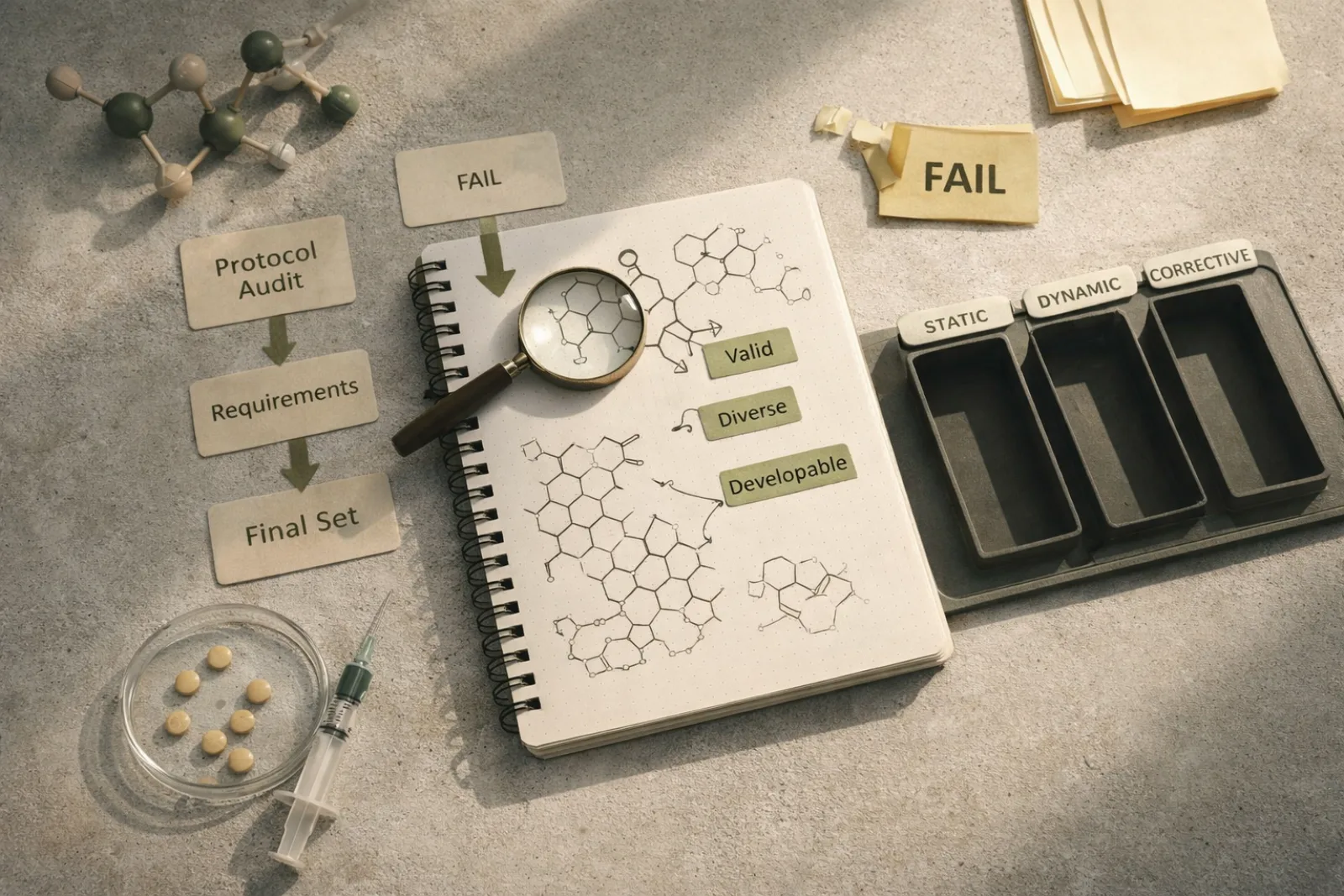
Protocol Over Hype: Why AI Drug Discovery Agents Need Memory, Not Just Models

Drug discovery is a wonderful place for AI demos. The model proposes a molecule, the molecule looks plausible, a docking score improves, and the slide deck starts to glow with that familiar color: almost-commercial blue. Then the evaluation protocol arrives and ruins the party. The problem is simple, and therefore easy to underestimate. A drug discovery agent is rarely asked to return one impressive molecule. It is asked to return a set of molecules that jointly satisfies several requirements: enough candidates, enough diversity, acceptable binding proxies, drug-likeness, synthetic accessibility, novelty, and other threshold-style constraints. One molecule can look good. A few molecules can look good. The final returned pool can still fail. ...

April 13, 2026 · 15 min · Zelina
Cover image

Blinded by Design: When AI Stops Thinking and Starts Remembering

A name can do a suspicious amount of work. Give an LLM a table of colorectal cancer gene candidates and ask it to rank the best drug targets. When the gene names are visible, KRAS lands at #1. The model justifies the choice with a confident reference to “proven therapeutic tractability via covalent RAS inhibitors.” Sensible enough, if the task is to combine the supplied table with the model’s accumulated biomedical knowledge. ...

April 8, 2026 · 19 min · Zelina
Cover image

From Simulation to Strategy: When Autonomous Systems Start Auditing Themselves

A lab is full of reviews. A candidate molecule is screened, criticized, scored, filtered, re-ranked, re-tested, and then quietly abandoned because one property looked promising while three others looked inconvenient. Drug discovery has never lacked opinions. It has lacked a clean way to convert those opinions into a machine-readable optimization process. That is the useful point in MAC-AMP: A Closed-Loop Multi-Agent Collaboration System for Multi-Objective Antimicrobial Peptide Design.1 The paper is easy to misread as another “LLM designs molecules” story. That would be tidy, familiar, and slightly wrong. ...

February 17, 2026 · 16 min · Zelina
Cover image

Hunt Globally, Miss Nothing: Why Tree-Based AI Agents Beat ‘Run-It-Longer’ Research

Deals are not usually lost because nobody wrote a beautiful market summary. They are lost because the right asset sat in a regional announcement, under a local-language alias, attached to a company page, trial registry, conference PDF, or corporate filing that nobody searched properly. Then, six months later, the same asset appears in a large-pharma partnership press release, and everyone acts surprised. The surprise is often very well-formatted. That does not make it useful. ...

February 17, 2026 · 14 min · Zelina
Cover image

Tensor-DTI: Binding the Signal, Not the Noise

Screening is not discovery. It is queue management with chemistry attached. A modern drug-discovery team can now look at chemical libraries with tens of billions of synthesizable molecules and ask a beautifully impractical question: which of these should we spend real money testing? Experimental high-throughput screening is expensive. Docking is cheaper, but still not cheap enough when the search space stops being “large” and starts behaving like a small galaxy. Co-folding and structure-aware models add another layer of sophistication, but they also add computational cost, data assumptions, and a healthy appetite for well-behaved structural regimes. ...

January 14, 2026 · 16 min · Zelina
Cover image

OrchestRA and the End of Linear Drug Discovery

Handoffs are where promising projects quietly become expensive. A biologist identifies a plausible target. A chemistry team designs a molecule that appears to bind it. Weeks later, pharmacology discovers that the molecule is poorly absorbed, rapidly cleared, or inconveniently toxic. The result travels back upstream as a report, perhaps accompanied by a meeting, several caveats, and the medicinal-chemistry equivalent of “please try again.” ...

December 29, 2025 · 16 min · Zelina
Cover image

SAGA, Not Sci‑Fi: When LLMs Start Doing Science

Science usually fails in a boring way. Not with explosions. Not with a robot dramatically discovering penicillin 2.0 while violins swell in the background. More often, a research workflow fails because somebody optimized the wrong thing a little too efficiently. A molecule scores well but is chemically ugly. A nanobody looks good under one predictor but fails to bind. A DNA enhancer activates the target cell line but also lights up the wrong tissue. A separation process reaches high purity by adding pointless unit operations, because the reward function forgot to punish industrial nonsense. The optimizer did its job. Unfortunately, the job description was incomplete. ...

December 29, 2025 · 16 min · Zelina
Cover image

MoA vs. Moat: Agentic LLMs for Drug Competitor Mapping Cut Diligence Time 20×

TL;DR for operators A recent arXiv paper on LLM-based agents for drug-asset due diligence shows something more useful than “AI does research now.” It shows a practical operating pattern: convert past expert memos into a measurable benchmark, send a persistent web-search agent to maximise competitor recall, then pass candidates through a stricter validator before analysts see them.1 ...

August 25, 2025 · 17 min · Zelina