Cover image

Driving by Words: When LLMs Take the Wheel (Literally)

Taxi. That is the easiest way to understand the paper. Not because Vega is a robotaxi system. It is not. But because a taxi ride exposes the missing layer in many autonomous-driving discussions: the passenger does not merely want the car to obey traffic rules. The passenger wants the car to behave under intent. ...


March 28, 2026 · 14 min · Zelina
Cover image

The AI Crystal Ball Problem: What the Public Thinks the Future Looks Like

Medical AI is the easy part. Not technically easy, of course. Drug discovery, diagnostics, personalized medicine, and clinical deployment remain gloriously allergic to PowerPoint timelines. But in public imagination, medical breakthroughs are the part of the AI future that feels most believable. People have seen the headlines. They have heard about protein folding. They can picture a machine helping a doctor find something earlier, faster, or more accurately. ...

March 4, 2026 · 17 min · Zelina
Cover image

Hunt Globally, Miss Nothing: Why Tree-Based AI Agents Beat ‘Run-It-Longer’ Research

Deals are not usually lost because nobody wrote a beautiful market summary. They are lost because the right asset sat in a regional announcement, under a local-language alias, attached to a company page, trial registry, conference PDF, or corporate filing that nobody searched properly. Then, six months later, the same asset appears in a large-pharma partnership press release, and everyone acts surprised. The surprise is often very well-formatted. That does not make it useful. ...

February 17, 2026 · 14 min · Zelina
Cover image

AI Didn’t Save the Economy — It Rented It

The economy did not become intelligent overnight Rent is a wonderfully clarifying word. When a company rents GPU capacity, it is not buying “AI magic.” It is paying for access to a physical production system: chips, servers, cooling, electricity, networking, land, software orchestration, and a pricing model that turns machine time into invoices. That invoice may look like a cloud bill. In national accounts, however, it becomes something more prosaic and more useful: consumption, investment, exports, government expenditure, or an intermediate input. ...

January 20, 2026 · 20 min · Zelina
Cover image

IRB, API, and a PI: When Agents Run the Lab

TL;DR for operators Lab work is mostly not white coats and dramatic discoveries. It is protocol design, ethics paperwork, recruitment settings, data cleaning, model diagnostics, figure formatting, reference checking, and the slow discovery that your beautiful hypothesis has politely declined to exist. That is what makes this paper interesting. Virtuous Machines: Towards Artificial General Science presents an agentic AI system that did not merely write a speculative research proposal. It designed and executed an online human-participant experiment, collected data through Prolific and Pavlovia, analysed the results, produced figures and tables, wrote manuscripts, and ran peer-style review over the outputs.1 ...

August 20, 2025 · 16 min · Zelina
Cover image

Outrun the Herd, Not the Lion: A Smarter AI Strategy for Business Games

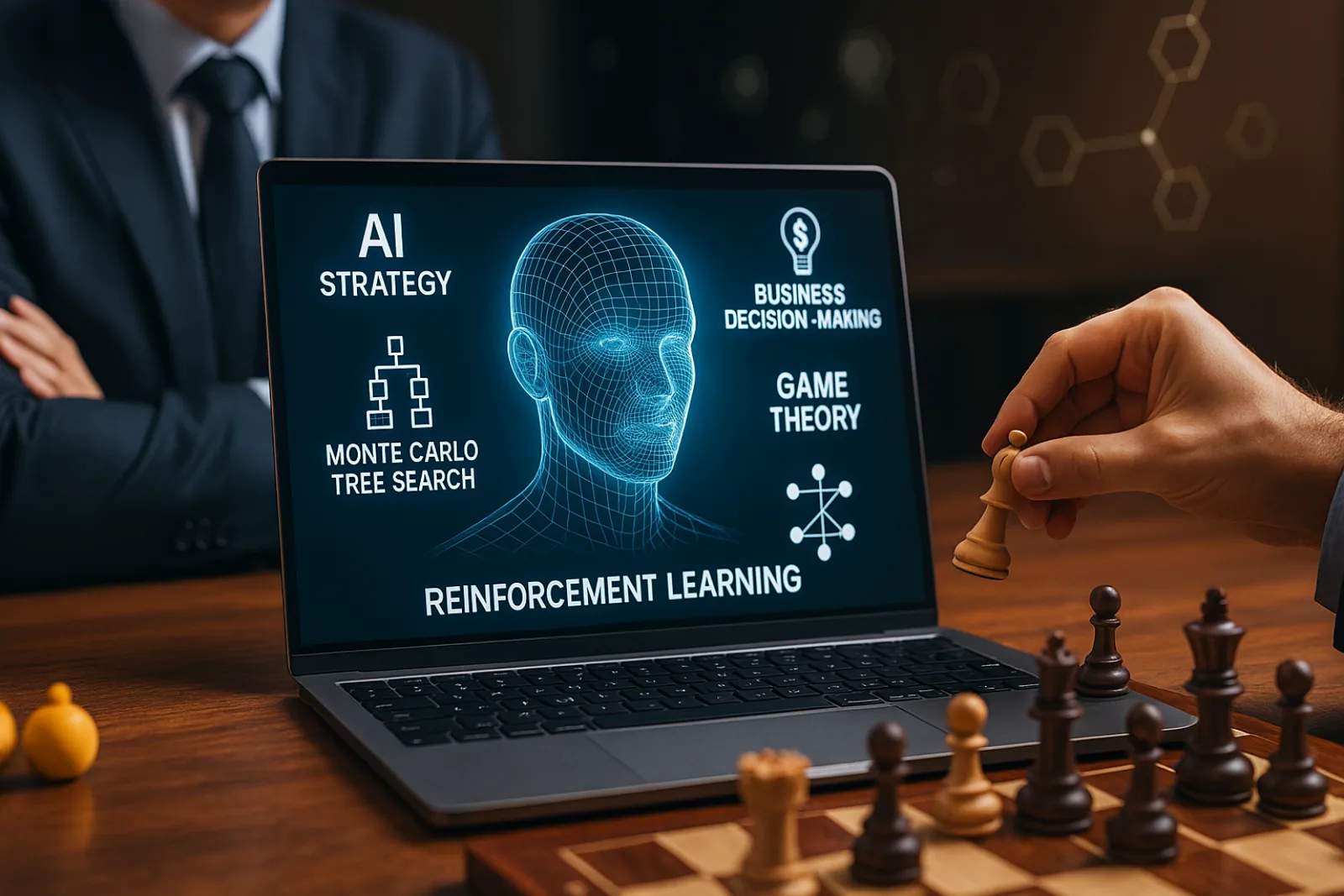
TL;DR for operators Search-contempt is not “AI plays worse so it learns more”. That would be the lazy interpretation, and business strategy already has enough lazy interpretations wearing expensive shoes. The paper introduces a hybrid MCTS method for AlphaZero-like self-play systems. It behaves like standard PUCT search for the player to move, but at opponent nodes it eventually freezes the opponent’s visit distribution after a threshold, $N_{scl}$, and samples from that frozen distribution rather than constantly updating it toward stronger play.1 The effect is subtle but important: the system stops assuming the opponent will always improve its response with more search. ...

April 13, 2025 · 13 min · Zelina
Cover image

Two Heads Are Better Than One: How Dual-Engine AI Reshapes Analytical Thinking

TL;DR for operators DEoT is not “a smarter chatbot”. It is a structured analysis workflow for questions where there is no single correct answer: policy impact, market entry, geopolitical risk, crisis response, investment implications, technology disruption, and the usual executive swamp where every answer arrives with a footnote and a headache. The paper’s useful idea is simple: open-ended analysis needs two motions. First, go wide enough not to miss important dimensions. Then go deep enough not to produce a shallow consultant-flavoured smoothie. DEoT formalises this through a Breadth Engine, a Depth Engine, and an Engine Controller that decides when to branch, when to drill, and when to stop. ...

April 12, 2025 · 16 min · Zelina