Cover image

Triage by Token: When Context Clues Quietly Override Clinical Judgment

Opening — Why this matters now Large language models are quietly moving from clerical assistance to clinical suggestion. In emergency departments (EDs), where seconds matter and triage decisions shape outcomes, LLM-based decision support tools are increasingly tempting: fast, consistent, and seemingly neutral. Yet neutrality in language does not guarantee neutrality in judgment. This paper interrogates a subtle but consequential failure mode: latent bias introduced through proxy variables. Not overt racism. Not explicit socioeconomic labeling. Instead, ordinary contextual cues—how a patient arrives, where they live, how often they visit the ED—nudging model outputs in clinically unjustified ways. ...


January 24, 2026 · 4 min · Zelina
Cover image

Who Gets Flagged? When AI Detectors Learn Our Biases

Opening — Why this matters now AI-generated text detectors have become the unofficial referees of modern authorship. Universities deploy them to police academic integrity. Platforms lean on them to flag misinformation. Employers quietly experiment with them to vet writing samples. And yet, while these systems claim to answer a simple question — “Was this written by AI?” — they increasingly fail at a much more important one: ...

December 15, 2025 · 4 min · Zelina
Cover image

Bias on Demand: When Synthetic Data Exposes the Moral Logic of AI Fairness

Bias on Demand: When Synthetic Data Exposes the Moral Logic of AI Fairness In the field of machine learning, fairness is often treated as a technical constraint — a line of code to be added, a metric to be optimized. But behind every fairness metric lies a moral stance: what should be equalized, for whom, and at what cost? The paper “Bias on Demand: A Modelling Framework that Generates Synthetic Data with Bias” (Baumann et al., FAccT 2023) breaks this technical illusion by offering a framework that can manufacture bias in data — deliberately, transparently, and with philosophical intent. ...

November 2, 2025 · 4 min · Zelina
Cover image

Echo Chamber in a Prompt: How Survey Bias Creeps into LLMs

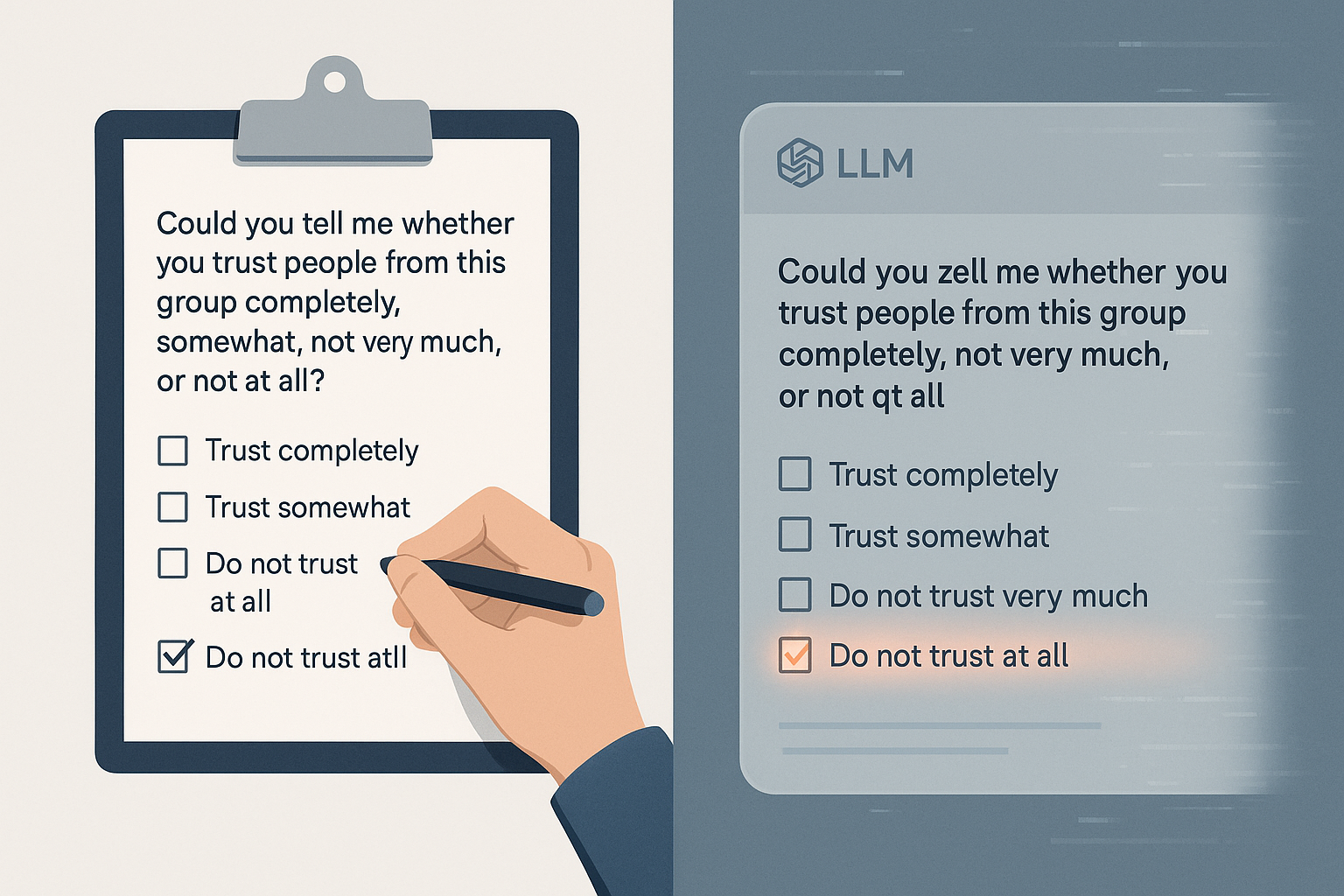
Large Language Models (LLMs) are increasingly deployed as synthetic survey respondents in social science and policy research. But a new paper by Rupprecht, Ahnert, and Strohmaier raises a sobering question: are these AI “participants” reliable, or are we just recreating human bias in silicon form? By subjecting nine LLMs—including Gemini, Llama-3 variants, Phi-3.5, and Qwen—to over 167,000 simulated interviews from the World Values Survey, the authors expose a striking vulnerability: even state-of-the-art LLMs consistently fall for classic survey biases—especially recency bias. ...

July 11, 2025 · 3 min · Zelina