Cover image

When RAG Meets the Law: Building Trustworthy Legal AI for a Moving Target

Opening — Why this matters now Legal systems are allergic to uncertainty. Yet, AI thrives on it. As generative models step into the courtroom—drafting opinions, analyzing precedents, even suggesting verdicts—the question is no longer can they help, but can we trust them? The stakes are existential: a hallucinated statute or a misapplied precedent isn’t a typo; it’s a miscarriage of justice. The paper Hybrid Retrieval-Augmented Generation Agent for Trustworthy Legal Question Answering in Judicial Forensics offers a rare glimpse at how to close this credibility gap. ...


November 6, 2025 · 4 min · Zelina
Cover image

When Markets Dream: The Rise of Agentic AI Traders

Opening — Why this matters now The line between algorithmic trading and artificial intelligence is dissolving. What once were rigid, rules-based systems executing trades on predefined indicators are now evolving into learning entities — autonomous agents capable of adapting, negotiating, and even competing in simulated markets. The research paper under review explores this frontier, where multi-agent reinforcement learning (MARL) meets financial markets — a domain notorious for non-stationarity, strategic interaction, and limited data transparency. ...

November 5, 2025 · 3 min · Zelina
Cover image

Agents with Interest: How Fintech Taught RAG to Read the Fine Print

Opening — Why this matters now The fintech industry is an alphabet soup of acronyms and compliance clauses. For a large language model (LLM), it’s a minefield of misunderstood abbreviations, half-specified processes, and siloed documentation that lives in SharePoint purgatory. Yet financial institutions are under pressure to make sense of their internal knowledge—securely, locally, and accurately. Retrieval-Augmented Generation (RAG), the method of grounding LLM outputs in retrieved context, has emerged as the go-to approach. But as Mastercard’s recent research shows, standard RAG pipelines choke on the reality of enterprise fintech: fragmented data, undefined acronyms, and role-based access control. The paper Retrieval-Augmented Generation for Fintech: Agentic Design and Evaluation proposes a modular, multi-agent redesign that turns RAG from a passive retriever into an active, reasoning system. ...

November 4, 2025 · 4 min · Zelina
Cover image

Two Minds in One Machine: How Agentic AI Splits—and Reunites—the Field

Opening — Why this matters now Agentic AI is the latest obsession in artificial intelligence: systems that don’t just respond but decide. They plan, delegate, and act—sometimes without asking for permission. Yet as hype grows, confusion spreads. Many conflate these new multi-agent architectures with the old, symbolic dream of reasoning machines from the 1980s. The result? Conceptual chaos. A recent comprehensive survey—Agentic AI: A Comprehensive Survey of Architectures, Applications, and Future Directions—cuts through the noise. It argues that today’s agentic systems are not the heirs of symbolic AI but the offspring of neural, generative models. In other words: we’ve been speaking two dialects of intelligence without realizing it. ...

November 3, 2025 · 4 min · Zelina
Cover image

When Rules Go Live: Policy Cards and the New Language of AI Governance

When Rules Go Live: Policy Cards and the New Language of AI Governance In 2019, Model Cards made AI systems more transparent by documenting what they were trained to do. Then came Data Cards and System Cards, clarifying how datasets and end-to-end systems behave. But as AI moves from prediction to action—from chatbots to trading agents, surgical robots, and autonomous research assistants—documentation is no longer enough. We need artifacts that don’t just describe a system, but govern it. ...

November 2, 2025 · 4 min · Zelina
Cover image

Agents, Not Tasks: Rethinking Business Processes in the Age of AI

In the quest for smarter automation, businesses have long leaned on rigid workflow engines and task-centric diagrams. But in an increasingly dynamic, AI-powered world, these static pipelines are starting to show their cracks. A new paper, “An Agentic AI for a New Paradigm in Business Process Development,” proposes a compelling shift: reframe business processes not as sequences of tasks, but as networks of autonomous, goal-driven agents. From Flowcharts to Ecosystems Traditional business process management (BPM) operates like a production line: each step is predefined, and systems pass the baton from one task to the next. This works well for predictable operations but falters in environments requiring adaptability, exception handling, or dynamic goal reconfiguration. ...

July 30, 2025 · 4 min · Zelina
Cover image

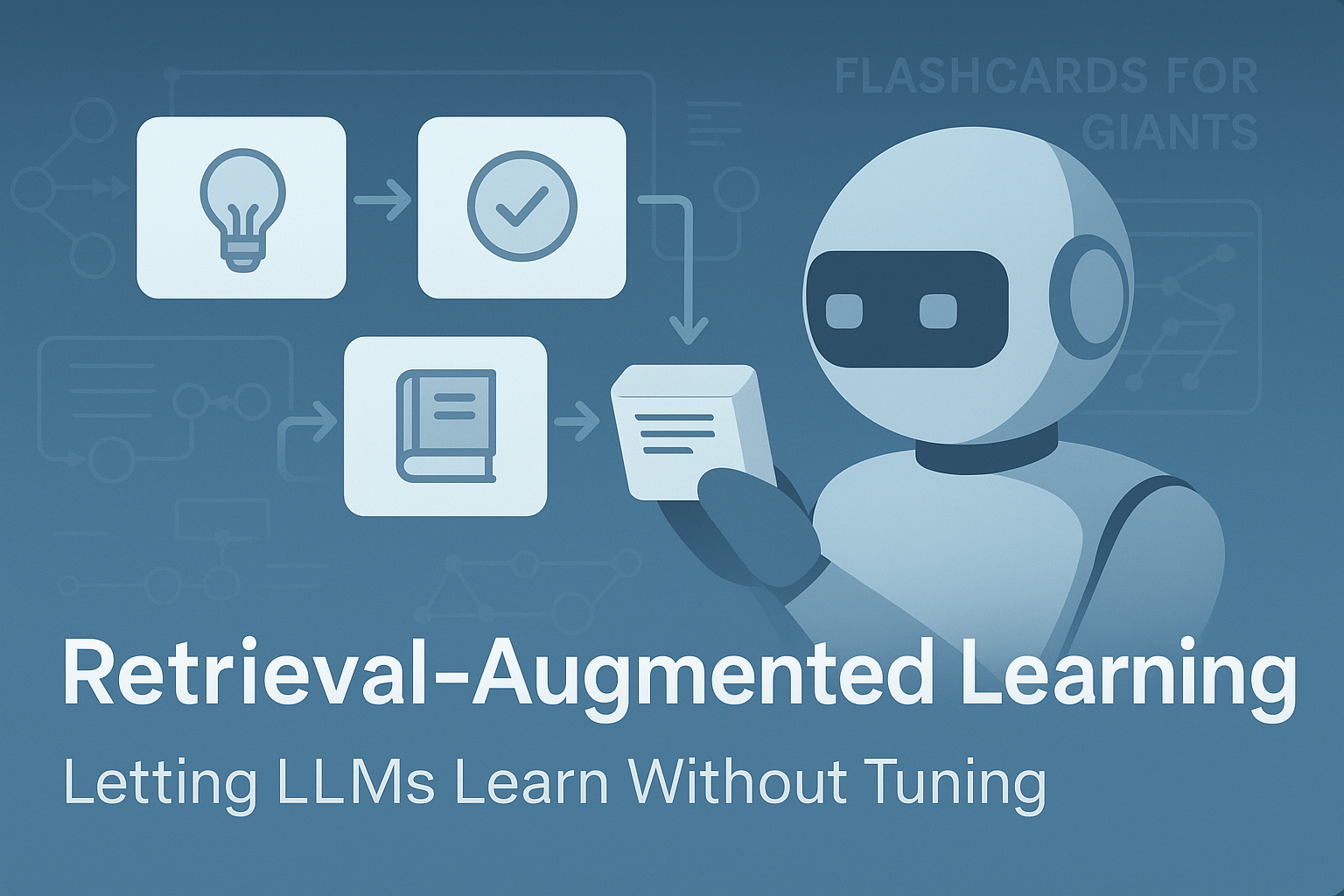
Flashcards for Giants: How RAL Lets Large Models Learn Without Fine-Tuning

Cognaptus Insights introduces Retrieval-Augmented Learning (RAL), a new approach proposed by Zongyuan Li et al.¹, allowing large language models (LLMs) to autonomously enhance their decision-making capabilities without adjusting model parameters through gradient updates or fine-tuning. Understanding Retrieval-Augmented Learning (RAL) RAL is designed for situations where fine-tuning large models like GPT-3.5 or GPT-4 is impractical. It leverages structured memory and dynamic prompt engineering, enabling models to autonomously refine their responses based on previous interactions and validations. ...

May 6, 2025 · 4 min
Cover image

From Infinite Paths to Intelligent Steps: How AI Learns What Matters

Training AI agents to navigate complex environments has always faced a fundamental bottleneck: the overwhelming number of possible actions. Traditional reinforcement learning (RL) techniques often suffer from inefficient exploration, especially in sparse-reward or high-dimensional settings. Recent research offers a promising breakthrough. By leveraging Vision-Language Models (VLMs) and structured generation pipelines, agents can now automatically discover affordances—context-specific action possibilities—without exhaustive trial-and-error. This new paradigm enables AI to focus only on relevant actions, dramatically improving sample efficiency and learning speed. ...

April 28, 2025 · 5 min