Cover image

From Text to Motion: How Manimator Turns Dense Papers into Dynamic Learning

Scientific communication has always suffered from the tyranny of static text. Even the most revolutionary ideas are too often entombed in dense LaTeX or buried in 30-page PDFs, making comprehension an uphill battle. But what if your next paper—or internal training doc—could explain itself through animation? Enter Manimator, a new system that harnesses the power of Large Language Models (LLMs) to transform research papers and STEM concepts into animated videos using the Manim engine. Think of it as a pipeline from paragraph to pedagogical movie, requiring zero coding or animation skills from the user. ...

July 22, 2025 · 3 min · Zelina
Cover image

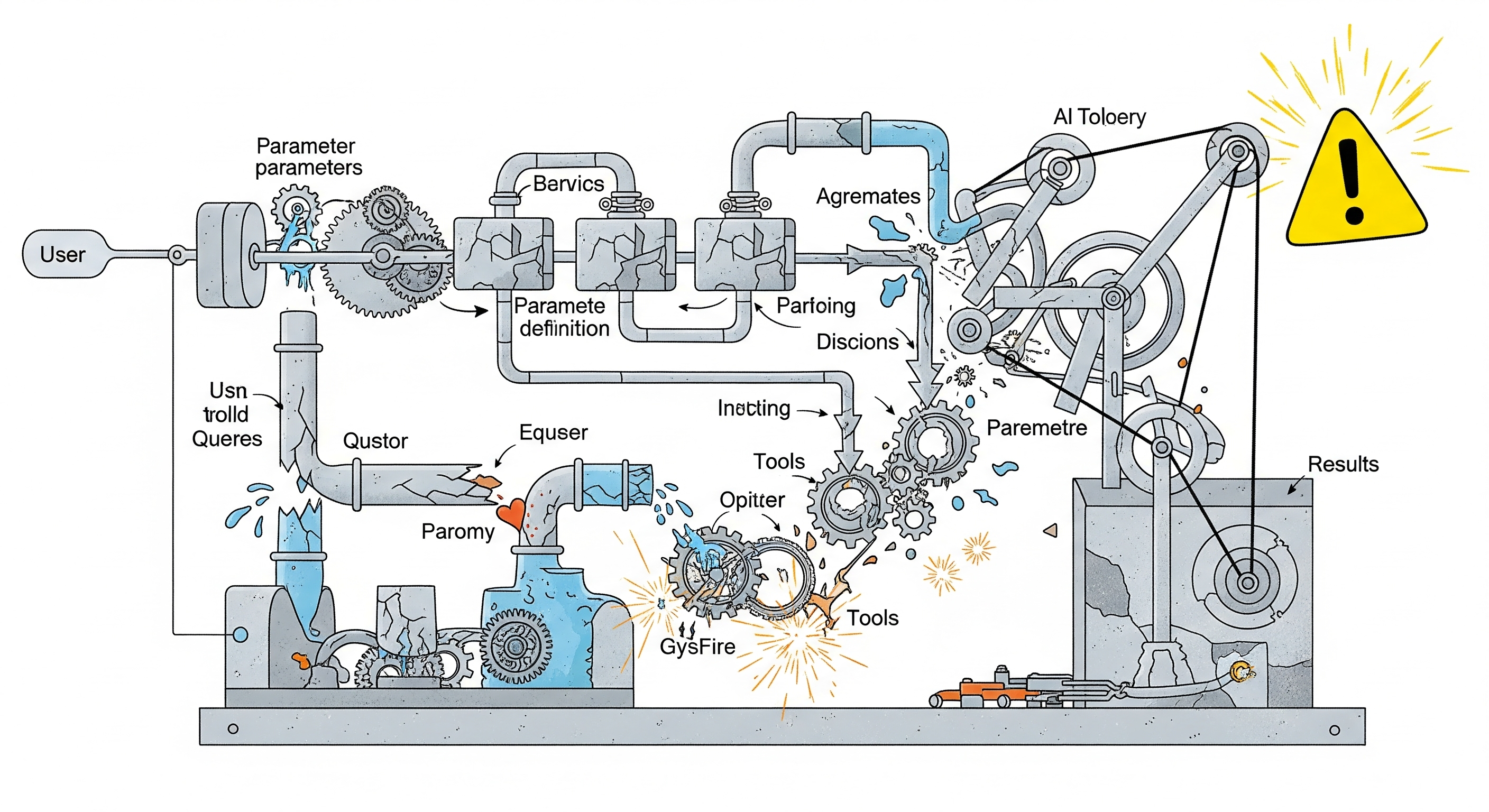
The Butterfly Defect: Diagnosing LLM Failures in Tool-Agent Chains

As LLM-powered agents become the backbone of many automation systems, their ability to reliably invoke external tools is now under the spotlight. Despite impressive multi-step reasoning, many such agents crumble in practice—not because they can’t plan, but because they can’t parse. One wrong parameter, one mismatched data type, and the whole chain collapses. A new paper titled “Butterfly Effects in Toolchains” offers the first systematic taxonomy of these failures, exposing how parameter-filling errors propagate through tool-invoking agents. The findings aren’t just technical quirks—they speak to deep flaws in how current LLM systems are evaluated, built, and safeguarded. ...

July 22, 2025 · 3 min · Zelina
Cover image

Bridges and Biases: How LLMs Are Learning to Inspect Infrastructure

In an age where aging infrastructure meets accelerating AI, a new paper out of George Mason University proposes a novel question: Can large language models interpret what even seasoned engineers find difficult — NDE contour maps of bridges? The answer, based on this pilot study, is a cautious but resounding yes — with caveats that echo through the entire field of AI-assisted engineering. The Problem: Data Is There — Expertise Isn’t Always Bridges are scanned using advanced non-destructive evaluation (NDE) tools — Ground Penetrating Radar (GPR), Electrical Resistivity (ER), Impact Echo (IE), and Ultrasonic Surface Waves (USW) — but interpreting those outputs requires human expertise, which is not always available, especially during emergency assessments or in rural areas. Contour maps from these tools don’t speak for themselves. ...

July 21, 2025 · 3 min · Zelina
Cover image

Serverless Bulls and Bears: How One Developer Built a Real-Time Stock Analyst with Zero Infrastructure

Most real-time financial systems rely on deep stacks of infrastructure, from custom APIs to cloud VMs and high-frequency data ingestion pipelines. But what if a single developer could deploy a daily-updating, AI-powered stock analysis engine without a single server? That’s exactly what Taniv Ashraf set out to do — and accomplished — in his recent case study on a fully serverless architecture using Google Gemini, GitHub Actions, and static web hosting. The result is an elegantly simple yet conceptually powerful demonstration of how qualitative LLM analysis and automation tools can replace entire categories of financial tooling — if wielded strategically. ...

July 15, 2025 · 4 min · Zelina
Cover image

The Retrieval-Reasoning Tango: Charting the Rise of Agentic RAG

In the AI race to make large language models both factual and reasoned, two camps have emerged: one focused on retrieval-augmented generation (RAG) to fight hallucination, the other on long-chain reasoning to mimic logic. But neither wins alone. This week’s survey by Li et al. (2025), Towards Agentic RAG with Deep Reasoning, delivers the most comprehensive synthesis yet of the field’s convergence point: synergized RAG–Reasoning. It’s no longer a question of whether retrieval helps generation or reasoning helps retrieval—but how tightly the two can co-evolve, often under the coordination of autonomous agents. ...

July 15, 2025 · 3 min · Zelina
Cover image

Mind the Gap: Fixing the Flaws in Agentic Benchmarking

If you’ve looked at any leaderboard lately—from SWE-Bench to WebArena—you’ve probably seen impressive numbers. But how many of those reflect real capabilities of AI agents? This paper by Zhu et al. makes a bold claim: agentic benchmarks are often broken, and the way we evaluate AI agents is riddled with systemic flaws. Their response is refreshingly practical: a 33-point diagnostic called the Agentic Benchmark Checklist (ABC), designed not just to critique, but to fix the evaluation process. It’s a must-read not only for benchmark creators, but for any team serious about deploying or comparing AI agents in real-world tasks. ...

July 4, 2025 · 5 min · Zelina
Cover image

From ETL to Orchestral Intelligence: The Rise of the Data Agent

Enterprise data workflows have long been a patchwork of scripts, schedulers, human-in-the-loop dashboards, and brittle integrations. Enter the “Data Agent”: an AI-native abstraction designed not just to automate, but to reason over, adapt to, and orchestrate complex Data+AI ecosystems. In their paper, “Data Agent: A Holistic Architecture for Orchestrating Data+AI Ecosystems”, Zhaoyan Sun et al. from Tsinghua University propose a new agentic blueprint for data orchestration—one that moves far beyond traditional ETL. ...

July 3, 2025 · 3 min · Zelina
Cover image

Hive Minds and Hallucinations: A Smarter Way to Trust LLMs

When it comes to automating customer service, generative AI walks a tightrope: it can understand free-form text better than any tool before it—but with a dangerous twist. Sometimes, it just makes things up. These hallucinations, already infamous in legal and healthcare settings, can turn minor misunderstandings into costly liabilities. But what if instead of trusting one all-powerful AI model, we take a lesson from bees? A recent paper by Amer & Amer proposes just that: a multi-agent system inspired by collective intelligence in nature, combining LLMs, regex parsing, fuzzy logic, and tool-based validators to build a hallucination-resilient automation pipeline. Their case study—processing prescription renewal SMS requests—may seem narrow, but its implications are profound for any business relying on LLMs for critical operations. ...

July 3, 2025 · 4 min · Zelina
Cover image

Innovation, Agentified: How TRIZ Got Its AI Makeover

In the symphony of innovation, TRIZ has long served as the structured score guiding engineers toward inventive breakthroughs. But what happens when you give the orchestra to a team of AI agents? Enter TRIZ Agents, a bold exploration of how large language model (LLM) agents—armed with tools, prompts, and persona-based roles—can orchestrate a complete innovation cycle using the TRIZ methodology. Cracking the Code of Creativity TRIZ (Theory of Inventive Problem Solving), derived from the study of thousands of patents, offers a time-tested approach to resolving contradictions in engineering design. It formalizes the innovation process through tools like the 40 Inventive Principles and the Contradiction Matrix. However, its structured elegance demands deep domain expertise—something often scarce outside elite R&D centers. ...

June 24, 2025 · 4 min · Zelina
Cover image

Half-Life Crisis: Why AI Agents Fade with Time (and What It Means for Automation)

Half-Life Crisis: Why AI Agents Fade with Time (and What It Means for Automation) “The longer the task, the harder they fall.” In the world of automation, we often focus on how capable AI agents are — but rarely on how long they can sustain that capability. A new paper by Toby Ord, drawing from the empirical work of Kwa et al. (2025), introduces a profound insight: AI agents have a “half-life” — a predictable drop-off in success as task duration increases. Like radioactive decay, it follows an exponential curve. ...

May 11, 2025 · 3 min