Cover image

When the Evidence Changes, Does the Agent?

TL;DR for operators An AI agent can finish a workflow correctly, explain its decisions, and recover after retries without demonstrating that it can respond appropriately when information changes. Sejin Kim and Sundong Kim propose evaluating adaptive reasoning through two complementary capabilities: transferring applicable rules across related tasks and revising decisions when new evidence invalidates an earlier assumption.1 ...


November 7, 2026 · 8 min · Zelina
Cover image

Small Backbone, Large Memory: What CHARM Actually Improves

TL;DR for operators A small neural backbone is not necessarily a small learned system: auxiliary task memories also consume parameters, and multiple inference attempts consume compute. In Structured Sparse Memory for Recurrent Reasoning1, CoSE cuts task-memory parameters by about 94% while improving controlled ARC accuracy. But CHARM’s strongest results also rely on rule-preserving synthetic examples, carefully configured recurrence, longer training, and inference-time aggregation. For teams evaluating specialized reasoning models, the actionable comparison is task accuracy versus total learned footprint, training-data investment, and inference cost. Private-memory updates are promising for adding related tasks without changing shared weights; the experiments do not demonstrate production savings or reliable generalization to arbitrary new work. ...

October 24, 2026 · 6 min · Zelina
Cover image

ARC-AGI-3 — When AI Stops Guessing and Starts Thinking

Demo days are generous. A sales engineer opens a prepared workflow, the agent clicks through a familiar sequence, the dashboard turns green, and everyone politely pretends not to notice how much of the intelligence was smuggled into the setup. ARC-AGI-3 is less polite. The paper introduces an interactive benchmark for agentic intelligence: not a static puzzle, not a multiple-choice exam, and not a coding task with a unit test waiting like a benevolent parent. An agent enters a novel, abstract, turn-based environment. It receives no explicit objective. It must explore, infer the rules, identify what counts as success, build a working model of the environment, and execute a plan efficiently.1 ...

March 28, 2026 · 16 min · Zelina
Cover image

Learning Less, Winning More: The Curious Case of Sensi’s Efficiently Wrong Intelligence

Logs are where agentic AI gets honest A business agent rarely fails in the dramatic way demo videos imply. It does not usually announce, with theatrical humility, that it has misunderstood the workflow, misread the screen, or built a wrong model of the task. More often, it produces a tidy chain of steps, a reasonable explanation, a few reassuring intermediate notes, and then quietly stores the wrong conclusion as if it were company policy. ...

March 19, 2026 · 17 min · Zelina
Cover image

Reasoning Loops, Not Bigger Brains

Reasoning Loops, Not Bigger Brains Scale is the easiest story in AI because everyone understands the shopping logic: buy more compute, add more parameters, train on more data, and watch the benchmark line move upward. It is also the story vendors enjoy telling, because nobody ever got fired for recommending a larger invoice. ...

December 17, 2025 · 14 min · Zelina
Cover image

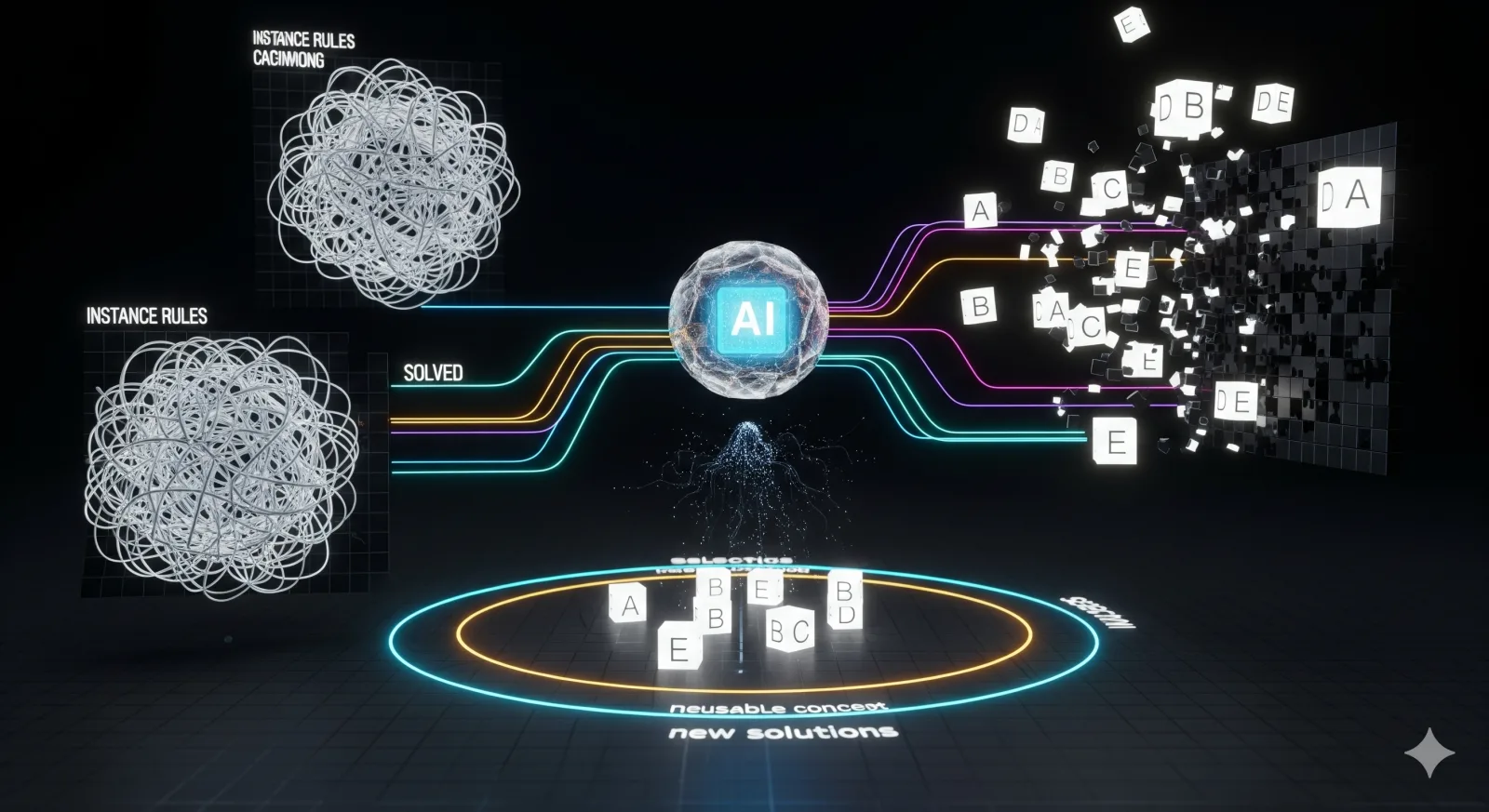
Pieces, Not Puzzles: How ArcMemo Turns LLM Reasoning into Reusable Skills

Tickets repeat. Spreadsheets repeat. Compliance reviews repeat. Code reviews repeat. Not exactly, of course. That would be merciful. They repeat with just enough variation to make last month’s solution almost useful and therefore mildly dangerous. This is where many enterprise “AI memory” systems become filing cabinets with delusions of competence. They store prior chats, snippets, tickets, documents, and summaries, then hope the next prompt will rhyme closely enough with something in the archive. Sometimes it does. Often it does not. The agent remembers the old puzzle, not the transferable piece. ...

September 8, 2025 · 15 min · Zelina