Cover image

Seeing Is Thinking: When Multimodal Reasoning Stops Talking and Starts Drawing

Image work has always had a small credibility problem: people can say where they looked, but we do not always know whether they actually looked there. The same problem shows up in multimodal AI. A model can answer a question about a chart, a photograph, a geometry diagram, or a robotic scene, then produce a neat textual chain of thought afterwards. It may sound procedural. It may mention “examining the relevant region.” It may even say “the graph shows…” with the confidence of a consultant holding a laser pointer. ...

January 15, 2026 · 17 min · Zelina
Cover image

Darwin, But Make It Neural: When Networks Learn to Mutate Themselves

A system breaks after a rule changes. The recommendation model suddenly faces a new product catalog. The warehouse routing policy meets a new constraint. A trading bot trained in one market regime walks into another and immediately discovers that yesterday’s “smart behavior” is today’s elegant way to lose money. The usual engineering instinct is to retrain, retune, or ask a human to adjust the knobs. Very modern. Very expensive. Very Tuesday. ...

December 21, 2025 · 17 min · Zelina
Cover image

From Benchmarks to Beakers: Stress‑Testing LLMs as Scientific Co‑Scientists

Benchmarks are clean. Research is not. A benchmark asks a model to answer a question, then politely stops. A research workflow asks the model to form a hypothesis, test it, read the result, notice what went wrong, adjust the plan, and try again without wandering into scientific nonsense. One is a quiz. The other is a beaker with a budget, a deadline, and a surprisingly expensive simulation queue. ...

December 18, 2025 · 16 min · Zelina
Cover image

Error 404: Peer Review Not Found — How LLMs Are Quietly Rewriting Scientific Quality Control

Deadline. That is the simplest way to understand why modern AI papers contain mistakes. Not because researchers suddenly forgot algebra. Not because reviewers are lazy. Not because the field has collectively decided that proofs are decorative furniture. The more boring explanation is also the more important one: the AI publication machine has scaled faster than the quality-control machinery around it. ...

December 8, 2025 · 20 min · Zelina
Cover image

Forecasting With a Spine: How Semantic Anchors Might Fix Time‑Series LLMs

Forecasting With a Spine: How Semantic Anchors Might Fix Time-Series LLMs Forecasting looks simple until the spreadsheet starts moving. A retailer wants next month’s demand. A grid operator wants tomorrow’s load. A finance team wants exchange-rate exposure. In each case, the raw material is not language. It is a jagged sequence of numbers: trend, seasonality, shocks, noise, reporting quirks, holiday distortions, and the occasional data pipeline accident wearing a fake moustache. ...

December 5, 2025 · 16 min · Zelina
Cover image

When AI Becomes Its Own Research Assistant

A junior researcher is not usually asked to invent an entirely new field before lunch. They are given a paper, a codebase, a baseline, and a moderately suspicious supervisor. They read, try a few modifications, break something, fix it, run experiments, write up the result, and then discover that reviewers are not, in fact, decorative. ...

November 7, 2025 · 13 min · Zelina
Cover image

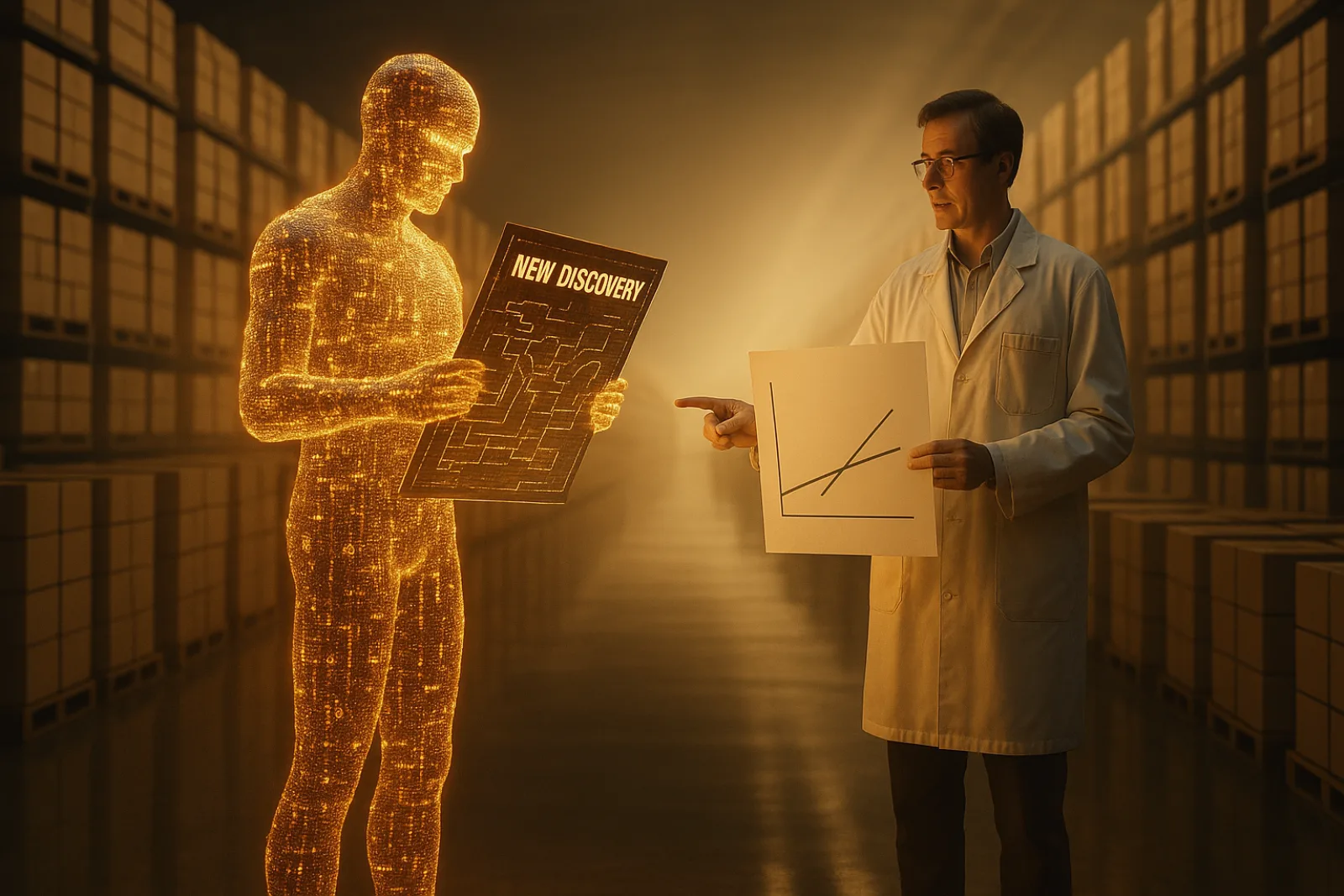
When AI Packs Too Much Hype: Reassessing LLM 'Discoveries' in Bin Packing

A warehouse manager, a cloud scheduler, and a container-ship planner all know the same unpleasant truth: fitting things into limited capacity is where tidy strategy goes to die. That is why bin packing remains such a useful test case. The problem is easy to explain and difficult to solve optimally. Items arrive. Bins have fixed capacity. The objective is to use as few bins as possible. In the online version, the system must decide where to place each item as it arrives, without seeing the future. This is not just a toy puzzle. It resembles production scheduling, memory allocation, server placement, freight consolidation, and every other operational setting where tomorrow’s workload has the bad manners not to disclose itself in advance. ...

November 5, 2025 · 15 min · Zelina
Cover image

The Rise of FreePhD: How Multiagent Systems are Reimagining the Scientific Method

A broken file link is not usually where scientific revolutions begin. It is, however, where many automated workflows die. That is why the most revealing moment in the freephdlabor paper is not the grand claim about personalised AI research groups. It is the rather unromantic episode where the system tries to write a paper, discovers that the experiment data are missing because of a failed symlink, attempts workarounds, fails validation, reports the failure, gets routed back through resource preparation, rebuilds the workspace correctly, and only then proceeds to manuscript generation.1 ...

October 25, 2025 · 15 min · Zelina
Cover image

Pods over Prompts: Shachi’s Playbook for Serious Agent-Based Simulation

A boardroom simulation is only useful if you know what was being simulated. That sounds obvious. It is also where many AI-agent demos quietly fall apart. Give one hundred language-model agents a set of personas, drop them into a toy market, forum, election, auction, or customer-support queue, and the result will usually look interesting. Someone panics. Someone coordinates. Someone overpays. Someone posts something faintly unhinged. Excellent. We have recreated the internet. ...

October 3, 2025 · 18 min · Zelina