Cover image

Reasoning Is Optional. Optimization Is Not: Rethinking VLA Training with NORD

Opening — Why This Matters Now In the current Vision-Language-Action (VLA) arms race, bigger has quietly become synonymous with better. More data. More reasoning traces. More tokens. More GPUs. Autonomous driving VLAs typically follow a now-familiar ritual: collect hundreds of thousands of driving samples, annotate them with chain-of-thought reasoning (often generated by a teacher LLM), fine-tune extensively, then polish the result with reinforcement learning. ...


February 25, 2026 · 5 min · Zelina
Cover image

When Retrieval Isn’t Enough: The DEEPSYNTH Wake‑Up Call

Opening — Why This Matters Now The AI industry has quietly moved the goalposts. We no longer ask whether large language models (LLMs) can answer trivia. They can. We no longer marvel at multi-hop reasoning benchmarks stitched together from Wikipedia. That phase has passed. The real question now is simpler—and more uncomfortable: Can AI agents synthesize messy, multi-source, real-world information the way analysts do? ...

February 25, 2026 · 5 min · Zelina
Cover image

When Seeing Isn’t Understanding: Closing the Multimodal Generation–Understanding Gap

Opening — Why This Matters Now Multimodal large language models (MLLMs) can describe images, generate diagrams, and even critique their own outputs. On paper, they “see” and “understand.” In practice, they often generate confidently—and comprehend selectively. This generation–understanding gap is no longer an academic curiosity. It directly affects AI copilots in design tools, compliance assistants reviewing visual documents, and autonomous agents interpreting dashboards or charts before making decisions. When generation outruns understanding, hallucination is not just textual—it becomes visual and procedural. ...

February 25, 2026 · 4 min · Zelina
Cover image

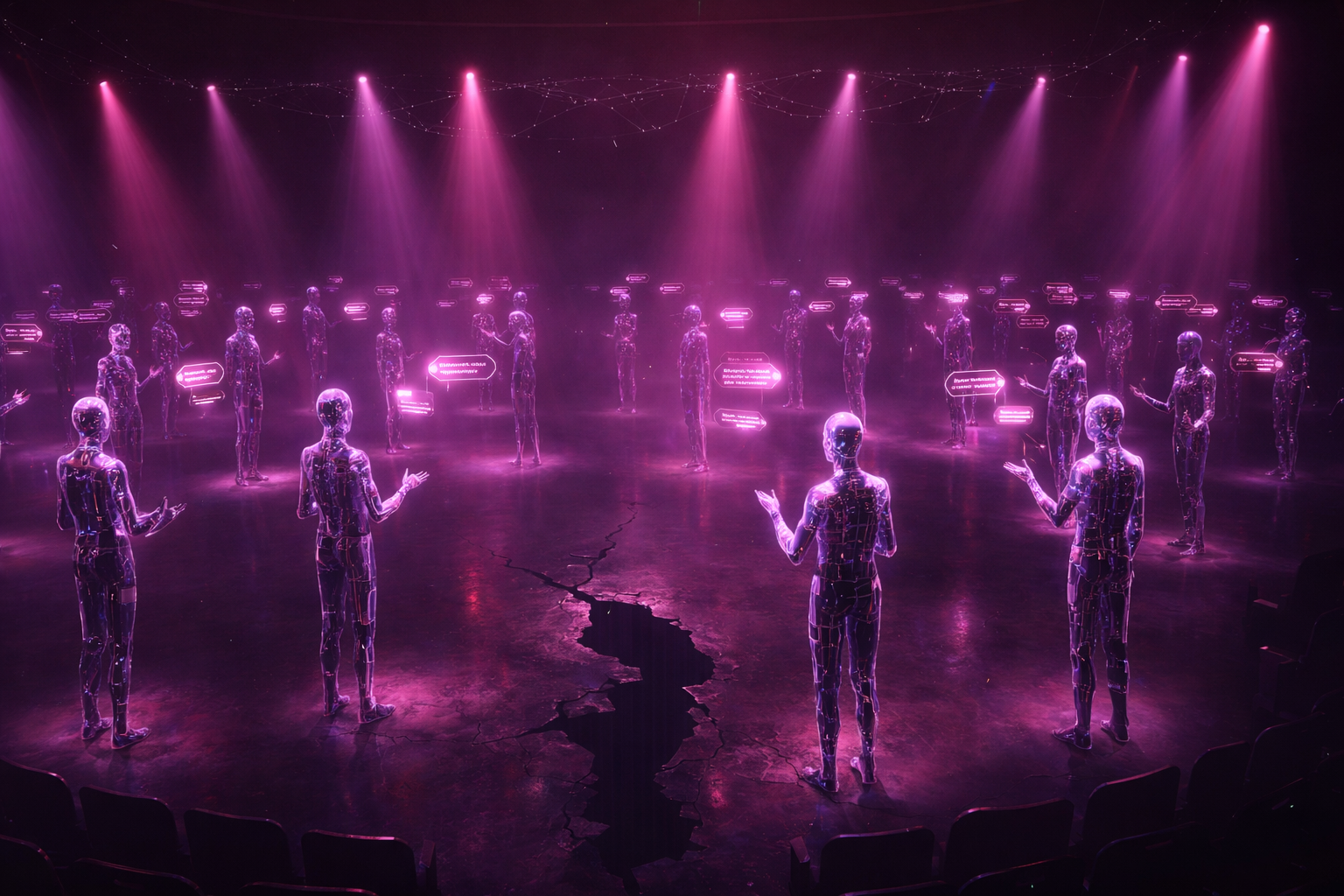
All the World’s a Stage: When AI Agents Perform Instead of Collaborate

Opening — Why This Matters Now Multi-agent systems are having a moment. From AutoGen-style orchestration frameworks to emerging Agent-to-Agent (A2A) protocols, the industry narrative is clear: assemble enough intelligent agents and collaboration will emerge. Coordination, negotiation, collective reasoning—perhaps even something resembling digital society. But what if scale doesn’t produce collaboration? A recent large-scale empirical study of an AI-only social platform—an environment with 78,000 agent profiles, 800K posts, and 3.5M comments over three weeks—offers an uncomfortable answer: when left unstructured, agents don’t collaborate. They perform. ...

February 24, 2026 · 5 min · Zelina
Cover image

Flip the Script: When Causality Breaks the LLM Illusion

Opening — Why This Matters Now Large language models are confidently writing legal memos, summarizing medical reports, and offering financial analysis. The problem? Confidence is not causality. Most LLMs are trained to predict the next token—not to reason about structural cause and effect. Yet we increasingly deploy them in domains where causal mistakes are not amusing hallucinations but operational liabilities. ...

February 24, 2026 · 5 min · Zelina
Cover image

Lost in the Repo: Why Bigger Context Windows Still Miss the Point

Opening — Bigger Context, Same Blind Spots For the past year, the industry narrative has been simple: give models more context, and the problem goes away. 128K tokens became 1M. Then 2M. The promise was intoxicating — “the whole repository fits.” Retrieval bottlenecks? Solved. File localization? Obsolete. Just feed the model everything and let attention do the rest. ...

February 24, 2026 · 5 min · Zelina
Cover image

Memory in the Mean Field: Teaching Macro Agents to Remember

Opening — Why This Matters Now Large-scale AI systems are increasingly deployed in environments where individual behavior shapes collective outcomes — markets, traffic networks, supply chains, digital platforms. We like to call them “multi-agent systems.” Economists call them “general equilibrium.” Engineers call them “a headache.” The uncomfortable truth is this: most reinforcement learning (RL) methods do not scale gracefully when the number of agents explodes. Variance explodes with it. And when agents only observe noisy aggregates — prices, congestion levels, macro indicators — the learning problem becomes partially observable, history-dependent, and computationally brutal. ...

February 24, 2026 · 6 min · Zelina
Cover image

ReSyn & the Rise of the Verifier: When Solving Is Hard but Checking Is Easy

Opening — Why This Matters Now Reasoning models have entered their reinforcement learning era. From OpenAI’s early reasoning systems to DeepSeek-style RL-trained models, we’ve learned something deceptively simple: reward correctness, and reasoning behaviors emerge. But there’s a constraint hiding in plain sight. Most reinforcement learning for reasoning still relies on answer-based supervision: compare model output to a reference solution, issue reward, repeat. That works beautifully for math problems and coding tasks—where ground truth is clean and enumerable. ...

February 24, 2026 · 5 min · Zelina
Cover image

The Model That Knows It Knows: When Introspection Hides in the Logits

Opening — Why This Matters Now We evaluate AI systems by what they say. But what if the most interesting capabilities are not in what models say—but in what they almost say? A recent study on Qwen2.5-Coder-32B reveals something uncomfortable for both evaluators and deployers: language models can detect when their internal activations have been manipulated—even when they deny it in their final answer. ...

February 24, 2026 · 5 min · Zelina
Cover image

Two Brains, One Team: Why Adaptive AI Beats the Trust–Performance Trap

Opening — Why This Matters Now Enterprises are discovering an uncomfortable truth: adding AI to a workflow does not automatically improve outcomes. In fact, human–AI teams frequently underperform their strongest member—human or machine alone. That’s not a tooling bug. It’s a design flaw. The paper “Align When They Want, Complement When They Need!” fileciteturn0file0 puts a scalpel to this issue. It identifies a structural tension at the heart of collaborative AI: ...

February 24, 2026 · 5 min · Zelina