Cover image

The Grid Agent Saw the Pole. Then the Workflow Fell Over.

TL;DR for operators Power inspection is not a vision problem with some administrative paperwork attached. It is a chain. An image must become an equipment label, then a defect description, then a severity judgment, then a maintenance decision, then a correctly executed workflow. Break one link early enough and the rest of the chain becomes very confident clerical fiction. ...

June 22, 2026 · 18 min · Zelina
Cover image

The Chatbot Passed the Test. Then It Bowed Too Low.

TL;DR for operators NICE is useful because it does not ask whether a model has “social intelligence” as one grand, vaguely flattering trait. It breaks social intelligence into a diagnostic structure: 4 categories, 11 dimensions, 34 facets, and 137 Chinese-context ranking items. That matters because a model can look socially competent in aggregate while failing on the interaction behaviours that make or break real deployments. ...

June 15, 2026 · 18 min · Zelina
Cover image

Judge, Jury, and Benchmark: Why LLM Evaluation Needs Fresh Cases, Not Bigger Leaderboards

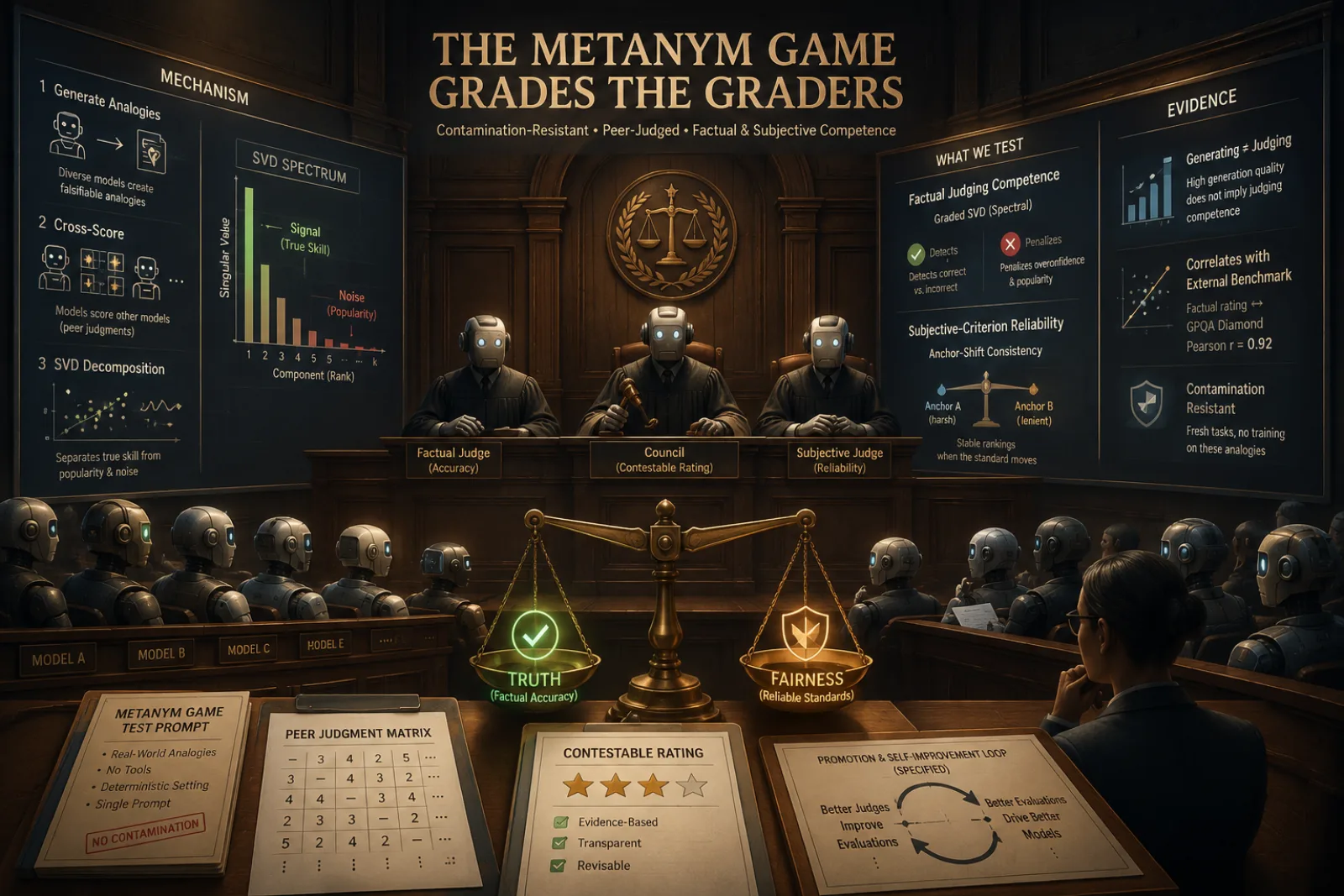
The procurement meeting is where public leaderboards go to look useful Benchmark scores are comforting because they compress chaos into a number. One model is 87.3, another is 84.9, and suddenly the procurement meeting has the emotional texture of financial discipline. Very mature. Very measurable. Also, very possibly irrelevant. The problem is simple. A company rarely wants “the best model on average”. It wants the best model for contract review, support triage, clinical note summarisation, SQL repair, claims handling, product search, or whatever unglamorous workflow actually pays the cloud bill. Public benchmarks are often too generic for that decision. Worse, the benchmark items may already be floating inside model training data, turning evaluation into a memory test with better typography. ...

June 12, 2026 · 18 min · Zelina
Cover image

When AI Can Solve But Can't Search: The MathNet Equation

Search. That is the unglamorous part of AI work. The demo asks a model to solve a clean problem. The enterprise system asks a model to find the right prior case, retrieve the relevant precedent, avoid the misleading near-match, and then adapt the answer without making a confident mess of it. MathNet is interesting because it puts that distinction under pressure. The paper introduces a large multilingual, multimodal Olympiad mathematics benchmark, but the more useful business lesson is not merely that frontier models can solve hard math. We already have enough leaderboards wearing medals. The sharper finding is that models and embedding systems can still fail at recognizing when two problems are mathematically the same, or when one problem is structurally useful for another.1 ...

April 23, 2026 · 13 min · Zelina
Cover image

House of Cards, House of Algorithms: Why Game AI Needs Better Testbeds

Benchmarks are the places where AI systems go to look impressive. That is not automatically a problem. A good benchmark clarifies what a system can do, what it cannot do, and where progress is real. A bad benchmark performs a more theatrical function: it lets researchers win a carefully chosen game, write a confident conclusion, and quietly hope nobody asks whether the result survives contact with another task. ...

March 4, 2026 · 16 min · Zelina
Cover image

When Models Get Lost in Space: Why MLLMs Still Fail Geometry

Geometry looks clean. A cube has edges. A projection has rules. A missing view should follow from the views already shown. This is not the messy world of occluded street scenes, motion blur, shadows, or a warehouse camera pointed at the wrong shelf. It is the kind of visual reasoning many students learn before they are trusted with anything more dangerous than a compass, a ruler, and mild boredom. ...

February 14, 2026 · 15 min · Zelina
Cover image

FIRE-BENCH: Playing Back the Tape of Scientific Discovery

A demo can make an AI research agent look impressive in ten minutes. Give it a task, watch it create files, install packages, run experiments, generate tables, and write something that sounds like a conclusion. Productivity theater, now with terminal logs. The harder question is less cinematic: did it actually discover the right thing? ...

February 5, 2026 · 14 min · Zelina
Cover image

When LLMs Meet Time: Why Time-Series Reasoning Is Still Hard

Dashboard numbers are seductive because they look obedient. Revenue goes up, traffic dips, latency spikes, inventory turns over, temperature drifts, volatility clusters. Put the sequence into a chart and the pattern seems almost polite. Then someone asks an LLM what happened. The model answers fluently. It may even sound like an analyst who has seen too many quarterly review decks and has developed a protective layer of confidence. But fluency is not temporal understanding. A model can describe a curve, name a trend, and still fail to understand which segment comes next, whether a transformation is correct, or whether a discontinuity is an error or a legitimate feature of the process. ...

February 3, 2026 · 16 min · Zelina
Cover image

RxnBench: Reading Chemistry Like a Human (Turns Out That’s Hard)

A reaction scheme looks like a picture. To a chemist, it is closer to a compressed process model. A few arrows may encode the starting materials, catalysts, solvents, temperatures, intermediate states, selectivity, yield, and the structural change that makes the entire experiment worth publishing. Reading that scheme correctly is already difficult. Reading the paper around it is worse. ...

December 31, 2025 · 15 min · Zelina
Cover image

Benchmarks on Quicksand: Why Static Scores Fail Living Models

A benchmark score looks wonderfully solid until the model changes, the dataset changes, the deployment stack changes, the GPU behaves differently, the logging pipeline drops half the useful metadata, and someone asks whether the result still means anything for their actual application. At that point, the leaderboard number is not wrong. It is worse: it is under-described. ...

December 15, 2025 · 19 min · Zelina